History Resumes
An anime avatar’s guide to the Russo-Ukranian War
As is usual when the world shifts gears without a clutch, there’s an awful lot to talk about. However we must first explain what has actually happened in the first 24 hours in Ukraine, and what it means. In order of importance:
- Ukraine is fighting incredibly hard and has outperformed all expectations. Their competence, capability and willpower have exceeded all expectations – including, apparently, those of the Russians.
- There is an ongoing battle of operational maneuver scale that the Ukrainians are holding their own at. Russia has made serious and threatening advances in one area, but are having enough trouble that their eventual victory is anything but certain.
- This is far from over. Russia has yet to commit roughly half their troops and Ukraine’s reserve units are still mobilizing. This is, in every way, classical conventional warfare; the kind fought in WWII; that takes place over vast distances and multiple days of intense combat.
The Current Situation
The most important fact is also the most obvious: Ukrainian forces have been demonstrably unimpressed by “shock and awe” and not only failed to collapse quickly, but defended their initial positions with incredible tenacity. The always excellent Michael Kofman (@KofmanMichael) has drawn this simple, but (so far) quite accurate Red Arrow Explainer that lays out Russia’s apparent operational plan:
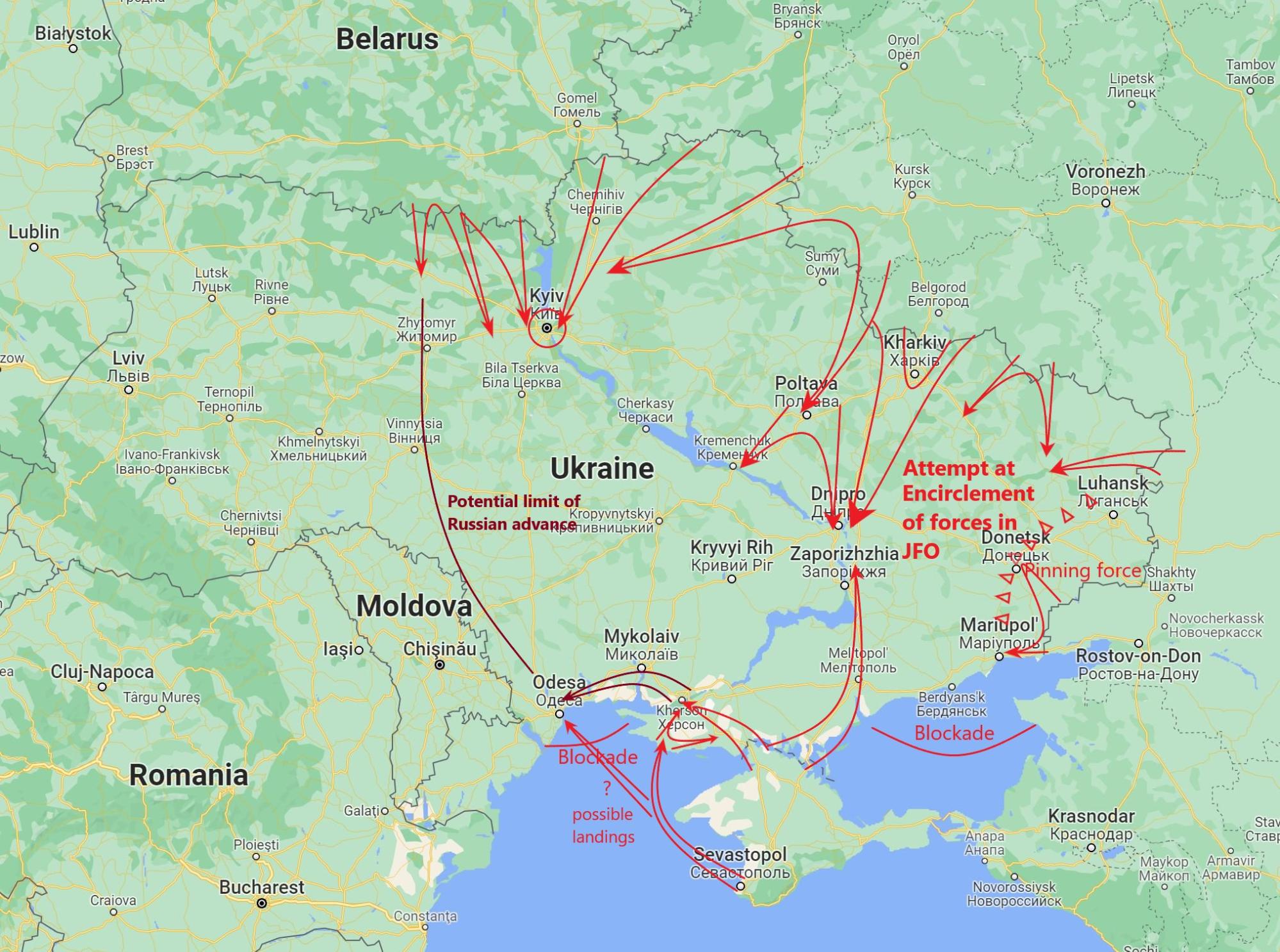
The goals Russian forces hope to gain via maneuver are 1. to encircle/flank/divide the Eastern Ukrainian flank from the rest of the country to ease defeating them in detail and 2. to take Kyiv itself – or rather, capture the government that is in Kyiv – the entire government; not just the top leaders, but all their subordinates and as many politicians/influential people as possible and kill them, so that Putin may install a puppet government without any risk of another revolution like the one that toppled his favored puppet in 2014.
Compare to this map of the present situation at roughly 9PM EST (-5 GMT) which is guaranteed out-of-date and somewhat inaccurate but reflects the best generalized picture that can be gleaned from watching the war unfold one shaky smartcam video at a time on Twitter:
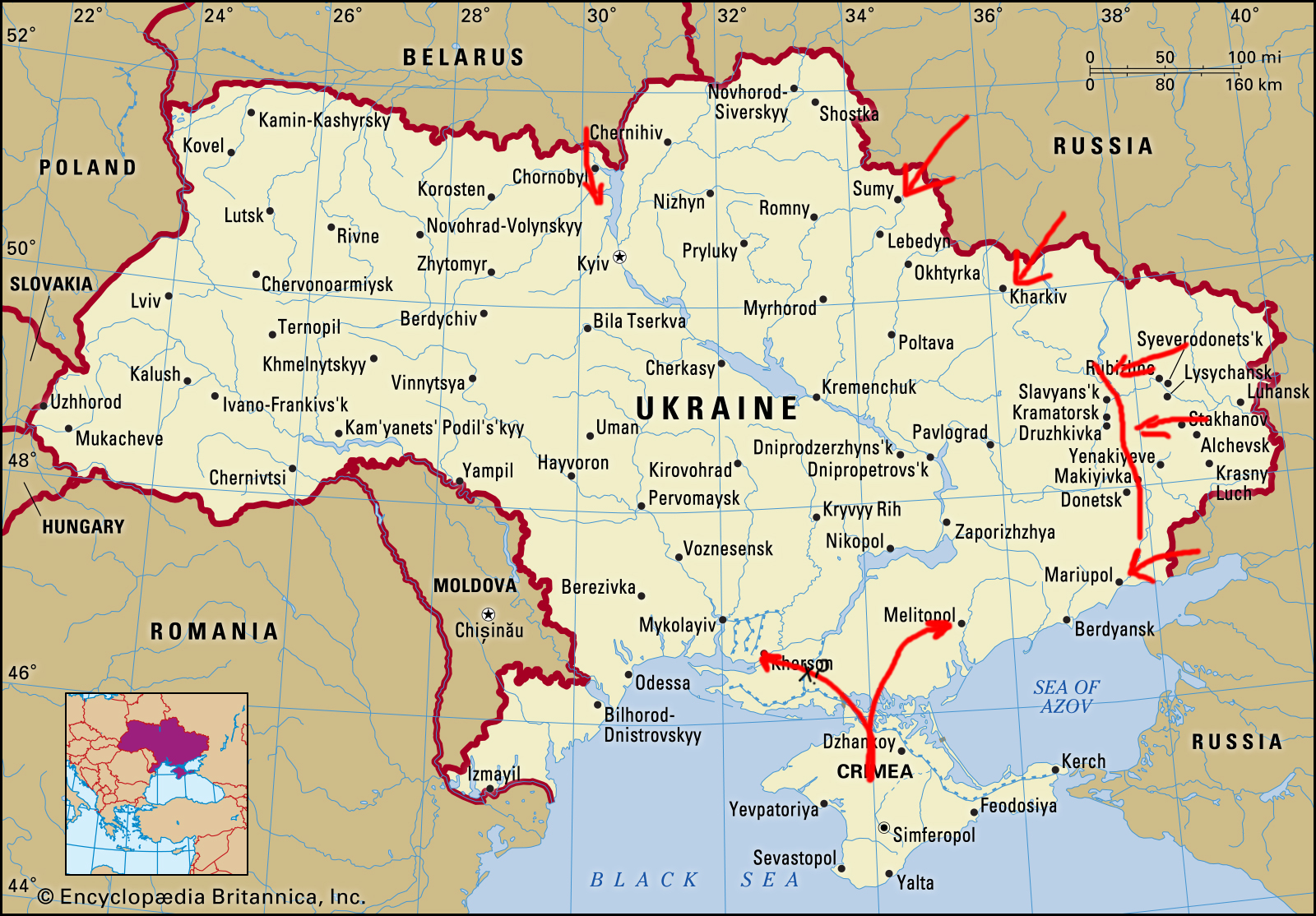
As you can see, the Russians are well short of their likely Day 1 objectives. Do not underestimate what they have accomplished; remember that Ukraine is a huge country; twice the size of California; and only slightly smaller than Texas. They have driven a good 160km from Crimea to reach the city of Melitopol and 100km to reach Kherson. However, how much significance this actually holds is questionable.
Even from a simple two-color map the significant natural barrier in Ukraine is obvious – the river Dnieper. This is no normal river; easily defeated by tracked bridge-laying vehicles or forded with snorkels on tanks; it’s a massive river the equal of the great Mississippi and represents a serious barrier to Russian advancement. To truly divide the country in half to achieve an easier defeat of Ukrainian forces in detail, piecemeal, they need to control both banks of this river. Hence the importance of the drive on Kherson. At last report the Russians had crossed the river and taken Kherson, but the Ukranians had somehow managed to re-capture the major bridge behind them. I’ve also seen reports that the Russians have been driven out of Kherson completely. Mixed messages like that in the fog of war typically owe to heavy, confused fighting (as evidenced by the mixed reports on the fighting at Hostomel Airport.)
At first blush it would seem that the Russians have made solid gains in the South, but this depends largely on how far inland the Ukrainians actually placed their Main Line of Resistance. Trying to bottle the Russians into the Crimean peninsula would have been a fool’s game given the vast amount of men and materiel the Russians crammed into Crimea to facilitate a breakout against just such a force; to say nothing of the amphibious landing capability that could land a (smaller) force west of them to assist a breakout or ferry forces across the Sea of Azov; either landing taking place well within range of heavy, massive supporting fires by Russian heavy artillery units and airpower from Crimea. When combined with the restrictions imposed by the need to capture a bridge over the Dnieper (there’s only so many bridges to target,) it makes perfect sense for the Ukranians to place their MLR back a ways from Crimea – at least out of long MLRS range – to obligate the Russians to come to them and step at least a little bit away from their base of supply.
There is also the road situation to consider. Much has been made of the hardness or softness of the ground, the fabled spring thaw/Russian mud, but the simple truth is that any army greatly values roads. The Roman empire’s roads were the backbone of its empire simply because it allowed its armies to move about quickly. Even in the relatively open terrain of eastern Ukraine it’s highly desirable to control the major roads – as evidenced by the Russian’s advance towards Melitopol in the first 24 hours being up highway E105, that runs parallel to the coast. Tanks can cross almost any terrain, but the supply trucks that feed them have a bit more trouble; even rugged military vehicles. Thus, if you consider the layout of the major highways north of Crimea, you can see that the Russians are a bit limited in options if they wish to maintain a speedy advance and not get overly bogged down:
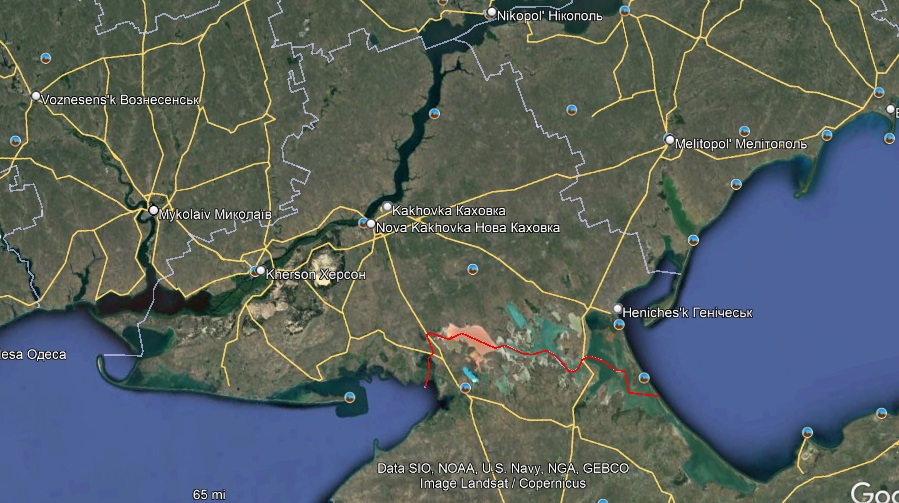
Melitipol can obviously be bypassed if Kherson and Kakhovka cannot be taken, but even with control of a bridge crossing it will be of much more limited use without free use of the highway that runs through Melitopol.
Thus, controlling those southernmost Dneiper bridge crossings (or, in the worst extremity, blowing them completely,) and controlling the gap between Melitipol and the river are key to containing the Russian thrust from Crimea and preventing Ukrainian forces from being flanked and isolated.
Tonight, this appears to be the most crucial part of the battle.
Other notes:
1. Russian amphibious capability can’t effectively bypass the need to hold a bridge – it can put a smaller force in a flanking position to help take one, but if they could feasibly keep one supplied with ferry runs around Crimea, the Russians wouldn’t bother fighting for a bridge.
2. Ukraine’s choice to fight for the Eastern part of the country, despite being so badly outflanked and on unfavorable terrain, makes sense if you consider it’s the heart of both their industrial AND agricultural industries. Losing Ukraine east of the Dnieper would be devastating.
This concludes the Red Arrows part of the explanation. If nothing else, understand that the most significant thing here is that the red arrows actually still matter. Ukraine is currently holding its own in a conventional, force-on-force fight with Russia and that’s significantly better than anyone expected.
Bear in mind the above info might have been rendered obsolete before I finished typing it. Part 1 goes up now for that reason; I now write part 2.
Northern Flank, Brick Tank
Once again, the roads explain almost everything about the fighting in the north of the country:
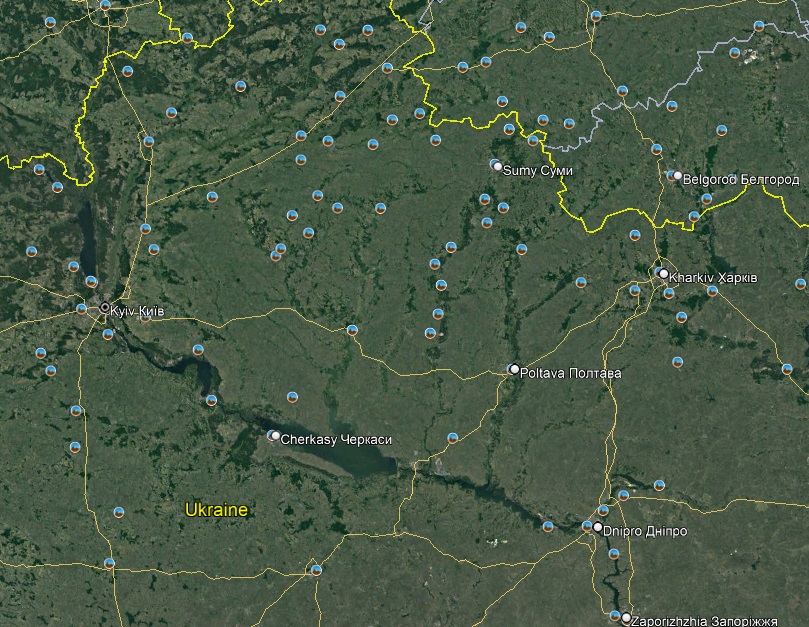
Kharkiv is a road hub so major that it played a big role in multiple battles throughout history; and while Sumy grants access smaller highways but Russian maneuver forces will want to hold both cities/highways to protect their flank and lines of communication (i.e. roads) back to friendly territory – because there are confirmed Ukranian armored units in Kharkiv. This translates to a powerful maneuver force that could absolutely succeed at an attack designed to cut said lines of communication and/or flank Russian forces. Without Kharkiv the Russians will be hard pressed to quickly and effectively race southward to outflank forces defending the eastern border.
Flanking Kyiv is a concern as well, but less of one because of its sheer proximity to the Belarusian border (Russian units should be nearing artillery range of Kyiv now,) but also because Kyiv needs to be actually taken, held and controlled for the Russians to achieve their primary goal of decapitation (and subsequent regime change.) Thus outflanking Kyiv isn’t going to massively help because Russia will face a nasty urban fight anyways, and because holding Kyiv was always non-negotiable for the Ukrainians they will have sequestered a very significant number of supplies in their city and well-fortified and hid them. Russia clearly committed to a fast, quick operation to kill/imprison the current government (and destroy the Ukrainian Armed Forces as completely as possible to ensure any future revolution can be easily destroyed) and thus avoid the costs of a prolonged occupation. Given credible reports from Russia itself that young Russian men are being forced to sign conscription papers at the border itself, this makes sense – Russia does not have the sheer professional manpower to effectively occupy Ukraine and conscription is extremely unpopular with the Russian people.
From what I can tell the Ukrainians have reserved their best units for the north of the country and for good reason; as devastating as losing Eastern Ukraine would be, losing Kyiv would spell the end of the Ukrainian nation as a free state and people. Between this and the apparent bloody tenacity of the defenders the Russians have simply been unable to break through either Sumy or Kharkiv – and this is without the fighting actually entering the cities proper yet! Even if the Russians – by dint of heavier application of indiscriminate firepower or more fresh reserves – manage to batter the Ukrainians well enough to force them back into the cities, they will have to go after them if they want full control of the roads to keep advancing and lines of supply/communication safe. Urban fighting is ugly, and given the conviction of the civilian populace it would be very ugly. I don’t want to say that maneuver “doesn’t matter” up here, but so far it doesn’t look like the Russians really can maneuver out of the need to take these cities. Remember that they are racing the clock here; Ukrainian reserves are mobilizing, civilians are signing up to fight en-masse and as Ukraine’s chances seem better with every passing hour the willingness of the West to take risks to keep resupplying them will grow, and Russian attritive losses will mount.
This matters greatly in the morale equation, as well – Russia’s conscripts are draftees dragged from their normal lives at gunpoint. Bad enough normally; but much, much worse when they’re being sent into an active warzone against a competent and tenacious foe. Ukraine’s reservists, volunteers and civilian militia, on the other hand, are fighting not just for their nation, but for homes and families that are, in most cases, right at their back. Russian difficulties on Day 1 may somewhat be attributed to a professional force that was told (and had decent reason to expect) that they would roll over the Ukranians swiftly; the speed and design of the Day 1 attack indicated at least some expectation of that strategy’s success. They have clearly been disappointed in that regard.
Speaking of conviction, morale, and competence, the things witnessed through Twitter, darkly, on Day 1 are significant enough to warrant their own discussion. But first, a vitally important discussion of materiel concerns – what matters, and what does not.
“Muh IADS”
Both the media and my own friends have, with surprising regularity, illustrated their pessimism of Ukraine’s chances in the opening few hours with the simple phrase - “their air defenses collapsed in an hour! An hour!” To which I invariably replied: “WHAT defenses?”
When multiple generations pass where the only serious wars fought by the first world are vastly asymmetric ones that pit powerful, sophisticated air forces against antiquated air defenses in limited-scope campaigns, this misunderstanding is inevitable. The collapse of a country’s air defenses is unconsciously associated with inevitable defeat from the air. This impression is grossly incorrect in the case of the Russo-Ukranian war for multiple reasons, chief among them 1. The Ukranian air-defense “system” never really existed in the first place and 2. Russia’s capabilities in the air, while formidable, are nowhere near equal to the standard set by the United States in particular and NATO in general, especially in a full-scale symmetric war.
First, Ukraine’s air defenses. Like so many former Soviet Republics, their air defense assets mostly consisted of legacy Soviet equipment; except because of prior corruption/poverty and later hostility they never had the opportunity to significantly upgrade those legacy systems, either via aftermarket purchase from Russia or through domestic development efforts (save a single homebrew upgrade to their SA-3 systems.) Missile defenses come in many sizes (and corresponding ranges;) from “theater-defense” systems that can protect significant portions of an entire country to small tactical systems that can shoot on the move and protect tanks from marauding attack helicopters. Crucial to understand is that these systems build upwards, like a brick wall – you can use the lowest tiers without the upper ones, but rarely if ever the other way around. (This is precisely what the US has done for decades with Patriot and why there’s crash programs underway to rectify it.) The reason is that big, powerful SAM systems are also big targets that cannot hide very easily, and thus are relatively simple to destroy by simply saturating their defenses; shooting enough missiles at them that they cannot shoot down all the incomings. A modern Integrated Air Defense System is a sophisticated, networked “system of systems” that weave together like chainmail; combining airborne and ground-based radars, fighter planes and an interlocking network of ground-based missile launchers; with short-range mobile systems serving as point-blank point defense against ground-skimming cruise missiles targeting the larger missile batteries.
Ukraine had none of this. Their S-300 systems were not just laughably dated (and thus very susceptible to Russian jamming and ECM) but were also literally built by the Russians and so amounted to not much more than targets. This goes double due to the relative lack of smaller missile systems to provide them point-defense. Ukraine did start this fight with a handful of SA-15 Gauntlet (Russian name “Tor”) systems which are actually still pretty decent mobile-tactical systems, as well as point-defense systems, but using them to protect big, poorly-mobile batteries that probably would struggle to acquire and engage a single target anyway would just be a moronic waste of them. Much the same goes for their other systems; the SA-3 and SA-4s. If these are still alive and fighting out there, more power to them, but they’re trailer-towed systems and thus have all the disadvantages that Ukranian towed artillery suffer on a modern battlefield where computers are doing the heavy lifting of locating enemy shooters and mailing death in their direction. Additionally, they are short-ranged systems; effectively tactical in their reach.
This almost total dearth of real SAM capability (against an opponent like Russia) translates into bad news for their air force. The Ukrainian air force was pretty small to begin with, but the inability to engage incoming cruise or ballistic missiles with any real reliability – plus the loss of strategic depth innate to Russia getting to surround Ukraine on four fucking sides – meant their air force had no real refuge. If your airbases cannot be put outside of the enemies reach they must be shielded from it, and Ukraine had no real option for that. In fact, the fact that Ukraine’s air force generated even a single sortie – much less the multiples they actually have – is as much due to Russia’s odd choices as Ukraine’s tenacity. (More on this later.)
Now, against an air force like the United States, or NATO (but I repeat myself) this dearth of defensive capability would indeed result in another Highway of Death; a dire replay of the brilliant and brutal airpower campaign in the Gulf War.
But, ladies and gentlemen, the United States’s equal the Russian Federation fuckin’ ain’t.
FLY TRUE, FIM-92
If you uttered “Muh IADS” don’t feel bad, because I’m currently sniggering at more than one OSINT-discord know-it-all who told me I was wrong about exactly what we’re seeing play out in Ukraine because they’re a LockMart engineer and know more than the plebs. What they didn’t know, apparently, was how to pay attention to Russia’s air campaign in Syria... which was mostly conducted with dumb bombs, not Precision Guided Munitions.
This isn’t that surprising – despite their seeming modern ubiquity, even the United States maintains significant stockpiles of old-fashioned iron bombs, because they are cheap. PGMs are fucking expensive and in a full-scale war of the kind we’re seeing play out in Ukraine; one scaled proportionate to US forces, the US would be using unguided munitions whenever possible as well. This is significantly worse for Russia; because despite a great deal of modernization and stockpiling, employing PGMs against tactical targets is a hell of a lot more complicated than just point-and-click. The conflict that put PGMs on the map as the new wunderweapon, the Gulf War? Most of the real carnage inflicted on Iraqi maneuver units – i.e. vehicle columns – were made with unguided cluster munitions or MK82 Snake-Eyes. Smartbombs had plenty of problems – just because you could find a target didn’t always mean you could guide a weapon to it, as illustrated by the problems in the “scud hunt:”
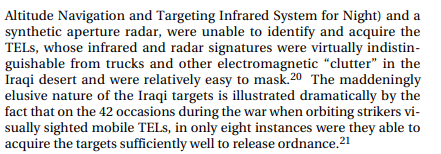
This is why a significant chunk of the F-35’s cost is invested in that dome housing a terrifying witch-eye sensor laced with eldritch power that lets it find one asshole hiding in a bush from 35,000 feet. This is also why planes like the A-10 – and, for that matter, any attack helicopter in existence – still exist. There is still a need for aircraft that can go down into the weeds and get very, very close to a target; not just to hunt for targets on their own, but also to bring in fire with pinpoint precision on targets to support troops in contact – often with unguided munitions like guns or dumbfire rockets. The problem with this is that to do it, you have to fly low, where every asshole with a rifle is shooting at you. The IL-2 is fabled as the most produced warplane of all time, but it’s never mentioned why – it was shot down so much. And yet, Stalin still threatened the factory foreman personally to increase production because despite that loss ratio, it was still cost-effective. The A-10 was designed in the 60s, and that’s effectively the kind of plane it is. And the fact that NATO isn’t ditching their Apache attack helicopters anytime soon – despite having the F-35 and it’s Eye of JDAM – indicates that they think there’s a real operational niche for that still as well.
Well, folks, in case you didn’t notice, the Russians don’t have an F-35. But they DO still have lots of attack helicopters, and SU-25 attack jets. They also have less money, less sophisticated air-to-ground sensors, and simply put, less practice in calling in supporting CAS fire from jets. This isn’t surprising, given Russian force doctrine has always favored ground-based fires (viz. artillery) over airpower for tactical/operational fires. Russian Tupolevs were performing medium altitude level-bombing attacks with dumb bombs in Syria; classic WWII style attacks – to save on precious PGMs. Sure, a big Serious War means they’ll be much more willing to expend PGMs, but they’ve also got many more important targets to hit with them... and due to the frugality in Syria required to save that stockpile for, well, now, they haven’t nearly as much experience at ground-to-air control.
Simply put, Russian tactical airpower was always going to be leaning heavily on attack helicopters and SU-25s relying at least in part on unguided or short-ranged weapons.
And that brings them into the MANPAD envelope.
Shoulder-fired anti-aircraft missiles aren’t magic; they have lousy range, can’t hit anything above 10,000 feet or so and their seekers are small, cheap and primitive compared to anything else. But they make up for this by being so small and portable they can be anywhere. Many MANPAD shots will be juked by flares or IR jammers; but if troops know how to employ them right (and video from the war I’ve seen myself indicates the Ukranians do) they’re still going to rack up the kills.
Ukraine can’t do fuck-all to stop bombing of stationary targets like bridges, barracks, ammo dumps, etc. They can’t stop an SU-35 at 35,000 feet any more than they can stop a high subsonic cruise missile. But that’s not the firepower that inflicts steady attrition on infantry and armored forces; the kind of firepower that really grinds down and decimates a force.
If attack helicopters are the cost-efficient, attritable way to move mud, then MANPADs are the cost-efficient way of shooting back at them. And the Ukrainians have lots of them – and as video from the first day of war showed clearly, they’ve been well-trained in how to use them properly.
This is far from optimal, of course – major maneuver cross-country with just MANPADs for air cover is still a miserable, brutal thing (lol Avenger) – but nonetheless, the Ukrainian forces are not helpless against Russian airpower.
Part 4 incoming. Hold tight.
Competence, Conviction and Morale
Something you probably heard about that I haven’t mentioned but in passing is the fighting at Hostomel (aka Anatov) airport, where yesterday Russian VDV (airborne) troops took the airport only 15km north-west of Kyiv in a heliborne operation, only to get Arnhem’d (a constant risk with any airborne operation) when the Ukranians promptly bombarded, then counter-attacked and crushed their little salient before they could start landing reinforcements in transport planes. Information (again, Twitter OSINT but apparently credible) indicates that the VDV lost several choppers on the way in, at least a few of them to Ukrainian MiG-29s, and during the assault on the airport the Ukranians were able to generate a sortie with one of their SU-24s to hit the airport.
I didn’t mention this before because, despite being dramatic, it wasn’t of major strategic interest once the attempt was crushed. Had the Russians been able to quickly build up a bridgehead, it would have been a big coup for the Russians; getting them to Kyiv much faster without having to fight their way there. But that required, above all, speed. To use an airport it’s not enough to physically possess the runway; you need to make sure nobody shoots the thing while rather delicate, thin-skinned transport planes are landing and taking off on it. That means you have to control a few kilometers around the airport as well, so sneaky lads with MANPADs or 81mm man-portable mortars can’t get enough to nail transports. Damage that would be survivable while on the wing is often fatal during take-off, and while landings are a bit more survivable a trashed, burning plane on the runway presents a problem for future air ops.
And even if they’d been able to get enough lightly-armed airborne infantry onto the airfield in time to do that, they’d still have the problem of, oh, all the heavier artillery in Kyiv, only 15km away.
There’s also the fact that the Russians 1. did not put every Ukrainian airbase and/or aircraft out of commission before it took off and 2. didn’t provide their airborne assault with a close air escort, nor a BARCAP over the airfield to cover the paratroopers. One or the other is understandable; USGOV reported 160~ missiles fired between the opening 4AM salvo and the follow-up attacks, and to properly knock out a single airbase can easily require forty or fifty munitions. Given the small size of the Ukrainian Air Force it’s understandable that they declined to work over their airfields that hard, but in that case their failure to run off a few cheeky lads in MiG-29s hugging the deck to avoid the S-400s over the Belorussian border is simply nuts. The fact that an SU-24 was able to sortie mid-day to attack the paratroopers mean the Russians 1. didn’t learn from losing those choppers and 2. didn’t have any plans to work over those airbases and render them unable to refuel and rearm aircraft with cheaper, much more affordable laser-guided bombs delivered via airstrike.
Sum total, the VDV got Arnhem’d because the Ukrainians were a hell of a lot less impressed with their shock-and-awe then they thought, and the Russians are apparently significantly less competent than most people, including myself, were expecting.
I was not expecting Ukrainian armored units to amount to much due to how dated their tanks are, how dated their armor-piercing ammo for those tanks are, and the sensors/technology advantage the Russians will have, to say nothing of training. Apparently the training the United States provided paid off handsomely because those old T-64s have made a decent accounting of themselves and even stopped Russian armored thrusts in maneuver combat in places, something that St. Javelin of Kyiv, despite her prowess, can’t do nearly as well.
Few people realize that the Ukrainian army has been receiving training from the United States for eight years since the Crimean annexation and invasion of the Donbas – not just on weapons systems, but on how to structure the army’s command and control itself. The Ukrainian army in 2014 was a joke; a government job in a horribly corrupt post-Soviet-collapse satellite state and thus just an excuse to strip-mine the carcass of the once mighty Soviet Army and sell it the highest bidder. It was every bit the generic caricature painted in that movie Lord Of War.
Eight years of training and support from the United States later, and it’s turned into a fighting force that has taken a massive haymaker on the chin from one of the world’s most powerful military’s and come out swinging. There’s a reason the US accomplished this with such modest aid, when twenty years of lavish expenditure on the Afghan army couldn’t produce a force that lasted for three fucking days against a bunch of 7th century goat farmers.
The Ukrainians give a shit.
Ukrainians are not just fighting for their government, nor their nation. They are fighting on their own soil to defend families and homes right at their back. They are fighting in their own cities, which the Russians, in characteristic Russian fashion, are raining indiscriminate MLRS fire on. These are people who overthrew their last pro-Russian President in 2014 out of disgust at his corruption and Putin-worship, for which Putin punished them with an invasion of their own soil; eight years of war, 14,000 dead Ukranians and the loss of most of their heavy industry.
In the first 24 hours on Twitter I saw clear evidence of this; not just in the tenacity of Ukrainian defenders that brutal Russian firepower could not dislodge, but directly in men lining up around the block, twice, to volunteer to fight, waiting to pick up their rifles. The Ukrainians say they’ve handed out ten thousand rifles in Kyiv alone and I believe them. I’ve seen at least one Russian supply truck with flat tires and a very, very dead Rooskie driver lying by it, and no other Rooskies nearby to chase away the guy with a cameraphone who was very close. All together that equates a rear-echelon supply driver that paused at a stop-sign and got lit up by some babushka with an AK. I’ve seen Ukrainian civilians verbally accosting and screaming at the Russian soldiers. I’ve seen Ukrainians gripping their heads in stunned anguish as they crouch over the bodies of family members killed by Russian MLRS strikes on their apartment buildings.
I have no doubt that the Ukrainian civilian volunteers will fight. They’re fighting in their own cities, watching their own fellow citizens get indiscriminately blasted by Russian rockets, and their families and homes are at their backs – literally, for those ten-thousand Kyiv citizens who just signed up to defend Kyiv.
As for the Russians, the situation is rather different. Despite a calm, efficient and pre-planned police crackdown, anti-war protests in multiple Russian cities quickly grew quite large. The “Mothers of Russian Conscripts” group (a sort of PAC for mothers that are pissed off when their young sons are drafted for their year of mandatory duty and come home in a body bag, as has happened before,) have said that conscripts are being actively used in Ukraine – and given that the Ukrainians have captured some, apparently not always in very, very rear-echelon lift-and-carry roles, either. The conscripts themselves, just judging by fitness and age, are clearly not cream of the crop, either, and yet Russia is using them in-country which tells you where their manpower situation is at.
Add to all this the simple psychological fact that the Russians clearly expected less resistance – at least enough to judge the risk of that airborne operation as worth it. Despite the fabled Russian indifference to casualties, they wouldn’t have risked the lives of two hundred odd elite airborne soldiers – who are rather scarce and expensive to train – if they hadn’t judged there to be a good enough chance of success. There’s no way that attitude didn’t percolate down to the troops themselves – if we in the West thought Ukraine’s chances were so grim, what do you think volunteer contract Russian soldiers who are neck-deep in the propaganda mill thought?
One noticeable facet of the war in the first 24 hours has been how there’s very little to any direct OSINT – i.e. some asshole filming on a smartphone and uploading it – of Ukrainian troops themselves, moving around, in contact, etc. I’ve seen an uploaded video of a Russian EW (ground jamming) unit that had clearly been hit by Ukrainian artillery – a unit member filming and uploading his own unit’s mission-kill. Twitter OSINT accounts are mostly agreeing not to spread any Ukrainian-side info they find to help them, but even THEY say they haven’t seen much if anything to censor. This message discipline – even among civilian volunteers – is the natural result of spending almost a decade fighting a prolonged “grey zone” war against Russia in which information ops are key. There’s a reason Ukrainian soldiers almost universally wear masks to hide their faces – it doesn’t pay to let Russian agents figure out who your mother is and what her phone number is.
Meanwhile, the Russian soldiers in Ukraine are reportedly using Tinder, so I’d say it’s safe to say that they seriously misread the mood of the locals that’d be greeting them. It went from “hot Ukranian chick want you liberate her long time” to “they have Grads too and they know how to use them fuck” in an awful goddamn hurry, didn’t it?
The upshot of all this is that the clock is definitely ticking against Putin. This war is massively unpopular in Russia, and the Ukrainians are fighting a hell of a lot harder, on average, then a good chunk of the forces Russia has to call upon as reinforcements and rear-echelon troops. This can absolutely make the difference; it not only increases Ukraine’s odds of holding out longer, but increases the stakes of prolonging the war significantly. Oh, Putin might not give a shit about ten gorillion protesters or even eleventy-billion but as this drags on the troops are going to be dragging their feet more and more.
And this is what we are just seeing now – in the first 24 hours or so. This fight is still relatively clean by Russian standards, by the scale of what could happen. If this goes ugly, the Ukrainians are highly likely to retreat to the cities and fight in them, and the Russians will have to send their weary troops, some of them unmotivated, in after them to fight Gronzy 2.0.
That’s the ~strategic~ consequences of the conviction and morale things I’ve seen through the OSINT window so far. And now that I’ve said it, it’s time to dig into what this war is going to mean for us. How it has already changed the world. And how Ukranian’s conviction is key to it.
He Who Honks Last
The last 24 hours has conclusively settled an awful lot of debates, and with it, an awful lot of insufferable think-tank types that I used to regularly insult on Twitter are currently reeling, clutching their heads, and asking how they could have missed how full of shit Joseph Nye was all these years. It’d be a lot funnier if the price of that wasn’t watching civilians being shelled as a free nation fights to the death to preserve their independence and sovereignty. It’s gratifying to see the neoliberals howling as History pops out of that grave Krushchev dug to bite them in the ass, sure. It’s fantastic to see those fools still whining about the INF staring in slack-jawed horror as MK1 War (Conventional Symmetric) kicks in the door screaming “DETER THIS!”
But of all the rude awakenings, the absolute best is the one received by those who so smugly lectured us on Russia’s Legitimate Security Concerns, as if Russia was worried about conventional land-launched missiles in Ukraine in a way they weren’t concerning ship/sub launched weapons from the Med, up to and including D-5 Tridents on a depressed trajectory tipped with thermonuclear MIRVs. It’s the people who patiently explained to me, a Greek-Orthodox man who sits next to native Slavic speakers from northern Greece in the same Greek-Orthodox church, that western Ukraine speaks Ukrainian, and Eastern Ukraine speaks Russian, and so that land is really Russian clay; trusting us to understand without explicit statement that the “rebellion” in Donbas isn’t a Putin sock-puppet but Totally Legit. And it’s especially the ones who claim the 2014 ousting of Putin’s puppeteered “President” was a CIA-led coup, and thus Ukraine’s desire to join NATO is clearly just an extension of a dire plot to “encircle” the biggest fucking country with the longest contiguous international border in the world.
I would pay almost anything to have seen the looks on their faces when Putin went on national TV and explained, for thirty minutes, why Ukraine – the entire country – was a filthy kulak capitalist NATO lie, why it didn’t deserve to exist at all, and why it was really rightful Russian clay from day one, so he was going to take it, by fire and force.
Not the Donbas. Not the Russian-speaking areas.
The entire fucking thing.
And then he threatened to nuke anyone who dared oppose him.
And then those same people; so many of whom had held forth quite smugly on the Tight Cultural Ties of Ukraine to Russia, of their disgust for their Rotten Corrupt Government, had to watch as the craven, dissolute, dejected people who Weren’t Really A Country Anyway, Much Less A Nation held off the much stronger, much wealthier, much much more vaunted juggernaut that they’d predicted would crush Ukraine in a day – in self-defense, of course.
If it’s not yet obvious how the Russo-Ukraine war changes everything, it soon will be once more video evidence of the carnage and the scale of combat comes out. It’s a return to the kind of fighting the world prepared for throughout the five decades of the Cold War but never ultimately ended up fighting. If the building tension between China and America was the 1930s tension between America and Japan replayed, then this is 1939; Germany crashing into Poland. Someone on Twitter said that a “senior administration official” told her to enjoy the last few hours of peace on the European continent for a long, long while, and he wasn’t wrong. The elaborate academic theoreticals have crumbled away to reveal the craggy face of might and conquest... and with it, the real truths of what give people an identity and what forges them into a nation. Common culture more even than common language, and common struggle above even that.
So pull up a ringside chair, oh statue avatar accounts. Gather round, international relations doctorate students. And watch the nation you made excuses for demonstrate that it wasn’t the victim of the useless neoliberals, but the dragon it fed. Watch very carefully as the AK Babushka you all laughed so hard at does more for her people and nation, and does more than anyone, especially the Russians, thought was possible to kick their asses and bleed them dry.
And then you can shut the fuck up.
48 Hour Update
At time of writing it is 1:30AM in Kyiv and according to all sources the major assault on Kyiv has begun and has been ongoing for over an hour at this point, with Kharkiv still fighting and not encircled, Suma encircled and bypassed (but still very probably resisting and denying the city center to the enemy, if not the primary road West,) and Maritipol is being torn apart by intense close-quarters combat. My prior predictions have mostly held up, with the exception of my air defense analysis – still accurate in the broad strokes but I underestimated the Ukrainian legacy inventory’s serviceability and as continuing friendly air defense activity indicates, so have the Russians.
Southern Front Update – struggle to contain breakthrough over the Dnieper River
This screenshot comes from this excellent new livemap which complements the one I linked previously as instead of showing rough unit/division AORs it shows front-lines and force concentrations. Given this Janes’s analysis largely agrees with it I’ll prefer it, esp. as Janes is working off the same information for the most part, just with less crowd sourced help and more subscription fees.

The analysis offered by the collator(s) of the map is accurate – having managed to solidify their bridgehead in Kherson and break through stubborn containment defense to the north of the city, the Russians are massing forces to pour over the second bridge in the area (which lies atop a dam) to exploit the breakthrough. This is bad, and we can expect to see the Ukrainians pull on assets that have been held back or in reserve till now – such as artillery, especially MLRS – to suppress and blast that chokepoint as hard as possible. Note this image shows a second blue line around Mykolaiv – not only does it benefit from another significant natural waterway barrier but crucially it controls the main highway north, which will make it an essential fallback position if a breakthrough is achieved out of Kherson proper. This crossing also has a rail bridge, making it even more crucial for Russian logistical sustainment past the Dnieper (rail can move much more freight in much worse weather than roads can.) Unlike Kharkiv to the north, there are no comparably huge cites in central Ukraine that control major road/rail exchanges to provide the defenders with the advantages of defensive urban fighting, so bottling Russian forces at this natural chokepoint is crucial and I expect the Ukranians will devote a tremendous amount of effort to doing so.
The Russians are also conducting heliborne insertions along the southern coast near Odessa but nothing indicates its in any serious strength; without follow-on forces those bridgeheads are little more than harassment.
As for the eastern drive, Melitopol is engulfed in incredibly violent close-quarters fighting and the Russians finally deployed their LST’s to land a force on the other side of the city. Whether to stop the defenders from escaping, stop Mauripol’s forces from reinforcing them or simply to try to create a double envelopment of the city’s defenders is unknown, but victory here will still require the Russians to take Mariupol to begin threatening the rear of the eastern Ukrainian forces on the Donbas border.
Northern Flank Update – the brutal city fight is now raging
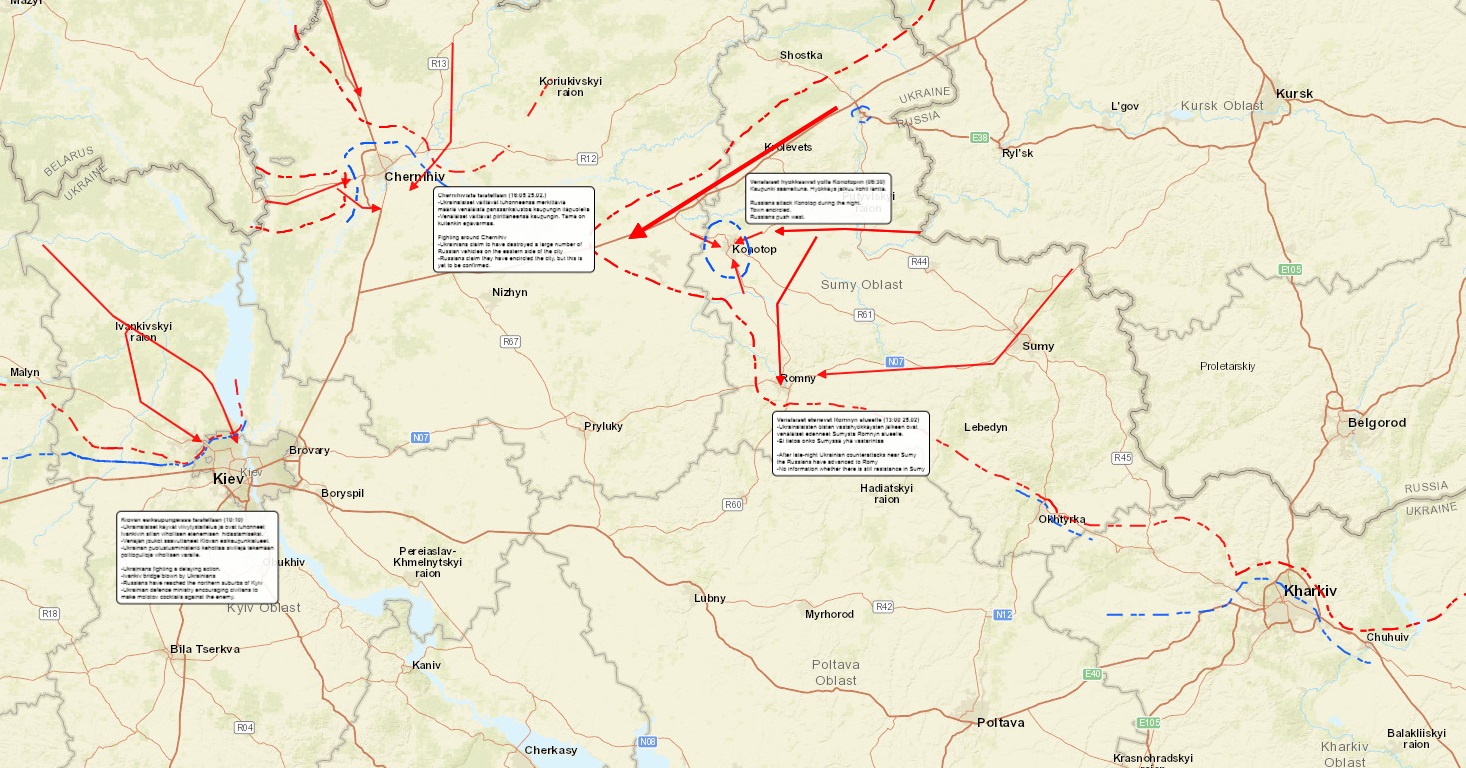
Simple and ugly. The northern Ukrainian defense has done an incredible job thwarting Russian designs – Kharkiv is not only well defended but not encircled either; anchoring the Ukrainian right flank (to the extent that they are even trying to form lines and fight battles of maneuver in this terrain; but given how successful they’ve been at that despite the on-paper odds, I can’t rule it out. Sumy (or Suma, depending) has been bypassed and possibly taken, but reports are going either way at this point. Note the map of Sumy:
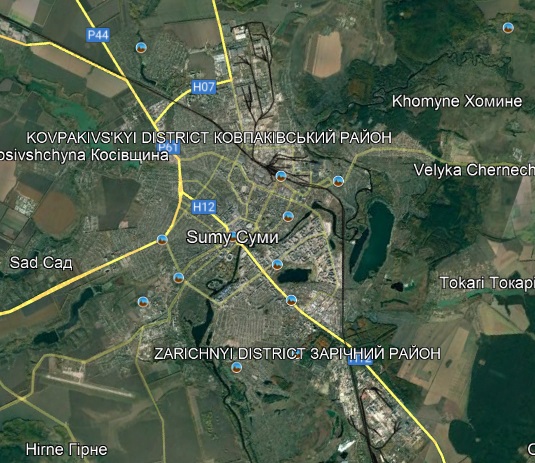
Note how the major highway skirts the northwest corner of city limits but doesn’t pass through the center. This means it’s possible for Sumy to be encircled and still partially contested but still leave the Russians in control of the roadway, allowing them to drive forces towards Kyiv to participate in the ongoing assault that started earlier tonight. However, if Sumy IS still contested, this means there could be a persistent threat to this roadway. This is especially true because I have seen two absolutely insane dashcam videos of civilians (incredibly) driving along large thoroughfares/roads weaving past defending Ukrainian armor only to end up in the middle of a gun duel between Russian and Ukrainian tanks, and one of these is confirmed to be from Kharkiv. This means there is a credible armored force in Kharkiv and if the Ukranians should choose to fall back a bit and use the urban terrain to combat that armor a thrust north-west to cut the H07 east-west highway out of Sumy is possible; esp. given that I had underestimated how many operational and useful tactical SHORAD systems the Ukranians likely started the war with (more on that in a future update.) Whether or not they could succeed with such a thrust given Russian fires/recon is dubious, and holding Sumy even moreso, but even a temporary interruption to the supply lines of the spearhead towards Kyiv would be highly disruptive. If the Ukrainians judge the fight for Kyiv desperate enough, they might do it.
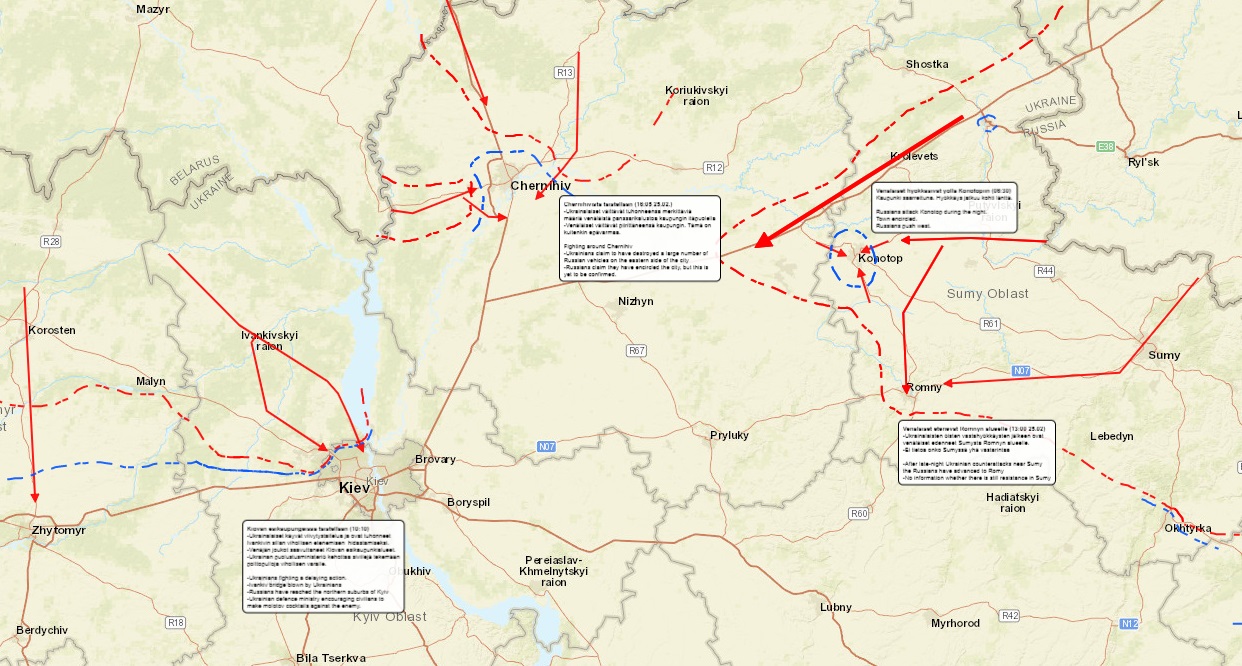
Speaking of Kyiv, the situation on the northern front facing Belarus is a testament to the tenacity of the Ukrainian defense. Konotop was reported taken and lost by the Ukrainian military itself last night but is only encircled; those roads are still denied the enemy.

Chernihiv continues to be an incredible stumbling block to Russian advancements. The claim here about destroyed vehicles east of the city I believe highly likely just because of the disposition of the roads – much like with Sumy the roads skirting the outskirts of the city can be used – or at least risked - if the city is contested but not strongly held, but Chernihiv is strongly held and the movements I saw last night/early morning on Twitter et al indicated lots of maneuvering by Russian forces trying to work their way around these smaller towns/cities, so it’s credible that they tried an end-run and the defenders demonstrated their sight lines and firepower.
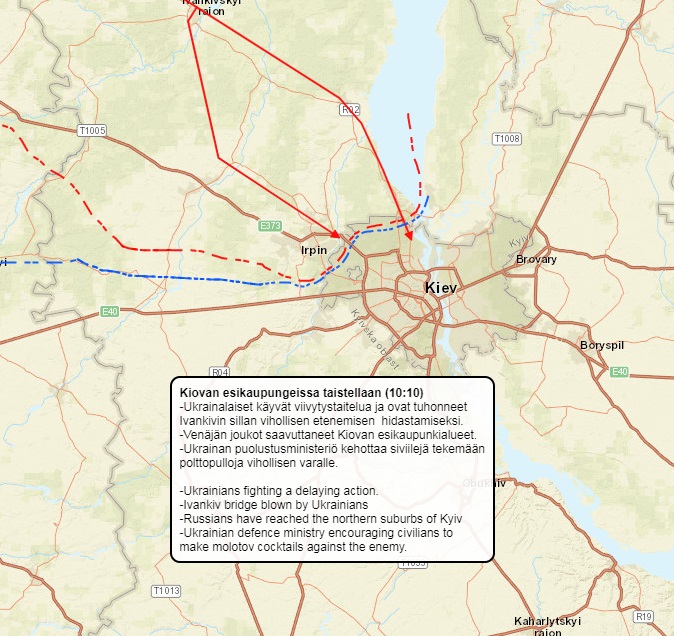
As said before, Kyiv proper has seen the first assault – or at least the bombardment preceding that assault - start in earnest around 6:30PM EST/1:30AM – and is now bracing for the ugly city fight I (and others) have predicted would come. Note the geography here – even if the thrust from the east reaches Kyiv the Dnieper provides a barrier protecting half the city and a few choke points – or none, if the Ukranians blow them behind them. Predictions are running rampant that Russia, badly behind schedule and facing a rapidly worsening international situation, will resort to as much force as possible, such as very heavy bombardment of the city proper and use of TOS-1 thermobaric MLRS systems.
President Zelensky of Ukraine, from Kyiv, said that tonight is the crucial night; the night when Russia will strain with all its might to break through the tenacious Ukrainian defense in every area – the Kherson bridgehead, Melitipol and of course Kyiv himself.
Given the way things are going, I believe he is right.
There is much more going on, much more to say, but I need to eat and I’m scared to look away from Twitter for ten minutes, worried that Kyiv might not be there when I look back. More updates soon.
UPDATE@ 8:21PM EST/3:21AM Kyiv
The Anatov Company’s official corporate twitter account (the same company that owned the airport NW of Kyiv that Russian paratroopers tried to take on the first day) reports that Russian VDV is conducting an assault on the airfield at Vasylkiv; about 22 kilometers south-south-east of Kyiv proper. Sightings of over 150 attack and transport helicopters being massed in a field in Belarus were made many hours ago (commercial satellite imagery) and I’ve seen earlier reports that those choppers were in the air around Kyiv, so the landings here are almost certainly that previously sighted force. This is one of the largest heliborne assaults ever conducted in history, but even with that massive commitment, deploying behind the city – even if they’re in 152mm artillery range of forward Russian troops – still leaves them vulnerable and without much heavy weapons to serve a long-term blocking role, so this is almost certainly a bridgehead to secure an LZ for follow-on paratroopers. This would track with Ukrainian claims that at least one (and more claimed) IL-76 transport has been downed tonight – the Ukranians claim by one of their SU-27s (possible) but it could also be the work of surviving Ukrainian air-defense. Also seeing claims attributed to the Ukrainian Army that the saboteur/infiltrator in false uniform activities seen yesterday are still in use on the Kyiv front. This is happening amid very heavy fighting in Kyiv proper. Fortunately the Ukrainians can read a map too and they had plenty of forewarning that a heavy helicopter assault was incoming; and given the small fleet of American ISTAR assets (including AWACS) monitoring the fighting from the Polish border, it’s likely they passed on warning to Ukraine while the choppers were in the air – if not from radar tracks, then from COMINT intercepts.
This is indeed the crucial hour. Expect the situation to change by the hour, if not the minute.
Day Three Update – Ukraine Survives The Night
Ukraine has survived their crucial hour. Melitipol has apparently fallen after heavy urban fighting, and the coastal roads around it seem barely defended; but in a stunning reversal the Ukranians have re-taken Kherson. An attempted drive straight from the bridges over the Dnieper towards Mykolaiv – with the assistance of an attempted VDV vertical envelopment (i.e. flanking by deploying troops behind the enemy with helicopters) was defeated soundly, and the Ukrainian counterattack pushed deep into Kherson. The Russian Dnieper bridgehead is now in serious danger.
To the north, the attack on Kyiv has been soundly rebuffed. The massive airborne operation clearly failed, with the follow-on paratrooper drop seeing two IL-76 transports shot down during ingress – i.e. with their paratroopers on-board. This has actually been confirmed by United States DoD, and given their persistent AWACS presence from Poland, they’re in a position to know. Russian airborne forces have taken heavy casualties in only the first 48 hours.
Even more shocking – there are now multiple sightings on social media video posts of Russian units stranded on highways due to fuel exhaustion. Before I could even get the chance to write about the logistical constraints in greater detail, they have already manifested in dramatic fashion. This CSIS paper from last month talks about the issues extensively; many of the predictions herein have already been borne out and I expect the rest to be in short order.
Before trying to cover the strategic situation further I want to try and cover some important background info as well. I’m going to write fast as I can and hope I can at least pace this entire mess. Upcoming updates:
1. Why the “Ghost of Kyiv” is bullshit (but I believe it) + why the Ukrainian air force is still alive
2. Why Putin’s actions have shifted the bedrock under the West and can be expected to (and already have) galvanized serious aid to Ukraine and outright embargoes on Russia that can and will have rapid operational effects
3. Why Ukrainian air defense is still alive and will remain a threat
Writeup 1 – The International Angle
Whilst the current events have struck the morons mercifully mute, the usual midwits are still happily rolling perfectly spherical armies around on frictionless battlefields; and chief among their sins is ignorance of the incredible rapidity with which serious international resistance has coalesced against Russia. France, one of the most prolific arms and military equipment exporters on Earth – as well as a nuclear power – have not only promised Ukraine money and military aid, but publicly said that the war is going to last a while. That’s not a prediction – that’s a promise, from the leader of a nation that can absolutely pour enough supplies and military materiel into Ukraine to make good on it. And he is far, far from alone. In the most unusual reversal, Germany has approved the transfer of hundreds of German-made anti-tank rockets from the Netherlands to Ukraine. This, from a country hell-bent on sucking at the energy teat of Russia, contributed only helmets to Ukraine, and even blocked the transfer of Latvian howitzers to Ukraine on the basis that the obsolete Soviet-era weapons had once belonged to East Germany. Sanctions, having failed to deter this crisis, have been discarded in favor of actual embargoes – the EU has completely banned its member states (and companies therein) from doing any aviation business whatsoever with Russia, retroactive to old contracts, which means that every Airbus aircraft in the country will soon be effectively grounded. If the US follows suit (and it probably will) it takes every Boeing jet with it, too. Russia’s state airline, Aeroflot, will be effectively grounded – which won’t matter in the UK, which has already banned Russian aircraft, commercial or private, from its airspace.
These drastic shifts only took 48 hours to develop. The meteoric rise of resistance contrasts sharply to the swift plunge of Russian readiness, with multiple videos on social media showing Russian units stranded for lack of fuel; showing Russia’s supply lines are already over-strained. It is no wonder that Putin is clearly nervous. He should be. Because as dramatic as the reversal of the world’s previously simpering treatment of Russia is, it’s not surprising, and, in fact, there’s every reason to believe it will continue to strengthen. To understand why, you must realize that Putin is terrifying the world. He’s just pulled out a grenade in the midst of a knitting circle meeting.
“The End Of History”
Naturally, this all revolves around nukes.
Way back when, when the plains were dark with buffalo, wars happened fairly often. Not the wars the zoomer generation know; brush wars, counter-insurgencies, long wastes of money in faraway places. Capital W War, like the one we’re seeing now; where hundreds of thousands of men clashed in desperate battles and the fate of entire nations hung in the balance. Every generation could expect at least one; because there was always some king(dom) who was on top of the economic pile at the time and figured they should grab while the getting was good. The only thing keeping them somewhat in check was that the world was what the eggheads call “multipolar;” i.e. once you got stuck in with one opponent, your Traditional Enemies (viz. anyone you’d shared a border with for centuries) were guaranteed to jump in and take some kidney shots while you were too busy to fend them off. (France cannonballing into the American Revolutionary War and the multi-nation intervention against the Ottoman Empire during the Greek Revolution are two classic examples of this.)
Then WWII ended.
Yes, ended. WWII wasn’t the biggest upheaval; it was in many ways a re-run of WWI only one generation later, with the previous no-holds-barred, every-country-for-himself mass melee evolving as larger and larger alliances formed, which is how, eventually, voting one Archduke off the island spiraled into a superalliance vs. superalliance showdown in ten seconds flat. (Zoomers won’t get this joke.) The world-changing shift is the one that ended WWII, when the land of the Rising Sun encountered a falling one at 8:16AM on August 6th, 1945. This changed the bi-polar nation-state (of nature) dynamic from a high-noon showdown to a Mexican standoff now known as the Cold War. You know the rest; both sides shit-tested and proxy-warred against each other for decades, but, ultimately, it turned out that neither side was totally insane and they both wanted to live. Before nukes, starting a war ran a risk of it ending with enemy forces marching into one’s palace and hanging one from the lobby chandelier, but within a generation nukes had made it a nigh-certainty – along with the guaranteed effective destruction of one’s country, and thus one’s immortal legacy as a leader. The Cold War established, through many decades and various crises, that the severity of the threat was actually sufficient to counteract the loss of wiggle room for human error that’d buttressed all prior nations since the dawn of recorded history. That last part is important – it’s not often mentioned by the erudite academics from their ivory Think Tanks, nor in The Literature, but one of the strongest legacies of the Cold War is that Mutual Assured Destruction actually does deter nuclear use, and that nobody is keen to let the genie out of the bottle. Be it a lone king or a vast national government, everyone weighs risk vs. reward, and since nobody’s fought a nuclear war before, but plenty have abstained from one, the sure bet appeals more than the unknown gamble. Thus the Sword of Damocles became a hand grenade, and the thrones of the world, effectively unassailable.
And then the Cold War ended, and lo, did the midwits rejoice. For now, they had a stable, peaceful world; girdled by the gentleman’s dueling agreements that limited things to pistols in order to keep the artillery away – but now the other fellow had tripped and fallen, his cannon was rusty and he was asking for a loan! The best of both worlds had arrived; the peace of the standoff without the shadow of the Grenade hovering overhead. The epic tides and flows of History had ended, and now the future was safe, beige and covered with sponsored advertising.
And so heady was that wine that many of those midwits remained drunk on it right up until Russian tanks rolled over the Ukrainian border a few days ago.
You see, it was pretty clear to anyone intelligent at least fifteen years ago that China was not keen on joining the gentleman’s club, and wasn’t content with puffing cigars and the occasional gentlemanly three-paces-turn-and-fire stuff. The same for Russia; greatly weakened, some limbs shorn, but still lugging its legacy Grenade. In other words, the world was multi-polar again – perhaps not the multi-nation cagematch it’d been pre-1900s but multi-polar nonetheless.
And now, the Grenade of Damocles had completely removed any penalty for great gambles – you might lose your stake, but never your shirt. Which, in turn, meant that the sanctified International Norms had lost the altar that supported them. They lived on as religion, shared fiction who’s power relied on mutual belief, much like the US Dollar.
The loud noise we all heard a few days ago was Putin hurling that rulebook through the plate-glass window before smashing a chair over Ukraine’s head, whaling away as the other Gentleman stared in mute shock. In one move Putin swept away The Rules and all but laughed as he flashed his Grenade; confident in it’s paralyzing power.
And now the leaders of the world are, at long last, getting off their numb asses and scrambling with great haste to adapt; to prevent this terrifying new two-tier world where those with Grenades can do anything they please to those without, and will naturally race to do so before said hapless ones manage to scrounge up their own. War, capital-W War, is back on the menu, and just as oxygen cannot selectively exist here or there in a volume, but only be present or absent, so to can War only kindle somewhere if everywhere is flammable.
The leaders of the world are scared.
And they damn well should be.
NOOK NOOK
Yesterday, someone in the Kremlin was instructed to take a Topol-M ICBM out on its transporter-erector-launcher truck and take it for a walk around Moscow a few times – and when not enough drivers uploaded giddy smartphone cam video to Tik-Tok fast enough, some Russian sockpuppet accounts started signal-boosting it, occasionally with poorly photoshopped “invasion triangles” on it as if it was driving around in Ukraine just for funsies. As gauche as this gun-flashing was, it was also redundant, given the explicit nuclear threat Putin issued to all would-be interventionists at the beginning of his invasion and the major nuclear exercises he timed to coincide with the invasion. Most stunning, however, was the threats issued to Sweden and Finland should they dare join NATO; making it explicit that what Putin is doing to Ukraine right now could befall anyone, anyone who makes a move to prevent the possibility. And indeed, the powerhouses of NATO are already explicitly worried that the taking will not stop, and as a Twitter search for “Taiwan” makes clear, it is lost on nobody what the global consequences of the New Rules could be.
But just as bad is the obsolescence of the old playbooks. The “rules” of the Cold War’s Mexican Standoff were explicit from the get-go; kill me, I take you down with me. How to work with and around that, how far you could push, where exactly the red line lay; it took decades to find out. It’s the difference between knowing the rules to chess, and knowing how to actually play it without getting your ass kicked. The smug assurance of the International Normists is that of the chess grandmaster who has read all the books and knows all the Queen’s Gambits; an accomplished player of a known game.
Now Putin has upset the gameboard and smashed it over Ukraine’s head, making it explicit that the actual rules changed long ago, and everyone was just persisting with the old game because it was so much more convenient than rolling dice under the long shadow of the Grenade of Damocles. Putin is the first leader to cast that consensus away since it was formed, and now everyone else has to ask how many more gentleman’s agreements he will cast aside. Because under Mexican Standoff rules, anyone without a gun is a fair target. Tactical nuclear employment on Ukraine, for instance – what are you going to do about it, NATO? Nuke me? Are you willing to risk your very existence to defend Ukraine?
This question strikes at the heart of the NATO alliance; which exists only insofar as it huddles under the Nuclear Umbrella. The bi-polar world of yesteryear formed in the shadow of two colossi squaring off as everyone else scrambled to pick one side or another, for if they didn’t they’d be in the crossfire when the shooting started. Now, however, the standoff isn’t guaranteed; and America is squaring up with the new kid on the block, China. But everyone still has grenades to throw, so will America really risk that exchange to protect nations whom aren’t in the line of fire with China, nations who aren’t intrinsically interested and salient to America’s struggle for survival? It’s far less clear cut than before. Everything is. And the dangers inherent to those unknown unknowns are so great, so compelling, that it’s chiefly responsible for many midwits – and some genuinely smart people – mistaking them as the ironclad Rules, rather than the playbook. To dive so deep, so fast into that dark pool, as Putin has, is patently insane by the ~norms~ of the West, and it forces them to ask; how far is he willing to alter this deal?
How far will he go?
Everyone Signals with their nukes, of course, but ever since History Ended that was just the Teller-Ulam Gambit, from page 47 of Play International Chess For Fun and Profit!, as traditional and wholesome as dad cleaning his guns on the kitchen table waiting for his daughter’s prom date to walk through the door. Last week, driving that Topol-M around Moscow was about as exciting as putting a leash on it and taking it for a walk. But now, it’s waving a gun in everyone’s face while screaming “don’t think I won’t do it,” and for the first time in decades, the rest of the world has a little reason to wonder if he isn’t serious.
This, naturally, is unacceptable.
World Police – Plural
There used to be a solution – call the bouncer. The 8,000 pound gorilla called America would trundle on over, seize the miscreant, and beat the absolute hell out of him. So prodigious was his strength that he could make knees buckle just by leaning on them. But everyone truly believed in the Rules, and so deep down didn’t think he was absolutely necessary, not after History ended, since in a static world no new miscreants would spawn. The gorilla was gauche. He fitted himself for a suit, slimmed down, talked in gentle tones, imposed sanctions.
Putin, however, pines for the days when Glorious Rodina was bouncer of her own club, and this slim effete fellow clearly – as is now explicit – did not impress. So now the gentleman in the club must do something themselves. History has started again, as well, a whole new problem unto itself, but conveniently, two birds can be downed with one stone – the best way to stop any other miscreants who might fancy a go is to lay hands on Putin, beat the ever-loving tar out of him, and hurl him out of the club. Let him stagger down the street, bloodied and penniless, without a trade agreement or SWIFT connection or even a gas pipeline to his name, and let everyone see that the sheriff is back in town, and if he’s weaker now he’s still got plenty of like-minded fellows to deputize if the offense is egregious enough. If you want in the clubhouse, you behave, and if you fuck around, you’ll get tarred, feathered and dumped in the back alley with North Korea to starve.
It’s the obvious solution – and given how shaky Putin looks, they have every incentive to do it quickly before he gets any closer to pulling that trigger, deliberately or by accident.
Desperation
Exacerbating all the above considerations is Putin’s apparent weakness. It’s not simply the Russian army failing to terrorize the Ukrainians into an early surrender – as the midwits say, we’re barely 48 hours (now 52) into this conflict, and Russia’s greater endurance will take at least a little time to tell. But it already seems to be flagging, here and there. Russian riot police; who were expected to serve as enforcers and hostage-collectors, were thrown into the frontal assaults on Kyiv last night. Reports and evidence from all quarters continue to accrue as to the extent of Russian efforts to fool and/or coerce Russian conscripts to the frontline, and Putin has openly appealed to one of his most loyal allies, Kazakhstan, for troops to assist – and been rebuffed. For an army that has yet to commit ½ of its massed forces, this is a striking display of barrel-scraping, especially this early in the conflict. It’s becoming clear why Putin was so willing to take that plunge and why the nuclear threats continue to come; if the West piles on with enough military aid, even without direct intervention, Ukraine could very well bleed Putin dry.
There’s also the massive protests against the war across Russia – Russian propaganda acknowledges the futility of trying to truly and completely brainwash an entire populace when they have an internet connection in favor of generating so much noise that the people simply resign themselves to bitter cynicism and carry on, resenting their peasant status but not entertaining any idea of opposing it for lack of a universally-accepted Truth to rally to. This has worked in Russia since the Soviet Union collapsed – and now it is not. Kings concern themselves chiefly with the opinions of their Lords, not their peasants – but even peasants rebel when things get bad enough, and with the world set to embargo Russia more than Iran has been, things are absolutely headed towards “enough.” Putin desperately needs a fast victory, and the insane – if not nigh-suicidal – fervor of some Russian pushes probably owe to this.
A nervous man waving nukes around is even more alarming than a calm one, and that’s only going to incentivize world leaders to move faster; to force Putin to back off while he still has some chance of a face-saving exit. If he gets stuck in too far to withdraw... that’s a risk nobody need brave.
History Resumes
I know this is long, and perhaps overly metaphorical for the tastes of many, but it’s necessary to get into the headspace of the world leaders now calling the shots. Even if they were slightly scrambled instead of sunny-side-up, you now hopefully grasp the upheaval as personally as they do – you feel the way their very world has tilted, just as yours would if you woke up one morning to find your house had neatly inverted during the night without even the courtesy of asking your say-so. This is what History is – Mongols, Sea Peoples, Huns at the Gates. It is, in a word, change. History moves; and so it runs over those who stand still.
And now that Putin has made that loudly, painfully, explicitly clear even for the perpetual fools in the back of the room, you can damn well expect world leaders to get off their asses and move.
72 Hour Update @ 7PM EST
Sitrep, Maneuver/LOC:
- Ukranians are not only holding in the north but have actively flanked the Russian thrust from Belarus towards Kyiv and now credibly threaten Russian LOC back to their base of supply in Belarus.
- Thrust from the north-east continues to progress but only against heavy resistance and while this thrust has a highway back to Russia, resistance in Sumy is still confirmed to be active, which threatens it. Furthermore, Konotop continues to be held by Ukranians, and a crucial rail junction runs through there.
- The aforementioned convoy the Ukranians claimed to have trashed as it tried to skirt Chernihiv is confirmed, and not only that, an entire damned train carrying 52 Russian tanks tried to thunder-run the town and was destroyed for its trouble. Nothing better underlines how Russian ability to advance is integral to their control of key transport crossroads (and thus, cities) than this does.
- I have literally lost count of how many ambushed and destroyed Russian convoys I have seen just today. I don’t know if they’re all from the last 12~24 hours or if some date back to the opening hours. Russian losses are becoming truly significant. This rate of attrition is hard to fathom as sustainable.
- Russians have bypassed Melitipol in the south and are moving rapidly through the coastal area because the Ukrainians are lightly defending it; most likely ceding this ground to use the Dnieper River as their Main Line of Resistance. There appears to be staunch Ukrainian resistance at a city north-northeast of Martipol called Tokmak, because it controls a crucial crossroads. Whether or not this smaller town, surrounded by ideal tank country and fairly close to Russian LOC can long last is questionable, but controlling it will significantly slow any Russian attempts to move past it as their supply lines struggle along side roads and cross-country. This should buy the Ukrainians time to destroy bridges, roads, rail etc. behind them and reinforce whatever new line they have chosen, anchored with the Eastern Donetsk front blocking forces as their eastern flank and the Dnieper river as their western one. More detailed analysis on this to come ASAP.
- Russians continue to bite the barricades of Kyiv and that’s working out about as well as you’d expect.
Sitrep, Logistical/Intelligence:
- Russian logistics appear to be a complete clusterfuck. I have literally lost track of how many different videos I’ve seen of fuel-exhausted Russian vehicles so far. I wanted to detail this yesterday but ran out of time: the many people saying Russia must be “holding back” because ½ its troops aren’t deployed in-country yet don’t understand that road and rail can only move a finite amount of materiel a finite distance in a finite time; and with troops already in contact the Russians will have to choose either between sending in more reinforcements or more supplies for the troops already there. That vehicles are now running out of fuel seems to indicate that Russia chose the latter; gambling that, while Ukraine may have been unexpectedly resilient at first, one more good, violently hard push would crack the shell and end things quickly. This gamble failed last night when Ukraine not only held, but pushed back in crucial areas (such as the Kherson bridgehead,) and now they’re paying the price for that gamble.
- Due to the troops > fuel choice my gut instinct is that the units that were first in contact came in with their own “organic” supply – carrying supplies on their own combat vehicles (in bustle racks on tanks/IFVs and in the form of their own modest contingent of dedicated supply transports) and my friends have told me that OSINT evidence bears this out; knocked-out Russian tanks surrounded by an impressive amount of MRE packs and ammo spam cans strewn about when they brewed up. Given that we are readily approaching the 72 hour mark, this means the Russian troops first in contact are likely hors de combat simply from supply exhaustion, (as the increasing number of abandoned vehicles indicate,) so Russian attacks can be expected to falter the further they get from their own territory.
- The huge number of successfully ambushed Russian columns indicates that if American intelligence/ISTAR support has not been providing tactical level intel from the get-go, it is now. This most likely means RQ-180 stealth drones, equipped with Ground Moving Target Indicator technology, are operating in Ukrainian airspace. The intelligence being provided to Ukraine can now be assumed to extend to tactical target localization and cuing up to and including counter-battery targeting.
- Elon goddamned Musk has moved Starlink satellite terminals to Ukraine; providing them with an infrastructure-independent communications option. Combined with their own homegrown cyber capacity and extremely probable US support, this opens up a whole new option for communications, with security being provided by end-to-end encrypted third party software. This is a massive boon to the robustness of Ukrainian C4 capability and should not be under-estimated.
- Western aid continues to pour in over the Polish border and donated weapons and equipment are adding up very fast. I count 600+ more stinger missiles and a staggering 1200 Panzerfaust-3 anti-tank rockets as promised to Ukrainian forces. OSINT has already spotted RPGs with Bulgarian factory markings on them on the front lines, indicating how OSINT is only capturing a small fraction of the real aid pouring into the country.
- Mention has been made by some of deliberate and skilled Ukrainian propaganda operations being conducted. Although the people alleging this are known to me for a history of hostility towards Ukraine and sympathy for Russian propaganda claims, there’s reason to believe their analysis has some merit, esp. combined with other indicators like strict Ukrainian OPSEC (which may be benefiting from US cyber support, as well.) Given that both morale and international opinion has already been proven to be crucial in just the first 72 hours, this aspect of Ukrainian operational skill sets should not be dismissed; especially as they are currently dominating Russia in that regard.
- For various reasons, Ukrainian supply lines from the Polish border to central-central Eastern Ukraine should be considered fairly secure and not at serious risk of deep interdiction by Russian strike assets; as indicated by apparent Russian refusal to attempt such ops, curiously limited deep attacks against infrastructure with aviation strike assets and the persistent credible threat of Ukrainian air defense (see following.)
Sitrep: Strategic + OOB/Materiel
- Ukraine is now proven to have substantial surviving surface-to-air missile and aviation assets, both of which the Russians have failed to conclusively put out of action or even seriously attrit. Big update on this to come later. For now, the consequences of this are:
- Russia does not have air superiority and cannot operate without, risk even above the MANPAD envelope, in most of the country. A persistent short-medium range SAM threat from tactical maneuver (SA-8, SA-9, SA-13, SA-15s) and short/medium-range high mobility SAMs (SA-6, SA-11) is demonstrated to exist and may be assumed to be higher the further west, and the closer to the center of the country (distant from both Belarus and the coast) Russian assets go due to terrain concealment and increasing distance from Russian airborne and ground based standoff jamming support. The refusal (or inability) of Russia to commit serious, sustained attacks on Ukrainian airbases (preferring instead to attempt repeated small cruise missile attacks likely aimed at taking out assets on the ground) make Ukrainian claims of surviving and still operable S-300 systems more credible than I first believed. These will likely be held back in the Western part of the country, esp. further west than the Black Sea Coast, as that means Moldova + Romanian airspace (closed to Russia and of course the Russian fleet) channels enemy approach lanes and effectively increases strategic depth. The ever-rougher terrain – plus the obvious reluctance of Russian forces to conduct offensive operations too close to the Polish border – also increase survivability of these theater assets in this area, and allow them, in turn, to utilize the strategic depth and terrain features to make Western Ukranian airspace a hostile environment for Russia. Given their evident failures to properly provide CAP and/or SEAD protection to tactical air operations in eastern Ukraine, the ability of the Russian air forces to brave the persistent air threats further west are highly questionable.
- My previous assessment of Ukrainian tactical/maneuver SHORAD systems is likely erroneous given the demonstrated existence of them in OSINT footage and the demonstrated presence of surviving batteries by the surprisingly high volume of demonstrated intercepts taking place above (or what should be above) the MANPAD envelope. The answer to “how much of Ukraine’s legacy small road-mobile SAM force was actually refurbished to operational status before hostilities commenced” is now, at least, guaranteed to be “more than just the half-dozen Tor systems that were known.”
- Prevalence of Ukrainian air assets is murky. Both fixed and rotary wing operations, and both anti-air and anti-ground sorties are being generated, but how many and to what effect is hard to say. There is firm reason to believe (up to and including US DoD confirmation) that Ukraine has, between last night and this, downed four IL-76 transports. There are also claims that the Vasylkiv interceptor airbase, the same one targeted by the all-out effort paradrop last night, is actually still active as a MiG-29 base, and that a MiG from said base actually shot down one of the incoming IL-76s. I found this hard to believe given the high likelihood of that base being reduced by the initial Russian missile blitz and the obvious wisdom of dispersing assets and ops personnel from more exposed bases to more distant, protected ones further in the rear, but not minutes ago a missile attack was conducted on the base that resulted in a truly huge explosion and OSINT images seem to indicate it was, indeed, an attack on the base’s underground fuel bunkers. That 1. this had not already been conducted in the opening blitz and 2. the Russians decided to do it now makes it more likely that Ukrainian claims of successful A2A engagements are actually true. It should always be borne in mind that there is great propaganda and deceptive strategic value in claiming surface-to-air kills as actually air-to-air kills, esp. if the enemy is actually fooled (which might be the case here,) but taken all together with other staggering displays of Russian operational incompetence taken into account it is clear that nothing is impossible at this point.
- More detailed AD explanation to follow.
UPDATE ON PRIOR INFO @ 10:30
1. Further research casts doubt on all evidence of sustained Ukrainian air operations at Vasylkiv airbase. The two reported IL-76 shootdowns yesterday were corroborated by an AP Wire reporter citing high level contacts, but was later countered by another reporter citing a high-level contact. Cloud cover yesterday prevented any IMINT via commercial satellite and Ukrainian forces have only just approached the areas where the planes might have gone down. Likewise the missile strike near Vasylkiv hitting the fuel bunkers is also difficult to determine; nobody can geolocate the pictures of cratered underground tanks well enough and conflicting reports on the exact location of the huge fires continue to circulate.
In any case, it does not substantially impact the conclusions vis a vis the Ukrainian air force’s continued survival as that has been confirmed beyond a shadow of a doubt, but previously discussed information vis a vis very bad Russian screw-ups has to be shelved until data is clarified.
2. Previous information about Ukrainian flanking the Russian LOC from Belarus to Kyiv has been confirmed by @spuddus (Big Spud on discord) who geolocated this video showing an ambushed/destroyed Russian tank convoy by identifying the egg-shaped monument in the middle of a large traffic circle – lat/long: 50.95046, 29.88186.
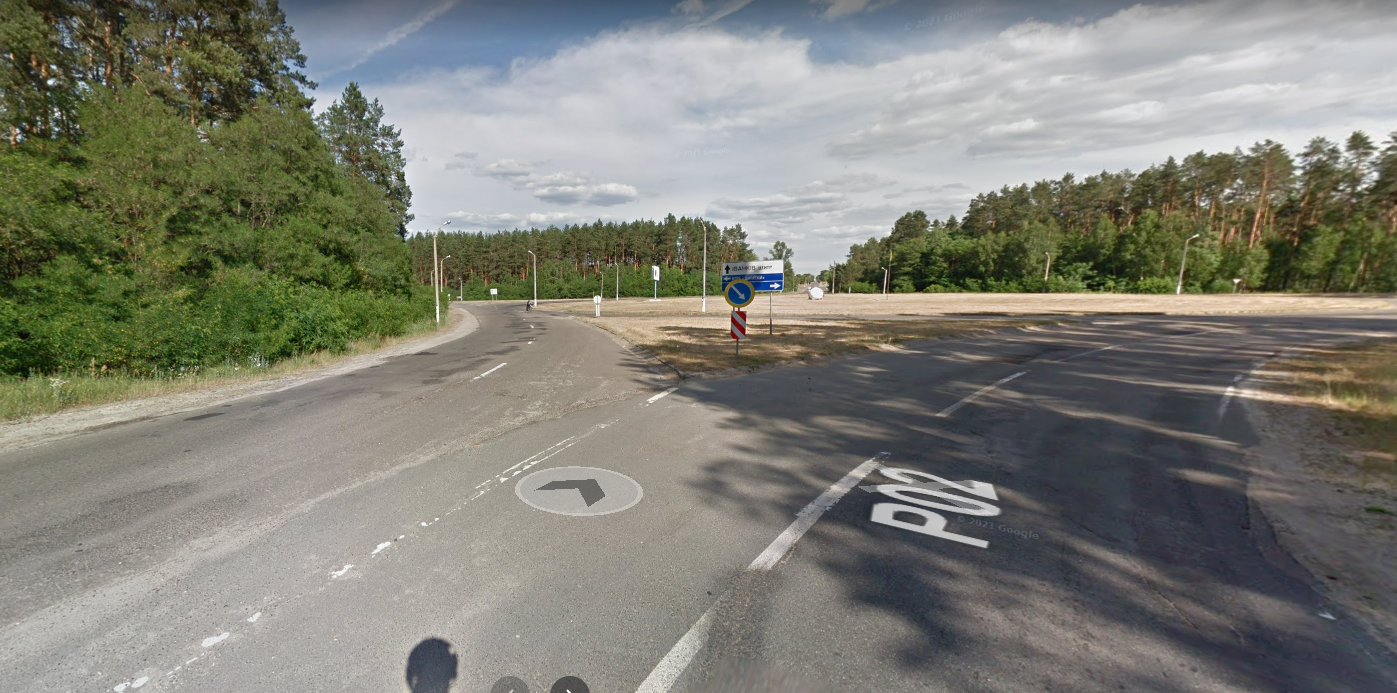
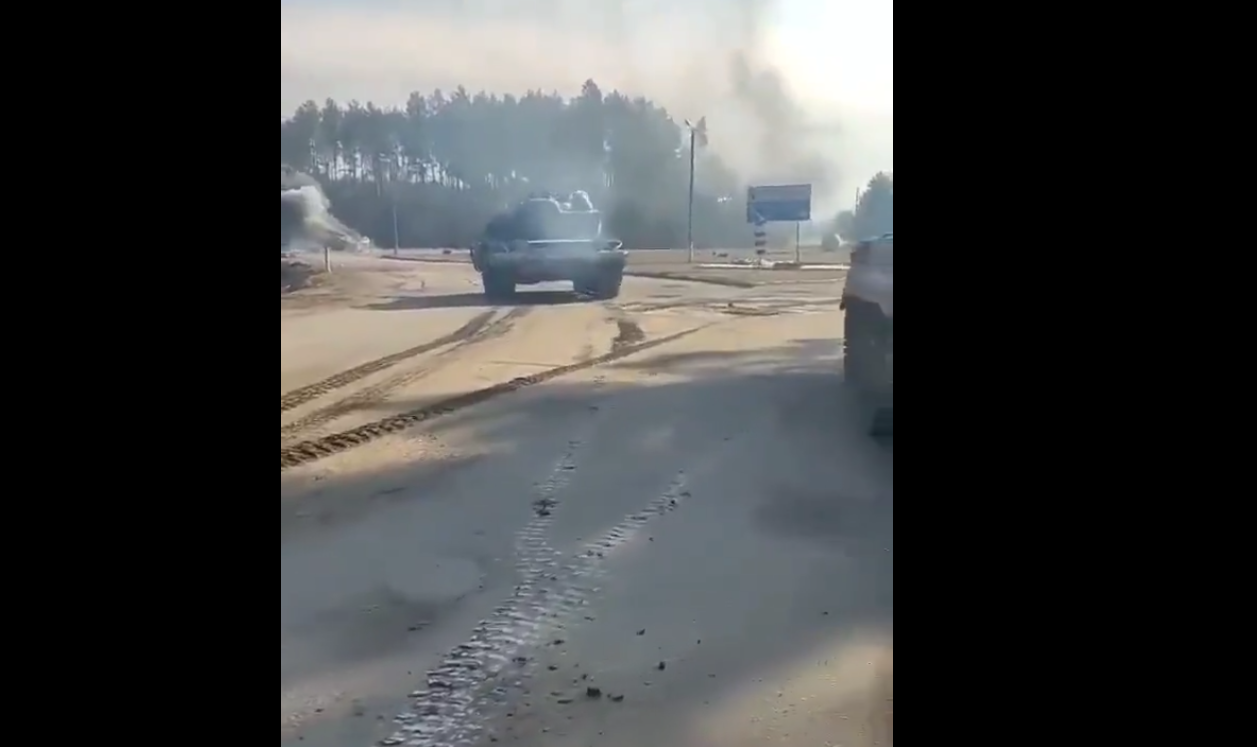
This traffic circle lies on the north-west outskirts of Ivankiv, and is a crossroads for the main road into town, the P02 highway and the P56 highway, both of which are the primary road lines of advancement south from Belarus towards the Russian forces at Kyiv.
This is hard confirmation that the Russian forces driving on Kyiv completely failed to cover their flank and that Ukranian counter-offensives have successfully interdicted the Russian line of communication to Belarus.
SOUTHERN FLANK SWAG “ANALYSIS”
This matches perfectly with the information taken from that scribblemaps that is being run by Finnish-Language Twitter OSINT fellows. Same source refers to the Russians in the south trying to drive to the “Polohy/Komysh-zoria/Manhush line.” All three towns lie along the Konka river, which runs roughly northwest/southeast. It’s a squiggly beast that I eventually gave up trying to even roughly sketch out on the map for you, but suffice to say it’s long, winding, and in military terms more of a creek than a river. It’s not the Dnieper river; it’s very very bridgeable and/or snorkel fordable.
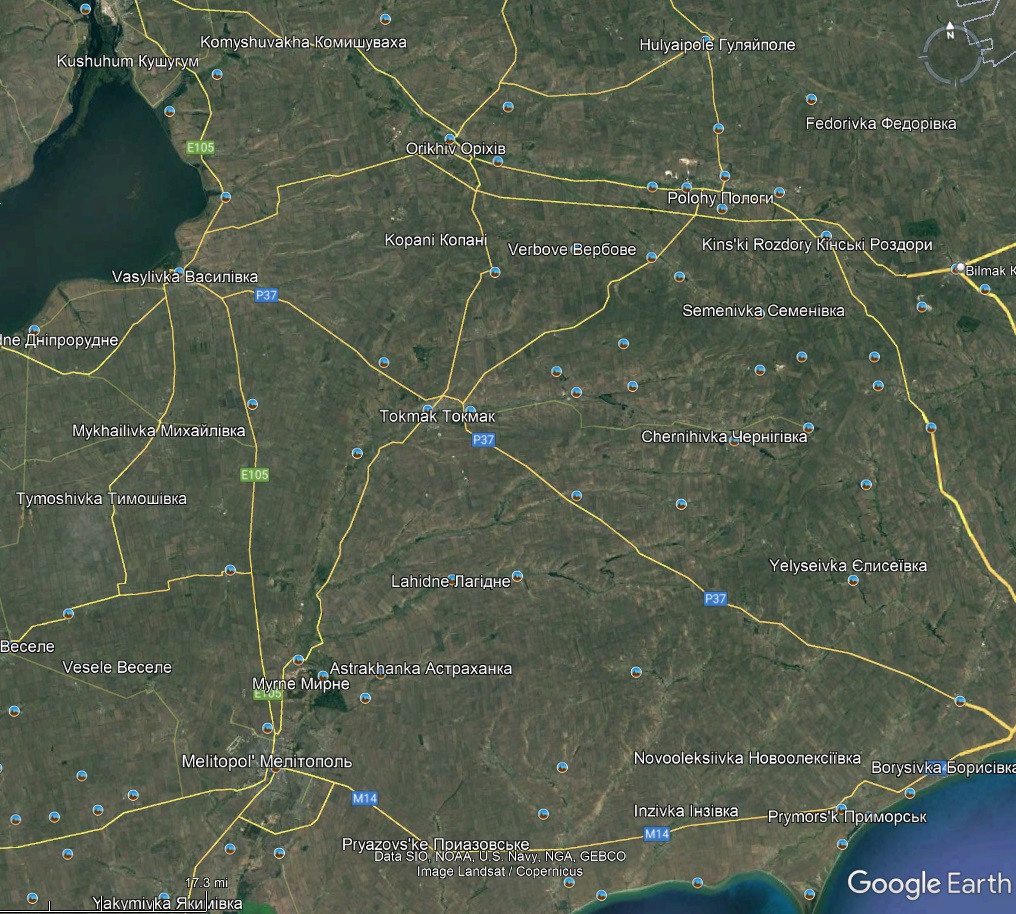
HOWEVER, Ukrainians are demonstrably destroying every smaller bridge they can, thus the river nonetheless offers them a barrier – something of immense value given that south-east Ukraine is mostly open flat fields; in other words, ideal tank country. Also, because of the highway that roughly follows its winding course, the settlements strung along it, in combination with the wooded areas that tend to follow its banks and watersheds, make for some modest cover against which Russian tanks will have to advance across wide-open areas. This is still not ideal – the Ukranians were, apparently, equipped with the old Javelin CLU, with a maximum range of about 2,500km, so Russian tanks should be able to out-range them with HE fire – but Javelin-armed infantry need not reveal themselves till hostiles enter range, and even after battle is joined and the lines defined, the cover improves their chances vastly. Given the terrain it’s about the best defense they could hope for, and unlike other rivers in the area, it anchors their right flank at Zaporizhzhia (a major city controlling a Dnieper crossing that benefits from a huge lake to its south-southeast that will limit the frontage available to the Russians to approach it,) and their left flank at Mariupol.
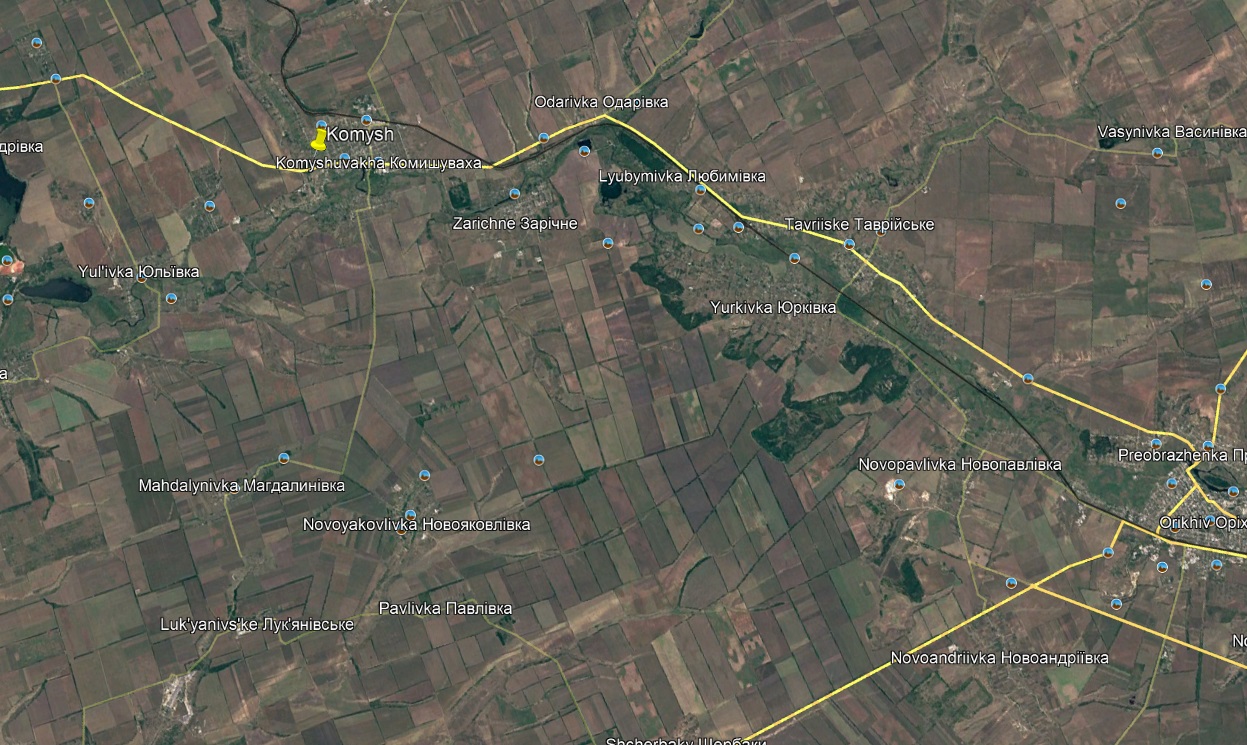
If Ukraine wants to extract their Donesk front forces before they are encircled, this line might buy them the time to do so. My assumption from day 1 was that those forces were unlikely to maneuver and may simply have prepared with as much supplies in situ as possible, given that their proximity to Russian air and artillery fire would likely pin them down. But given the larger supply issues Russian forces are facing, and the fact that I underestimated how many mobile SHORAD units they have to cover their maneuvers, it’s possible that they could brave Russian tactical airpower and that Russian artillery units may be running into ammo issues, despite being inside their own lines of supply. (it’s been mentioned by Ukranian command themselves that the Donestk from has been under constant bombardment since initiation of hostilities, exactly as one would expect, to pin those forces down.) Ukraine’s disappointment of Russia’s planning likely extends to their logistics, and after three days of incredibly tenacious resistance in multiple other cities raising the demand for heavy artillery/MLRS expenditures its likely the nearby ammo dumps are sorely taxed.
These are all theoreticals, of course. I don’t know, qualitatively, what the state of any of those variables really is. But, relatively, if Ukraine wants to extract their eastern border forces north-west to form a new front from Dnipro (on the Dnieper) north along the E105 highway to Kharkiv, around now might be the best opportunity they’ll have – when Russian initial stockpiles have been obviously drawn low, before fresh stockpiles can move over congested road/rail links that were pushing in fresh forces rather than fresh supplies, and after three days of exhausting urban fighting for the enemy while those Eastern forces mainly sat in dugouts listening to artillery pounding on the roof.
90 HOUR SITREP @ 3:03PM
Northern Front
1. Kyiv is encircled. Tracking the real situation around Kyiv is very difficult due to the nature of the information flow but it’s clear that the Ukrainian Army has fought hard for every inch of Kyiv’s left flank, and have inflicted significant casualties while doing so. A significant Russian force has been seen advancing on Kyiv in commercial satellite imagery, presumably down the P02 highway. This information fits with constant imagery claimed to be from Bucha, Hostomel and Irpin – all suburbs right off the north-western side of Kyiv; indicating a Russian fighting advance south. The point of this would be to flank and eventually encircle Kyiv. Whether or not they can maintain that encirclement against a dedicated break-in attempt is anyone’s guess. I have not been able to find any evidence or information on serious clashes for towns significantly north-west of Kyiv; i.e. not in its suburbs. Either the Russians belatedly secured their flank and the Ukrainians faded without contesting the ground, or it could mean they have not attempted to secure it. No way of knowing. Another hard fight for Kyiv is incoming.
2. Russia’s westward push from the Russian border is still a disaster, as Ukrainian resistance in Konotop, Sumy and elsewhere continue to deny critical road junctions to the Russians, complicating their supply lines. This area has seen the most videos of fuel-starved vehicles being abandoned and soldiers looting stores for food. Russians are demonstrably leveling the town, and multiple videos show continued active fighting (and destruction of Russian armored vehicles) around the city. These videos came out fairly recently, too. This video from yesterday of a Russian supply truck being hit by a molotov illustrates the difficulty of running supply lines through resisting areas. This video of a battle-disabled SPG being towed by a tank, and both of them bogging down in the mud, illustrates the costs of being forced to conduct even a short over-land divert to avoid side-road ambushes and denied major road intersections.
Note that only the video of the burning tank on the road with the Sumy street sign has been positively geo-located. I have seen occasional attribution of these same videos to other regions/areas. But on preponderance of evidence – especially the number of abandoned vehicles in rural areas being seen attributed to Sumy – I would say the resistance in these cities is real and Russia’s westward push can be considered supply-interdicted.
Southern Front
1. Russians confirmed at Zaporizhzhya. A tweet from a reporter in-country, who also indicated she traveled from “Mauripol to Dnipro,” i.e. most likely along the highway that roughly follows the Konka river. It seems the Finnish OSINT scribblemaps was right. NASA FIRMS satellite data (infa-red satellites that show large fires) also showed significant fires in northern Zaporizhzhia last night, though those could indicate air/missile strikes on crucial infrastructure. Denying locals crucial infrastructure, however, would be most likely part of a preparatory bombardments prior to assault.
2. Same reporter indicates that Mauripol is now surrounded. This does track with the video uploaded by rebel forces of the Donbas region front line’s entrenchments and bunkers seemingly abandoned; no firefight is happening, no bodies, no destruction from heavy bombardment.
3. Circumstantial evidence for Ukrainian withdrawal from the Donbas defensive line to avoid encirclement. This video released by the Donbas “rebels” indicates that Ukraine expended one of their precious Tochka-U’s against a tank farm in Rovenky, a coal-mining town close to the Russian border. I located the tank farm on Google Earth (NW corner of town:)
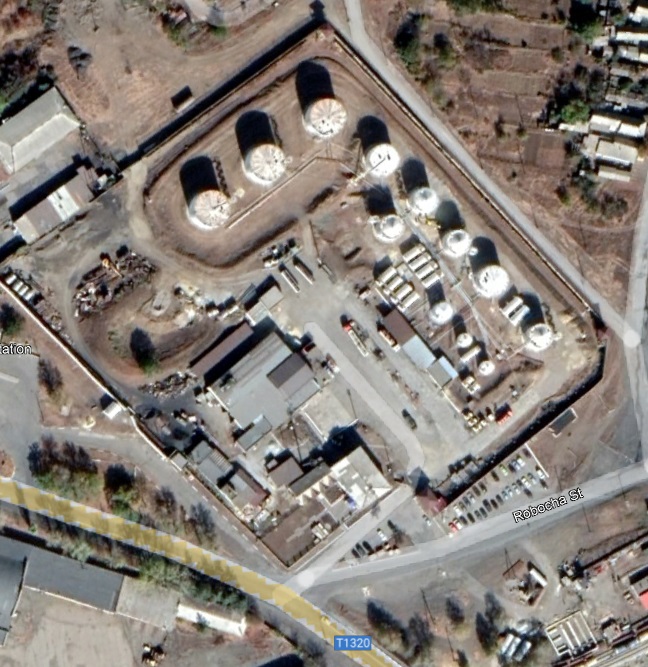
Those more familiar with this infrastructure tell me this is essentially a large gas station that sells diesel fuel to large farms or smaller industrial operators. Other videos of multiple burning tanks on Twitter are likely from the facility recently struck south of Kyiv by Russia; as only one tank is burning in this video. The Tochka-U can accept a bomblet submunition warhead, and given the relatively intact state of the debris, no visible blast crater, and no visible shrapnel damage to the non-burning tanks I suspect they are simply empty, and the burning one was ignited by bomblet damage to the roof.
The Tochka-U represents Ukraine’s only deep-strike option against Russia; an especially important capability for them given the mismatch. To expend this weapon on that tank farm is curious; as with the Donbas line between them, none of the major Russian thrusts can really access that fuel. Taken together with the abandoned frontline positions, this may indicate the Ukranians are pulling their eastern forces out, and the new Konka river line will cover their withdrawal. This would still require the Donbas line be held to avoid flanking from occupied Donbas. However the abandoned positions do make sense in conjunction with reports of Mauripol being surrounded:

The Donbas front line was so close to Mauripol that artillery fire could usually be heard in the town during the Donbas war. If the Ukrainians are leaving only a rearguard/delaying force in those fortifications they wouldn’t be able to hold against a heavy, determined push by the Russian forces in Donbas – fortunately for them, said forces are pushing for Mariupol, which can anchor the end of the line anyways. It would make perfect sense to abandon positions and relocate in that event.
One Tochka-U strike a withdrawal does not make, mind, but it is an interesting allocation of a precious resource by the Ukrainians.
4. Kherson area bridgehead continues to be an insane fight:
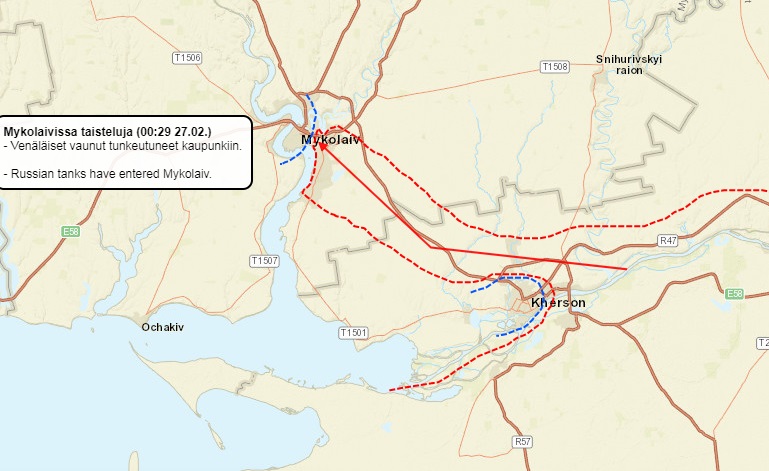
More than a few videos showing fighting around Mykolaiv, but as the Finnmap shows, I’ve heard nothing of Kherson being retaken by the Russians. Recent video of outgoing MLRS fire from Nova Kakhovka (the dam crossing to the northeast) indicates that their bridgehead there is far from uncontested, as well. The direct drive to the crossroads at Mykolaiv mirrors their prior attempts.
Ukraine is devoting serious resources towards halting this breakout attempt. Two of their SU-25s were said to be downed, with one absolutely confirmed shot down, pilot(s) KIA, over the area, and more recently the first confirmed attack of a Ukranian TB-2 occurred, destroying multiple vehicles on the tarmac at Kherson International Airport (positively geolocated.) High confidence with experts that it’s not the recycled footage from the Armenian-Azerbaijani war that has been floating around. The fighting here seems to be particularly intense.
D+5 Update In Brief – No Huge Changes
My updates have slowed down, not just due to exhaustion but because the situation has stabilized a little compared to the first days. This update will be very brief; not all of it I have independently confirmed but it does match predictions I made based on earlier data so it’s worth noting as tentative data:
Northern Front
- Reports Of Kyiv being encircled were apparently premature and/or the forces encircling Kyiv were too light and/or not present in strength. Alternatively statements to that effect referred more to the roads out of Kyiv were denied to effective civilian evacuation by indiscriminate Russian long range fires/aviation. I saw a video of a distant bombardment at night claimed to be an SU-24 bombing run on Makarivskyi, a town further west of Kyiv, but it could have been anything (MLRS etc.) However I’ve seen enough persistent mention of the town (without video evidence) to conclude there probably is active fighting there. This makes perfect sense as the town controls the closest decent crossroads that allow a southern march around the west flank of Kyiv in order to begin properly encircling it. Given that multiple columns were destroyed in the north-western suburb cities of Kyiv yesterday in incredibly dramatic fashion; with an entire airborne column in Bucha bottled up by a blown bridge, then hit with HEAT submunition MLRS bomblets, it’s no surprise the Russians would shift their axis of advance away from the force concentrations present in Kyiv.

- North-East advance is now credited with a stable front line developing as Ukrainians defend at convenient urban areas and/or crossroads. I have seen no chatter about this at all and will have to verify with place-name searches later. Chernihiv is said to most likely be surrounded at last, though we have seen how little that has helped Russia before.
- All in all the push west from Russia proper still has not reached Kyiv, and even if it does, and even if Resistance in Sumy and Konotop are finally crushed, it’s unclear to me that the Russians can establish effective security along the 186 mile long route back to their supply dumps in Russia. (The route to Belarus is still blocked by Chernihiv and given the examples set by Sumy and Konotop resistance in that city will not fade for a minimum of several days yet; additionally the one open route along the P02 highway will be clogged with supply traffic supporting the forces that moved from Belarus. Transport routes have finite capacity.) Additionally this excellent paper on Russian logistics makes clear the Russian reliance on rail over road, and specifies 90 miles as the rough limit of Russian road-mobile logistics support based on the number of supply trucks they have present. Given the low manpower-to-firepower ratio of Russian Battalion Tactical Groups they will be sorely lacking in light infantry/light vehicles to secure such a long over-land route, both road and rail, and while we’re already seeing video evidence of Russia commandeering civilian heavy trucking they have also demonstrably lost quite a bit of supply vehicles in-country already (some of them captured with their supplies intact!) Thus they’ll be hard pressed to commander and deliver enough vehicles quickly to not only make up their losses but establish a sufficient supply chain back to Russia. All in all the westward push does not worry me as much as it might otherwise.
Southern Front
- Kherson continues to be a bloodbath but no reports of Russian breakthroughs yet. A rumored naval landing at Odessa last night never materialized. Very little news out of Odessa; apparently due to deliberate OPSEC implementation by civilians, possibly at the request of the mayor. (This is a rumor, treat it as such.)
- It is confirmed that Russians have reached the town of Enerhodar, on the southern bank of the Dnieper, and the nuclear power plant it holds, but have not entered the city. No word on Ukrainian defenses yet.
- Finnmap reports that civil administrators announced an attack on Zaporizhia proper, specifically on the airfield, and that it was repulsed. I couldn’t confirm this. If it’s true, most likely another airborne operation, given the target. Less likely to be ground assault as the airfield’s in northern Zaporizhia and the Ukranians are highly unlikely to not anchor the Konka River line at the southern edge of the city.
- Tokamak and its crossroads are still contested. Little information past that.
- Finnmap credits Russia with having advanced up to the Konka river line, but offers no information and I have seen nothing to confirm this. All we know for certain right now is that the Ukranians are entrenching along this line or a line close to it vis a vis the in-country journalist’s report from yesterday.
- Finnmap also claims that the separatist “rebel” forces are advancing without serious resistance in northern Donbas, potentially indicating a fighting retreat by forces there to avoid encirclement. Also claims that Volnovakha, north of Mauripol is being bitterly contested with the separatists. This does match my own predictions of a withdrawal from the eastern line that still maintains flank protection for the Konka line, but I have not verified a word of this.
Update to come: airpower in the conflict and the “Ghost of Kyiv,” then confirming as much of the above as I can later today.
Why The Ghost Of Kyiv Is Bullshit – But I (Mostly) Believe It
If by some miracle you haven’t heard of the “Ghost of Kyiv,” you’ve probably seen the many, many memes (justifiably) mocking it; the legend of a Ukrainian MiG-29 Fulcrum pilot who allegedly became ace in a day and is still marauding around Ukrainian airspace downing the invader like an Ace Combat hero. It’s almost certainly bullshit, given the complete lack of proof, but the legend of the lone aerial gunslinger has held imaginations in thrall since the days where WWI aces, leaving on lone hunting patrols, were storied as “knights of the air.” Thus it took off like wildfire.
However – nothing attributed to the Ghost of Kyiv (at least by the first person to attach concrete claims of kills to the Fulcrum pilot, a War Thunder youtuber,) is actually impossible. In fact, it’s not even improbable. And now that a few days time has cleared the fog of war a little, we know that the mythic marauding Fulcrum’s continued presence isn’t terribly questionable either.
The Mysterious Case Of The Vanishing VVS
A few days in and the professionals are taking note of the Russian Air Force’s mysterious absence. The continued survival of the Ukrainian Air Force (UAF) did not baffle me as much. As I mentioned in the first 24 hours’ analysis, it can take a good 40 to 50 munitions to comprehensively put an airbase out of action – if you cannot destroy the aircraft themselves in their hardened aircraft shelters – because, for example, they’re not there – then you have to take out the fuel and munitions bunkers, so even if those aircraft fly back to that base from elsewhere, they cannot refuel or rearm and thus cannot generate actual combat sorties. Since the aircraft shelters, munitions bunkers and fuel bunkers are all hardened as much as possible (and the fuel + munitions can be made very hard indeed) you’ll need to put one (for aircraft shelters) and multiple (for fuel and munitions) precision-guided, penetrating-capable (i.e. “bunker busters”) munitions on each target.
Russia launched only 160~ cruise/ballistic missiles in the first two waves on D-Day (100 at 4AM, 60 more a little later, according to the US, who had AWACS up to watch it.) That’s enough to hit critical supply dumps, C2 nodes, and crater runways to prevent take-offs for a few hours. Runways are not hard to fix; there’s an entire class of open-market commercial products designed specifically to rapidly repair damaged runways with a nice smooth surface to allow fast jet operations. As the above article notes, the point of closing runways is to keep enemy aircraft bottled up until you can get a big airstrike there to comprehensively clobber the place and render it useless for serious air ops. The enemy might be able to fly a few fighters in and out, refueling/rearming off trucks, but with their effective fuel/munitions/spare parts supply dumps and aircraft maintenance infrastructure etc. destroyed (to say nothing of base housing and facilities for the small army of people who maintain, refuel, and re-arm aircraft. Handling, preparing, arming and loading air-dropped weapons is a profession unto itself, for instance.)
The problem for Russia is that Ukraine, as a former Soviet state, had the airbases – and the airframes – left over from the Soviet heyday, but only a handful of those aircraft were operational. After the 2014 Donbas invasion, which saw the Russian regular forces invade Donbas and directly engage and destroy Ukrainian forces to prevent total defeat of Russia’s sock-puppet “rebels,” the Ukrainians engaged in a hasty re-armament program, re-activating as much of their old Soviet weaponry as possible. (This is why I mistook the Ukrainians actual SAM inventory; the “paper figures” on Wikipedia only said how many they had, not how many were actually operational versus mothballed. More on that in my eternally delayed SAM post.) All in all, the Ukrainians allegedly had about 30+ MiG-29 Fulcrums, 12 SU-24 Fencers, 15ish SU-25 Frogfoots, and 30ish SU-27 Flankers in operational condition. How many of those were combat-ready is anyone’s guess; typically a good 1/3rd to ½ of any squadron is “down” for routine maintenance (combat aircraft are expensive and delicate beasts.) With a major war breathing down their neck the Ukrainians probably made an all-out effort to prepare all aircraft, but some of them were likely destroyed in the opening strikes.
Still, even if all their operable inventory was ready to rock, that’s not very many combat aircraft – but Ukraine has the full complement of Soviet-era airbases (and dual-use civilian airports). They have a fraction of the airframes, but 100% of the airbases to disperse them to. Even with intel and simple logistical concerns narrowing the target list a bit (airbases tend to service one or two types of aircraft; if you land your MiG at a Fencer airbase they’ll have bombs and fuel for you, but no A2A missiles or spare parts), that’s still a lot of airbases for the VVS (Russian Air Force) to hit. Cruise and ballistic missiles are heartbreakingly expensive and very useful, which is why it’s preferred to hit these bases with airstrikes and laser-guided bombs, but Russia’s PGM stockpile is also pretty limited and there’s plenty of demand for those weapons to support troops in contact; esp. in city fighting. So the VVS’s reluctance to expend literal tons of munitions to plaster every hole the UAF could play whack-a-mole with is also understandable.
Russia has tried to take out the surviving UAF assets on the ground with single cruise missile or Iskander shots (this is most likely what they’re trying to do, as a single or pair of munitions aren’t going to do much against fuel/munitions bunkers except at small interceptor bases,) but they clearly lack (or refuse to commit) the recon assets required to accurately target those attacks. (Airbases are big places and shrapnel only goes so far.) Ultimately, this failure shouldn’t matter either as with only 60ish aircraft (at best) to array against the staggering three hundred various jets Russia massed near Ukraine for this war, they should simply be able to keep a Combat Air Patrol up and clobber the UAF when they show up.
Except they haven’t.
Even through the fog of war, the persistent operations of the UAF have demonstrated this, at least. Most stunning to me was the SU-24 bomb-run on Hostomel (aka Anatov) airbase on the first day. That’s only 50 nautical miles south of the Belorussian border. While the UAF can and have been avoiding the S-400 batteries in Belarus by flying low, under the radar horizon, an SU-34 Fullback, especially with an A-50 AWACS plane backing it up, should be fully capable of detecting and shooting the UAF out of the sky. Nor can “de-confliction” concerns fully explain this – the Russians could simply instruct their SHORAD crews in the field that anything above 10,000 feet is not to be engaged (as it’s either friendlies flying above the MANPAD envelope or will be blasted by the S-400 batteries in short order,) and the S-400 batteries are huge, state of the art IADS stuff; networked with computers out the wazoo. They are absolutely capable of basic IFF interrogation. Combined with some airborne jamming support; which should be quite effective against the dated Ukrainian aircraft, they needn’t even fear the Ukrainian fighters shooting back. Their air to air missiles are newer and should have longer range. They have every reason to do this.
And yet, for some baffling reason, they haven’t.
Ass In The Grass and Balls To The Wall
Which brings me back to the Ghost of Kyiv. The videos which inspired the idea were posted by the same user who posted, in the same twitter thread, the now oft-seen clip of two Ukrainian Fulcrums hauling ass over an outlying residential areas. (You’ve likely seen this one mislabeled as a “dogfight” between a Ukrainian Fulcrum and a Russian aircraft, but they’re both Ukrainian MiG-29s.) The second two videos of a lone MiG staying low over Kyiv’s rooftops, on the other hand, sparked the (in)famous “Ghost of Kyiv” myth.
So what did we actually see?
We saw at least two Ukrainian Fulcrum pilots hugging the deck to avoid being engaged by the S-400 batteries in Belarus, hauling ass (if that apparent sonic boom is any indication) and performing defensive counter-air (since they’re clearly carrying missiles, but no bombs or obvious air to ground ordinance.) This is exactly what I’d do in their situation – get out there, stay low as possible (not just to duck the S-400s, but also to use the ground clutter against Russian fighters and AWACs) and keep my speed up as much as possible; keeping the energy I need to juke missiles or fighters and/or just bug out when needed. My goal would be to find something with a VVS star on it and ram some heaters up its ass – doesn’t particularly matter what. A few Fulcrums can’t make a big dent materially, but they can make every Rooskie in the AO pucker their asshole, check six and start jinking, which means they’re paying that much less attention to their actual mission objectives. Additionally, I wouldn’t worry much about SHORAD if I was pushing supersonic – the horizon issue again. By the time I pop over the horizon and the little Gaskin that couldn’t sees me I’ve already ripped right past him and vanished beyond the opposite treeline. (This is exactly why better SHORAD systems have “slew-to-cue;” an offboard radar tells it where the baddie is coming from so it can have guns/missiles pointed at where it’s going to pop up. But since I’d be looking for aircraft to geek I’d not be deliberately overflying major troop concentrations.)
Now consider what the Russians had up. On day one, I would have assumed (as did most) that the Russians had some combat air patrol up; but the above considerations, especially given that they also had their own fixed-wing SU-25s and possibly SU-24s making low-level runs, means that the Fulcrum’s survival for a time in that airspace isn’t impossible. Russia has less practice at this and not engaging an enemy is better than positively blasting one of your own aircraft with friendly fire. The Russians also demonstrably had a shit-ton of helicopters in the air; attack helos providing fire support everywhere and transport choppers heading towards Hostomel (and note that some of those choppers shot down were attributed, by the Ukrainians, to their Fulcrums.) An AO swarming with slow tactical CAS airframes everywhere is what any fighter pilot calls a “target-rich environment.”
So, even before we knew that the Russians probably weren’t flying CAP that day, it is entirely believable that a couple of Fulcrum pilots hauling ass through the weeds were able to geek a few helicopters or SU-25s before bugging out. At the least they could’ve gotten rid of their heaters, even if they saved their radar-guided stuff (a lot less useful at close ranges due to their design era and much more valuable to save for pegging at high value targets from longer ranges.) And now that we know the VVS is still MIA, the continued presence of Fulcrum pilots zooming in on the deck to bag a few helicopters before bugging out at afterburner is also entirely believable. That’s exactly how I’d use these assets too. It’s not like they’re invincible, either; at least one Ukrainian Flanker was confirmed by multiple sources to have been shot down over Kyiv on D+2, with it usually attributed to “a SAM,” and given the altitude at which that fireball appears to be, I’d say that’s plausible – he flew a little too high and paid for it.
None of this is hard to swallow.
The Ghosts Of Kyiv
I understand the prickly irritation, given that reality quickly gave way to unadulterated bullshit about “GOAST OF Kyiv OWO” shooting down multiple fighter jets and becoming “ace in a day”. But it’s just as bullshit to claim that those Ukrainian Fulcrum/Flanker pilots (plural) aren’t out there hauling ass on the deck, popping up to bite the odd Russian tac-air in the ass, and generally making a damned nuisance of themselves – as well as making Russian mass paratrooper operations (which involve big, slow transport planes loaded with precious, expensive, and scarce VDV airborne troopers) a lot more dangerous, esp. given the VVS’s apparent refusal (or inability) to provide them CAP. That they’re also out there is likely playing a role in the VVS’s disinclination to perform deep interdiction missions – over the rugged terrain of western Ukraine hugging the deck would give the UAF more benefit from ground clutter, the Russian AWACS would be a bit more distant (esp. given the Russians’ wise choice to not approach the Polish border too closely with their high value assets) and from a low-to-high angle standoff jamming couldn’t give them much protection. The persistent threat of “surprise SA-11 tracking radar from nowhere” is likely playing a bigger role there, but the UAF is helping too.
Yes, the knuckle-dragging simians hooting GOAST OF KEEF between Borethunder rounds are annoying. But the people hyperventilating over the idea that some bold Fulcrum bois could be out there executing what are textbook bag-and-drag tactics for high-altitude denied airspace need to calm the fuck down as well. The truth is that every Ukrainian pilot still flying is the Ghost of Kyiv – what they’re doing is incredibly dangerous, but they’re getting the most possible value out of their air-frames for their country, at a time when their country needs every single advantage it can get. And they are indeed paying with their lives, but as that exact example demonstrates, they are selling them dearly. Kherson is perhaps the most crucial single point in the entire war, and if those SU-25s hit even a single sizable Russian column near there with a good cluster-bombing run each, then their sortie – and even their lives – were well-spent.
I’ve spent my life in rapt fascination with combat aviation; and if there’s one consistent trend I’ve seen from both pilots and those who truly write about them well, it’s an appreciation for how thin the veil between life and death is. For most of aviation’s history, aircraft have been dangerous enough in their own right even when they weren’t being shot at; and while the machines are now more reliable and sophisticated, so are the weapons devoted to their destruction. A scene I’ve seen time and again, arrived at independently or deliberately echoed, is one where a pilot, living, beholds the ghosts of all those aviators, often combat aviators, who’ve gone before – complete with their ships; perhaps inseparable. Many pilots in many wars have reported acceptance of being a dead man walking. As Heinrich Gontermann said to Ernest Udet, the only other survivor of the entirety of Jasta 15, “The bullets fall from the hand of God... sooner or later they will hit us.” He was dead three months later. Werner Voss displayed what fury such men could unleash, freed from any concern for their own survival, during his legendary final dogfight when he took on an entire flight of British aces and left all their planes holed, some disabled, before he was finally downed. The British aces landed, shaking and in awe, keenly aware that they had just witnessed something incredible, already regretting that they had to kill their foe.
Werner Voss was twenty-three years old when he died.
The Ukrainians now contesting the air over their homeland are already dead men. At those low altitudes and high speeds, successful ejection from a stricken bird is far from guaranteed. They risk friendly fire from their own triggerhappy troops, used to a sky mostly owned by the enemy – if they don’t just hit a flock of birds first. But the value of their presence cannot be overstated. As I mentioned on day one, with only the popular perception of recent wars to draw on, most people, even in the military, have a skewed perception of what “ownership of the skies” actually means in terms of real combat prowess. The Western media and my own friends alike quailed to hear that Ukrainian air defense had been “destroyed in a day,” despite it being patently untrue. Ukraine’s defenders could not have felt otherwise, especially as Hinds and Frogfoots rained rocket fire upon them. The roar of Fulcrum engines in the skies of Ukraine, thundering through the night, reminds them that the skies of their homeland do not belong to the enemy; that the galloping ghosts of the Azov coast are still marauding, that the enemy has to keep an eye on his six or to the sky, and feel the same fear they do.
The “Ghost” of Kyiv is aptly named; but just because it’s ephemeral doesn’t mean the many Ukrainian pilots it inhabits aren’t very, very real. They now walk in the footsteps of many ghosts who’ve gone before them, and every soldier and civilian volunteer with naught but a cheap RPG and a cosmoline-caked rifle to their name right now can sense that when they hear those engines roaring overhead in the dark.
They know, in that moment, that the Ghost of Kyiv dwells within them as well.
D+6 Update @4PM
Northern Front
Summary: Little information to go on; likely a regrouping in effect, assume prior dynamics in play.
* The much-reported massive convoy from Belarus seems to be stalled. Given the amount of equipment and personnel present this is no surprise; cat-herding will be required before a new assault can be conducted. With Russian attempts to encircle the city still apparently struggling to fight their way south – and with prior precedent regarding their vulnerability to flanking attacks in this area and its terrain – it’s likely that the major roads into Kyiv will remain open as defenders move materiel into the city in preparation for the likely encirclement and very hard fighting to come.
* Information on this front seems sparse overall today and late yesterday. Only statements I can find regarding the fighting in the countryside east of Kyiv are from Ukranian military/government officials who indicate their forces are fighting for towns at Pryluky and Nizhyn – naturally, crossroads. Given that the Kharkiv area/region has seen more videos of abandoned or captured supply trucks than any other – and considering how conducive the woodier, more varied terrain is to ambushes – we can presume that if the Russians bypass these towns, as they have preferred to do in the past, that they will continue to suffer the same supply interdiction issues. Their utility in the assault on Kyiv is questionable, past being able to encircle the town to easy passage from the east.
Southern Front
Summary: Getting worse, but still, incredibly, holding.
- Kherson area: Better than has been reported. Seeing a lot of doomerism about this on the discord, for understandable reasons. Resistance in Kherson is, incredibly, still active. Russian troops apperently bypassed Mykolaiv and moved north along the N11 highway but were promptly ambushed and destroyed in the town of Bashtanka. I was not expecting such ambushes in this area, as the terrain is incredibly flat, level, and open – ideal tank country; that should play to Russian materiel advantages in artillery and armor. Judging by the truck with the towed field gun, this was not a recon element, either.

- Ukrainian officials claim they are committing their MI-24 Hinds to this area; continuing the trend of aggressive deployment of their limited air assets on this front. Given the incredible importance of the area, and the unfavorable defensive terrain outside of major cities and the Dnieper river itself, this makes sense.
- Reported artillery duel at Severodonetsk with “rockets lighting up the sky” last night and a video claiming to be Russians entering Starobilsk 45km north-east of there seems to indicate high mobility fights (counterbattery employment and the simple speed of advance from Dontesk.). More recently video of civilians blocking Russian troops (a recon element) in Kupiansk have been seen – which is 100km north-west of the aforementioned towns and only 100km east-southeast of Kharkiv. Those troops are likely from the north-eastern forces probing south to find a way around Kharkiv, but the speed with which towns well north-west of the old Donbas line have apparently fallen indicate to me that Ukranian eastern forces (on the Donbas line) are making a fighting retreat – or at least falling back in good order – likely to anchor a new line around the southeastern flank of Kharkiv.

- Combat reported in the vicinity of Vasilievka, 40km south of Zaporizhzhia. Russians at least this far north here. (This has not been geolocated.)
- Russians confirmed to be assaulting Poltava; in the form of two videos of abandoned tanks – whether out of fuel or simply deserting crews crews is unclear. (These have not been geolocated but preponderance of reports favors this. Multiple pictures of civilians in Poltava organizing support services; food etc. have been seen as well.)
- In addition, Russians in Kherson have been seen looting stores for food.
- These events together indicate that supply exhaustion is affecting the southern push out of Crimea. This is of vital importance, given the criticality of defending crossings over the Dneiper river, the Russian army’s dependence on rail transport for logistics, and the intact rail line into the south via the Kerch strait bridge through Crimea. Regarding this, the widely reported TB-2 drone strike on a large Russian fuel tanker train was, incredibly, localized to a railway in Crimea by commercial satellite photography. This would mean the aircraft is operating in an area where an S-400 battery is almost certainly active. Barring more info the TB-2 should be suspected to have LO properties from certain angles at this point in time. The importance of this strike cannot be over-stated; it shows that Russian logistics in territory they solidly control is not beyond reach of Ukranian strikes. While Ukraine only had six TB-2s at beginning of hostilities, the fact that airframes are already being delivered by NATO means that Turkey may be willing to (quietly) deliver more.
- Maruipol is now under proper assault but defending forces seem well equipped with artillery and are making use of small, likely commercial drones to spot their attacks. Given the Russian’s have mostly not deployed their storied ground EW capability (more on this later) we can expect to see more low-cost, high effectiveness tactics like this. (More on this below.) If fanatic resistance in other Ukrainian cities are anything to go by Mauripol will hold for quite a while yet.
Analysis – state of Russian forces now and future performance
(Skip to “conclusions” if you’re lazy or an officer)
It is a fool’s errand to try and link every sighting of completely abandoned tanks and even high-end SAMs, but this incident deserves note as the vehicle is fully functional – the Ukranians start the engine and drive it away without problem. Videos of farmers hauling away abandoned IFVs with their tractors are already making the rounds, but this shows civilians with heavy equipment (cranes and flatbed tractor-trailers) removing a pair of SA-8 Gekos (one of the better and more sophisticated mobile SHORAD units with a limited capability for missile interception!). Not only are vehicles like this lighter than tanks and thus possible to move with lighter and more common civilian equipment, but they make a larger difference than a single tank does given the problems a persistent SAM threat causes for airpower and the relative shortage of such systems in the Ukranian OOB. Furthermore, the units being abandoned include Tor (SA-15) and Pantsir (SA-22) systems, among the most useful, sophisticated and brand-new surface to air systems in the Russian inventory. Additionally, all but the SA-22 are already present in Ukrainian stocks. For example, while only six SA-15/Tor systems were re-activated before the war, Ukraine has many more of them in storage that they did not have money to re-activate; thus there should be no shortage of spare parts and ammunition reloads, and there’s even operators trained to use the systems. Examples of deliberate recovery efforts being made on Russian vehicles, mostly SAMs, often by farmers with tractors are now so common I have lost count.
In addition, supply convoys are being intercepted and not only destroyed, but outright captured, esp. in the Kharkiv region where Russian efforts seem to be coming to grief quite frequently, for instance this truckload of 280mm Smerch rockets. With the long range of this system and the relative low ammo stockpiles Ukraine has for it’s small number of launchers, captures like this weaken the Russians while strengthening the Ukrainians. This fuel truck reportedly ran into a tree after swerving to avoid civilians in the road, and this convoy was apparently ambushed, with one truck destroyed and another loaded with MLRS rockets captured.
The troubles of Russian forces go significantly deeper than ammunition supply, as well: early reports that Russian frontline troops were using cheap, civilian radios without encryption is now confirmed beyond a shadow of a doubt; thousands of people are listening in to unsecured Russian field communications using web-linked radio receivers and crowd-sourcing the intelligence collection from it. One unit in particular, Buran-30, has become famous for the frequency with which he gets lost and has to call for help from other units who are also lost. This is the likely reason why Russia has almost completely neglected to deploy its formidable ground EW systems (one was spotted yesterday moving towards Kherson, likely as a counter TB-2 drone measure.) Worse, POWs are reporting that they have no long-range radios to contact their headquarters whatsoever. Radios are not a logistical concern like ammunition, fuel, food, and other consumables that must be channeled into a fight by a constant (sometimes literal) pipeline; they are basic and vital pieces of common kit. To constantly be broadcasting unit movements in the clear, with United States ELINT assets hovering all around the nation, feeding that data to Ukrainian ground troops, is staggeringly incompetent and ill-prepared.
Next I wish to draw attention to something I’ve dubbed terrain attrition; i.e. the losses incurred by accidents crossing terrain. These happen in any military and are a major reason training with armored vehicles is important, but Russia seems to be having more problems than normal. Multiple videos of Russian tanks that drove off small (or over destroyed) bridges have been seen. More vehicles have been seen abandoned by the side of the road for unclear reasons. A video showing two abandoned T-80s that collided had a tow chain hooked between them; likely one had broken down. Multiple sightings of mud-bogged and abandoned vehicles have been seen as well; the S-22 above being one good example.
Due to good OPSEC by both sides’ uniformed military most OSINT so far has been civilian sightings of combat from (usually) a safe distance, and almost all of it has been of combat’s aftermath. Videos of the Russian advance into Kherson yesterday gave a rare look at Russian infantry actually maneuvering, and displaying incredibly lackadaisical attitudes about it. I initially took this as indication that UA had withdrawn from Kherson to the crossroads; we now know that is incorrect and that the city was still occupied at the time. Given overall performance of the entire Russian Federation Armed Forces over the past several days and persistent evidence of outright desertion, not just of individual vehicles but of entire OPs, vehicles included, the quality of regular Russian troops, including infantry, should no longer receive the benefit of the doubt.
One last data point: commercial imagery is now available of Ozerne Airbase in Zhytomr Oblast, showing the impacts of what were probably opening-day salvos by Iskanders. Incredibly, it shows the majority of the seven weapons deployed missed their targets. Tellingly, every impact seems offset from their likely intended target by the same distance, and in the same direction. This is highly reminiscent of the 2019 Indian Air Force strike on a terrorist camp in southern Pakistan which apparently missed the mark because strike planners misunderstood the intricacies of coordinate systems and as a result, missed their intended targets because the elevation data was not correct.
Conclusions
Let me paint you a picture. You have a military force that is suffering from high rates of desertion and abysmal morale, having persistent supply problems even in areas where intact railheads are not far to the rear, and have poorly trained troops who cannot conduct proper bounding overwatch movement in uncleared and suspected hostile cities, nor, apparently, can drive or service their vehicles properly, neither when negotiating tricky terrain or dealing with bogged-down machines. On an operational level this force is relying heavily on completely unsecured comms that are easily jammed by enterprising civilians broadcasting with their own radios and is feeding a constant stream of troop movement ELINT to enemy allies, giving hostile forces both indications of your maneuvering and easy artillery targets. Worse, your lower level maneuver elements often lack longer-range radios, leaving them unable to contact HQ. Your troops are engaging in repeated “thunder runs” with just one or two vehicles, likely for scouting, as your air force is loath to sortie and when it finally does on D+5 it’s flying strike jets around in the SHORAD/MANPAD envelope due to a likely shortage of PGMs. If this is not enough, your own air defenses are evidently unable to protect even your most important rear areas, using your best, most powerful long-range air defenses, given possible LO capabilities of a cheap drone that your intelligence agencies had years to study due to employment in nearby conflicts. If this is not enough, your operational-level strike planners cannot effectively utilize division-level long range precision fires because they apparently have a shortage of competent, trained and practiced personnel. On a force structure level, you have reportedly committed 80% of forces massed for the operation but still cannot muster enough infantry or mechanized forces to adequately secure your own lines of communication/supply from partisan/SOF activity and cannot commit to clearing tenacious defenders in towns that occupy key crossroads; forcing wheeled vehicles to deviate over side-roads where ambushes are much easier, or go overland and risk bogging down. Worse, you cannot utilize rail at all on two out of three fronts due to these same occupied cities, and in the third those lines are proven vulnerable to enemy airpower. Your enemy is extremely highly motivated, receiving top-tier SIGINT/ELINT support and very significant quantities of materiel aid down interior lines of communication that your air force will not or cannot perform deep interdiction against due to poor SEAD capability and the persistent mobile SAM threat against even higher altitudes that the enemy clearly retains. Your enemy has incredible support from the civilian populace, with passive resistance to your forces common, and materiel aid being supplied constantly. Enemy forces – with said civilian aid – are recovering your abandoned vehicles wherever possible, and where those vehicles were bogged down too much to easily recover, or in an area you are likely to retake, they destroy them in-situ to deny you their use.
Furthermore, this enemy has demonstrated a willingness to boldly use armor and mechanized infantry assets to conduct deep raids and attack your flank to cut your lines of communication, not afraid to parcel them out in small units and maneuver aggressively instead of trying to retain them for decisive massed action due to their moderate qualitative inferiority and significantly smaller numbers.
Right now, many analysts are saying that the Russian Federation’s early setbacks and mistakes were born of terrible restrictions in ROE and a worse operational concept that has hamstrung their forces by forcing them to fight in a manner contravening their doctrine; without significant use of combined arms and not enough reliance on their long-range fires. These analysts allege that a shift is now underway, and when the Russians resume their all-out push it will be in accord with their doctrine, and thus they will perform much better and inflict much higher casualties.
My conclusion: Given the above points, which call into question the basic quality of the troops, their ability to maintain supply flow mandatory for the doctrinal heavy use of artillery fires, and above all the absolutely atrocious state of their C3, I highly fucking doubt that the BTGs will suddenly start performing more like we expected them to. Furthermore, the Ukrainians have demonstrated real competence in the use of their armor assets; to the point where I would not rule out their ability to fight a tank battle in the South, if one should be required to advance on the southern Dnieper bridgeheads to retake them.
Brief Update @ 8PM EST
- Of passing interest, I can now confirm that the fuel storage at Vasylkiv air base was indeed the target hit a few nights ago, not a civilian oil tank farm nearby. This strengthens the claim that the UAF was bold enough to be operating MiG-29s out of that base only a few days ago. In related news, I’m seeing more reports of Russians hitting fuel storage at various Ukrainian airbases with long range precision weapons now. This should help curtail the operations of the UAF, however, it’s unclear if these were above-ground storage or actual dug-in bunker storage – many airbases have both. Given the Russian’s propensity to be sparing with their cruise/ballistic missiles so far it may be the former. They’ve also given the Ukrainian military almost five days to offload fuel from those tanks into tanker trucks and disperse them. There’s still no replacement for bulk storage, but the UAF has limited numbers of airframes to service anyways, meaning that UAF operations might not be much curtailed while waiting for fuel deliveries already promised by France.
- Reported Russian airstrikes in Zhytomyr. That’s a good 110km west of Kyiv; a decent-sized city controlling a major crossroads that would be essential to moving through central-western Ukraine and cutting the country in two; isolating forces protecting the Dnieper river. No word of hostile ground forces anywhere near there but this could be the first preparatory work for an eventual drive on that city.
- Kherson city center has reportedly fallen; one would presume any future resistance would be of the asymmetric and irregular kind.
- Ukrainian forces destroyed a railroad bridge in Vasylvka, 40 km due south of Zaporizhzhia and on the shore of the huge lake where the Dneiper turns northward. The railroad bridge is only over a relatively short span, however the fact that the deck is intact but sagging indicates the supports themselves were blown. Smaller bridges can often be destroyed to a greater degree of thoroughness with greater ease since their supports are small enough to demolish directly. On larger bridges only the spans are easily destroyed, multiple must be taken down to prevent bridge-laying vehicles from covering the destroyed span, and repair work is far easier and faster.
- Railroad bridges are more difficult in every case to repair due to the sheer weight of trains, of course; there is no such thing as a bridge-layer for a train that I am aware of. The road bridge upstream has not been touched that I know of, but as previously discussed pre-emptive denial of rail is more important. In the Kherson area there is one rail bridge that could have been destroyed (it seems intact) but the Nova Kakhova dam upstream has a road and rail connection, built on very strong concrete pillars rooted in an earthen dam, making the entire thing very hard to comprehensively destroy. This contributes massively to the importance of actually controlling this area, as there are no smaller bridges that are easily destroyed on the other side (that I have found) to limit the reach of rail on the other side of the Dneiper.
- Boeing has officially cut Russia off. Aeroflot is effectively grounded.
- Ukraine is continuing to attack Russian forward airbases with what can only be Tochka-U missiles (this base is in Russia, just on the other side of the pre-war Donbas border.) Given the Tochka’s relatively short range of only 120km this shot must have been fired from Mauripol or the Ukrainian-controlled areas north of it. To date I have seen only one claimed interception of a Tochka attack by Russian air defenses. They seem to be making good use of these weapons; they risk losing them to counter-force attacks by reserving some, but by doing so present a persistent risk to air operations on these forward airbases, forcing greater dispersal of aircraft and ready munitions on the tarmac and adding psychological stress. Holding munitions back also allows for timing the attacks when intensified hostile air activity is seen; guaranteeing that aircraft at the base will be out of their revetments and personnel, running around unprotected on the tarmac. They seem to be making careful use of their limited deep fires to achieve maximum
- disruption of enemy operational tempo.
Background Update: Concerning “They Will Level The Cities!”
Much has been said about the Russians “using more firepower” on the cities in order to defeat them, but even with heavy thermobaric-based artillery, this doesn’t make as much sense as the journalists seem to think. Russia does this, as evidenced by Gronzy, but it’s not as useful for taking a city as it might seem. Cities are tough fighting terrain because every halfway decent structure (made out of concrete and a few stories high) makes for an easily fortified strongpoint, that can then be combined with other nearby fortified buildings to create interlocking defensive fortifications. By building interior bunkers (to protect against spalling) and intelligently using loopholes/firing ports (so the FOV that can see into and fire on the hole is small enough that the shooters can cover that area and shoot back) these positions can be made extremely hard to suppress, and by using internal “fatal funnels” (doors and hallways) equipped with pre-positioned defenses (a GPMG behind a concrete highway barrier is popular and effective) they can be made very hard to assail.
There are two general solutions for this. The first is as old as repeating firearms themselves, as evidenced in the Mexican-American war: “mouse-holing.” Making new openings in walls to move through and between buildings instead of down exposed lanes of fire in the street. This is also useful to enter fortified buildings from new angles not covered by defenders, but still requires very difficult and grueling close-quarters combat, the likes of which very few soldiers (almost always SOF) are actually trained and practiced in enough to be considered proficient.
The second solution is armor support. Tanks combine a powerful direct-fire weapon with advanced optics that can pinpoint enemy fire and accurately engage it, often achieving outright destruction, not just suppression of the firing position.
Note that neither of these approaches involve leveling a structure completely. That’s because doing so, especially against the kind of huge, heavily built concrete structures so common in Eastern Europe, requires insane amounts of ammunition to achieve. It can and has been done, but when a strong-point is so strong it requires outright demolition, tank cannons alone aren’t enough – an example would be Aachen, where self-propelled artillery had to be brought in to utilize direct-fire against select buildings. Even with large-caliber guns employing direct-fire, huge buildings require incredible amounts of ammunition to effectively destroy, and to actually collapse them outright often requires well aimed airstrikes with heavy (2,000lbs) class bombs. While smaller structures are easier to handle, the rubble they leave behind – even rubble from relatively light wooden structures – provides ample cover for determined infantry as well, so constant fire overwatch is required to ensure the enemy does not re-occupy those positions at some point. (If they’re in the building when it collapses they are typically killed; so direct fire can force them out, but it does not eliminate the position as a high-cover threat.)
Furthermore, a great deal of the artillery a Russian Battalion Tactical Group (BTG) brings to a fight is unsuited to this kind of systematic destruction, as they are Multiple Launch Rocket Systems (MLRS). Rocket artillery excels at long range and salvo throw weight; it can put an incredible amount of ordinance on a target all at once. Hence why they’re sometimes referred to as the “grid square removal service.” This is of incredible value for fire-and-maneuver, as they can blanket entire enemy maneuver formations (tanks, IFVs, etc.) with sub-munitions, then move to avoid return counter-battery fire. The disadvantages are inaccuracy and reload time; they spread rockets over a wide area not by design, but by inevitable consequence of the technology, and once they’ve shot their wad, every tube must be manually reloaded with a rocket. This is why BTGs still bring self-propelled artillery guns that can keep a steady barrage of shells on a target to suppress it. The inaccuracy and spread of rocket artillery makes them poorly suited to actually destroying point targets, even when using unitary HE warheads – and a great deal of their ammunition will be unguided sub-munitions of various types which are useless against heavy structures.
Russia does have unique weapons suited for this kind of work – the TOS-1 Thermobaric launcher (which the media has been quailing about regularly) and the 2S4 Tyulpan 240mm self-propelled siege mortar. However, they don’t have many of them – only 10 Tyuphans were known to be operational and it’s unknown (especially given the shitshow of Russian logistics on display) how many of the mothballed stockpile could be activated, and the TOS-1 only numbered 45 at its peak (naturally, how many have been actually deployed is also unknown.) While they are very effective for their tonnage and supply consumption, I don’t see these assets as being numerous enough to truly make the systematic leveling of a city a viable proposition; they are more like an “airstrike in your pocket,” capable of engaging point targets like bunkers and fortifications that can rebuff average field artillery (105-155mm) and would otherwise require a heavy (2,000 pound) class delayed-fuze bomb delivered via strike aircraft to defeat. That’s a valuable capability, but to level a city is an order-of-magnitude larger in terms of ammunition supply for those weapons; and to finish before the heat death of the universe would require more units than they now possess.
Then there’s the “soft” consequences of utilizing such a strategy. Putin may well be counting on these weapons more as terror tactics to coerce capitulation by the Ukrainian government. Indeed there are hints such tactics are already being employed. The initial paratrooper assault on, and subsequent heavy fighting over Hostomel airport left the one-of-a-kind A-225 superheavy aircraft (only example of its kind) untouched. Sometime in the last few days, however, the hangar and the aircraft were destroyed; and given that fighting had already moved past this location – and that the hangar itself offered no real positional advantage in controlling the airport itself – it seems the aircraft was deliberately targeted by an airstrike, simply to destroy an icon of Ukrainian technological achievement. Given the extreme resistance already exhibited by Ukrainian civilians, this approach would be an obvious blunder that would only serve to further stiffen resistance and add more and more civilians – many of them grieving lost family and seeking revenge – to join the military’s ranks proper, as well as encourage partisan activities behind Russian lines.
Worse would be the foreign reaction. Open and systematic slaughter of Ukrainian citizens would shock and terrify western voters to a degree they have never truly felt before in their lives. It will highlight that Putin’s Russia is an active threat to the West that cannot be reasonably appeased or accommodated. Working in synergy with this is how the media-inflated prognostications of Ukraine falling within 72 hours have been upended in dramatic fashion by both Ukraine’s fierce resistance and Russia’s blatant incompetence. In but five days the dynamic has gone from “why should we send our soldiers to die in a major war with a nuclear-armed power to protect some corrupt nowhere in Eastern Europe?” to “we could deploy NATO’s air force, knock these clowns over with a feather, and stop the slaughter of an incredibly brave and tenacious people.”
The vaporization of Russia’s public image as a military powerhouse also invalidates Putin’s claims of “legitimate security interests” in Ukraine; as his armies blunders and his air force’s almost complete absence from a fight going badly against a weaker, poorer neighbor insinuates that Russia’s conventional forces would have a snowball’s chance in hell against NATO’s armies no matter how much “strategic depth” they had to fight in. Thus it highlights the idea that Russia’s nuclear deterrent was and is the only real existential guarantee it has, and that isn’t affected one way or another by Ukraine. Complaints of “warning time” can and will be easily countered by Western nations (and the US) disclosing intelligence of how often Russian SSGNs have patrolled along their coastlines and showing reporters placards with Russian nuclear-capable cruise missiles on them. By going on the offensive against a much weaker nation and attempting to conquer it completely – under an explicit nuclear umberella – he has forced Western leaders and voters to acknowledge that Russia cannot simply be allowed to take what they want because they invoke nuclear weapons. If they walk ten men into Poland and say “surrender, or I end the world,” what then?
The more brutality Putin unleashes against the people of Ukraine the more poignant this point will become to the average western voter, as the costs of non-intervention become more stark and terrifying. This conflict is not a brush war in a perpetually war-torn part of the world, but a full-scale war in a modern European nation, who’s borders touch Poland and control of which would put a victorious, aggressive – and after embargoes and sanctions – now vengeful Russia on the doorstep of Western Europe. This is no banana republic coup, but an unprecedented threat that could plunge Europe back into the horrors that many now living Western voters remember from stories passed down by their parents and grandparents. The more violent and horrifying Putin’s tactics become, the more political support there will be for Western intervention, and the more logical said intervention will seem to Western leaders.
None of this means Putin will not do it, of course – he has alienated both his people and the “oligarchs” (best understood as feudal lords) who support him. He has made the stakes existential for the Russian people and the lords that back him. Putin has no way out, but his lords and military do – to offer him up on a platter. Putin could order the button pushed to take the West down with him, but it’s now far from certain that the military would obey, committing their own suicide to go down with a leader that led them into disaster.
The problem is that he has already set up this situation for himself; so it might, from his point of view, make sense to pull out all the stops and hope for victory. Whether he decides to cut his losses, or keep digging deeper remain to be seen. But in any case, the simple decision to unleash heavy ordinance against urban centers is in no way a serious improvement for Russian fortunes in this war, nor the death knell of effective Ukrainian resistance.
D + 7 update @ 1:45PM EST: Still holding
Northern Front
- Fighting seen in Borodyanka, 25km north-northwest of Kyiv and astride the main road south. Note the tank engaging an (apparently) large concrete building is exactly the kind of strongpoint-reduction tactic I mentioned yesterday in my brief about urban combat.
- Effectively no information available about fighting south of this point except that it’s likely happening – at what scale and in what fashion, no idea. It’s possible that they’ve learned from their mistakes and are securing crucial crossroads at their back (such as Borodyanka) before moving on, but given their record so far that’s no guarantee.
- Russians likely still sorting out their reinforcements for assault. Kyiv still isn’t encircled and defenders are no doubt pouring resources into the city in preparation for the attack.
- Can’t find much information about the area east of Kyiv, except vague references to the Russians advancing. Given that interdiction of supply convoys around Sumy continue apace (with this video clearly showing the ambushers to be irregulars, most likely Territorial Defense Forces i.e. local official militia) my prior comments about these forces likely being ineffectual still apply.
- I’ve seen many ambushed supply convoys now but not a single knocked out IFV with them – the Russians don’t seem to be providing any security for their supply convoys, which is simply stunning.
Southern Front
- God has chosen sides – the recent weather in Ukraine (tons of snow followed by slightly above freezing temperatures) has turned the wide-open fields of Southern Ukraine from perfect tank country to soft muddy ground that is bogging entire Russian vehicle platoons. This penalizes the Russians more for leaving the roads, which makes the Ukrainian strategy of stubbornly holding crucial crossroads significantly more effective than it was before in the South.
- More Russian troops seen in Bashtanka, a solid 85km to the north of Mykolaiv. Instead of an ambush, this time they’re encountering another impromptu civilian body-block as well as resistance from (allegedly) local militia volunteers. (Note this Grad dovetails with the towed gun seen yesterday; they’re trying to move serious forces into here.) Oddly I’ve seen no mention of Snihurivka or Bereznehuvate (both on the TI505, a two-lane road that runs north from Kherson parallel to the Inhulets river, and about as far north as Bashtanka.) The Russians may have learned from their earlier outflanking at Ivankiv and want a covered flank, plus they would benefit greatly from having both the H11 (another two-lane) road and the TI505 to utilize for northern movement, both for capacity and to avoid packing too many targets onto one road. As long as Mykolaiv is held, however, the four-lane north-south P06 is denied to them. So is the Varvarovsky bridge and Inhulʹsʹkyy drawbridge over the Southern Bug river plus the relatively modest Inhul river crossing on the northeast outskirts taken by M-14. The Inhul parallels H11 north-northeast and while it’s quite crossable with a pontoon bridge it still presents a barrier, as the small bridges crossing it (and there don’t appear to be many) are much more easily demolished (this includes the M-14 crossing.) Additionally pontoon bridges have limited capacity, aren’t terribly robust under serious artillery attack and are even more exciting to set up in such conditions. Taking Mykolaiv could solve a lot of headaches for them. They don’t need it, given the terrain is far more open than near Sumy and the threat of ambushes reduced thereby, but the main roads around Mykolaiv are still within artillery distance of the defenders; and the TI505 is only a two-lane itself.
- Apparently a Russian attack bypassing Mykolaiv has reached as far north-west as Voznesensk, but enterprising locals demolished the local bridges. The objective appears to be the nuclear power plant near the city.
- The nuclear plant at Enerhodar, south of Zaporizhia, has had hasty roadblocks erected before it by local civilians. Likely useless, but the Russians haven’t moved to take the plant yet.
- Mariupol has reportedly been under heavy bombardment for over fifteen hours with MLRS cluster munitions being used to level entire residential suburbs. The civilian death toll is likely awful, but it won’t eliminate the suburbs as useful cover for defenders, just reduce it. The Russian assault on Mariupol has yet to properly begin.
- No information on the Donbas region I can find – only one or two unexplained red arrows on the Finnmap.
Maneuver/other “analysis” to come shortly.
D + 7 Analysis: “Blyatkrieg”
Now that the initial fog of war has settled a little and even the enemy’s figured out that they’ve humped the hound, it’s time to ask: why are they maneuvering like this?
Russia’s catastrophically flawed operational premises have gone up in smoke and taken their initial tactics/ROE with it, as the now heavy use of artillery fires demonstrate. What remains puzzling is their continued use of almost suicidally reckless advances against an enemy that has, and still is, teaching them the consequences of not properly securing their lines of communication. Ukrainian militia have most recently demonstrated their ability to ambush supply convoys even in the flat, almost completely concealment-devoid fields of southern Ukraine. Even where they aren’t trying to drive unguarded supply convoys past occupied cities filled with hostile local militia, their insistence on advancing as rapidly as possible continues unabated. The Russian drive to Bashtanka and even more aggressive drive straight to Voznesensk – both of which encountered heavy resistance and were forced to retreat a good 100 clicks back down the roads they’d just come from due to having over-extended - are good examples. The goal in Voznesensk was likely the nuclear power plant (a trend with disturbing implications) but try as I might I can’t see the strategic value of Bashtanka except as a strong-point along the road that effectively covers the flank of the north-south rail line that could supply their drive up Ukraine’s center – not something requiring urgent movement (or justifying the now-expected casualties such rapidity would incur.) Nor does dragging a towed gun along for a reconnaissance in force. The baffling thing is where they lost it; in town – suggesting that even if they were preceded by a scout element and were traveling in force, they thought that trying to move through was worth the risk, despite the Ukrainian militia having repeatedly taken every opportunity to stage an ambush. Typically if you bring a towed gun, you unlimber it and set it up before sending your direct-fire assets into contact. Given the scarcity of urban areas that favor the Ukrainian's clearly favored tactics at this time, even attempting to move through the town rather than taking and clearing is baffling. Perhaps there was another objective – suspected supply dump, etc. - and of course one towed gun a doctrine doesn’t indicate – but it fits a pattern.
In a word, I suspect it’s... Blyatkrieg.
The forbidden word
If you want to make a military historian turn purple, simply utter “blitzkrieg!” and let the huffy lecture roll over you. You’ll hear all about how there was never no such doctrine – and they’re right, insofar as 1939 is concerned. “Blitzkrieg” was what happened when some bright young officers took their Prussian-centric officer corps’ well-established “Auftragstaktik” principles that stressed individual initiative and applied it to the mobility of armored combat. After this toppled a nation that’d resisted Germany for four years of all-out war in only 36 days, it did become doctrine, Prussia’s tradition of infantry snobbery be damned. Not that it matters, because the same concepts were doctrine for the Soviet Union by the 1930s: “Soviet Deep Battle.” Not that the Russian Federation’s army is the Red Army of the 1930s – or even the 1980s, for that matter. They’re not even a tank-centric army; but an artillery army with a lot of tanks.
None of that changes the fact that running riot through an enemy’s rear areas, disrupting his internal lines of supply/communication, flanking his front-line units and attacking his supporting assets, if not HQ elements directly is a Good Thing, sperg as the pendants might. Moving fast is the point of modern mechanized maneuver; if you’ve an opportunity to do so through the enemy’s rear areas before he can muster troops, so much the better.
Except the Ukrainian reserves should be mustered by now, and Russian forces are already suffering keenly from supply problems without over-extending themselves further. This is especially puzzling for the southern front out of Crimea; they (should) have an intact rail line back to Russia, the only axis of advance so blessed at present. While resistance in Kherson was (unsurprisingly) resilient, with attacks and (attempted) ambushes just last night, it’s doubtful it can deny Russian forces the use of the rail yard there for long. An attempt to invest Mykolaiv and start reducing it with artillery would make more sense, advancing up the road only to secure the north flank. The enemy is alert, fully mobilized, and heavily committed to an attrition strategy that Russian forces clearly can’t suppress effectively. Given the Ukrainians can read an OOB as well and have forces bearing down from Belarus, they’re clearly not without a plan for an enemy on their side of the Dnieper river. As any asshole with a Twitter account has been saying sagely since this insanity began, Russia is bigger and stronger and has more bang-shooties and sooner or later the Mass Should Begin To Tell.
So why the hell aren’t the Russians acting like that?
Montgomery wasn’t considered a crack strategist prior to WWII; he was respected as a training general. He catapulted to fame and higher command when, in North Africa, a man used to sizing up his army actually considered what his motley crew of green troops, old reservists and exhausted veterans could feasibly do – and so instead of charting out an intricate dance of maneuvery death his troops couldn’t possibly pull off, he gave them a job they could – a mostly static defense-in-depth that relied on his superior mass to grind down a wily opponent that could afford losses less than he could.
Assuming that Russian military command is not filled with goddamn morons and that the colossal fuckups of this campaign’s opening days was imposed by Putin, they should be pulling a Monty as we speak – abandoning what doesn’t work and leaning into what does. They’re apparently doing this around Kyiv (not that they’ve much choice,) but still thunder-running about in the South. The opportunity to force a fast, catastrophic collapse of the Ukrainian forces has come and gone; the timeline’s blown and what was perfect tank country is now a bog that restricts their freedom of maneuver greatly. What they’re doing now only increases every source of attrition they have – bogged vehicles, opportunistic ambushes by an enemy actively pursuing the tactic with irregular, regular and special forces, and simply letting confused drivers get lost, which seems to be when individual, isolated crews choose to desert the most (not wanting to sit around till someone pops an RPG into them and with nobody near to machine-gun them for their treason.)
So what gives?
Out Of Options
I can only think of a few distinct possibilities:
1. Logistical constraints have given them no choice. They may simply be running out of supplies – not supplies at the front, but supplies, total. Some recently captured “battle plans” indicated a 15 day timeline for the defeat of Ukraine – and even if that document is mere propaganda, it neatly fits most prognostications I heard even optimistic Western experts making, to say nothing of those predicting Kyiv’s fall within 72 hours (which seems to be closer to Putin’s expectations.) I initially assumed the Russian military was competent, and thus attempted a hail-mary but had backup plans in case it failed, but after seeing Russian troops communicating with unsecured commercial radios and a T-72A of 1970s vintage deployed in the field, I’m starting to fucking wonder. How many days of supplies are waiting in those dumps back in Belarus and Russia? 15 days supply? 30? 30 days of supply as they’re fighting now, or as they intended to fight, limiting artillery fires instead of constantly utilizing them to level entire city districts?
2. Operational/Morale constraints have given them no choice. That morale is horrid among their troops is well-established at this point, and if the continuing desperation of Russian command to source personnel is any indication, they’ve realized the mistake of signing up not for one, but a series of Stalingrads. Given BTGs are equipment-heavy and infantry light, and they’ve got pretty much every civilian in Ukraine gunning for them with whatever they can lay hands on (and thanks to Western support, that’s increasingly something pretty damned lethal) the writing is clearly on the wall. They don’t need Ukrainians spray-painting “welcome to hell” to know what Kyiv is gonna be like – they know what happened in Gronzy. This is precisely why the Ukrainians have preferred to hold cities and let the Russians bypass them; urban fighting gives them the greatest advantage, and maneuver combat favors the combatant with more vehicles to maneuver with. By holding objectives that are logistically indispensable they ensure the enemy has to come to them. Any Russian commander who can add point #1 and point #2 together may have concluded that they simply don’t have the time.
#3. Strategy shift to coercion – or even the unspeakable. Russia has already stepped up attacks on civilian infrastructure – Mariupol has already been denied gas (heat), power and water, and no doubt a major goal of the encirclement of Kyiv is to impose such conditions on its defenders as well. Russian forces were quick to isolate the nuclear power plant at Enerhodar, which powers Zaporizhia; and the only thing of significance in Voznesensk (aside from a way to flank Mykolaiv that’d be 100km shorter with a pontoon bridging of the river) is the nuclear power plant there. Russia already has two major generating stations under their effective control, counting the hydroelectric dam at Nova Kakhovka; taking three would start to put real pressure on the Ukrainian grid. It’d dovetail neatly with the systematic and deliberate slaughter of innocents underway in Mariupol and Kyiv, a terror/coercion strategy aimed at making the government, and people, capitulate.
There is a darker possibility, however. The incredible unified response of the West, and the world, caught everyone by surprise – including, I believe, Western leaders themselves. The writing is on the wall for Putin’s timeworn nuclear coercion tactics; the West has clearly decided that this has gone far enough, and that capitulating now would guarantee an eventual attack on Poland, putting NATO to the final and most ultimate test. That would truly be the eve of Armageddon. NATO needs “strategic depth” too, but in credibility, not territory, and allowing Putin to take an entire country because he screeches OR I NUKE YOU would wound it, perhaps beyond recovery.
So it’d be very useful to Putin to have an ace in the hole, right now – and the implicit threat of multiple Chernobyls – caused by “crazed nationalist Ukrainian commie-Nazi lizardmen terrorist kulak wrecker terrorists,” of course – would be an excellent one, wouldn’t it? Especially for the master of the gray-zone tactic, who’s exploited NATO’s inability to work in-between bright lines before.
If you think he wouldn’t do this, read up on the Holodomor and recall that Putin thinks the collapse of the Soviet Union was a bad thing. Then watch Putin’s speech where he explains why Ukraine is a fake country that doesn’t really exist and who’s people don’t deserve self-determination, then look at how he’s murdering those people en-masse, right now, to conquer them. Do that, and have yourself a good think about how far this son of a bitch is willing to go. Because I promise you, there’s very well paid people in governments across the somewhat-free world doing just that, and they probably don’t like the conclusions they’re coming to.
4. “Blyatkrieg, Noun: The belief that you can conduct a style of maneuver warfare dependent on rapid, aggressive movement to catch your enemy unawares and leave him confused as to your position and objectives, when using unsecured commercial radios with American SIGINT/ELINT assets hovering nearby.”
D+8 Update @9PM EST
Northern Front
Good news for Ukraine but much of it is unverifiable statements from NATO’s side. Claims are, however, probable.
Sitrep: Maneuver
- Rumors that Ukrainian forces have cut off Russian troops marching south along T1019 are likely true, as video evidence of defeated Russian assaults in Irpin (note the airborne vehicles; indicating elite troops), the retaking of Bucha, and this recently surfaced video from Gostomel confirming the destruction of the AN-225 strongly suggests that Ukrainian MoD claims these cities are back in Ukrainian hands are true. To cut off the Russian advance to Kyiv’s SW would require further westward movement towards the T1019 (the suburb cities are 6km from Kyiv’s outskirts proper, that highway, 20, ) but the fact that the fabled “huge convoy” has yet to reach the area makes this likely. Simply put, the road south is congested with reinforcements + supplies, so its unlikely that (sufficient) supply is reaching the forces already around Kyiv. Ukraine’s own supply dumps are close by and their internal lines of communication uninterrupted so it’s no surprise they’re pushing the enemy out of the suburbs. Since they can also access the E373 highway west out of Kyiv, which runs straight to Borodyanka (which was, and given precedent probably still is the site of heavy fighting) it’s highly plausible that Ukrainian troops were able to push westward and cut the T1019 (wooded terrain also helps given light infantry disparity in Ukraine’s favor.) Forces south of them are now not only supply interdicted, but denied. Fuel and ammo are used up very fast in fights like these.
- According to Ukrainian MoD reports they’re posting on Facebook (sigh) Russian forces are attempting offensive operations in suburb cities directly north of Kyiv and as far south as Fastiv (79km SW of Kyiv) and Obukhiv (40km directly south of Kyiv, almost at the Dnieper.) This is an incredible distance of advance, if true, and given the tardy reinforcements from the North + likely supply situation represents another fantastic example of Blyatkrieg. I do not expect these forces to hold, especially given how Territorial Defense militias seem to come out of the woodwork everywhere.
- Ukrainian MoD claims Russian forces are indeed moving west towards the major city of Zhytomyr 130km west of Kyiv and previously noted airstrikes against that city continue as I type. MoD claimed the advance was halted in three small towns just west of Makariv, indicating Russian use of the T1015 as the axis of advance. Given the terrain gets quite wooded west of Makariv this doesn’t bode well for the Russians, given the success Ukraine has had with AT-armed light infantry tactics in this rougher terrain.
- Additionally new Russian forces have opened up a new thrust straight from Belarus directly south towards Zhytomyr (according to the Ukrainian MoD, again,) but due to heavy cloud cover over all Ukraine right now no independent confirmation of this can be made via commercial imagery etc. They’ve only advanced 20km so far, allegedly. Likely route is P28 highway.
- These efforts could both secure Russia’s right flank as well as an alternative rail-line from Belarus.
- Cherniv, Konotop and Sumy still held by Ukrainian forces, with consequent supply route interdiction.

Sitrep: LOC/Logistical
- Anonymous DoD sources have coyly hinted that Ukrainian forces have attacked the huge convoy north of Kyiv and others have outright stated that Ukrainian forces have engaged it with Javelins. Statements have also been made that it was originally multiple smaller convoys (which is how sane armies dispatch any supply effort, to avoid creating a “highway of death” but has become one massive one as mechanical breakdowns, supply shortages etc. bite hard. These observations highlight likely serious maintenance problems with Russian vehicles, including supply vehicles, making the possibility of breakdowns even more keen. Given the terrain is uniquely suited to ATGM ambushes along the highway route (plenty of woods and overlooking hills) and Ukrainian SOF have been very active in staging these ambushes it’s likely true. It’s exactly what I would do.
- As fuel exhaustion affects the convoy, with fuel trucks unable to make it down the line due to route congestion, expect air attacks on the convoy with TB-2s and perhaps SU-24s. Without fuel, SHORAD units cannot power their electronics or radars.
Southern Front
Sitrep: Maneuver
- Power plant in Enerhodar is finally under assault. Battle has been going for some hours which is incredible in light of its cut-off position + lack of depth (back to the Dneiper where it becomes a huge lake.) Battle is being livestreamed from the plant as I type and according to Discord’s commentary Russian infantry tactics leave much to be desired.
- Resistance in Kherson has reportedly ended after deal struck with the Mayor, who’s imposed restrictions amounting to cessation of civilian resistance. However there has been two nights already of persistent guerrilla operations against the occupiers (multiple ambushes, some failed, some successful).
- Mykolaiv is still heavily contested and defenders are actively blowing smaller bridges and overpasses to defend it. A completely abandoned (by desertion, given no fuel exhaustion or mud bogging) platoon of Tunguskas was found (and destroyed) and prisoners are being taken.
- No news from the north, including Bashtanka.
- With the mud now in effect and various other Russian problems in mind (logistical/mechanical/morale) it is unlikely Russian mechanized advantage is going to make a huge difference in this area anytime soon. The limited volume of the two-lane roads available to them w/o taking Mykolaiv + severely constrained offroad movement is a great hindrance.
- “Rebel” forces claiming taking cities in the North-East, south of Kharkiv. Little information to go on here but fits with the likely withdrawal of UA Donbas-line forces to avoid encirclement.
- Fighting still underway, incredibly, in Tokmak. These images, esp. one showing an AT gun set up out in the open with little concealment and not even dug in or sandbagged, show how difficult it is to conduct static defense without pre-prepared positions in this open terrain. How long they can hold here is dubious. This journalist’s report from Poltava shows improvised anti-tank road barricades and in multiple images extensive earthworks/trenches. Poltava anchors the center of the Konka river line. Given earlier reporting of identical efforts all along the line it can be assumed that Russian forces will encounter serious handicaps attacking. Expect anti-tank ditches, dug-in AT guns and well-sited minefields to be present as well.
- Mariupol under heavy attack but still holding.
- Long-suggested Russian amphibious landing near Odessa has yet to materialize; likely due to it being suicide without serious Russian air support which they’ve been reluctant to commit so far.
Sitrep: Logistical
- Russian forces now have two heavy city fights on their hands (Mykolaiv and Mariupol) and as recent TB-2 activity has demonstrated even Crimea is not entirely safe from line-of-communication interdiction, so despite being the only axis of Russian advance with an intact rail-line; and the capture of the Kherson railhead, ammunition supply issues cannot be ignored.
Sitrep: Overall Strategic Picture
- Russian ISR is shit. Lack of air control + SEAD means no large drones. Probably why so many 1 and 2 vehicle patrols were noted early on (scouts.) Conversely Ukrainians have excellent battlespace awareness.
- Incidents of supply interdiction too numerous to count. Russians discovered disguising fuel tanker trucks as ordinary supply trucks and hiding ammunition in a medivac vehicle (itself captured with destroyed tires along with the would-be tow vehicle, still hooked up with a tow bar.)
- Incidents/evidence of outright desertion becoming very common, often citing horrid supply issues (food esp.) and generally miserable conditions e.g. weather.
- Marked increase in attacks on civilian infrastructure, including power stations, with non-nuclear power plants simply being destroyed via missile strikes.
- Mostly unverifiable but frequent reports from multiple sources regarding ongoing active Ukrainian air defense. Russians are committing SU-34s and at least one shoot-down is now highly probable (photographed debris.)
- Summation: Russia has lost operational momentum and is now trying to switch to a slow grind coercion strategy. Expect Ukrainian forces to embrace this where applicable or unavoidable (Mariupol/Kharkiv) do not be surprised if counter-offensives are launched (especially in Kyiv.) Kherson area ground conditions hinder counter-attack as well as attack but a southward push from near the river(s) to bring the bridgeheads proper under artillery fire might be attempted. Given terrain, continued enemy Blyatkrieg behavior, force concentrations and LOC/logistics, counter-offensives around Kyiv are most overwhelmingly likely as 1. all conditions favor the Ukrainians most here and 2. this seems to be the main overall Russian effort, making for a vast amount of men and materiel that can be caught out of position and destroyed/captured given great success, and defensive depth gained for modest success is still of great use (see constant fight over Kyiv’s NW suburbs.)
D+9 Update + Analysis @ 10AM/D+10 (March 5th)
Late because of exhaustion and a dearth of significant information/developments yesterday. Most significant was confirmations/clarifications of previously reported information:
- Journalist in Mykolaiv conveys for Ukrainian Army that the main bridge across the Southern Bug river has been rigged for demolition. Of the other two bridge crossings in the city (both over the spur that becomes the Inhul river) one is a pontoon footbridge (easily disassembled or sunk) and the other is a drawbridge(trivial to disable by raising the drawbridge, then shoving a few thermite grenades into the main gearing/motors to fuze them in position. This also prevents spanning the gap with a normal bridge-layer – not that I’m aware of any deployable bridges that can easily span the 65~ meter gap of the drawbridge in Mykolaiv. Perhaps the greatest operational failure of the Ukrainian Army on D-Day was not wiring the bridges near Kherson for demolition (little could be done about the dam;) they are clearly not making the same mistakes twice.
- Logistical/Maneuver Considerations: Previous observations vis a vis Mykolaiv and Russian options for advances remain; esp. M-14 highway being accessible without those bridges (only a single smaller bridge within Russia’s bridging capability is a barrier.) However there are persistent reports of Russian LST’s hovering near Odessa, although recent weather has precluded any landing operations. Ukraine’s military seems to believe that Odessa is a prime target, an impression I’ve garnered from various circumstantial evidence (where the Territorial Defense Forces are placing roadblocks, pre-emptive small bridge demolitions etc.) Two possibilities exist: one, taking the entire southern coast would effectively landlock Ukraine, with attendant economic consequences and given that total victory now seems very remote for Russia this could drastically strengthen their hand at a negotiating table later (they keep Donbass/Crimea in exchange for Odessa and Mykolaiv. Two, taking Odessa’s major port would allow for an alternative logistical route into the country, plus a new axis of advance into the relatively lesser-defended rear areas that serve as a mostly safe haven for Ukrainian supply, repair, and logistics (given the Russian air force’s absence.) Ships can move an awful lot of cargo at once, and while they’re slow, they need only come from Crimea, which is relatively close. (I have no idea if their ten amphibs can reasonably support any significant force via constant ferrying from Crimea, or if the one rail line into Crimea can support the (foolish) three-axis push in Southern Ukraine and also provide enough supply for such an effort. I’ll contact an SME on this matter and update you further at a later date.)
- In any case, taking Odessa with an amphibious landing alone (especially given Russian airpower’s track record so far and the difficulties innate to city fighting) is dubious at best. Given the speed of an LST and American reconnaissance support any landing will find significant maneuver/artillery assets waiting for it on the beach. An amphib landing could at best be used to support the primary land advance (by cutting coast-road communication from Odessa to Mykolaiv area after a breakthrough there, flanking the city to encircle it and cut resupply, etc.) Either way Odessa depends on Mykolaiv.
- Bridges in Mykolaiv also control its usefulness as a port for the Russians:

Note the major dock facilities are on the “wrong” (Eastern) side of the Southern Bug river. The military’s own docks for their warships are near the pontoon bridge, and while they’re unsuited as cargo docks they can likely be denied by proper wrecking of the pontoon bridge to create a hazard to navigation. This port can still assist if they continue to control the M14 highway (and invest Mykolaiv well enough that counter-attacks from the city are unlikely and counter-battery can suppress persistent artillery threat to that artery.) Given that the furthest westward Russian advance to Voznesensk has still not crossed the Bug river even where it becomes more bridgeable, however, that’s a big “if” (given how persistent resistance is in the northern/north-east cities even with their supply lines cut via encirclement.)
- The role of Ukrainian Special Forces has been officially acknowledged by the Ukrainian Army to the Wall Street Journal; especially their focus on infiltrating Russian “rear” areas to attack supply convoys. The use of sniper teams is also confirmed. The probability of that “supercolumn” north of Kyiv having been graced by a few well-placed Javelins to the lead elements is almost certain now.
- Logistical developments: I’ve seen more Russian vehicles with obvious tire failures than I can count. Even over-road movement will be problematic for them. While this commentator’s predictions may be overly optimistic, he still raises a point I was going to make myself; resolving the massive traffic jam on the highway from Belarus isn’t going to be easy, given that (as commercial satellite imagery has shown) the Russians lined up vehicles three abreast on that road; leaving no room on the hard surface for fuel trucks to move down the length of the column and refuel the lead elements. This issue isn’t insurmountable but will still take significant time and effort to resolve; esp. since air-lifting fuel bladders to the column’s front will put those helos directly in the sights of UA SOF MANPADs.
- Geo-located photo taken by a journalist on March 3rd shows Ukrainian Army forces in Ivankiv, near the crucial crossroads of the highway(s) from Belarus. Tanks and IFVs can be seen. The Ukrainians have gained a shocking amount of ground back. They’re threatening the flank of the attempted Russian movement westward by doing so.
- Many reports of the maneuver situation in North-East Ukraine; south of Kharkiv and north of the Donbas line. This is the most dynamic part of the war right now; with Russian forces trying to achieve an encirclement of the Donbass line forces from the North. Unsurprisingly, RUMINT also suggests that the announced Ukrainian counter-offensive is developing here. Little information was available yesterday; there should be more today. Logically it makes sense; significant UA maneuver elements should be in/around Kharkiv and given the Russian’s recent blyatkrieg tactics, bypassing Kharkiv to attempt that encirclement should leave them open to a strong flanking attack to cut their LOC and encircle them in turn. Between Ukrainian successes in the north (gaining back ground + the dismal state of the Russian reinforcement column) and the threat in the north-east, this makes sense as the most important place for a counter-attack.
- Logistics/Rear area security: Russian forces are adapting, but slowly. Their convoys are now being actively escorted by air defenses and by IFVs, but as the second video shows they’re not committing IFVs in sufficient numbers to really secure these convoys (although it’s better than nothing and might impact TDF ambushes more, esp. in the south where there’s less good cover. Russians are aware of that, as evidenced by improvised wooden protection being seeing on the cabs of some supply vehicles. Russia’s logistical train is in dire condition; commandeered civilian vehicles with the “V” identifier were spotted in Western Russia moving east on a flatbed train. Many of the vehicles were mere vans, not even flatbed trucks. Another train spotted in the Russian far east was headed west with military vehicles on it; indicating Russia is pulling reserves from as far as the Pacific. This is a desperate move and indicates the severity of equipment losses they have sustained; the forces now available to them must be considered insufficient to accomplish their goals.
Sitrep coming later today. Maybe more analysis/background.
Ukrainian Air Defense – In-Depth Overview
My day-one overview of Ukrainian air defenses was only partially accurate, mainly in the broad-brush sense (i.e. no integrated air defense, no ballistic missile defense, but a persistent SHORAD threat.) However I was grossly negligent in my evaluation of how many maneuver SHORAD and medium-altitude capable SAMs they had – the picture looks much better than I initially reported.
The difficulty of research owes to a paucity of decent English-language sources and the fact that Ukraine has a large stockpile of Soviet-era equipment that is often cited as the “paper” arsenal, but this doesn’t tell us anything about the number of actually operable systems. As Russia’s problems with rotted tires demonstrate, even mere trucks cannot be left alone in a depot and still be fully operational in even a single year; Ukraine’s weapons have been sitting for decades. The ever-excellent Oryx’s writeup on the multi-year effort to restore just Six Tor (SA-15 Gauntlet) systems to active service gives an idea of the challenges Ukraine had to face. (This also highlights the significance of Ukraine’s current captures from the Russian military; at time of writing three captured Tors are in their possession; in a matter of days they have increased their number of these systems by half-again.) These three sources are the only ones I could find on the actual numbers of operational systems fielded by Ukraine before the war began, so I’ll have to rely on these. Especially for the older/longer-ranged SAMs the number/type of vehicles per effective battery is vague; I’m basing this off nominal Soviet/Russian practices but Ukraine isn’t obligated to do likewise. More concrete numbers are (sometimes) available for the mobile SHORAD systems.
Ukraine’s inventory pre-war:
Theater defense systems (long range):
S-300PT and S-300PS (SA-10/SA-10B “Grumble”): Unclear organization. Batteries are nominally twelve TELs (four missiles each) plus a command/computer vehicle, a CLAM SHELL search radar and a FLAP LID fire control radar. Three batteries to the regiment. However, less TELs can be assigned if desired. Additionally, the PT utilizes towed missile launchers (ergo they are only EL’s, erector-launchers,) unlike the PS which has proper self-mobile TELs. These – along with a handful of S-300V1 (SA-12 Giant) systems are organized into “five or six brigades and a similar number of independent regiments” which means fuck-all to me. Nor is the difference in numbers between towed and self-mobile systems made clear. At the most pessimistic assumption of 12 TELs per battery assume 16 total batteries (i.e. pairs of engagement radars) with each able to engage six targets at a time.
9k81 S-300V (SA-12 “Giant”): Highly unclear numbers. One source credits “a few” battalions (each battalion consists of four batteries.) Difficult to find any further information. This system is actually two different systems owing to it using two different missiles, the 9M83 (SA-12A “Gladiator”) is an anti-aircraft and anti-missile weapon, whilst the 9M82 (SA-12B “Giant”) is essentially the same missile with a bigger solid-fuel rocket motor, optimizing it for engaging tactical ballistic missiles at the cost of magazine depth. (Three Gladiators or two Giants per TEL.) The batteries apparently split their twelve nominal TELs evenly between these two missile types. I have no idea if Ukraine is operating both types and/or has full complements per alleged battalion, so I’m going to assume one battalion of four batteries each; making for four more radars that (to the best of my knowledge) should be able to illuminate for the related S-300PT/PS systems. Even with a few more batteries the dated nature of the system (i.e. likely low pK%) and the sophistication of contemporary Russian Iskanders means it’d make little difference; Ukraine is still effectively without serious ability to stop Tactical Ballistic Missile attacks, as they’d have to concentrate multiple batteries to properly protect one area.
S-200 (SA-5 “Gammon”): Reportedly none, as they were installed in fixed sites that were damaged by their earlier removal for storage. However, this does not preclude a hasty/makeshift deployment now that Ukraine is on a war footing. Three batteries nominally available to make operational.
Medium range, med/high altitude systems:
2K12 Kub (SA-6 “Gainful”): Two regiments active. A battery consists of four missile TELs and one radar vehicle with four batteries per regiment. This equals 40 vehicles, with 8 batteries carrying 12 ready missiles each. Every battery can engage one target at a time.
9K37 Buk M-1(2?) (SA-11 “Gadfly”): Three regiments of eight batteries each, with each battery consisting of three vehicles (two TELARs which carry missiles and a fire-control radar and a TEL which carries missiles and a crane to reload the TELARs) for a total of 72 vehicles. Each battery can engage two targets at once. There’s some limited interchangeability between this and the older Kub from which it evolved (likely can guide weapons for each other.)
S-125-2D Pechora (SA-3 “Goa”): Allegedly two regiments with four launchers and two radars (search and fire control) per battery. Ukraine clearly uses the stationary four-rail launchers instead of the towed three-rail variant. Reported domestic upgrades (in addition to using a significantly newer radar) amount to a much more modern system than the original pure SARH weapon; the missile is directed to the kill-box by the ground station and only relies on its own SARH guidance for terminal attack. While not a true track-via-missile system it should perform much more similar to one; i.e. using proper lead-pursuit against high-rate crossing targets etc. Can’t find information on batteries per regiment; will assume 4 as with other Soviet-style air-defense regiments; for a total of eight launchers. Simultaneous engagements are probably only one-per; however “time-sharing” of missile illumination like AEGIS does cannot be ruled out.
Maneuver SHORAD vehicles:
(Note these vehicles are all self-contained shooters; thus units == batteries.)
9k330 Tor-M (SA-15 “Gauntlet”): Six operational vehicles. Now nine, if all three recently captured examples are restored to operation.
9kk33 Osa (SA-8 “Gecko”): Unclear. Source alleges a total of 75ish SA-8s and SA-13 “Gophers” operational, no word on how many of each. Wikipedia reports 125 SA-8ts and 150+ SA-13s; illustrating the difference between total paper figures and operational systems.
9K35 Strela 10b (SA-13 “Gopher”): See above.
K22 Tunguska (SA-19 “Grison”): Seventy-five vehicles. Combined SPAAG (self-propelled anti-aircraft gun) and SAM launcher; max range ~8km or so for the SAMs. From what I can find the SAM’s are command-guided with high velocity (Mach 3) but low range; which makes sense given that they’re co-located with a twin 30mm gun system (they’re employed much the same.) Accurate, but limited in range.
ZSU-23-4 Shilka: 300 in storage, unknown how many are operational. A useful weapon still, but in the current fight likely inferior to the many Stinger MANPADs already in Ukrainian service for the purposes of air defense against helicopters.
State of Ukrainian Air Defense:
What this all means for Ukrainian air defense:
True area denial of Ukrainian airspace is difficult, but a long-range threat over the major battle areas is still possible. With the age of the SA-10 system and Russia’s intimate knowledge of it, defensive jammers on aircraft, standoff jamming support etc. will be markedly more effective than on contemporary weapons, to say nothing of the older system’s lower baseline pK% (probability-of-kill). Especially since a good number (unknown how many) are towed, their ability to relocate to avoid counter-attacks is dismal. However this must be evaluated in light of the Russian air force’s dismal performance so far; almost complete lack of sorties for the first week, and now that they’re finally turning out in some numbers they are already taking losses at unsustainable rates. While their relative dearth of SEAD weapons is known, (with only two ARMs available, likely of only average capabilities) their structural inability to plan large, complicated air ops was hithero unknown to me and also most expert commentators (though they are the ones who damn well should have known.)
A “large, complicated air op” may be the definition of proper SEAD/DEAD missions as it involves coordination of sensors and shooters. While the aircraft itself can engage with an ARM unsupported, targeting is greatly assisted by dedicated standoff ELINT aircraft, which can not only provide a bearing to the target radar, but a much better range estimate, letting the attacking pilots know if their weapons can reach the target. It also pinpoints the target’s location much better for a dedicated attack on the site the old-fashioned way (Vietnam style; low-level cluster-bombing of the battery directly.) In short, Ukraine’s SA-10s can feasibly take pot shots at long range without serious danger of reprisal. (Any decent ARM made since mid-Vietnam war includes a “memory” so it can continue an engagement when the targeted radar shuts off, but the further away the target is when the radar goes cold, the further the missile has to rely on comparatively inaccurate INS guidance. Depending on how quick the defending pilot is on the gun, and how quickly the SAM operator can conclude his engagement and shut off his radars, there’s an excellent chance the incoming ARM won’t hit the broad side of a barn. This is precisely why the latest versions of the venerable HARM also have GPS/INS guidance to more accurately hit the known vicinity of the launcher, using data passed to the shooter before launch from better sensor platforms, and even active millimeter-wave radar that can not only pick out the SAM battery’s vehicles, but identify the silhouette of the radars and target them to decisively put the battery out of action.)
Ukraine’s ability to defend against long-range precision missile attack is low, not not nonexistent. Against the Iskander there’s almost nothing to be done; only the S-300V could attempt to engage those, and between the dated nature of the system and the evasive capabilities of the Iskander, even that is dubious. Against cruise missiles, however, the news is better. The SA-11 systems have some ability to successfully engage cruise missiles. The handful (six, possibly nine) SA-15 batteries can definitely do well at this, as one of its original missions was intended to be point-defense against cruise missile attacks. Surprisingly, even the SA-8 and SA-19 have some capability here as well; despite using command-guided weapons, the high speed/acceleration of the missiles (Mach 2.4 and 3 respectively) make them surprisingly accurate, and their poor utility in crossing engagements is mitigated by them being small, self-contained launchers easy to place right next to high value targets needing protection (i.e. point-defense.) The Russian Kalibr cruise missile presents a unique challenge here as it has a terminal supersonic “sprint,” but both these systems would at least stand some chance, if not great, of engaging various legacy air-launched Russian cruise missiles without this feature.
The challenge for using these systems is one of speed; specifically detection-to-engagement. The US “Avenger” system has a “slew-to-cue” feature, where it can be directed to aim at a bearing by data passed from off-board defense radars; allowing the missiles to aim at where an incoming air threat will be when it crests the horizon (or treeline.) Russian mobile SHORAD systems of yesteryear often had “battery command vehicles” with their own superior search radars and simple datalinks to provide similar unified service for their unit’s launch vehicles. How many such vehicles are still operable and/or available to the Ukrainians I cannot say. These datalink systems are (obviously) incompatible with longer-range radars/sensors such as the ones the surviving S-300 batteries have; (such extensive networking for small mobile SHORAD is a development these Soviet-era systems significantly predate.) More primitive arrangements can still be effective, however, if only co-locationg their most effective point-defense systems with some longer-ranged SA-11s and simply “going live when we hear the Buk crack off.”
Given persistent reports of outgoing SAM fire from Kyiv, it should not be taken completely for granted that every single-weapon Russian cruise missile strike is guaranteed to hit.
Ukraine can present a persistent threat to Russian tactical aviation, both CAS and strike aircraft. The SA-11 “Gadfly” is an improved version of the SA-6 “Gainful.” The latter, older system can still be dangerous, as evidenced by the damage it inflicted on the infamous Package-Q strike in the Gulf War. Its limitations were also illustrated by the F-16 driver who famously dodged six Gainful missiles in a row; but while he was fighting for his life he was not accomplishing his mission. (Note the Package-Q strike went to hell when the Iraqi SAM operators realized that the Wild Weasel Phantoms had RTB’d due to bingo fuel, and were free to turn on their radars and start shooting in earnest.) There’s also the experience of Operation Allied Force, where a Serbian SA-6 managed to down an F-16 – over a month after the fighting had begun in earnest. US airpower, which had been perfecting the art of SEAD/DEAD since developing the art in Vietnam, was still unable to conclusively destroy all Serbian SA-6 batteries due to their small size and high mobility. This is the essential lesson – while short/medium range systems like the Buk and Kub cannot deny large swathes of the air to hostile forces, they can lurk in the weeds and pop up to bite the enemy in the ass. That persistent threat either forces the enemy to expend more effort to achieve the same result (providing SEAD, etc.) or if they cannot (like Russia, apparently,) force them to accept the constant attrition of previous airframes. The SAMs will take attrition too; on D+2 incredible footage was caught of a Russian MI-24 catching a Ukrainian Kub whilst in-transit on trailers, for instance. But without high-altitude SEAD tactics, this is Russia’s only option; and going into the weeds with tac-air and CAS guarantees heavy attrition from MANPADs. This, more than any other consideration, is what is restraining Russia from using their air power effectively. If they cannot at least suppress these SAMs while they are actively prosecuting strike missions, they are going to take unsustainable losses during constant operations.
Ukraine has enough mobile SHORAD systems to enable effective use of their maneuver formations even in the face of hostile Russian attack helicopters and jets. This is aided greatly by the excellent saturation of modern MANPADs courtesy of NATO. “Maneuver SHORAD” systems have often consisted simply of a MANPAD missile launcher that’s been motorized - the American Avenger is a classic example. The Avenger is also a classic example of insufficient maneuver SHORAD that only works for people who have a powerful air force to handle the majority of air defense for them, illustrating the limitations there. However, this is both a question of coverage, as well as capability. While Ukraine’s number of operable SHORAD systems may be insufficient for the number of maneuver formations they have on paper, this is made up for by the MANPADs. MANPADs are crappy missiles; they have little energy, limited envelopes and poor guidance by the standards of larger missiles – but since they’re tiny (two-man infantry teams) they can come out of nowhere, and be fielded in numbers, which is how they score kills. You may dodge six MANPADs, but it’s the seventh one – fired from close range with a great angle – that ends up killing you. Likewise, while Ukraine’s SHORAD vehicles may be relatively scarce on the ground, they provide bigger, more capable weapons that pose a much greater danger to any attack helicopter caught in their sights. Their weapons can also reach significantly higher, and are effective against faster aircraft, making them a decent deterrent to strike/multirole fighters like Russia’s SU-30s/SU-34s.
Given proper utilization (which Ukraine seems to be doing), Ukraine is fully capable of keeping the Russian air force, as it’s been revealed to be, from making a scale-tilting contribution to this war.
Other Notes:
1. Every Russian SAM system since at least the SA-2 has included a backup optical guidance system to engage targets even under conditions of heavy jamming. On more traditional missile systems, including the SA-2, SA-3, SA-6 and SA-11, this more or less amounted to 1. a useful way to visually identify targets at closer ranges and 2. a fucking bad joke, because all this would allow is launching a missile without guidance into the general area of an incoming aircraft with a time-set fuze; like a huge anti-aircraft gun... and not one with radio proximity fuzing, either. The Package Q strike was taking ballistic launches of that nature (which did nothing,) which is why things only got hot when the Wild Weasels had to RTB and the Iraqi’s could actually guide their weapons. (The SA-11, at least, will resort to pure command guidance in this situation.)
However, for the Ukrainians, there’s some advantages to these electro-optical aiming systems; namely they allow passive positive ID of aircraft without having to turn on their radars. This allows Ukrainian AD batteries to stay well-hidden and camouflaged, engines off (and thus less visible even on thermals) and only turn on to engage when they know hostiles are in the area. (With some MANPAD teams providing cover against marauding attack choppers or CAS jets, of course.) These backup electro-optical systems are especially useful for the SA-8 and SA-19 given how their weapons work; especially the SA-19; these units can hit the target without their search radars on. By the time the enemy gets a radar threat warning, the AD unit is already firing. These should excel at engaging low-flying helicopters, which is the majority of Russian CAS assets.
The 3KM minimum range of the SA-11 means that such ambushes are less feasible; however (in theory) it should allow the unit to fire a missile using passive radio command guidance and guide it towards a hostile, then turn on the radar when the missile is already close. How well this works depends on how sophisticated the command-guidance is; (it may not be able to conduct lead pursuits against crossing targets,) but there is at least the potential. An expert in Soviet AD systems I am not; if you can find one, please tell.
2. An oft-forgotten aspect of Soviet SHORAD systems that the Russians, being absolutely insane, has a secondary ability to conduct surface to surface attacks; just in case Glorious Rodina managed to shoot down all of NATO’s planes, they could expend their remaining missiles on ground targets. This capability is obviously limited, and it’s usefulness to a nation slinging Javelins around, obviously low. There is, however, one significant possible application in this war – shore-to-sea missile attacks.
Ukraine’s domestic anti-ship cruise missile, the Neptune, reportedly had its first delivery made in late 2021 – how many are operational, however, is anyone’s guess. Should that number be insufficient to stave off the expected naval landings near Odessa, SA-11s could theoretically be added to the attack. Against a sea target, with minimal ground clutter, the semi-active guidance system should work decently, and even the backup command-guidance option may suffice. If nothing else it will add mass to the attack; helping saturate the LST’s point-defense to get the Neptune’s through.
It should be noted that the SA-3 system nominally had that capability, and given the Ukrainian upgrades to a better radar and a combined command-guidance/SARH terminal attack, there is potential for similar employment. Unlike the SA-11 they take time to transport and set up, but given that the Russian LST’s must land on the beach themselves (instead of dispatching fast hovercraft moving at twice to three times their speed from over the horizon, as most nations do,) there may yet be the opportunity to attempt that employment. Alternatively the Russians may prove predictable and come right to the batteries themselves, esp. if they were set up near Odessa.
It is absolutely insane to me that this is relevant.
D+10 Update: “Operational Pause”
Things were so (relatively) slow today that even the ISW, who are putting out a pretty decent daily summary of their own, albeit one that takes Ukrainian MoD statements at face value, had little to say. There is maneuver happening; a Russian spearhead well west of Mykolaiv, Russian efforts to widen their flank to the north-west of Kyiv, whatever the hell is happening south-west of Kyiv with the (possibly?) cut-off Russian advance forces and most importantly, persistent claims/rumors of a Ukrainian counter-attack developing around Kharkiv. As I (and any idiot with a map) said before, a thrust east or south-East from Kharkiv will cut the supply lines of Russian forces trying to bypass and link up with forces pushing north-west out of northern Donbas. It’s likely this Ukranian counter-attack won’t simply cut the lines of communication, but engage the Russian rear guard (assuming the dumb bastards have one) to catch them between the counter-attack and the Donbas line just as the Russian advance seeks to catch the Donbas forces between them and the thrust from Donbas.
Recursive encirclements, if you will.
A few other things:
- According to the mad lads monitoring Russian communications, the Russians are now using “Mode B” communication – i.e. speaking in Chechen, like some ghetto slav Navajo code talker. You can’t make this shit up. Especially funny because there’s Chechens volunteering for Ukraine.
- In addition to devoting more IFVs to their supply convoy protection details, the Russians have finally started using attack helicopters to guard their convoys. This is a serious improvement in reconnaissance and firepower, largely because rear-area TDF militia don’t have Stinger missiles (yet.) I suspect the NSV 12.7x108mm machine guns they’ve been stripping off all those abandoned tanks are going to make life interesting for those pilots soon enough, however. To say nothing of the ERA blocks – it won’t take them long to put that plastique into simple Explosively Formed Penetrator off-route mines.
- Allegations that Russians are pushing hard to reach a hydroelectric power plant about 100km South of Kyiv, which would be a feat of Blyatkrieg hitherto unimaginable.
An Aside
That’s it for the update on D + 10. Nothing much happening today – or, rather, there’s a hell of a lot happening and the Ukrainian Ministry of Defense can’t say too much about it for OPSEC reasons. So I’d like to take this opportunity to talk about something that’s bothered me since day one.
Open up Google Earth, (if you have it downloaded,) or failing that, Google Maps with satellite view. Now zoom out to view your 100x100km corner of the state.
Now imagine the state next door is invading. (Or Canada, if you can take them seriously long enough for this thought exercise.) Look at your land, your home as you never have before. Look at where the highways run, where the rail lines merge. Where are the major crossroads? Which cities are the densest? You know these cities, you’ve driven through them, lived in a few at some point. You know how they’re built, where they sprawl. Which one would give your ATGM-armed troopers the best chance?
Now look at your local area. Consider which roads and sheltered lanes would be the best for an ambush of an enemy patrol, or supply convoy. Which areas offer clear sight lines? Your militia will only have small arms and cheap RPGs; plan accordingly. Where are the turns? Where are the farm fields which the farmer can till up ahead of schedule to ensure they’re too soft for a wheeled IFV to have easy going of it? Which areas offer good tree canopy to hide you from patrolling hostile choppers?
We’ve all been dissecting Ukraine from a birds-eye-view for over a week now, thinking in terms of axes of advance, lines of communication, defensive terrain. But one thing that I’ve noticed looking at the Google Street view and the odd pictures still on Google Earth – Ukraine is a beautiful country.
And right now it is being torn to fucking pieces because of a murderous son-of-a-bitch who wants to resurrect a repressive, evil shithole of an empire and enslave all the former vassals who managed to escape it after over a hundred years of genocide and suffering.
Imagine it happening to you.
And keep that in mind the next time you see some glib fucking takes on Twitter about it.
D + 11: Hidden Movement
More information today; some confirmations of Ukrainian Ministry of Defense Statements, current and prior, some only on their say-so.
Northern Front
- Given that they’re at the end of a long and frequently interdicted supply line their usefulness is in doubt. They’ve left even more Ukrainian-held towns to their rear (all at crossroads, naturally) to push this far, and the forces pushing past Chernihiv still haven’t taken that city and are thus denied its rail line and crossroads.
- Ukrainian MoD reports enemy pushes towards Malyn, NW of Kyiv and indicating Russian movements further west. This widening of the front could “secure” another highway for Russian advances, as well as an alternate rail line that passes west of the Chernobyl region.
- The Finnmap now seems most based on official statements by the Ukrainian MoD, which isn’t bad, but will necessarily lack timeliness or detail due to OPSEC.
- Russians have reportedly re-taken Irpin (again,) which is probably what occasioned the widely-reported fleeing of civilians in the last two days, including civilian casualties during the attempt.
- The fighting north-west of Kyiv is still unexpectedly pitched. I’m surprised that Russian forces have not exhausted their supply. Enough must be getting through to enable continued operations, even with most of their supply and reinforcements still stuck on that highway and reportedly camping out in the woods on either side of the convoy for lack of other options. The western highway may already be in use.
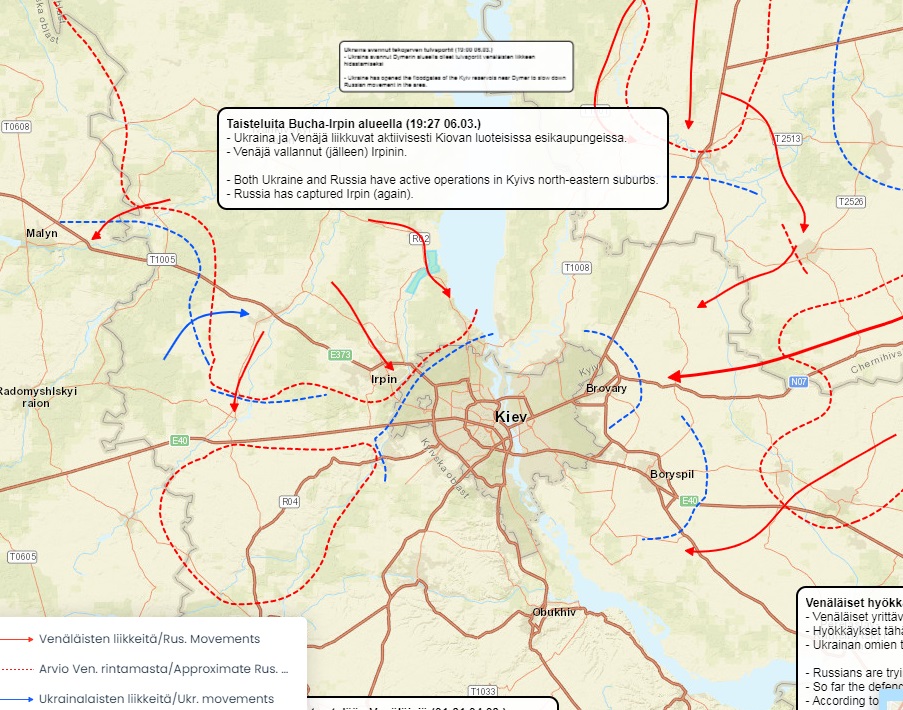
Southern Front
- Russian forces around Mykolaiv are apparently getting their asses kicked. I’ve seen video of an entire battalion level battery of 122mm D-30 towed guns put out of action by a direct hit to an ammunition vehicle (mortars, TB-2 cluster munition or artillery ICM counter-battery are all possibilities,) several VDV airborne vehicles captured, and a field full of Russian corpses. Note the rural terrain and use of towed guns suggest these aren’t meeting engagements northwest of Mykolaiv, but the city’s defenders taking the fight to the enemy.
- Ukrainian MoD statements (?) indicate that Tokmak and Vasylivka have fallen, which means the Konka river line is certainly in full contact with Russian forces now. Note the Finnmap shows the line already crossed in Polohy, which I very much doubt – there’s only very recent (30m ago) claims to this effect from Literally Who’s on twitter. It seems unlikely for Polohy to be bypassed so quickly, especially with the fortification and natural barriers it has to call upon. (The river is bridgeable, but especially in this area tends to wind and branch, forming wide marshy areas. Given the saturation of the terrain right now and the ATGM-heavy nature of the defenders I doubt they could push through without a serious advantage in manpower.)
- Claimed counter-attack by Ukrainian forces on the Donbas line towards Mariupol, but no more information.

Eastern Front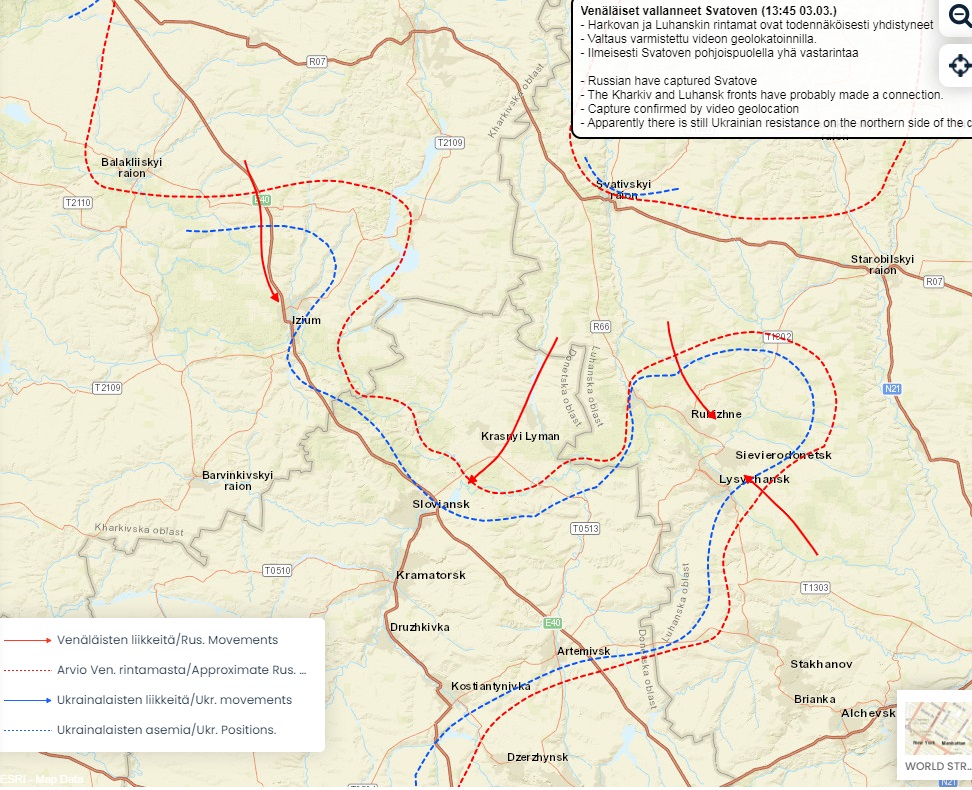
- Ukraine MoD claims they have counter-attacked out of Kyiv and liberated Chuhuiv, which cuts the M03/E40 highway north/south. This is a sizable town, not a mere village, that should offer good cover for a defender.
- Movements on Finnmap are mostly based on Ukrainian MoD reports, but we have some scant evidence to verify them now. There is definitely fighting in Izum, though whether they came from the East or North I cannot say. There is/was definitely fighting in Severodonetsk. Interestingly, a similar scene is found in Novoaydar, almost 40km due East, and in both images the Ukrainian T-64s seem to be in “hull down” positions behind berms created by raised roadbeds, indicating defensive deployment. This supports the theory of a fighting retreat. Overall I think this apparent “pocket” is indeed forming. The Ukraine deployment tracker (based on UoD official statements) indicates the UA 92nd Mechanized Brigade is in Chuhuiv, with the 57th Motorized Brigade and 79th Air Assault Brigade holding the pocket of Rubizhne and Severodonetsk. That amounts to motorized light infantry (ideal for city defense) reinforced by elite mechanized forces (the air-assault brigades.) Air assault brigades were converted from legacy Soviet airmobile brigades into elite mechanized units; they have Ukraine’s best equipment and are reinforced by a tank company – T-80s, no less. There is also the 111th Defense Brigade, which hasn’t had any reported changes of position, but given it’s a Defense Brigade, and its garrison is Severodonetsk, I’d say they’re still there. An analyst I can’t vouch for estimates there’s about 7 Russian Battalion Tactical Groups operating in this area, but since I have no clue myself I’ll use his estimate. BTGs consist of a tank and artillery battalion but only a single motorized/mechanized rifle company. Thus the 92nd Mechanized (which has three mechanized battalions, one or two motorized battalions and a tank battalion) is outnumbered in tanks (7 vs. 1) and artillery (4 vs. 1) but is mustering 4-5 infantry battalions against a grand total of one reinforced battalion (7 companies) of Russian motorized/mechanized infantry. Additionally one of their artillery battalions are actually T-12 anti-tank guns, which (while lacking vs. tanks) could make a decent accounting of themselves against IFVs, especially when properly dug-in (saving ATGMs for anti-tank work.)
- These disparities neatly illustrate why the Ukrainians are fighting so defensively; armor and self-propelled artillery are the key weapons for maneuver combat in more open terrain. This counter-offensive may seem limited, but if it forces the Russians to come back to them to secure the crossroads, it plays to their strengths. Note also that mechanized infantry can reach out and touch people; not just with artillery, but in person; controlling the town aids in control of the area around the town, esp. given the presence of TDF militias and friendly civilians that can provide local patrols and information on enemy movements. Add in the steady attrition Russian forces are suffering and the ground situation (which penalizes maneuver no matter who’s doing it) and I expect the most aggressive counter-attacks (at least in the more open areas of the country) won’t come until the ground dries out.
- If you see any info on the Ukrainian 4th Tank Brigade moving east, however, prepare for some serious shit.
General Developments
- Russian airpower’s very bad, no good day yesterday (seven aircraft downed) continues today with a shoot-down over Kharkiv, which was definitely not a MANPAD; most likely an SA-11. Ukrainian air defense is highly effective against Russian operations.
- Following truly outrageous Russian claims that America was helping Ukraine develop nuclear weapons and open threats against the EU for supplying weapons to Ukraine, the Harry S. Truman’s Carrier Strike Group moved to the north of the Aegean Sea, putting it as close as it can possibly get to Ukraine. The carrier was, at last report, operating under NATO command and with the Italian carrier ITS Cavour and the French Charles de Gaulle (itself a CATOBAR ship.) The surface fleet Russia put into the Med (ostensibly) to deter such action holed up in its Syrian port at Tartus under land-based air-defense cover. NATO is sending clearer and clearer messages that it is done dancing every time Putin rattles his saber, nuclear or otherwise.
- After repeated demonstrations of why air-droppable armor is ill-suited for assaults, VDV formations are now being reinforced with heavy armor support.
- Russia is continuing to hit airports – twelve weapons were launched at Vinnytsya AB today. They are struggling mightily to put the Ukrainian air-power out of action.
- Tochka-U missiles were seen moving in Belarus towards the Ukrainian border and a Tochka booster section crashed in Desyanka, near Chernihiv in Ukraine. This likely indicates Russia’s munition stockpiles of Iskanders and Kalibrs are running low (approaching their reserve levels for contingencies,) given they’ve fired at least 600 ballistic and/or cruise missiles since the beginning of the war. (They’ve also committed 95% of the troops massed for the operation.) This also represents Belarus’s first direct action against Ukraine so far.
D + 12 Update (Posted on D+13)
Another day of slow news. Despite posting this on D+13 I’m marking this separate for posterity’s sake so we know what information was available on March 7th.
- First confirmed shootdowns of Russian cruise missiles: both a Russian air-launched weapon and a Kalibr. I have been informed that the land-attack variant of the Kalibr does not have a terminal supersonic sprint, making it fair game for most Ukrainian SAM systems, as this demonstrates.
- The SU-34 intercept over Kharkiv on D+11 was recorded from inside the SAM vehicle that destroyed it – an SA-8 “Gecko.” This video shows the crew tracking the intercept using the vehicle’s electro-optical system, and gives you both an idea of the limited picture quality those dated systems provide, and also of their continued utility despite that.
- Russian aircraft, especially expensive strike assets, are seemingly only sortieing at night now. This is likely to reduce their casualties from MANPADS. Given that they are using iron bombs exclusively this further degrades their effectiveness (conducting iron bomb attacks while wearing NVGs is not easy. Everything is harder when peering through those things.) It also provides them little protection against actual SAM systems; while the aircraft are harder for an individual with a MANPADS to find, it also makes small wheeled systems like the SA-8 or SA-11 harder for the jet to find as well; and a combination of old-fashioned sound spotting and their electro-optical systems can allow for laying their launchers before turning on their search radars to establish a track and engage.
- There is no shortcut for the Russian air forces; they must either get good at SEAD or accept the irrelevance of much of their airpower.
- If one assumes Ukrainian air assets are keeping a low operational tempo in order to preserve their combat power and avoid airframe losses from continuing Russian airstrikes on their bases, the lack of a single-day “highway of death” event is understandable. Given how long this column has been stalled it’s clear Ukraine has time to steadily attrit that equipment without taking undue losses of precious airframes. The damage even a single SU-24 can do with a bomblet dispenser is horrifying, and with every passing day the TB-2 operations will degrade enemy air defenses more and more.
- The significance of this event, aside from the morale boost, is that it illustrates how dangerous a Russian amphibious landing would be. If a single Grad can wound a ship at standoff distance, it’s not hard to calculate the chances of multiple LSTs approaching the beach to land on it directly. As the joke in WWII went, LST stands for “Large, Slow Target.” Much of the coast is unsuitable for an amphibious landing and given that land transit is faster than water, any amphibious force can expect Ukrainian artillery to be ready and waiting for them when they disembark.
- Ukrainian MoD claimed that their marines conducted a night raid on Kherson Airport and destroyed some 30 Russian helicopters. Commercial imagery showed the airport was hosting at least forty-nine helicopters the day before, so the targets they claimed to attack were definitely present.
- This indicates how Russia is using airpower to try and resolve logistical difficulties. Moving supplies via air is very expensive and has limited volume but given how dangerous the roads are for them, it’s an operationally sound decision. The reason to use the airport, despite helicopters not needing runways, is likely to utilize the aviation fuel already stored there; taking it from the enemy instead of burning their own supply.
- Note this would be far more valuable for Russia if they could bring in IL-76 transport aircraft, which are much more efficient transport than helicopter fleets, but the persistent SAM threat Ukraine still has precludes this.
- No significant or solid information on ongoing maneuver battles. The ISW’s summation of the day is illustrative; for the most part preparatory shelling was still reported to be in effect. The one incident of note was the Ukrainian army’s own report that “a Russian BTG crossed the Inhul River at Kashpero-Mykolaivka, roughly 50 kilometers north of Mykolayiv, on March 6.” At time of writing (March 8th) I’ve heard no more about that unit. It might quite possibly have been a single BTG’s complement of mechanized infantry utilizing their amphibious IFV capability, in which case it’d amount to a reconnaissance in force (one mechanized rifle company without heavy armor support.) Their tanks can ford/w snorkels but their supply trucks cannot; and if they deploy a pontoon bridge they’ll want to defend it – and if they’re going to do that, they may as well send in follow-on forces. I’m guessing this is either a reconnaissance-in-force, or there’s more than one BTG on the other side of the Inhul river now. If they want a naval landing at Odessa to work, this is exactly what they’d have to do; bypass Mykolaiv and position to link up with that force.
- This could cut Ukrainian internal lines of communication to Mykolaiv, but the forces they seem to have committed to this axis (approx 6 Battalion Tactical Groups) seem woefully insufficient for such an attempt. They could invest both Odessa and Mykolaiv in an attempt to starve them out, but it doesn’t seem like Russia’s overall strategic picture has time for that. Moreover the mass-murder of civilians by the millions is almost sure to bring a NATO response; much like Stalin’s attempt to starve out West Berlin was countered by the Berlin Airlift (and god help Russia if they threaten kinetic action against such a move.) Nor do they have the infantry to take those cities; six BTGs amounts to roughly one reinforced battalion worth of infantry; woefully insufficient for urban fighting against even the known or suspected regular Ukrainian units, to say nothing of militia forces and civilian resistance.
D+13 update coming later today.
D+13 Update
I’ve gotten around Facebook’s fucking nagwall and can read Ukrainian General Staff official update bulletins myself. As they’re the only source of detailed information on a lot of maneuvering I’m going to stop endlessly qualifying them and just use them. I’ll tag this info with “UMoD” (for Ukrainian Ministry of Defense) to identify this as official government press releases. Any corroborating OSINT evidence will be attached afterwards. Not even the Institute for the Study of War’s excellent daily updates are fully conveying the information in these bulletins.
Sitrep: Maneuver
Northern Front
- UMoD says that two BTGs have advanced to Byshiv; 40km west-southwest of Kyiv and 20km south of Makariv (see map.) Efforts to encircle Kyiv continue but are still far from realization.
- This hideous video from Makariv shows a BMP murdering an elderly couple in their car. Note that the BMP was providing security for a small convoy of supply trucks. This paranoia and trigger-happy ruthlessness is indicative of how effective Ukrainian rear-area interdiction has been.
- Incredibly, UMoD reports that Russians are conducting offensive operations against Ivankiv, which is not only 70km north-northwest of Kyiv, but should be behind enemy lines, given UMoD statements to the effect of Russian movements clear to the west bank of the Dnieper river in the suburbs directly north of Kyiv. This jells with the report/photography by a journalist on D+9 (three days ago) showing Ukrainian forces in southern Ivankiv. Russian forces must be utilizing more western road links to Belarus (such as the RO2) given that Ukrainian forces have apparently controlled (or at least threatened with artillery fire) the crossroads at Ivankiv.
- No reports of Russian forces actually taking Malyn or pushing as far west as it, meaning they don’t have access to an additional two-lane highway to the Belarusian border, only surface roads. Perhaps they’re using helicopters to help deliver supplies forward?
- Russian troops are still near the eastern suburbs of Kyiv but haven’t had success in actually pushing into them.
- Interdiction of Russia’s long supply lines continues apace, as exemplified by the successful engagement of this supply column despite a T-80U escort. ISW claims Russian units around Kharkiv are diverting to help secure that territory better, and UMoD now states that Russian forces near Chernihiv are moving east, presumably to assist in this. It seems they are finally learning. With Konotop and Chernihiv still held the Russians are still without a rail line, however.
- This video of three T-80U tanks abandoned at (allegedly) Myrhorod is alarming – this is very deep in what is effectively the Ukrainian rear area and indicates a possible threat to Ukrainian lines of communicating to Kharkiv (via Poltava.) Of course, the fact an entire platoon of armor was simply abandoned illustrates the problems Russia faces when not moving in strength. Despite this attrition, Russian forces continue to aggressively commit small patrols long distances; likely due to a need for reconnaissance data and their apparently awful aerial ISR ability.
- A force of four tanks and at least one BMP-2 was engaged and destroyed near the village of Moskovs'kyi Bobryk by the Ukrainian 93rd Mechanized. Additionally a full platoon of T-80s was captured at Chupakhivka, about 20km east. The village is 60 kilometers south-west of Sumy; hence the surprise of enemy tank platoons probing as far southwest as Myrhorod. There’s quite possibly no well defined “front line” in this area, but I haven’t seen any indications by any force disposition estimations to indicate Russian troops are advancing south-west in serious numbers. Given the need to secure the long lines of communication from eastern Kyiv to the Sumy area this isn’t surprising.
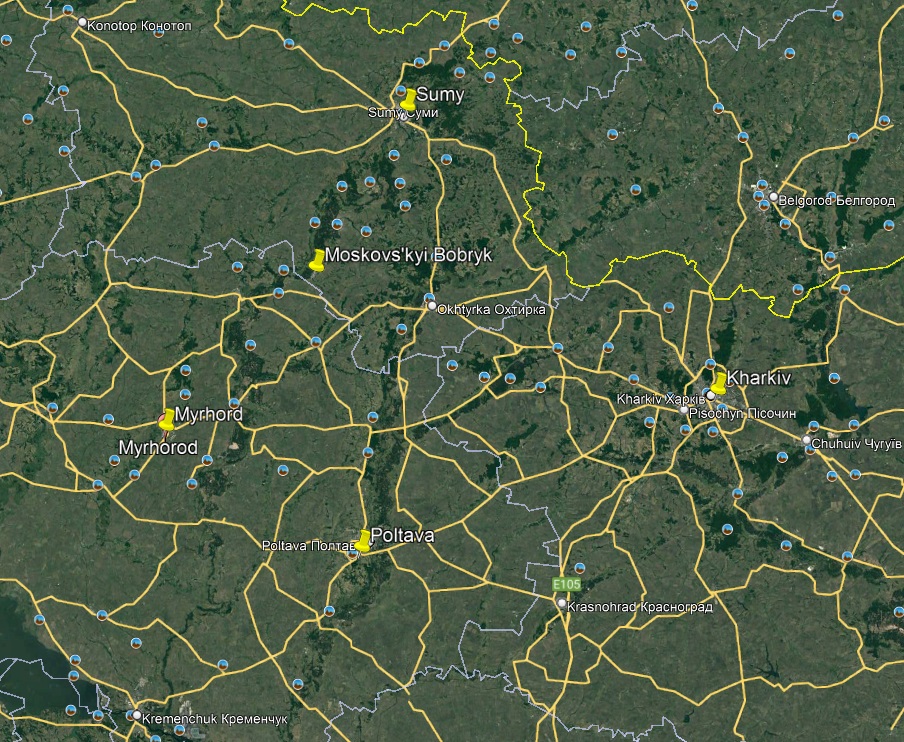
Eastern Front
- UMoD confirms continued fighting at Izum, with Russia conducting pontoon-bridge crossings of the Siversky Donets and Berek rivers, and “rebel” forces have allegedly advanced as far as Rubizhne. Whether or not the Ukrainians continue fighting for Sievierodonetsk or withdraw will probably depend on how the southern front east of the Dnieper fares, but as long as they have Izium, their exit route from the city is probably secure.
Southern Front
- UMoD states that Russian forces are prioritizing a drive towards Zaporizhia along the eastern bank of the Dnieper. No official statements about Mykolaiv.
- OSINT indicates active combat around Mykolaiv, as well as the city mayor’s statement that they’re bracing for another assault. OSINT is also showing a constant drip of destroyed/captured Russian supply trucks and combat units in the open countryside, indicating that Ukrainian defenders in the area are not limited to contesting the city itself. These units might be supply convoys attempting to reach forces that have advanced further than Mykolaiv, but neither OSINT nor UMoD has much to say about how far west Russians have gone (or still are) in any significant force.
- Note this video shows sandbags on the tank’s “cope cage” positioned to give overhead cover to anyone manning the flexible .50 caliber gun, and the BMP-3’s crew is riding with the rear clamshell doors open, allowing them to provide flank security against infantry ambushes. The Russian army is learning how to fight – the hard way.
Sitrep: Logistics
- The death of a high-ranking Russian officer was recently confirmed by a communications intercept, in which an FSB officer explained he was informing his superior via insecure cell phone call because the 41st Army had lost all secure communication capability. The inability of entire armies to establish secure lines of communication will be a serious impediment to their ability to engage in successful maneuver warfare.
- Several recent OSINT tidbits confirm that Western-supplied anti-tank weapons are indeed reaching the front lines across the country and give an idea of the integrity of Ukrainian internal lines of communication:
Strategic Update
- In addition to the outrageous demand that Putin’s dethroned puppet be installed as Ukraine’s Prime Minister made yesterday, today’s negotiations saw a demand for Ukraine to reduce its military to a mere 60,000 men. Given this insanity, reports that Russia is “backing away from its maximalist demands” should be disregarded until such time as Russia actually negotiates instead of spewing lunacies.
- The saga of the on-again-off-again Polish MiG-29 deal took a surprising turn today when Poland outright declared their willingness to immediately turn over their MiG-29 fleet to the US, (by way of Ramstein AB in Germany) at no charge, and requested the sale of equivalent-capability airframes (i.e. F-16s) as soon as possible to make up for it. US diplomats openly admitted they were taken by complete surprise by this announcement, then said that Poland’s proposal was “not tenable” due to the US not wanting to fly those aircraft directly from a NATO airbase into skies contested by the Russian Air Force.
- Both Poland and the US are clearly keen to make this transfer of MiGs happen, but this two-step tango of diplomatic fuck-ups is not encouraging to behold.
D+14, D+15 Update: Last 48 Hours
The frontlines have remained mostly static in the last 48 hours, but the preponderance of information (including some independently verifiable data) now supports the view that this is reflective of what’s actually been happening at the frontline. Sources for the most part are directly from the Ukrainian Ministry of Defense (these five posts on their official facebook page cover all official information released in the last 72 hours: [1] [2] [3] [4] [5]) (Oh wait add [6] because fuck the boomers at the Ukrainian MoD consolidate your posts you FUCKS) The Institute for the Study of War’s March 9th and 10th assessments are useful for understanding the MoD reports but I’m reading and analyzing them myself nonetheless instead of relying entirely on ISW’s summaries, and trying to find corroborating OSINT whenever possible. I am also cross-checking against the Finnmap and trying to verify those claims one Twitter search at a time.
I’m not having much fucking luck.
Sitrep: Maneuver
Northern Front
- Russian forces appear only partly combat-capable (at last.) Analysis dropped today by the best OSINT ORBAT tracking I’ve seen estimates 18-20 Battalion Tactical Groups near western Kyiv. This puts UMoD statements regarding force sizes on March 8th into a new light (five BTG force mounted repulsed attack on Bucha, four BTG force moved on Yasnohorodka.) On the 9th UMoD stated that “separate units of the 29th, 35th and 36th”. This is referring to the parent regiments of the BTGs in question. In theory each regiment can provide troops/equipment to form up to three BTGs, but @JominiW, who has been tracking reports of individual BTGs since the war’s start, credits this as only five actual BTGs, analysis that even ISW didn’t offer. (I don’t know what his sources are; feel free to ask him!) Taken together this suggests Russian supply situation in the area can support two regiments worth of offensive operations (only half their local force) and for whatever reason they are only moving towards individual objectives at regimental strength. Given the March 8th advance on Bucha was repulsed, not massing two regiments for operations on the 9th hint that the Russians cannot do so, for whatever reason (likely coordination e.g. secure radio communication issues.)
- Russia attempted no major offensives in NW Kyiv’s suburbs and had a three-company assault repulsed from Brovary on Kyiv’s eastern side.
- UMoD reports retaking Moshchun, 12km north of Kyiv and only 8km east of Hostomel itself. Earlier UMoD reports on imminent Russian attack on Ivankiv have yielded no further word, raising the possibility that Ukranian forces could extend a salient north to link up with forces at, and strongly hold the Ivankiv crossroads.
- UMoD reports liberating Muraviyka, just south-west of Chernihiv, on March 10th. This follows a report of Russian forces cutting the highway between Chernihiv and Kyiv by taking the village of Kozelets about halfway between them on the 9th. If this line is still cut it’s likely it won’t remain that way long enough to weaken the defenders; keeping this road/rail link from effective use by Russian supply efforts.
- A reporter for the Kyiv Independent claims that Ukrainian forces have re-taken Makariv, 40km west of Kyiv. This is the first solid claim I’ve seen on Makariv’s status so far. That Makariv was contested was hinted at, but that Russian forces were strongly holding it is anyone’s guess (see the trigger-happy BMP convoy escort from my last update.)
- This source is on-scene (in the city) and is one of the on-scene journalists western media is contacting for information. Regardless I have no independent confirmation of this claim at this time.
- UMoD clarifies regional frontline to the northwestern countryside a bit. Finnmap is a mess compared to UMoD statements so here’s mine:
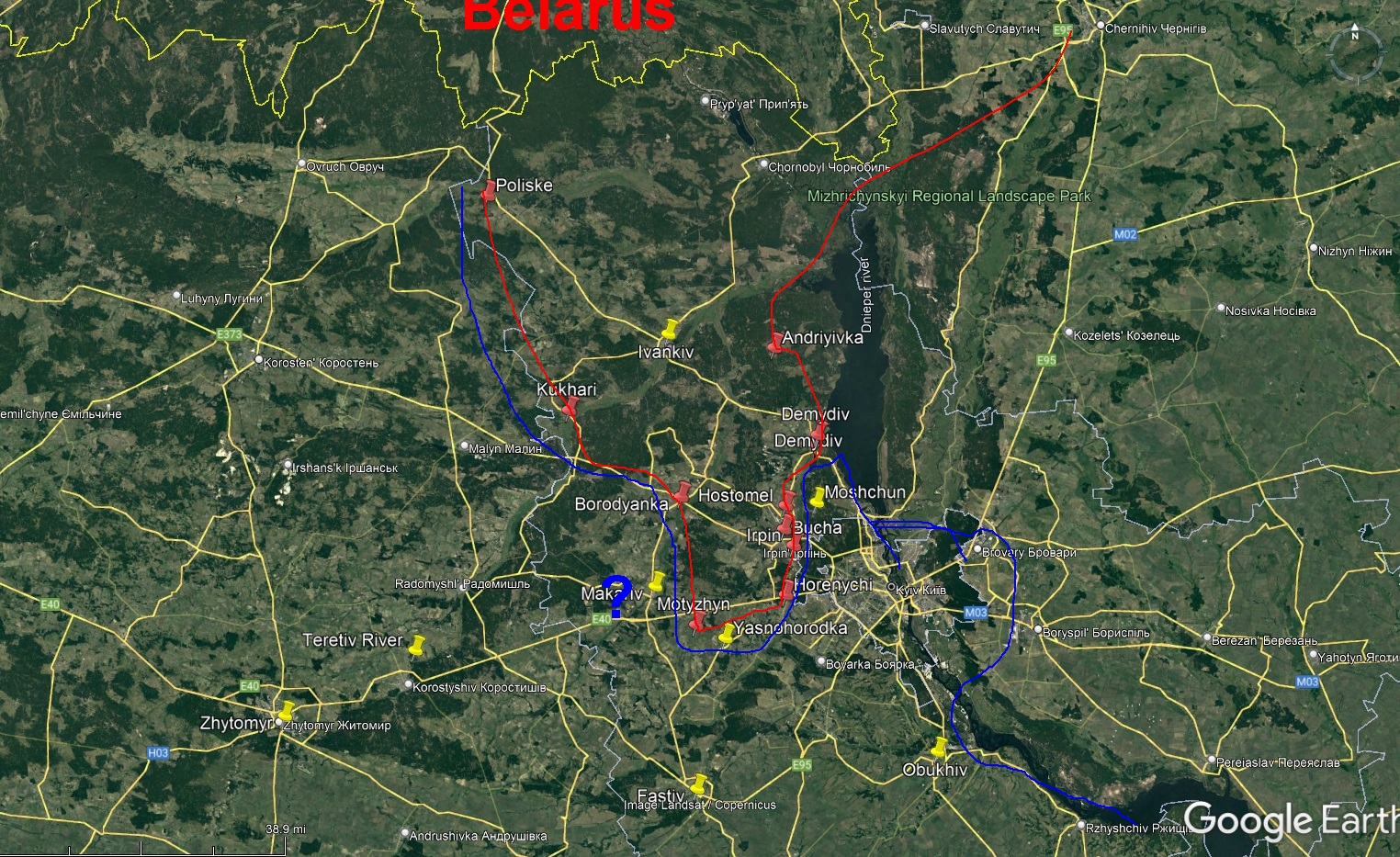
- The massive convoy stuck on the P02 and/or P56 (it has never been made explicitly clear) has largely “dispersed and redeployed,” according to commercial satellite imagery. Between the imagery and basic logic this amounts to armored fighting vehicles, not supply trucks, moving overland as best they’re able (with the usual attrition theoretically recoverable since it’s in an area where no TDF have been operating that we’ve seen, so likely only Ukrainian SoF.) This means Russia’s pause in attacks yesterday was likely to reconstitute units using these reinforcements. Whether or not they have the supply to attack with them is another matter; though moving the actual AFVs overland should reduce congestion on that highway significantly.
- Note, however, that this is after a solid week of attrition by Ukrainian attacks, and the troops/crews will be at lower readiness due to their extended, unplanned camping trip.
- Previous UMoD statements to the effect of Russia shifting forces from the Chernihiv and Russian border north of Sumy axes of advance has been corroborated by anonymous US officials quoted by journalists. ISW’s previous analysis that the Russians are attempting to properly secure their LOC from Sumy to Kyiv seems likely, as the atrocious toll Ukrainian TDF and the defenders of Sumy have been wreaking daily on their supply chain is obviously unsustainable. I’ve seen so many ambushed convoys near Sumy it’s hard to keep track of them.
- This could also explain the aggressive exploration south of this LOC as noted yesterday; to widen the flank and provide some defensive depth to that line.
Eastern Flank
- Izum is still held by Ukrainian troops 72 hours after the first reported Russian attack there. Given Russia’s lack of success it would seem Sievierodonetsk is not in great danger of encirclement anytime soon. No statement to this effect, rather, no UMoD statement that Izum has fallen.
- Kharkiv is still taking shelling, but no serious ground assaults. It’s possible that Russian forces are shifting units north to actually take Sumy and end the bleeding wound in the side of their logistics pipeline once and for all. (SW’s analysis.)
- Northwestern Kharkiv suburb of Dergachi retaken by Ukraine, according to the aide of President Zelensky. It’s only a few KM outside of the city proper, but given the advance to Chuhuiv a few days ago, it shows a widening of the defensive lines on each side of Kharkiv proper. With Chuhuiv held, Russian forces attacking Izum (or anywhere NW of it up to Chuhuiv) are denied the crossroads.
Southern Flank
- Russian forces are attempting to bypass Mykolaiv, according to UMoD and corroborated by commercial satellite imagery. Additionally the Russians are trying to expand their front northward in the region between the Dnieper and the Southern Bug rivers, driving north along the meager two-lane roads available in the area as discussed a few days prior, as well as moving past Mykolaiv along the eastern bank of the Southern Bug:
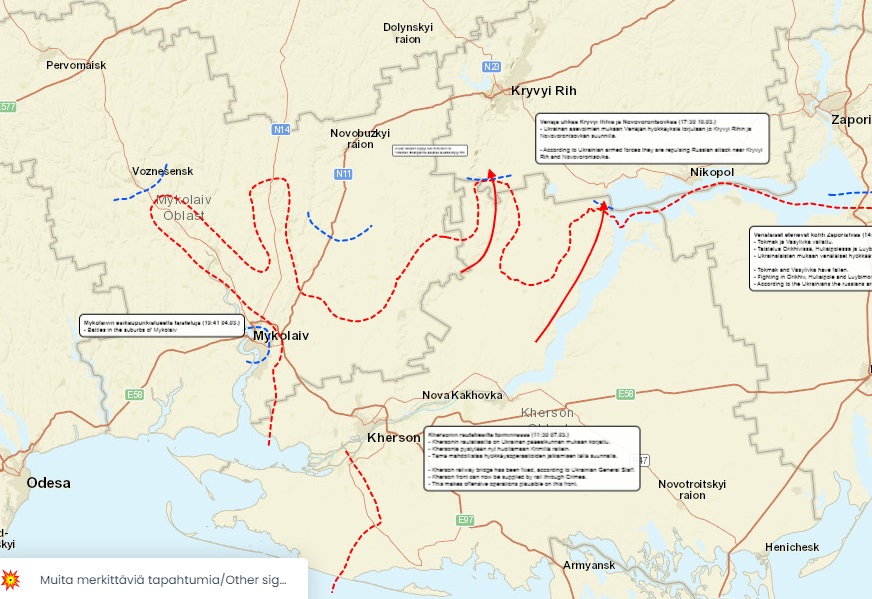
- UMoD claims no serious crossing (i.e. bridge, not just amphib IFVs) has taken place over the Bug, and I haven’t seen evidence otherwise via OSINT channels. Note Ukrainian defenders are (as always) holding crossroads. Given the muddy terrain in this area is going to heavily incentivize, if not mandate an attack similar to the one seen in Brovary (i.e. down the road) and the roads here are only two lanes wide, I don’t anticipate Russian breakthrough efforts having much luck to the north.
- Two odd things, Kherson region:
- UMoD claimed on the 9th that Russian soldiers in civilian clothes are moving towards Mykolayiv – either new infiltration attempts (also reported in Kyiv) or an attempt to infiltrate forces past Mykolayiv, perhaps by using a rope bridge or boats somewhere north of the city, then infiltrating through Ukrainian-held countryside to somewhere else.
- This video showing a large convoy of troops, armor and supplies moving south through Kherson, towards the waterfront.
- Taken together this could insinuate something is being planned vis a vis an amphibious landing.
- This will not go well for the Russians.
- Mariupol is still under bombardment but not ground assault. At this point encircling Mariupol is keeping Russian forces pinned down, unable to participate elsewhere.
- Still no solid information or even UMoD statements on the southern defensive line between Mariupol and Zaporizhzhia.
There are other things to talk about but they will have to wait till later tonight or early tomorrow. I’m tired.
D+15: Shit That Matters But I’m Too Tired To Organize It So Fuck It
- Personnel balance is shifting in Ukraine’s favor. US estimate is 5 to 6k Russian KIA, by standard battlefield ratios for full-scale conventional war that means 15,000-18,000 Russian soldiers WIA and thus out of the fight. Ukraine claims to have shut down recruitment of foreign volunteers due to having more than they can arm at this point, over 100,000. Even if they’re full of shit, the volunteers they are getting are high quality. Active-duty defectors from the UK, American pilots with > 1500 flight hours each, many British and American veterans of Iraq and Afghanistan, even highly skilled veteran snipers. Contrast this to the replacements that Russia can get, which are effectively conscripts. The entire reason Battalion Tactical Groups exist is because the Russians have a lot more tanks than soldiers who want to sign up to be infantry; so they have a battalion of armor, and the artillery complement one-third a fucking regiment, but only a company of mechanized infantry in it. They cannot replace these people. Ukraine can.
- Much has been said about apparently limited deployment of Russia’s much-vaunted ground electronic warfare capabilities; with their reliance on commercial radios the best explanation so far.
- UMoD has openly informed its people to prioritize targeting Russian EW systems as they are interfering with small drones used for reconnaissance. Russian troops have also been using small battlefield drones for short-range recon and artillery spotting. Ukraine likely doesn’t have as many purpose-built military drones. However, they do have a bizarre and diverse arsenal of drones built over the last eight years of war in Donbas by volunteer domestic experts from all corners. Furthermore, they are hardened against Russian EW systems used against them in Donbas, systems that sidelined purpose-built military drones like older EQ-11 Ravens from the US (they didn’t have the hardened communication link of newer models.) Thus Ukraine isn’t entirely dependent on cheap commercial drones that are easy meat for jammers.
- This rare look at a Ukrainian tank engaging the enemy also shows an abandoned MT-LB that was clearly camouflaged before abandonment (not the first vehicle like that I’ve seen.) See also this stationary and apparently camouflaged BMP-2 that was captured... with the crew still inside it! These incidents demonstrate that many of these abandoned vehicles aren’t being left out of choice; but because the crews have no way to recover or effectively tow the vehicle. It’s normal for armored vehicles to break down, get stuck, and in general have problems, which is why any armored unit has recovery vehicles along with them. It’s also normal for some tanks knocked out in combat to be repairable, not total losses (less so for Russian tanks given the turret explodey issue but true enough for their IFVs at least.) In other words, a lot of the attrition that any armored force would normally suffer is becoming not just total losses, but Ukrainian GAINS due to Russian incompetence.
- Co-location of 42 AN-2 biplanes with two electronic warfare aircraft and an ELINT aircraft at Seshcha airbase in Russia strongly suggest the AN-2s have been converted into drones for SEAD/DEAD operations, i.e. dedicated decoys for air defense.
- Russian losses from the engagement seen above in Brovary (see whole thread)
- Some slight corroboration of UMoD claims of repulsing Russians from Moshun. There was at least a fight, most likely.
- Chechens fighting for Ukraine.
- Despite earlier predictions that Russia was running out of missiles not reserved for contingencies, they are still firing about two dozen weapons a day. We’re approaching 800 cruise or ballistic missiles fired into Ukraine now.
- Three more advanced SAMs capable of point-defense against cruise missiles captured by Ukraine.
- Confirmation that some Russian equipment was recently activated from mothball/reserve status.
- US reporter quotes anonymous DoD official as saying that air defenses superior to MANPADS will soon be provided to Ukraine. Now that Ukraine is clearly not going to be over-run in the short term, this could easily mean a NATO-made SHORAD system, not just ammo reloads for their Buks from old Romanian or Polish stocks. The risk of operating systems with NATO crews, or providing technical advisers, or even “contractors” that are (recently?) retired NATO military members trained in the systems in question, is far less risky. This goes double for the city of Lviv, which is only 75km from the Polish border. Despite housing both an aircraft repair depot, the Lviv tank factory and most of Ukraine’s mothballed T-64s, it hasn’t seen a single Russian missile strike yet. Now that the war is clearly going to last a while, this deference may not last; proximity to Poland be damned. A handful of anti-ballistic-missile capable systems placed near these crucial infrastructure resources in Lviv could make a huge difference for Ukraine; as their biggest weakness right now is that they have limited ability to intercept cruise missiles and very limited ability to stop tactical ballistic missiles. A few active-duty NATO SHORAD systems are capable of ABM work as well as engaging cruise missiles. A few, such as I-HAWK Phase III, have been recently retired by some NATO members, and are still in active service with others (e.g. Netherlands and Greece respectively) and thus mothballed stocks and trained operators and technicians should be available.
- Ukrainian artillery competence. This video shows Ukrainian artillery near Borodyanka actively engaging single tanks and scoring direct hits, showing the accurate fire displayed in Brovary was not mere luck via firing into a target-rich environment. To achieve this kind of accuracy with old Soviet guns lacking the sensors and computerization of more modern weapons is possible but requires very well trained crews that know their weapons well – and have kept them in excellent working order. Compare to Russian equipment – this captured towed gun shocked a Ukrainian – presumably an artilleryman – with the poor condition of the weapon. See above comment on recently un-mothballed reserve equipment.
- The MiG-29 deal is dead as a doornail. What I took for an uncommonly selfless offer was, in fact, the Polish government dumping a hot potato in the US’s lap as revenge for them repeatedly ignoring Poland’s statements that they weren’t going to give up 1/3rd of their active fighter force with a possible war with Russia right on their doorstep. Sasuga fucking D.C. Whoever’s puppet-mastering the senile pedophile isn’t doing a great job of managing these things.
D+16 Update: Limited Movement (posted D+17@ 2PM EST)
Increasing evidence of limited Ukrainian counter-attacks in the north, and one solidly confirmed Russian gain in the south-east. Russia launched missile strikes against crucial military infrastructure in far Western Ukraine for the first time. UMoD claims Russian offensives on every front have stalled and Russian forces are regrouping/resupplying.
Northern Front
- Some suggestion that Nizhyn, almost 70km south-east of Chernihiv, has at least been contested, as the mayor of the city claimed it was hit with MLRS fire on March 10th. Note this is third-hand information (facebook post reported by a Ukrainian booster account.) This follows UMoD claims of the liberation of Baklanova Muraviika (incorrectly “Muraviyka” in D+15 update) 13km south-east of Chernihiv (not sw as said in D+15) and actual video evidence of Ukrainian troops entering the (devastated) town of Viktorivka posted yesterday. Video of a counterattack said to be in this region was posted the 9th or 10th but with no information on what the objective was. Taken together, this would suggest that Ukrainian forces are indeed engaging in a limited counter-attack to ensure Chernihiv is not encircled and that its lines of communication to Kyiv (and thus to Ukraine proper) remain intact. Note this southward movement is well east of the main road connection between the cities; the E95. The Dnieper widens into a 10km wide lake north of Kyiv for a good 60km northward where it narrows again to pontoon-bridgeable widths, with the only other crossings being the major bridges in Kyiv itself. Ergo, by clearing and holding territory to the east of that road, Ukraine can let the Dnieper protect its west flank, and Russian forces trying to move south from Belarus to attack it will have to pass Chernihiv and its defenders.
- Remember that Chernihiv controls not just a southern highway to eastern Kyiv, but also a rail link. Having this city in hand would drastically alleviate Russian supply issues in eastern Kyiv as they’d be able to supply the forces advancing from the Sumy axis directly from Belarus, and right off the train. Options for working around this are limited; as the major rail junction/railhead in Russian “held” territory further east is Konotop – which is still held by Ukrainian defenders at last report. Russia will either have to build a new railhead (switches, turnaround, unloading equipment etc.) or take Konotop to move their railheads closer and relocate their primary supply dumps further forward.
- See also this spent Tochka-U (likely Belurussian/w bomblet warhead) seen today in Avdiivka, some 30~km east of Chernihiv.
- Kyiv’s western side seems (relatively) quiet from social media, just as UMoD suggests.
- Image allegedly from Demydiv, 15km north of Kyiv west of the river, showing a Ukrainian sniper taking cover from air attack in a slit trench. This is the definition of a slit trench; something barely deep enough for you to get below ground level and so narrow you have to slot in sideways. This is (obviously) a hasty field fortification, the kind of which would be dug by advancing soldiers. This matches previous statements by UMoD of northwards Ukrainian advances from Kyiv.
Southern Front
- Volnovakha seems to have fallen. This city is 60km directly north of Mariupol, so its fall effectively means the flank of the southern defensive line to the Dnieper river is threatened. Most images (unsurprisingly) are coming from “rebel” forces; and while they have already demonstrated a penchant for photographing the same two T-64s from multiple angles to claim them as new losses, the images coming out are new and indeed show knocked-out Ukrainian T-64s in an urban environment. (I’m saving these as the pro-Russian accounts are likely to get nuked.)
- As there is no good withdrawal option that will leave Kharkiv with an open LOC I would expect either a Ukrainian counteroffensive or fallback to prepared earthworks/positions outside the town (if they exist.) At time of writing a counter-attack is being rumored but obviously there’s no evidence of this yet.
- I still cannot find a whisper of information on where the southern defensive line actually is right now, but Finnmap still illustrates the importance of Volnovakha for anchoring the defensive line. Without this city the Ukrainians lack a good highway to move armor long-distance for any relief effort for Mariupol.
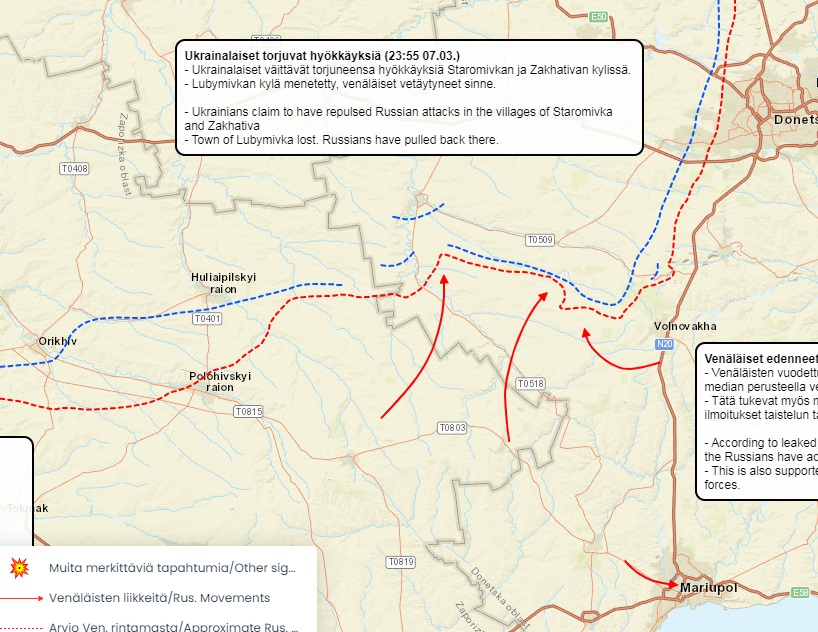
- Possible corroborating evidence of UMoD reported counterattacks around Kharkiv. Possibly the push to recapture Dergachi the UMoD claimed the other day. No more solid info on counteroffensives in this area just yet.
- Mykolaiv remains under heavy shelling. Unclear if also under heavy ground assault, or if the Russians are simply trying to level the city before moving in. Russian forces appear to still be stalled on this front. UMoD claims the probes along surface roads north of the city have found no success and no independent information confirms or denies that. Certainly no social media info on Russian forces west of the Southern Bug river.
- Mariupol under shelling but not assault as of March 11th.
- Confirmation of conflict near Izum in the south-east. This is in Yatskovka, a town 20 kilometers east of Izum. Russian forces presumably still trying to close the pocket around Severodontesk.
Strategic
- First Russian missile attacks on crucial infrastructure in Western Ukraine. The most important target hit was a repair plant that services and repairs MiG-29 engines. This indicates a shift in Russian strategy towards a long-haul fight. Fortunately, Ukraine can always send their MiG engines into Poland for servicing as they also operate the type, but other infastructure (such as the Lviv tank plant) are far more precious. This underlines the dire need to get better anti-missile point defenses into Western Ukraine.
D+17 Update @ 8:54PM EST
No major developments at this time. The ISW report, which is drawing off mostly the same sources I am, is a good overview of the big nothing that has occurred. However I’m hearing rumors of a major counterattack on the southern defensive line towards Volnovakha – and perhaps further. Absolutely no confirmation either way but solid sources have indicated these rumors are coming from both sides, including pro-Russian accounts. I will update again tonight if any major confirmation is found, or confirmation of bigger and more sustained Ukrainian counterattacks near Kyiv or Kharkiv than the ones documented in the last update.
General:
- This is ominous as it implies Russia is preparing for a negotiated cease-fire with an eye towards keeping as much of Ukraine as possible.
- DC scuttlebut indicating Russian forces have lost fully one-fourth of their equipment.
- Anonymous DoD official quoted as saying 80 of Ukraine’s fixed-wing fleet still intact, with a sortie tempo of 56 jets at 5-10 hours per day due to constraints from Russian SAM coverage, which tracks with any realistic prediction.
- Yet another example of incredibly accurate Ukrainian artillery fire.
- First sighting of a small loitering munition made – this one Russian. No video or even mention of Ukrainian use of Polish “Warmate” drones has been mentioned (they are a known customer from before the war.)
- Russian strikes now deliberately destroying food warehouses in Mykolaiv and near Kyiv. (Geolocation (50.5282385, 30.8473788) This indicates full commitment to an “isolate and starve” strategy; effectively holding the civilian population hostage to force favorable terms. If Ukraine does not bend, this will amount to a slow genocide, and drastically increases the possibility of more overt Western intervention. Not necessarily kinetic; mind – a modern-day “Berlin Airlift” to supply food (and much more crucially, water) to these (encircled) cities is highly probable, as I mentioned before, but would necessitate (unarmed) NATO assets moving directly into the combat zone. Mariupol is a port city, and the US Navy actually has deployable desalination plants that can be delivered by land, sea or air to alleviate the crisis. US Navy ships have also used their onboard desalination plants to provide fresh water during disaster relief; these plants are also present on US Navy supply ships that only feature defensive armament (if any.)
- Today Russia explicitly threatened to attack arms shipments from the West to Ukraine: “Ryabkov said that Russia had “warned the US that pumping weapons from a number of countries it orchestrates isn’t just a dangerous move, it’s an action that makes those convoys legitimate targets.” Given these convoys are being driven by Ukrainian troops using Ukrainian trucks into Poland to make the pickups, strikes on them on Ukrainian soil shouldn’t threaten NATO personnel, and weapons are already assumed to be legitimate targets. Ergo this is a veiled threat (e.g. “dangerous move.”) This indicates a steady escalation of threats made by Russia. Every time Biden opens his senile mouth and blathers that America will never fight Russia in Ukraine “because it’d be WWIII” we move one step closer to Russia having the confidence to commit the unthinkable.
- Taken in combination with recent fantastical Russian propagandizing vis a vis biological and chemical weapons in Ukraine’s possession, there is reason to worry that Russia may be contemplating options beyond the pale. Expect them to keep pushing boundaries.
Northern Front
- Images now coming in of damage to Makariv; 40km directly due west of Kyiv and controlling the main road (and route of advance) south. Little to no information was on Twitter before then regarding this city; strongly suggests this IS fresh data and could be evidence of Ukrainian counter-attacks towards the city – but UMoD has made no such claims. I might email the Finnmap authors and ask what their source is for claims of Makariv’s recapture they cite.
Southern Front
- Mariupol is now under actual ground attack after several days of nonstop preparatory shelling. Note these Russian tanks advancing past a roadblock made with busses (geolocated here.) CBS posted the later part of this video showing the tanks are engaging a large apartment building. Recall this is how I described the proper use of tanks in urban assault days ago; using their optics and gun to engage firing positions in large buildings that have been turned into heavily fortified strong-points. This suggests a serious effort to reduce and take Mariupol now underway.
D +18 and +19 48 hour update
Russian advances are still largely stalled in the last 48 hours (as I expected) so I took more time to verify data and attempt to draw some bigger conclusions instead of regurgitating the ISW report. The Institute for the Study of War reports are pretty good, but they are overly reliant (read: entirely) on Ukrainian General Staff bulletins and only occasionally cite secondary confirming sources. No effort will be made to keep D+18 and D+19 information apart, as time lag between events happening and it showing up in OSINT circles is at least > 24 hours in many cases.
Kyiv AAO
- The reported capture of five mud-bogged T-72s at Mokrets; 50km due east of Kharkiv, shows the continuing difficulties Russia is suffering along the long line of communication back to the Russian border near Sumy, as well as the continued presence of Ukrainian pressure on said LOCs.
- Russian efforts to destroy Ukrainian fuel supplies at their airbases continue apace. Oddly enough, this airbase’s fuel stores were already attacked on Feb. 27th. This was either an attempt to hit underground fuel bunkers (which most airbases have, at least as a reserve, in addition to an aboveground bulk farm,) or to hit the same fuel depot again. Ukrainian TB-2 operations are clearly maintaining a higher sortie tempo than their traditional fixed-wing assets (if the spate of videos coming out is anything to go by) and unfortunately for the Russians, the TB-2, due to its size and humble propeller-driven powerplant, is far more fuel efficient than their legacy Soviet fast-jets. It should be possible to keep these in operation even if all fuel must be provided by tanker-truck.
- Russia continues to scrape for the light infantry required to really assault Kyiv; with their convoys increasingly showing civilian vehicles.
- Ukrainian artillery continues to demonstrate high competence against point targets, such as this pontoon bridge over the Irpin river northwest of Kyiv. (The widely-published direct image of one end of the bridge submerged seems to have been taken via a drone, making artillery the likely culprit. Some have suggested that this is a ruse; the use of “underwater bridges” that are navigable by military traffic but are just far enough beneath the surface of a small muddy river to avoid aerial detection has been demonstrated by Russia in various exercises. However underwater bridges are nothing new in warfare and the point is to hide their presence from the enemy entirely, not to make them appear damaged, as even damaged targets will attract artillery fire, if only to prevent expeditious repair or recovery efforts.)
Kharkiv-Sumy AAO
- More confirmation that Ukrainian forces took Derhachi (also spelled Dergachi,) or at the very least that there was a fight there.
- Some evidence that Ukrainian forces have advanced 27km from Kharkiv to Zolochiv, as pictures of shelling damage are just now showing up en-masse. [2] [3] I’ve seen nothing on social media posted earlier than the 10th implying this damage is recent. Airstrikes are performed against rear-area assets but artillery fire indicates active ground combat operations. There’s also a sighting of an abandoned Russian tank on the road between Derachi and Zolochiv (date unknown and no geolocation.) Most tellingly, Russia’s UK Embassy was propagandizing about “Ukrainian nationalists preparing a false-flag chemical attack on Zolochiv” on March 9th. This is standard Russian/Russian proxy practice to provide cover before launching limited chemical attacks for local tactical gain, as seen in Syria. This suggests Zolochiv was of tactical significance to them on the 9th (with the claim either to cover possible chemical use, spook Ukrainian attackers with the threat of such, or both.)
- Naturally, Zolochiv is a crossroads. Ukrainian counter-attacks are seriously impeding Russia’s options to find alternate routes around the city:

- The expected attack against Sumy has yet to be reported.
- Kupiansk, 40km east of Chuhuiv, hosts a rail yard and if this March 14th video is any indication it’s proximity to Russia and its rail yard has made it another logistical hub for the Russians. Kupiansk is only 50km from Izum by road; while holding Chuhuiv complicates direct movement around Kharkiv to quickly allocate reinforcements, use of internal LOCs in Russia proper to Kupiansk could allow this. This may have much to do with Russia’s ability to press the Izum area hard.
Donbas/South-Eastern AOO
- Russian claims of taking the city are dubious; note the terrain along the line in this entire area (in Oskill, Yatskovka and other nearby towns where combat has been reported recently) is along the banks/tributaries of the Oskill river and the terrain is heavily wooded in the vicinity, unlike most of this area. Thus the urban areas don’t represent the only defensible terrain. Also, a single squad advancing in file does not a “retreat” make.
- Little can be extrapolated from a single data point, but the Russians employment of unitary-warhead MLRS against a single squad is a very odd use of valuable ammo. One would expect 122 or 152mm fire against a point target of this nature. This could indicate problems with Russian artillery accuracy, or simply a shortage of self-propelled guns to support their advances.
- UMoD confirms Russia has taken Staromlynivka, Yevhenivka, Yegorivka and Pavlivka, clarifying that Volnovakha has indeed fallen and the defensive line, at least in this area, has been pushed north of the Konka river. Taken with this report of “loud in Toretsk” and geolocated image of incendiary munitions being used in Popansa the (verifiable) front line looks like this:
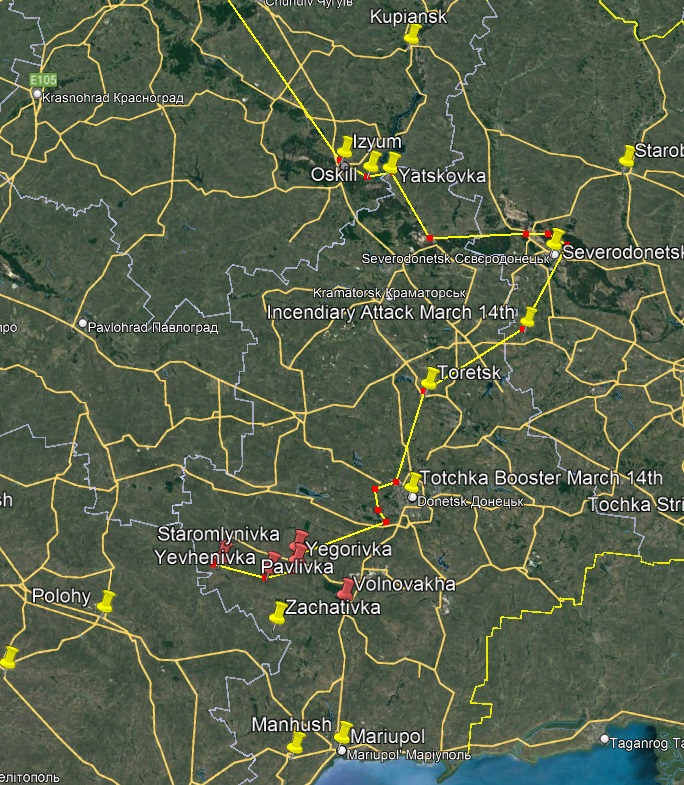
- * Confirmation of the heavy fighting in Volnovakha. Video of a tank during the fight in the city.
- * Heavy Russian air activity in this AO – mostly Frogfoots, still.
- The Tochka-U SRBM that came down in downtown Dontestk was possibly a Ukrainian attempt to attack the railhead in Dontestk that was intercepted by Russian missile defenses. Damage characteristic of light HE-frag bomblets was photographed not far from where the intact booster section came down. Russian media showed the missile remains and shrapnel damage in detail. Note the engine (the smoking mostly intact section with a rocket nozzle,) the guidance package (the burnt, shattered bit with the cable hanging off it) and the steering section (the shattered, mostly unrecognizable mess with the grid fins clearly visible.) Compare with this image of an intact Tochka – note the cabling run between the guidance section (which sits under the payload in the nosecone) down past the engine/fuel tank and to the controls section (with the grid fins that steer the weapon.) From the shattered remnants of the rearward-most section (the guidance section) and the way the rocket-nozzle end of the engine section is dented in (as if it hit first) it seems the weapon came down rear end first. Compare to the remains of the Tochka employed against the Rovenki fuel storage facility, (all three sections separated but are substantially more intact and very close together,) and these two recent Belorussian Tochkas which are almost completely intact save for the payload. Also note the rather modest damage in the area; as Russian propaganda itself is saying, if it hadn’t been shot down, the coverage of bomblets would’ve been denser, more uniform, and wider.
- Since SRBMs don’t re-enter backwards and we see no shrapnel damage to the visible parts this was either a catastrophic weapon failure (unlikely) or the result of a head-on engagement by a Russian S-400 system defending the city. Current preference for missile intercept is either a hit-to-kill engagement (best) or directional blast-frag (second best and common with dual-use anti-aircraft/ABM missiles.) Fly-past proximity detonation (fragmentation or continuous-rod style) are disfavored due to very high closing rates in head-on ABM engagements often failing due to these weapons being fuzed in expectation of much slower aircraft engagements (unless the weapon is purpose-built for both ABM and cost-efficiency e.g. Tamir.) Ergo the payload bay itself most likely took the hit. Impact plus disruption of aerodynamic streamlining would likely lead the weapon to flip end-for end, spoiling its terminal accuracy.
- Trajectory/range analysis shows the weapon would have had to have been fired from fairly close to the front lines (in the area directly north of the city) to be a Ukrainian attack; however this is consistent with the Ukrainian’s repeated (two) strikes against diesel fuel storage facilities in Dontesk and employment against airbases in Russia proper. With a 120km range the Ukrainians would need to base these weapons fairly far forward to get the most out of their deep strike capabilities. Given these weapons represent the only deep strike capability the Ukrainians possess and their pattern of utilizing them against logistics in the Dontesk area, there is no other probable target that I can discern. Given the long Russian occupation of the Donbas region this is the one area the Ukrainians don’t have TDF troops conducting rear-area supply line interdiction, so it’s unsurprising they would expend their limited deep strike capability here.

- Credible possibility of a Ukrainian deep raid towards the vicinity of Melitipol conducted within the last 48 hours. Late March 13th saw rumors flying about a rumored counterattack on Volnovakha that might have pressed, somehow, all the way south to Mariupol. On the 14th this was followed by UMoD claiming the destruction of a “200 vehicle convoy” destroyed somewhere north of Melitipol (which happens to be the closest rail yard on the north-east axis of advance out of Crimea.) These rumors were noted by reliable OSINT accounts who noted their local sources were reporting an awful lot of noise in the area north of Melitipol, which made this stand out.
- Oddly, this is the same general region in which Ukrainian general Zobrodskyi, during the direct combat between Ukrainian and Russian forces in 2014, conducted what is allegedly the longest-distance armored raid ever conducted behind Russian lines, running rampant in the Russian’s rear. (Video narrated by Dr. Phillip Karber, who has met Ge. Zobrodskyi personally.) Zobrodskyi would repeat this feat later, cutting behind a fast Russian advance before turning to attack them in their forward flank. That the Ukrainians had a good general is one thing, but having a regiment capable of executing such bold orders – in 2014, when the Ukrainian military was a shadow of what it is now, after eight years of support and training at all levels by American advisers – is phenomenal.
- The best ORBAT tracking I have seen (working largely off the same sources I’m finding but with better day-to-day tracking) credits the entire southern flank (i.e. not the eastern Donbas front) as having maybe five Russian BTGs present, total. This matches with UMoD predictions of the main effort in the south being directed towards Mykolaiv. These are thin forces to cover this much ground. If the Ukrainian army successfully pulled off not one, but two “thunder runs” in this area in 2014, then the Ukrainian army of 2022 could absolutely do this. Melitipol, as the major rail yard in this area, would definitely be a priority target, as it must be a Russian supply hub now.
Kherson AOO
General Conclusions:
- This previously shown video and the very likely related drone footage shows us how Ukraine is effectively dealing with Russian artillery superiority. Note how the Ukrainians are operating – they’re using small SOF units that can infiltrate close to enemy artillery positions (likely localized earlier with sound-spotting systems) without being easily spotted even by drone reconnaissance. From close range (the M57 60mm mortar they’re using only reaches 2,500 meters) and with the assistance of squad-integral man-portable drones they locate the enemy firebase, identify the likely location of the ammo dump, then engage it with rapid-fire 60mm mortar fire. You can hear the secondaries of their successful work during the interview. Mortar ammo is heavy – at the ROF you see in the video they will exhaust what they brought with them quickly. This is the goal; to put as much ordinance on target as fast as possible to put the unit out of action via destroying their ammo dump before rapidly extracting from the area before they can be found and counterattacked. Note the one soldier commenting on “how fucking stupid” the Russians are; “flying around shooting at god-knows-what,” indicating Russian attempts to control the area from the air without ground patrols are clearly fruitless.
- Closing the distance with an enemy that has superiority at range is a classic tactic, but it further emphasizes the consequences Russia is paying for their extremely top-heavy forces.
- This also demonstrates that the ISR environment favors Ukraine. Both sides are making frequent use of small man-portable drones at the squad level, and neither side has a great capability to counter them, but as an equipment-rich, infantry-poor army the Russians are much more vulnerable to the kinds of attacks such integral reece capabilities provide. Moreover the Ukrainians have the benefit of American/NATO ISTAR assets feeding them data; so strategically they have a “big picture” the Russians will struggle to generate.
- This further reinforces the crippling consequences of having a mostly unsecured radio net easily jammed by civilians playing music over the radio; units must rely on their integral drones as communicating it past shouting range is difficult and time-consuming.
- Russian gains in the south-east are the one place in this war where “but the Russians are still slowly taking ground!” actually has merit, as the terrain strongly plays to their strengths here, and while the very slow Russian advance (likely due to incredibly tenacious defense and low troop commitment to this axis) makes it likely that Ukraine could extract its forces from this area in good order, it has to hold a line somewhere from the Dnieper to Kharkiv if it’s to keep the city. To lose Kharkiv is to effectively concede all of eastern Ukraine to Russia, and if they do, they may not get it back.
- The 4th Armored was last reported to be in Kharkiv – one of only two Ukrainian regular army tank regiments. Kupiansk is extremely reachable from Kharkiv via armored assault, and the Russians have (UMoD claims) been shifting forces away from the impenetrable nut that is Kharkiv to prepare for an assault to finally remove the dagger in the side of their Main Supply Route that is Sumy. If I was running this show I’d want to ram the 4th armored into Kupianski, lay waste to anything with a Z on it, trash the railyard as best I could (preferably by wrecking rolling stock on the rails to temporarily block it and blasting the local rail bridge, again,) then get the hell out before they shout over the dancing pig meme song jamming their unsecured Chinese comms enough to figure out what the hell is going on. If the state of their comms, tactical acumen and airpower performance is anything to go by – and past Ukrainian performance, much less current, is any gauge of quality – Ukraine can absolutely pull that off.
- In any case, even though they’re defending doggedly, the time is fast approaching when UMoD will have to make a hard decision in the south. They may be wagering that the fight for Kyiv will either be won or lost before that time comes (given the glacial speed of Russian gains) and since Kyiv will likely determine the war, delaying is fine as a long-term strategy. Russia has not mounted a serious offensive in NW Kyiv for three days now, and that follows failed battalion-level attacks that themselves were preceded by an operational pause. If the Russians take long enough to unfuck themselves the Ukrainians may well go to them and decide the matter. If they decide that’s not feasible, then something will have to be done in the South, as it indicates Russia is switching to a longer siege style strategy, and thus the timelines will not permit indefinite delay on other fronts.
As usual there are more general happenings to cover but it’s 9:45 and I’ve been working on this since 3PM. I need a fucking drink. I will add the bulletpoints in properly in a few minutes. P.S. NSA hire me I was staring at sat photos of the DPRK just because I really wanted to know where they hide those TELs I was doing this shit before it became cool for twenty minutes PAY ME AAAAAAAAAA
Brief Update @ 8PM EST
General Background Things Update:
1. The Iranian SRBM strike in northern Iraq fortunately didn’t have (much) to do with America: the target was a mansion belonging to the CEO of a company that does business with/in Israel, [2] ergo it constituted retaliation against Israel for the deaths of some Iranian whoevers in the last round of Israeli airstrikes recently. I’m sure they were thrilled to rattle America’s cage due to proximity to the under-construction consulate. Also, the weapons used were Fateh-110s, which are cheaper and in far greater stockpile numbers than Iran’s MRBM or IRBMs, (so they’re less precious munitions to expend.) Obviously the Iran-Russia relationship still has implications for the war in Ukraine but this event doesn’t seem to be a big signifier on its own. That’s good. That’s very good.
2. I’m aware of the crashed TU-141 recon drone and Croatia’s claim that it had a warhead in it. The claimed warhead size was 120kg, or about 260 pounds. My take: it’s possible Ukraine converted some old TU-141s into ghetto cruise missiles but not very likely.
Some background: understand that the TU-141 is an old piece of kit; it’s comparable to the Ryan Model 147 recon drone flown during the Vietnam war, itself based on a simple target drone. These are pretty simple aircraft – you program their autopilot with waypoints, they fly the waypoints and take pictures with their camera, then when they finish their waypoints they shut off the engine and pop a parachute so you can snag them out of the air with a helicopter. They’re also old as hell; both in terms of the technology and also the equipment’s own age since manufacture. Thus it’s almost guaranteed this drone went so far off course due to a malfunction; it was common for drones of that era when they were new, much less now that they’re decades old.
Now military experts have weighed in already and said the explosive the Croatians are talking about was probably a small scuttling charge meant to destroy information/data so enemies can’t get it. Some drones today have this feature and it was ubiquitous on drones of this vintage (given the aforementioned reliability issues.) Another possibility is that the drone’s solid-fuel retrorocket (fired to slow it before popping it’s recovery parachute) exploded on impact. It is possible it was an actual jury-rigged warhead. 120Kg isn’t much of a warhead but you can’t simply ram things into an airframe and expect it to work out right; especially for an antiquated drone with a simple 1970s autopilot; if the aircraft’s center of gravity is thrown off more than the autopilot is expecting its commands will be useless and it’ll simply crash – and it won’t take hours of it flying off-course before it does, either. So the potential warhead size would be limited to the mass of camera gear the thing is designed to use; at least for a hasty jury-rigging.
However, doing so doesn’t make much sense for Ukraine. Simply put, a 264 pound warhead isn’t very big, and a cruise missile using only 1970s inertial guidance is going to be very limited in its effective accuracy. 1970’s inertal nav is better than you might think, but it’s not good enough that you’re going to reliably get close enough to a target that the fragmentation radius of a 264 pound warhead will reach it. This is precisely why older SRBMs like the Tochka-U were mostly equipped with sub-munition warheads; so the spread would compensate for their limited accuracy. Jury-rigging a submunition dispenser onto one of these drones is definitely complicated enough that Ukraine doing it in two weeks is dubious, although I can’t rule out possible pre-war preparations of that sort. But even then, 264 pounds just isn’t enough bomblets to really get good coverage.
The original role of these drones – high speed reconnaissance – is still perfectly valid, and despite their age they’re one of the few options Ukraine has for getting that kind of intelligence. Ukraine has plenty of smaller drones but nothing with the range of the TU-141. As an old-fashioned autopilot-only machine it’s invincible to ECM, and it can avoid S-400 batteries by flying low, under the radar horizon. These old systems are perfectly capable of that; one Ryan 147 in Vietnam bugged out, dropped a zero and flew its waypoints at 150 feet instead of 1,500 feet. When the photos were developed the analysts were rather shocked to see pictures of transmission towers taken from underneath the power lines. While the Ukrainians are getting intel straight from the US right now, they will still want their own sources of data, because even the best allies are going to hold information back from you. Phillip Kaber’s lecture I linked yesterday mentioned this in passing; as he said the US was providing intel to Ukraine, but then telling them they couldn’t conduct counter-battery fire on Russian artillery because they were firing from Russian soil and “attacking the territory of a superpower is a no-no!” You can imagine how the Ukrainian general staff felt about that, and even though eight years of US support has definitely smoothed things over, it’s still prudent and wise to gather as much information for yourself as possible – if only to verify that your allies are being straight with you, and to collect information your allies can’t share as it’d expose collection methods they wish to keep very secret (not necessarily from you, but from enemy agents infiltrating your command.)
Most likely this drone was being used by Ukraine for its intended purpose and just malfunctioned. The reason Croatia is making claims of a bomb in it is because they’re probably pretty fucking pissed off that it flew through NATO airspace for an hour without NATO doing a damn thing about it and letting it come down in their country where it could’ve killed someone. I’d say their irritation is understandable.
- This abandoned Russian field kitchen is startling to see; this is 1. a very important piece of logistical equipment (soldiers have to eat and a kitchen lets you utilize local food sources instead of having to ship in MREs, and hot food is a HUGE morale booster in the field,) and 2. something that should be in a rear area far from the frontline (eating in a frontline foxhole is precisely what MREs are meant for.) TDF hitting supply convoys in “rear” areas is expected, but for them to be captured would require Ukrainian general army units to be moving into areas that were (previously) Russian rear areas. This is just one data point but if we see more high value, rear echelon equipment falling into Ukrainian hands it might indicate something about how their counterattacks are going and how well the Russians are responding to them.
- More examples of Ukrainian artillerymen being very good with their weapons.
- This “sad example of a cope cage” made me write an entire paragraph on how my theory of those cages being meant for overhead protection in urban combat before someone told me it’s just a rocket rack. I’m telling you this because the fact the Russians are still using fucking rocket racks on AFVs, like a Calliope Sherman in the year of our lord 2020 is significantly more cringe than any cope cage could possibly be. What even the fuck are Russians?
- Another short clip illustrating Ukrainian special forces’ doctrine (mute sound, hardbass warning.) Notice the sniper rifle and scoped LMG being used to kill dismounting Russian armor crews fleeing their burning vehicles. These guys are not fucking around; they’re ensuring that those Russian crews cannot mount up to operate a replacement vehicle. They could just be suppressing escorting infantry as well,
- Direct evidence of Russia employing their frontline EW capabilities.
- I’m seeing evidence of Ukrainian use of anti-vehicle land mines for the first time. Obviously they’ve probably been in use since the conflict began, I’m just noting the direct evidence of how they’re being employed as they come in. I’ve also seen video of a road that has logs and ant-tank mines lined up on the side of it for quick deployment by troops at a nearby roadblock if needed.
- About the strike on the training center – this isn’t a very important facility when there’s a full-scale war on. Nobody’s going to be sitting around reading powerpoint presentations, they’re going to be outside getting quick and dirty instruction in how to shoot a rifle and conduct basic fire and maneuver. Most interesting thing here is that Ukrainians claim 30+ cruise missiles were employed against the target, specifically so they could saturate the air defenses around it. This is a real world example of why anti-cruise missile capable air defenses are so valuable – even if the target is destroyed, it still forces the enemy to expend a lot more precious munitions to do it, reducing the ammunition available to fire at other targets.
- Also that Reddit post about it making the rounds is probably bullshit. And it’s not the only bullshit like that out there. Not all of it’s deliberate Russian shitposting, though, some of it’s just assblasted war tourists upset that Ukrainians need people who want to serve, not just clowns that want to kill.
- Russia is making deliberate efforts to limit the Ukrainian government’s ability to communicate to its people by destroying TV transmission towers.
- More examples of Russian forces using disguised saboteurs (flagrant violation of the Geneva convention, naturally) to attack civilians. Previously they’ve been seen conducting recon and target location. Russia has to resort to these tactics to make up for a lack of precision guided weapons and aerial reconnaissance capabilities. The use of local militias greatly increases Ukraine’s ability to police rear areas against this kind of tactic; another example of Ukrainian manpower advantage having tangible consequences in the field.
- This stuck Ukrainian Tochka-U TEL shows you how recovery of stuck armored vehicles can be done. Obviously, earthmoving equipment is very useful for it. Civilian earthmoving equipment is always a useful resource for military forces. Yet another thing Russia has to ship in if they want it, something more to compete for room in their logistics pipeline.
- Ukrainian SWAT team using drones to drop improvised munitions. Nothing new in the least of course; this war has demonstrated all over again that a few rifle grenade rounds dropped from drones are nothing compared to the artillery they can serve as spotters for, but this shows you how paramilitary forces such as police are contributing to Ukraine’s defense. These troops aren’t accounted for in the total count of their military; keep that in mind.
- Direct evidence of effective Ukrainian counterbattery fire. Wild to see how MLRS rockets zoom off on their own when they start cooking off. Note the drone footage; probably the same drone that spotted for the fire.
- Continuing Russian attacks on crucial Ukrainian aerospace industry.
Apologies for being late; I was rather ill yesterday and couldn’t keep working.
There is much to talk about. Maneuver/force positions will come later, I will cover more general background things here, and go into detail on a few matters which the preponderance of evidence now gives me more solid ground to speculate on.
Artillery Usage Comparison (March 16th)
Field artillery has been present on the battlefield since Roman times, but when the corned gunpowder revolution arrived it quickly grew in stature to become the “king of the battlefield.” Infantry was still the queen, but as the saying goes, “everyone knows what the king does to the queen.” The lethality of artillery is hard to overemphasize. In modern combat between unsupported light infantry forces, by the time ammo is exhausted and one side has lost or won, 20% casualties are considered very high. This is the point of flanking; when you gain a positional advantage on your opponent that negates their cover and/or lets you apply your firepower to them more effectively than they can do to you, they either have to withdraw or accept destruction (and obviously, they usually withdraw.) This is how firefights are won and ground taken.
Artillery does not afford soldiers the luxury of a chance to withdraw – it arrives quickly, mows down those who are exposed without cover, and keeps the more fortunate pinned down in their foxholes as long as it’s falling. Artillery can kill more men in ten minutes than a raging close-quarters firefight will kill in a day. Thus it’s been a cornerstone of military affairs for a hundred and fifty years, and especially so for Soviet-legacy armies (e.g. Russia and Ukraine.) Western doctrine uses fire to enable maneuver; i.e. artillery pins down and constrains the enemy, allowing maneuver forces (viz. tanks) to close with them and apply their direct firepower to destroy them. (The point of maneuver is to apply firepower.) Russian doctrine always emphasized using maneuver to enable fire; with mobile units locating, engaging and stopping the enemy so heavy artillery can obliterate them. In practice these doctrines are flexible and any competent field commander can switch from one to the other as needed, but this does guide the general procurement strategy of these forces. The nature of the Russian “Battalion Tactical Group,” which adapts for Russia’s severe manpower shortage by pairing relatively scant mechanized infantry with the tank and artillery resources of an entire regiment, increases the artillery focus even more. Thus the performance of Russian artillery fires is a crucial factor in understanding their performance in the ongoing war.
Pre-war, the largest single materiel factor weighing in Russia’s favor was artillery. Significant superiority in tanks was a close second, but it was generally understood even by the layman years ago why the Javelin was such a significant boon to Ukraine; upgraded Soviet-era tanks wading into the face of the most modern anti-tank guided munitions was always going to be ugly. (Even the United States has only equipped a fraction of its tank force with active-protection systems for shooting down guided missiles; much like the small drone threat everyone understands this is the future, but adapting vast equipment stockpiles for it is a very costly and time-consuming task.) Artillery, however, worked as well as ever, and its one of the few weapons systems where “quantity has a quality all its own” still rings true. Even the USA, who has insane munitions like the “Excalibur” (basically a GPS-guided glide-bomb fired out of a howitzer) still relies on simple unguided HE shells as the mainstay, for they’re cheap, plentiful and effective. Reliable numbers of specific systems are hard to come by, but Russia started the war with at least seven thousand artillery units, compared to Ukraine’s total of three thousand.
Far worse, Ukraine’s artillery is biased more towards towed guns than self-propelled ones; a severe disadvantage in modern maneuver combat. Because of artillery’s power, the first target for any artillery battery is typically their enemy counterpart; “counter-battery fire.” Self-propelled gun systems mount the cannon on a tracked (or occasionally wheeled) chassis and protect the gun, its ammunition and its crew under armor that shrugs off shrapnel from hostile units. This lets them “shoot and scoot” to avoid retaliation, as well as keep up with tanks and mechanized infantry. Standard artillery cannons, that are towed behind vehicles, then unlimbered and set up in a stationary firing position, are still important for any military – much cheaper and easier to transport/deploy, and thus are essential for volume. But self-propelled guns are essential for the forces that make areas safe enough for such stationary firebases to get set up; the units that dodge hostile fire while firing back and eliminating the stationary guns of the enemy.
Then there’s the MLRS – Multiple Launch Rocket System – artillery. Based on the Katyusha of WWII fame, rocket artillery excels at shooting long-distance and achieving area coverage. Rockets are inaccurate and spread out a lot, but this is also a feature; it lets them plaster wide areas. Rockets also excel at salvo weight; they can put more steel into the air in one minute than an entire battery of self-propelled guns can deliver in thirty. This allows them to plaster entire wide-open fields with munitions; they can engage and destroy entire armored formations that are on the move. They’re awful at picking off single targets requiring precision (“point targets,”) and take forever to reload, but that’s what the Self-Propelled-Guns (SPGs) are for.
And then there’s the ammunition. First and foremost, the amount. Russia prepared for this war years ago; using small drones to drop thermite grenades on major Ukrainian ammunition dumps. These attacks destroyed many thousands of stockpiled Soviet-era ammunition, which Ukraine couldn’t replace. Incredibly, Russia even sent agents into NATO countries like Czechoslovakia and Bulgaria to destroy ammunition dumps there – literal acts of war on NATO soil – to eliminate stockpiles of Warsaw pact ammunition in Ukraine-friendly countries. That’s in addition to the shells expended during eight years of war in Donbas – they fired off more shells worth of old Soviet stocks than NATO has stockpiled total. They eventually started a new ammunition factory, but it can only produce 14,000 rounds a year. Even at triple capacity, it’d take years of production to build ammo stocks back up. That’s not unusual; that’s how every army on earth stockpiles ammo – not just artillery and missiles, but even rifle bullets. War consumes ammunition at a terrifying rate.
Then there’s the sophistication. Modern technology’s produced guided MLRS rockets, which turn the inaccurate area weapon into a very long-range precision weapon (the American G31 rocket is called “the 70km sniper rifle.”) In fact it turns them into a miniature SRBM launcher (see also the American ATACMS, an actual Short Range Ballistic Missile that can be fired out of an MLRS launcher.) Russia supposedly had plenty of these, while Ukraine had... about a hundred, at best.
But the most lethal artillery munition is much older and simpler – DPICM, “Dual-Purpose Improved Conventional Munitions.” When the fabled “VT” radio proximity fuze entered WWII, it didn’t just revolutionize anti-aircraft fire, but also ground artillery – it could reliably set artillery shells off in the air, spreading shrapnel much further and more uniformly and killing soldiers that should’ve been safe inside their foxholes. Patton called it the “funny fuze that won the Battle of the Bulge.” Improved Conventional Munitions further refined the concept; filling artillery shells with many small bomblets; raining a pattern of little grenades over a wide area. These reached their ultimate incarnation in the “Dual Purpose” kind: tiny shaped charges that could easily punch through the thin roof armor of tanks, and also had a fragmentation jacket and an incendiary ring around the explosive charge. In artillery shells these are devastating; they kill everything and set the remains on fire. In MLRS rockets, which are bigger and can carry more, they are known as “steel rain” and are responsible for the M270 MLRS’s reputation as the “grid square removal service” (as in the one square kilometer grid squares on standard military maps.) This is how MLRS can wipe out an entire company of spread-out tanks in wide-open fields without trouble.
These are one of the most powerful weapons ever fielded on Earth – and I’ve yet to see a single instance of Ukraine firing them, whilst Russia is raining them down every day.
By every single conceivable metric, the Russians should be dominating Ukrainian forces under a crushing hurricane of steel.
But instead, they seem to be getting their asses kicked square.
Curious Russian munition usage
As I noted on D+6, an awful lot of images of Russian MLRS “cargo” rocket containers have been seen throughout the war in bombarded cities; embedded in streets, buildings, and even embedded in unlucky civilian vehicles. These casings hold hundreds of small bomblets; usually DPICM, sometimes dedicated incendiaries, or even air-delivered anti-personnel and anti-tank mines. Russian airdropped “butterfly mines” were quickly photographed a week ago, but I’ve seen nothing about mines in Kyiv or Kharkiv. There’s the occasional sighting of incendiary weapons, but amid the many scenes of devastation from Kyiv and Kharkiv as they suffer nonstop bombardment I haven’t seen the kind of widespread fires incendiaries would inflict (and those are most effective against residential suburbs filled with wooden houses, anyways; Eastern Bloc construction emphasizes massive concrete apartment blocks that aren’t very susceptible to incendiaries.)
Since MLRS cargo rockets leave evidence that HE frag artillery doesn’t, I’d put this down to a selection bias – but for the fact that at least 30% of the videos uploaded of this war are just shaky smartphone cam of artillery bombardments lighting up city skylines at night, and in the vast majority I’ve seen you can see the telltale “popcorn” rippling explosions of submunitions going off. That video is especially interesting as you can see the size of the buildings the munitions are landing around – they’re sizeable. Now sub-munitions can (and clearly have) level suburbs with small residential homes; the explosives punch holes in roofs and make the buildings uninhabitable and secondary incendiary effects then gut the structures. (The rubble still provides cover to infantry, just not as good as the building.) This video from today in Kharkiv is emblematic of the damage I’m seeing in most of these heavily bombarded cities; while the buildings have been rendered uninhabitable for civilians, they’re still substantially intact. There’s few if any shell craters to be seen; and almost never an actually leveled building. This is what you’d expect from heavy use of MLRS submunition warheads over unitary rockets or HE-frag shells.
Bluntly, this choice of munitions is stupid from every conceivable angle. Even if committing murder of civilians for the sake of murder (to hold the populace hostage as a bargaining chip in negotiations) submuntions only hit people walking around on the street; and most civilians in these bombarded cities will be in bomb shelters whenever possible (see the many taking refuge in the subway tunnels of Kyiv as we speak.) This is also true for military troops; the first shells/rockets of artillery are the most effective as they catch men by surprise, standing up out in the open and thus most exposed to shrapnel.
There is one good use for sub-munitions in a city: “blocking fire.” By dropping steel rain on the streets you force enemy infantry to take cover, thus stopping them from moving through streets to react to your own movement. But I’m seeing MLRS cargo shells on social media still, and even accounting for reporting lag (Tiktok upload to OSINT twitter picking it up and circulating it) Kharkiv and Kyiv proper haven’t been under direct ground assault for many days now. Kharkiv especially; the fighting is clearly moving away from the city and I’ve seen absolutely zero mention of Russian troops attempting advances into the city proper for many days. Thus there’s no maneuvering forces in the city to be blocked. As harassing fire it’s certainly lethal; preventing military defenders and civilians alike from conducting “business as usual” without being hampered by keeping close to shelter at all times, but single HE-frag shells are highly effective for that as well and much more efficient than MLRS rocket ammo, which is very bulky and harder to deliver to the front. Most importantly, MLRS sub-munition rockets are the best weapon for fighting maneuver combat; and their vast spread also makes them more effective when attacking targets who’s position isn’t precisely known (as we’ve seen, Russia is obviously struggling to conduct longer-range reconnaissance.) Blind-firing with artillery does work if done smartly. Japanese resistance forces during the Battle of Okinawa in WWII were producing an artillery gun from hidden caves to fire harassing rounds at American positions. The Americans performed a “map recon,” marked every place in the rough terrain that was flat and wide enough to house an artillery gun, handed out firing assignments and went about their day. The next time they took harassing fire, the gun crews started pounding their assigned targets, and sure enough, one of those flat spaces happened to have the Japanese gun and crew in it, fully exposed.
Cluster munitions aren’t even good for mass-murdering civilians in major cities. Russia’s continued use of them against those targets suggests to me that they might not have enough more suitable munitions to use. Soviet era stockpiles were build for actual maneuver war in open areas; just like America’s massive stockpiles, the bulk of them were DPICM. They may simply be using the most plentiful ammo available to them – which happens to be poorly suited to reducing the inner city strongholds they need to assault, especially Kyiv.
The other possibility is that they can’t hit a flock of barns if they were standing inside the middle barn and are compensating with cluster warheads. Russian official propaganda has been bafflingly scarce. We know they’re inflicting casualties on the Ukrainians. They know that Ukraine is dominating the information war (and thus the perceptions war with NATO which is what’s greatly aiding the influx of volunteers, supplies, money and weapons from NATO) because Russian losses are posted to social media but not Ukrainian ones. And yet we’ve seen very little of their operations and strikes, and even then the footage is heavily cut. This drone video of Russian artillery strikes from yesterday is representative. Note the odd cut and how few artillery shells actually landing we’re allowed to see. Note how one shell has clearly landed on the railroad tracks of the rail yard, well short of the truck park that is clearly being targeted. An initial spotting round going wide isn’t unheard of, of course. And with a sample size of one we can’t conclude that the Russians are lousy shots. But it does invite the question of why the Russians are keen to deny us a wider sample size – if they had video of Russian artillery plastering Ukrainian forces, wouldn’t they put that out there?
Even odder, I’ve seen more drone videos of Russians employing their laser-guided 152mm shells than I’ve seen of normal quick-fuze engagements. (Note again how short and clipped this video is.) Ukrainians have multiple videos of their artillery achieving incredible precision, engaging point-targets like tanks, but Russia can only show similar results when artillery-fired PGMs are employed. And if their very infrequent use of other PGMs is any guide, they probably don’t have many of these, either.
Doctrinal Failures
This raises the question of how competent Russian artillery actually is. One thing you’d expect from any army, especially a Warsaw Pact army and explicitly from Russian BTGs is an obsessive focus on artillery fires – both in delivering and avoiding them. For a tank BTG, which nominally only has a single company of mechanized infantry, one good MLRS attack could erase the force’s entire infantry complement. A BTG can better withstand losses from counter-battery fire than unopposed attacks on their maneuver elements; dispersing the latter properly is just as important as aggressively accepting artillery duels with the former.
By that metric, the Russians don’t seem to know what the hell they’re doing. This video (again from the spotting drone) released today shows what appears to e a Russian command post being attacked by (characteristically accurate) Ukrainian artillery. Note how there’s no obvious attempt at camouflage, and the units aren’t dispersed (spread out so one artillery shell can’t damage or destroy multiple units.) Going back to this video of a Ukrainian counterbattery strike I noticed the foliage near the Russian positions is already on fire. Also, you can see Russian personnel ambling around in no great hurry. Either they had already taken fire, or their own artillery had set the foliage on fire by accident, giving away their position (MLRS backblast, perhaps.) In both cases it would be time to leave, in a goddamned hurry – again, shoot and scoot. Even towed guns can be limbered up and moved promptly if the enemy gives you a few minutes to do so. And yet the personnel present clearly show no such urgency.
Another odd thing – I’ve seen more examples of Russian towed artillery that have not dug into field positions than ones that have – in fact I’ve only seen the first example yesterday. Note the dirt berms and the ready ammo dump protected by earth-filled tires. Even rudimentary fortification such as this vastly increases the survivability of gun crews; especially in the wide-open flat terrain of southern Ukraine. The dirt berms that guarded the guns themselves were probably produced by a bulldozer; a single bulldozer can work up protection for an entire gun battery very quickly, depending on terrain. Gun batteries don’t always have time to dig in, if the need for artillery support is dire – and if they don’t have a bulldozer handy, they may never have time to dig in, as building berms high as the one you see there with just entrenching tools and your gun-crew manpower is very difficult. Again, we’re only getting the barest glimpse of Russian operations, but it’s becoming easier to see why Ukrainian commandos feel that dropping wee 60mm mortar shells on Russian gun batteries is effective – if they lack the training – or perhaps just the equipment – to dig into their firing positions, one little man-portable mortar can indeed put a whole gun battery – and it’s ammunition dump – out of action in a hurry.
Finally, there’s the impact of communications on artillery. Drones are so powerful in this conflict because the biggest challenge to artillery has always been information – finding the target, then communicating it back to your gun crews. This is why forward observation is an art form unto itself. Russian units are frequently operating the Orlan-10; a small man-portable fixed-wing drone. You can tell the Orlan is the main drone spotting for Russian artillery by how jerky the camera feed is; as a fixed-wing drone its a far less stable camera platform than small consumer quadcopter drones who’s primary use is as an airborne camera.
The other difference between these drones is, fixed-wing platforms have much longer range. The Orlan-10 is equivalent to a militarized hobbyist remote-control airplane; powered by a gasoline engine. And like the miniature airplane it is, it has great transit speed (90-150km/h) flight duration (16 hours) and range (it can be commanded up to 140km from its ground station.) Compare to consumer quadcopter drones powered by batteries. Since they’re meant for convenience and taking neat pictures from above, their range is pathetic and flight duration on batteries limited; fifteen minutes to an hour, typically.
The point I’m making is that most Russian drone-spotted artillery strikes we’ve seen are being controlled by the gun battery operating its own drone directly, whereas most Ukrainian ones are taken by small quad-copter “backpack” drones operated by a squad in proximity, who must them communicate their spotted information as a traditional fire mission to their artillery support. The recent Wall Street Journal article on the fighting in Vosnesenk (more on that later) included this very revealing detail of how Ukrainians are improvising field communications. Territorial Defense militiamen aren’t equipped with secure radios that regular forces have; but they were still able to use social media messaging apps to pass spotting data to a forward observer – observing fucking social media PM’s, before communicating the fire missions to Ukrainian artillery units with a fucking cell phone. It’s a given that a force (Russians) relying on unsecured civilan walkie talkies will also be utilizing cell phones when possible. They’re harder to intercept and can’t be jammed by any Ukrainian civilian playing loud music over their kid’s baby monitor, but using them requires leaving cell phone towers intact, and thus the same communication option open to their enemy.
In short, due to a failure of planning and procurement, the Russians are being matched in terms of communication integrity by militiamen texting each other on fucking Facebook. How do you think they’re stacking up against Ukrainian regulars with proper radios? How many Russian maneuver units can actually call for artillery support and promptly receive it? Or do they have to use “Mode B” through a Chechen fucking code talker and wait thirty minutes for the artillery unit to send its own drone?
Truly incredible.
Assembling a picture
All this evidence is circumstantial, of course, but it’s also spaced across enough time – two weeks now – that we can at least see some patterns. Additionally, we have a larger context to put it in as well. We’ve seen captured Russian guns that were in terribly maintained condition. We’ve seen evidence that some equipment stocks were recently re-activated from mothball status; and given lacking Russian maintenance of their forward-deployed vehicles (witness yet another sighting of a vehicle who’s wheel hub seals clearly dry rotted due to neglect) whether or not mothballed equipment was properly checked over and serviced before return to duty is doubtful. We’ve seen examples of flat-out ignoring sane doctrine; un-escorted supply convoys, poor spacing and movement discipline in hostile cities, poor use of combined arms, poor adherence to basic military principles such as use of camouflage, dispersion, and entrenching and if the continuing trend of entire mud-bogged tank companies is any indication, even a failure to conduct proper route recon. Even if these failures could be explained away as the myopia of the OSINT window the fact remains Russian forces are embarrassingly slow to adapt to the prevalent conditions. It took them far too long to start escorting convoys and using air patrol along the MSR and their failure to disperse, dig in and camouflage indicates a failure to adapt to the ubiquity of small squad-level recon drones on both sides – while the Russians have tactical EW the Ukrainians don’t in this regard it’s clearly not enough to establish spectrum dominance and certainly won’t help against strike UAVs like the TB-2, which their SHORAD has proven ineffective against as well. Nothing I see indicates they’re acting like people who understand that eyes are overhead at all times, and the people peering through them are not hajis with a handful of antiquated 81mm mortars to pop off with, but a modern military with heavy long-range artillery and the skill to use it well.
In sum, Russian artillery forces seem mis-provisioned for the siege warfare they’re now faced with, lacking in skill, and deficient in both basic military doctrine and their ability to adapt it to the situation. For two weeks the Learned Experts™ have insisted that this was just the OSINT window myopia at work; that the trickle of information was biased and that prudence dictated the assumption of competence. They were right – then. But now we’ve enough evidence in hand of systematic failures at every level of military organization that this assumption must be challenged. Perhaps the Ukrainians could slip into the woods and film a propaganda film by firing a 60mm mortar at nothing – but I do wonder where the devastating secondary explosions heard in that video came from. That their formations are very equipment heavy but infantry light is already well-known; but if they’re unable to perform foot patrols to keep squads of infantry from dunking on them with fucking 60mm mortars, why not with airpower? Or drones? Or mounted scouts; even unmanned ground vehicles?
In short, we’re seeing a failure not just to adhere to their known doctrine, but a failure of the doctrine itself – it doesn’t seem they ever bothered to answer these questions, to find solutions to the known problems, before starting a full-scale symmetric war with a near-peer adversary. I contend this extends to the artillery domain. The Russians are, most likely, not only incompetent and ill-prepared to use their most pivotal source of firepower, but facing a Warsaw-pact legacy military that is very, very skilled at employing their own.
They’re fucked.
Postscript
I Am Not An Artilleryman. If you are and I said something stupid, feel free to let me know. I’m no genius, just a – may Allah forgive me for uttering this word – journalist, and all I’m doing is using a broad familiarity with military matters to collate as much data as I can. Input from people who know what the fuck they’re talking about is a major source of data.
I’ve been writing all day since I woke up from my ick-haze. I’m going to try and crank out an update on the maneuver situation tonight, as well as another “general” update covering strategic matters. Stay tuned.
D+19 and D+20 update (March 15th-16th)
Sitrep: Maneuver
Kyiv AOO:
- Combat continues all along the frontline west and north-west of Kyiv itself, right up to the Belorussian border. The recently released video of Ukrainian artillery strikes on (either a command post or forward supply dump) has been geolocated to a point not twenty kilometers south of the Belorussian border, near the town of Poliske, which the UMoD has previously cited as the furthest western extent of Russian advance in that area. Incredibly this truck park and/or command post is scarcely two hundred and thirty meters away from the P02 highway that runs south from Belarus and to the traffic circle crossroads at Ivankiv. That it came under artillery attack indicates the Russians have not been pushing their front line further west to provide more strategic depth. While not pushing as far as Malyn to open up an additional highway is one thing, not at least securing the flank of a main line of communication along its entire length, leaving it open to artillery interdiction... what even the fuck? (PS it’s still burning.)

- It seems Bucha is at least contested yet again. This video of apparently abandoned VDV armor has been geolocated to Bucha. The vehicles aren’t damaged, but it taxes imagination to suppose that Russian crews would allow random civilians to videotape their precise locations, given how accurate Ukrainian artillery has proven. Perhaps they’re simply storing the vehicles there, using civilians as human shields against their own countrymen, but I guaran-fucking-tee every tank would have sugar in the gas tank by the time they got back, if the locals didn’t just douse them with gasoline and light them up. Shit, hop in, fire them up, see if the turreted guns work. Russia’s continued inability to decisively hold even the suburbs of Kyiv calls into serious doubt their ability to even push into Kyiv proper before the heat death of the universe.
- This video from a Russian convoy shows the Ivankiv traffic circle is still a graveyard for Russian vehicles. Given recent Ukrainian pushes northward from Kyiv up to Demydiv, it’s very conceivable they’ve brought the crossroads into long artillery range (30km, for MLRS.) The distinctive decoration in the middle of the circle is hereby dubbed the “egg of death.” This is at least the third confirmed time that Russian forces have eaten shit in this roundabout.
- Evidence of Ukrainian advances west of Makariv – this Russian video of a laser-guided artillery strike on two Ukrainian BMPs has been geolocated to 50.5609492, 29.6365587, 17km north-west of Makariv. Of course, given this is a Russian propaganda release we have no way of knowing the likely date of the video, but local (to me) journalists are reporting persistent rumors of Ukrainian advances this far west on the 16th and it matches previous evidence of recent fighting in Makariv. The Russians released their video on the 15th; scouting on the 15th would have preceded any Ukrainian advance on the 16th.
- It was noted there were only a few bridges in the Ivankiv area that allowed passage south past a local river. It seems the Ukrianians were proactive in destroying it as a recently spotted pontoon bridge has been geolocated to near the area (51.03762, 30.12761). Incidentally, if Ukrainian forces can push north from Demydiv to within 12km of Andriyivka, this bridge will be in MLRS range, and if they push to a few km of the city, it’ll be in 152mm range.
- Recent evidence of combat in the Chernihiv area – at the village of Yahidne, a highway crossroads/exchange 13km south of the city itself, at Stara Basan, 31km east-northeast of Kyiv’s eastern suburb of Brovary and another field fire-damaged about 16km east-northeast of that. These are near Novyi Bykiv, where a brilliant combined-arms DEAD engagement by Ukrainian forces was recently seen (more on this later.) This indicates Russian forces are at least within 152mm range of this town; a solid 60km east of Brovary. They’re either pushing east from Kyiv, north from the defensive lines that sprang up to resist the Russian drive from Sumy, or both.
- See also this geolocated data of fields 16km northwest of Ivankiv (51.041111, 29.734972) showing vehicle tracks closely correlated with shell craters. This was taken on the 12 so doesn’t necessarily indicate where Ukrainian positions are now, but is further evidence that someone is pretty consistently punishing vehicular movement with accurate artillery fire, and I think we all know who that is at this point.
- In general, information from this area is scarce and circumstantial, but given the trends of the last few days it seems Ukrainian counterattacks are steadily pushing the enemy back from Kyiv and Chernihiv in multiple directions. At the very least they are actively contesting the areas around the city. Russians are not struggling to break into the city, they’re struggling to keep hold of the staging areas around the city. It is unclear how they can build the momentum to reverse this trend, much less generate the operational momentum required to start fighting into the city proper.
Donbas/South-Eastern AOO
- UMoD claims that Russian forces have tried to encircle/bypass Izum and a (relative) wealth of geolocated images of strikes/fighting seems to confirm intense combat in that area:
- This also makes the Tochka-U attack on downtown Dontesk very odd, because if Ukrainians are still defending a line just outside of the city, they could easily shell the rail yard in the city without bringing artillery too close to the front line.
- Another Tochka attack was just reported in Dontesk the other day; this one further east, far from any possible legitimate targets, and this one left a crater, indicating the use of a unitary blast-frag warhead. The chances of Ukraine expending such a weapon with no obvious strategic target and having it land (yet again) in the middle of the street is rather suspicious. These may well be false-flag attacks conducted with Belorussian Tochkas.
- Not geolocated but reported by multiple good sources: fighting in Rubizhne continues. This was previously reported as lost to Russian forces; that this suburb west-northwest of Severodonetsk is still defended is good news. Rough look at the front line:

- Shelling of Kharkiv continues, but no ground assaults reported in the vicinity.
- According to UMoD Ukrainian forces are slowly losing ground on the southern defensive line. Taking UMoD at face value, the Finnmap seems accurate here:
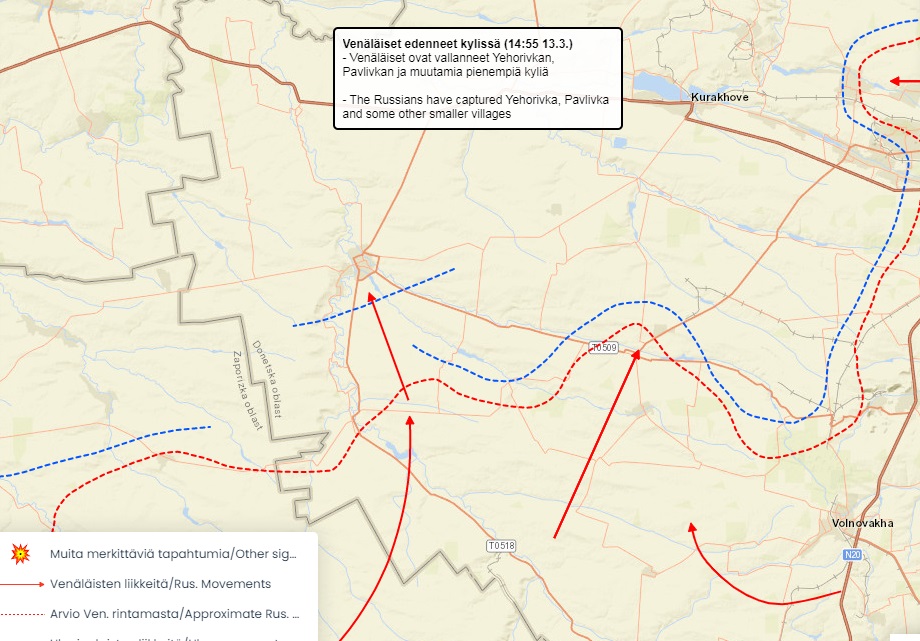
- Only circumstantial supporting evidence is available but UmoD’s statement that the assault is now directed at the town of Velyka Novosilka makes sense given it’s a crossroads. Between the muddy terrain in southeastern Ukraine and the seeming failure of Russian forces to adequately adapt to conditions, they are very much road-bound; an observation the UK Ministry of Defense has echoed on their official Twitter account. Russia’s advantage in maneuver assets has been reduced even more than I expected by this, perhaps explaining their glacial rate of advance in what is otherwise open terrain that favors their artillery superiority (as well as the limited forces they seem to have committed to this theater.)
- It remains to be seen if Ukraine’s forces will fight for every inch in this area to buy as much time as possible, or if they’re holding to buy time for a fallback defensive line to be entrenched. The answer may be both, as in terrain like this, against heavily mechanized forces, defense-in-depth is the favored response.
- Russian units are moving deeper into Mariupol proper now. The hospital reported to have been taken is only 5km from the city center, and this widely-circulated video of a “rebel” T-64 getting lit up by multiple RPGs at once geolocates to deeper in the western part of the city (47.098538, 37.523711). This fight is far, far from over however. Russia just deliberately bombed a civilian bomb shelter that had been marked with “CHILDREN” outside of it in the city. Given the nature and quality of the units defending the city, and deliberate, shameless murders like this, I do not expect Mariupol’s defenders to surrender. A fight to the death is likely. Furthermore, Mariupol was the likely main objective of Russia’s direct attack on Ukraine in 2014; as it was the closest major city to the Donbas frontline, and sat on the main highway along the Azov coast to the Crimean peninsula; ergo it was always a mandatory target for both the Russian-puppeered “rebels” and Russian forces proper; as securing a land link to the Crimean peninsula was a major goal of Russia’s eight years of low and high intensity warfare in Ukraine. In other words the city was heavily fortified for almost a decade. These people will fight, and fight like hell. Even if Mariupol falls, the Russians are going to pay a very dear price for it; one they can scarce afford.
Kherson/Mykolaiv AOO
The biggest news is a rare detailed report of the battle of Voznesensk, the town 80km north-west of Mykolaiv along the banks of the Southern Bug river that marks the furthest west known advance of Russian forces. What seemed like a probing attack (to the best of our knowledge at the time) was apparently a brutal two-day battle that saw the Russian BTG committed to the thrust effectively destroyed as a fighting unit. The Wall Street Journal’s in-depth article is a rare in-detail look at ground facts (here is an archive.is link that bypasses their fucking paywall.) This battle reportedly took place on March 2nd and 3rd, the date when their thrust was first noted. It appears that instead of bugging out once they met stiff resistance, they went all-in trying to take the town (and its nuclear power plant) and were simply obliterated. According to the Ukrainian city officials, the Russian BTG left 30 of their 43 AFVs behind when they retreated “fifty miles” (probably to the occupied northern suburb towns of Mykolaiv.) 100ish Russian troops were reported slain; which would account for 1/3rd of a mechanized company (rendering it combat-ineffective) or easily a battalion worth of tank crews.
The entire article is worth a read. It reveals much about how the fighting is preceeding, how Russian troops are comporting themselves in general, and how Ukrainian professional soldiers, reserve militiamen and even civilians and civilian authorities worked together to defeat them. Of especial note: “Russian troops in two Ural trucks were preparing to assemble and set up 120mm mortars on the wheat field, but they got only as far as unloading the ammunition before Ukrainian shelling began.”
(Odd note – it says the municipal swimming pool was hit by a missile strike. The building reported hit in Rubizhne is also a municipal swimming pool. Whether this an extension of the terror strategy or just strikes meant to contaminate a source of relatively clean water in case a siege is required, I cannot say. Either way, Russian forces commitment to outright savage murder is hideous in the extreme.)
The other major story from this AOO is confirmation that the Ukrainians were telling the truth about their two attacks (March 6th and March 15th) on Kherson’s airport and destroying helicopters there. And not just helicopters, but supply trucks and logistical vehicles (much dispersion so revetments such artillery hardening.) Commercial satellite imagery from the 12th shows how the first attack was conducted. Note the red dots marking MLRS rocket impacts, compared to pre-strike commercial SAR imagery of where helicopters were located. To be blunt, those were not MLRS rockets. They were either either incredibly precise shooting by some Ukrainian self-propelled howitzers that did a thunder run down the road from Mykolaiv to get in range... or we have hard evidence of Ukraine’s first confirmed usage of their limited stockpile of guided 300mm MLRS rockets.
- Remember this the next time some asshole tells you that you can’t fight a tank with an AR-15. It’s not tanks searching for small arms, is it?
- Yet another example of rear-echelon equipment (in this case, towed guns) being captured by Ukrainian forces near Mykolaiv proper. The guns were limbered for transport and not in their revetments, implying they were abandoned simply because their prime movers (towing trucks) were hit or otherwise nonfunctional – or perhaps a Ukrainian advance came across them before they could hook them up and they fled. It’s odd that they left ammo behind as well, even if it’s only a ready pile near a firing pit. There’s no visible damage to the guns, no attempt to decommission them by shoving a thermite grenade into the breech, so it seems the Russians left in a hurry. Note the terrain; they’re nowhere near even the suburbs of Mykolaiv. It seems the Ukrainians are actively contesting the area.
- Suffice to say that Russian efforts on the western side of the Dnieper haven’t had much success. Given these developments I think UMoD statements concerning the halting of Russian thrusts northward closer to the west bank of the Dnieper are most likely credible. Even without regular mechanized forces or tank support, one town brought not only halted a BTG, but almost completely destroyed it in detail. I doubt the Russians are having much luck elsewhere given how they are splitting their forces up so much.
That’s the big things. There’s an entire general update to go but I need to sleep for now.
General Update (March 15-17)
There’s a LOT to talk about.
Sitrep: Logistics/OOB/TO&E
- Russia is desperately scraping for more materiel. You’ve all seen the media reports that Putin asked China for help by now – but as this reporter points out when multiple “favored” publications get the same information from their anonymous sources at the same time, that’s because the government wants the information out there. The message is “we know all about this and we are watching.”
- Russia is also scraping for more troops. There’s video evidence of them emptying out their garrison and occupation forces in their various little puppet states in occupied territory of prior victims. This is the forces in occupied Georgia clearly mobilizing. [2][3] (Also recall the train seen on March 5th moving old garrison vehicles from the Russian far east.) The UK Ministry of Defence additionally alleges they’re pulling troops from garrisons in Armenia and even from the Pacific Fleet. Given the paucity of infantry in the average BTG, the intense urban combat they’re facing and the Ukrainian advantage in manpower from both reservists, Territorial Defense Forces and new civilian volunteers, this is unsurprising.
- President Zelensky announced that Ukraine is now fully mobilized – that means the 200,000 reservists of the Ukrainian army are fully prepared for action. Given that three out of five of Ukraine’s tank regiments are reserve regiments, this is a big deal and means a lot for Ukraine’s usable maneuver forces.
- POTUS publicly called out the massive refugee problem on the 15th, likely indicating that NATO is indeed considering the strategic consequences for Western Europe. He also acknowledged “12 million people who require humanitarian assistance inside Ukraine” and announced a “global humanitarian response with our partners in Europe and beyond.” Berlin Airlift is now on the table.
- Russian cruise/ballistic missile strikes now stand at roughly 950. As Russia grows more desperate their willingness to dig into stocks previously set as reserved against wider war(s) will grow, but there’s a limit even to their total stockpile. It’s uncertain when they will reach it.
- NATO is nervous; it’s announced intention to deploy “substantially more” forces to its eastern border, in addition to the Rapid Reaction Force which has been mobilized and deployed for the first time in NATO’s history.
- First sighting of a TDF technical, using one of the 12.7x108mm (.50 caliber-ski) machine guns they’ve been seen to be stripping off every abandoned T-72 they find. Technicals work; which is why armies use them too – even if it’s just a pickup truck and not an HMMV with the gun mounted, it’s far better than nothing and provides some badly-needed heavier weaponry to TDF units.
- Possible first sighting of a Russian “gun truck” from both Ukrainian POV (drone and personnel) and Russian (captured dashcam.) “Gun Trucks” are a simple supply route/convoy security measure; an open-topped APC improvised by adding armored sides to supply trucks. These were invented by the US in Vietnam, and then re-invented for Iraq because even though a dedicated convoy security IFV was made for Vietnam and is still in service, there weren’t enough.
- Russia is learning, but whether they’re learning fast enough to stanch the losses before they become decisive, and whether or not they have the rear-area logistical support to put those lessons into action remains to be seen. Every welder in Ukraine is making tank barricades. How many welders can Russia lay ahold of near the front, where the vehicles requiring modification are? We will see.
- Commercial satellite imagery provides a good idea of how heavily Russia is using their strategic airlift capabilities to ferry supplies to the operational area.
- As this account (and half the internet) has noticed, Russian forces in general are lacking in more advanced equipment, with night vision goggles especially scarce. (One of the contributors to the @UAWeapons account is @CalibreObscura, a mutual of mine before I was yeeted from birdsite, and a very thorough OSINT analyst who’s been tracking the informal Middle East black arms market on various social media for years. The other contributor, @ArmoryBazaar is also known to me of old. They’ve been observing patterns in light infantry TO&E gleaned from social media posts for years. These guys are good.)
Western material support updates:
- UK confirms they are sending Starstreak missiles. While there’s doubts among some as to the Starstreak’s usefulness compared to the Javelin against aircraft, the Starstreak has a credible secondary anti-IFV capability, and the pedestal mount system (which includes an automatic tracker and a passive volume-search IRST system to cue it) is the only MANPADS system which can be credited with an anti-cruise missile capability greater than “extremely notional.” Anti-PGM point defense is one of Ukraine’s keenest needs.
- The US’s new support package includes 800 more Stinger missiles (possibly of a newer bloc than the ones previously supplied,) 2,000 more Javelins, 1,000 “light anti-armor weapons” (likely M-72A7 LAWs; will likely include specialized variants such as the Fire From Enclosure and Anti-Structure Munition models for use in urban combat), and 6,000 AT-4 disposable AT weapons (which can absolutely threaten tanks.) Also included are 100 “tactical unmanned aerial systems”, 100 grenade launchers, 5,000 rifles, 1,000 pistols, 400 machine guns and 400 shotguns (all likely for SOF use,) and most significantly, over twenty million rounds of various small arms and grenade launcher/mortar rounds. 25,000 sets of body armor and helmets are also included.
- The small arms are significant: see this reporter’s Ukrainian contacts (snipers he met/interviewed a week before the invasion) explaining their supply issues. They’re using .308 hunting rounds because they can’t get steel-core ammo that’d penetrate foliage and light cover reliably. Many also purchased their own precision rifles and optics from the US with personal funds, so there’s little standardization of equipment; and more specialized, higher-power rifles and ammo (such as .338 Lapua). They don’t even have good man-portable thermal camera observation systems (like this device) and observation/recon/artillery spotting is a huge part of a sniper’s job. The numbers of weapons being promised are peanuts compared to the vast stocks of old Soviet rifles the Ukrainians are handing out en-masse to volunteers; the weapons and (some of) the ammo America’s sending are almost certainly specialized high-end weapons to fill needed niches like the ones these snipers require.
- The drones are confidently alleged to be Switchblade loitering munitions. Think a Javelin but with longer range and the ability to loiter. They’re fearsome weapons. Ukrainian SOF so armed will make their current attacks on Russian artillery positions with 60mm mortars look like child’s play. One man can and will put entire gun batteries out of action by nailing their ammo truck from a safe distance.
- Given the ammo consumption rates in modern war, twenty million rounds of small arms ammunition is significant. I’ve never heard rumors that Ukraine is short on small arms ammo, but the US could definitely purchase bulk stocks from major non-NATO allies who use Warsaw pact weapons. They could also purchase from the domestic and global civilian ammunition market – major commercial manufacturers supply the bulk of ammo to civilians as well as the military market.
- The US also has military stockpiles of Warsaw Pact ammo. The US military keeps a small arsenal of Russian-designed guns and has even manufactured new copies (angering the Russian firms owning the patents) for the benefit of Special Forces who train troops from allied nations with Warsaw Pact weapons in their TO&E. In fact, the American company Airtronic makes a clone of the RPG-7 and its most common ammunition for nations who need commonality with old Soviet era bulk stockpiles but want a launcher with modern features, picatinny rails and without 40 years of rust and dings. And, in fact, this launcher has already been seen in Ukraine.
- The amount of body armor being donated is absolutely massive. It’s enough to fully equip two divisions worth of frontline infantry. Possibly three (when one considers rear echelon/support personnel will probably not be wearing it.)
- US also officially and openly declared they’re working to source Soviet-era SAMs the Ukrainians can immediately field, both systems and missile stocks, likely from NATO member states with old stockpiles.
- Note these SAMs can also engage cruise missiles effectively, unlike MANPADs, providing badly needed point defense capacity.
Sitrep: Operational/Tactical developments
- A good look at the kind of terrain Ukrainian forces are fighting in. This looks likely to be around Kharkiv or Sumy, though you can see this kind of terrain in some parts of the northwest around Kyiv as well. It’s not nearly as bad as the south; but you can see this is going to be pretty good tank country once the ground conditions improve (and they very clearly haven’t yet in this footage, ick.) But as you can see, there’s still some cover and concealment for infantry to work with. The unfamiliar would be surprised at how little it takes to conceal an infantryman, or how seemingly flat ground can have shallow rises and falls that provide just enough dirt to shield a soldier from bullets. This doesn’t just benefit Special Forces, but also the Territorial Defense Force, as those reservists are locals who’ve lived in their local area and know it intimately.
- Ground conditions continue to be absolutely horrible across the country, even further north (this is allegedly Sumy oblast) where frequently-tilled farm fields are rare. As this entire column of very badly bogged-in T-80U’s show, Russian forces still aren’t doing “route reconnaissance,” sending a lighter vehicle(s) ahead to find out if the ground is muddy or not before an entire armored platoon charges in and gets stuck fast. RE: my comments yesterday about Russia still failing to substantially adapt their behavior to conditions.
- In case anyone wondered, American ISTAR support continues, including our old friend FORTE11 and an E-8C JOINT STARS with its long-range ground-moving-target-indicator radar that can track the movements of Russian ground formations from an impressive distance.
- The Russian UAV that briefly transgressed Polish airspace before being shot down by Ukrainian air defenses isn’t a near-miss with Article V as some have hyperventilated. It does indicate that Russia is finally attempting to locate the flow of crucial supplies coming into Ukraine over the Polish border so it can attempt to interdict it with airstrikes or standoff precision munitions.
- The drone being shot down should tell you what their chances are of succeeding at that. Very ISTAR. Much Recon. So killchain.
- Also note this engagement was geolocated and the Russian SAM was parked directly beside a school.
That’s the big things for now, naturally I’m sure I forgot some. Maneuver update later today; presuming there’s much maneuver to repor-
- Right, I almost forgot – Russia bombarded the Odessa area on the evening of the 15th and reportedly shelled the shore with ships, but to nobody’s surprise declined to commit suicide by attempting an opposed landing without land support. At best they seem to be attempting feints to draw away Ukrainian regular forces.
- Vasiliy Bykov, (Pennant No. 368) was finally seen again without any obvious battle damage, so it can’t be the ship hit by a Ukrainian Grad from the Odessa-area shore. The civilian ship seen to be smoking from Odessa last week was recently spotted still smoking in satellite imagery – but at coordinates 46.3692, 31.1203 which is a good 15 nautical miles (16.63 statute miles) offshore. Typically you can only see ships about 12 miles out to sea, and in the footage released the day after the MLRS strike a smoking hull was clearly visible, not just a smoke plume. Also, that ship appeared to be either white or haze gray. The civilian ship hit off Odessa and videotaped smoking on the horizon was either the Namura Queen, Lord Nelson or Helt, and none color match. I’m pretty sure the Ukrainians hit something, but it wasn’t any civilian ship in the area that we already know about.
- Why the Russians declined to post images of an undamaged No. 368 after the UMoD specifically identified it as the ship hit is unknown. It seems like the lowest hanging fruit possible but despite their characteristically smug style of diplomatic shitposting in past years, Russia was silent on the matter.
Okay that’s it for real, maneuver later today
D+21 (March 17th) Maneuver Sitrep (posted 18th @3PM)
Kyiv AOO
- Not much change from the last report, aside from this report from a volunteer confirming my prior assessments that active fighting has pushed east, away from the Kyiv suburb of Brovary. “The front is active, all these small villages east of Boryspil and Brovary are the front. “ Interestingly, it also describes the operations in brief – artillery preparation followed by infantry combat in the villages.
- While this report is secondhand, it comes from a reporter who’s been on the ground in Ukraine since 2014, with an extensive number of sources and has proven reliable in the past.
Kharkiv/Donbas AOO
- Ukrainian defensive line along the northeast seems to be slipping. Rubizhne, the big suburb north of Severodonetsk, was apparently taken by “rebel” forces yesterday.
- An anonymous US defense official has said that Izyum is assessed to be in Russian hands now. (At time of writing I can’t find the tweet of the original reporter making the claim.) I’m seeing plenty of evidence of fighting [1] [2] but since Izyum (or “Izum”) has been contested for at least a week now this could be old evidence. I’m also seeing scattered reports that Ukrainian army units still hold part of the city. Given the terrain this would be likely in any case given the Siverskyi Donets river divides the city in two. That would certainly slow an assault, even a successful one – and given the layout, from either north or south, as well. I delayed this update in hopes of getting more concrete information in Izyum but none has been forthcoming despite an extra 12~ hours.

- ORBAT analysis indicates that Russia may have deployed some operational reserves to this region. This may have something to do with UMoD’s claim that Russia’s 252nd Motor Rifle Regiment (or rather, BTGs comprised from it) took 30% casualties, (in the area between Kharkiv and Izum specifically) which would mean they’re combat ineffective. But there hasn’t been enough footage from this area that I’ve seen to confirm either way.
Southern AOO
- No reported changes to the southern defensive line.
- The fighting in Mariupol is still heavy.
Kherson AOO
- Ukrainian units have advanced from Mykolaiv to the village of Possad Pokrowske. This video released by Ukrainian forces shows a sign at the 2-second mark – note that the first line looks identical to the Russian spelling of Possad Pokrowske in Cryllic, at least according to Google Translate. Ergo I assess this as likely true. This village is about between Kherson and Mykolaiv directly on the main M14 highway:
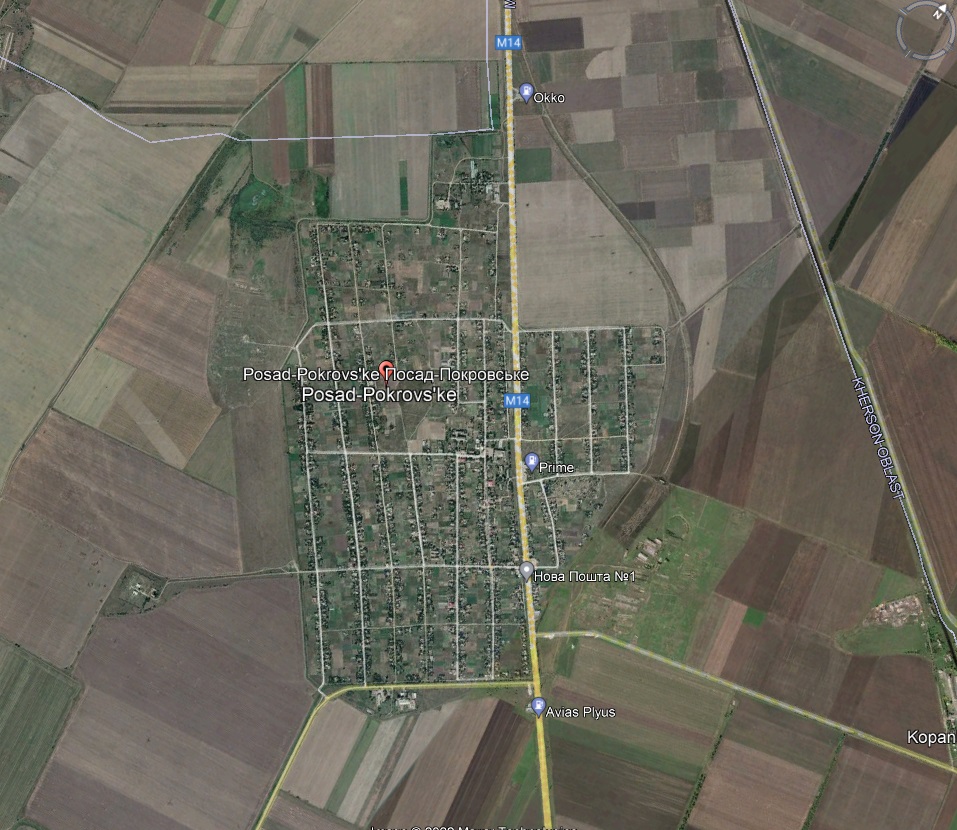
As you can see from Google Earth, this landscape is even more like a dinner plate than normal. The village is also small and mostly light residential buildings so its fortification value is low. In other words, a Ukrainian reconnaissance managing to reach this indicates that Russian forces have quite probably retreated from Mykolaiv back to Kherson, simply because there’s no good place to take a defensive posture in this terrain that isn’t either in Mykolaiv or Kherson. Despite my 12 hour delay UMoD has said nothing about this region except that Russian forces haven’t been actively advancing west (towards the Southern Bug, specifically.)
With so little information to go on, I’m going to have to do some “analysis” to get some idea of where this is likely to go. Stand by.
D+22 General update
I have a hangover so this isn’t gonna be organized
- Putin’s having a normal one. While a lot of people are indeed leaving Russia due to the escalating authoritarian crackdown the numbers aren’t necessarily significant given the country’s population. More important to ask is who is leaving – engineers? Scientists? People who have disproportionate impact on the nation’s economy and arms industry?
- Note that Pryluky this is a solid 100km east of Kyiv. A good example of how Russia’s taking attrition due to that very long line of communication. Note this was a military convoy and they were paying attention; that MRAP’s windows were open so soldiers could fire out and the MRAP managed to get off the road before it was knocked out. This is the consequences of not having some defensive depth south of their main supply route; it’s in range of enemy patrols and SOF ambushes along its entire length.
- More examples of how Ukraine is employing anti-vehicle mines. For the most part they seem to be using them at the squad/platoon level to enhance local defense or as part of ambushes; not as big monolithic area-denial weapons. Date in the first video is the 16th but I’m really unsure on the location; place-name similarities are causing problems again.
- Russian forces capturing mud-bogged Ukrainian IFV. They’re rigging a tow with a tank; looks like tracks are fine there but wheels aren’t. Good example of how General Mud restrains both side’s ability to maneuver offroad.
- First confirmed TB-2 loss. Given we’re 20+ days in, and likely a high sortie rate, these are proving to have a pretty good kill ratio.
- Russian helo pilots are now lofting rockets at areas from long range instead of approaching to actually put warheads on foreheads with anything approaching accuracy. If the location tag is accurate this also confirms ongoing fighting at Popansa, 35km south of Severodonetsk and commanding the eastern side of the Severodonetsk salient. (Only a single geolocated incendiary attack near here was previously seen.)
- If Russian tactical aviation dares not get close to their intended targets its going to severely restrict their usefulness. If they had sufficient air-launched ATGMs or other light standoff missiles (Hellfireski etc.) they’d be using them, not doing this.
- Apparently Russians have been seeing doing this before in Syria.
- I hereby dub this maneuver the “Blyat Loop.”
- Official footage released by Russia’s MoD showing drone-spotted artillery strikes seem to have one common theme – their drone’s optical sensor resolution is absolute dogshit: [1] [2] [3] The last one is especially telling; it looks like they’re operating at very high altitude (perhaps to avoid MANPADS) and just dropping bombs on wherever a lot of truck tracks meet, without being able to see if the trucks are actually still there or not. For a propaganda video, especially, you’d want to show actual vehicles getting blasted. The two Russian drone videos I linked the other day were also of this same poor quality and heavily chopped up (the strike on Ukrainian BMPs was damn near a .gif with only two frames.)
- I conclude the ISR value of Russian drones are most likely inferior to whatever Ukraine has been gifted, purchased, or built homewbrew. Given Ukraine was still the primary military electronics supplier for Russia until Russia attacked them in 2014 this is perhaps unsurprising.
- There’s no credible intelligence reason to deliberately degrade these images. These aren’t 100 million dollar Global Hawk drones; these things are affordable and also attritable (i.e. it’s expected they’re going to have pieces falling into enemy hands semi-regularly.)
- I have been reliably informed before that Russia’s optical sensors (thermal and NV) are considered poor by the standards of the West’s cutting edge stuff. Now there seems to be some empirical evidence to demonstrate that.
More stuff to talk about but it has some operational significance that I need to think about instead of just yeeting it out.
D+23 Maneuver Update + Analysis (March 19th @ 6PM)
UMoD dropped a very detailed update today which I’ve cross-reverenced with extant/independent information best as possible. Brace for arrow maps. (Imgur gallery link so you can view in glorious high[er] resolution if desired.)
Kiev AOO

UMoD hadn’t much to say about this region except that Russian forces are still not taking strong offensive action. They did, however, mention several villages by name they hadn’t before as where Russian forces are holding a defensive line. Most significant is that the Russians are as far south as Kopyliv and Motyzhn, meaning the E40 highway west to Makariv is cut. However, image evidence (not yet geolocated) and statements from local police, both from today, indicate ongoing airstrikes and mortar fire in Makariv, implying to me it’s still actively contested. Given the E40 is cut this means Ukrainian defenders are using their line of communication from the west. Contesting Makariv means further southward movement by Russian forces will be difficult; even if they deign to continue fighting south through the Kyiv suburbs their advance will be narrow and vulnerable to flank and rear attacks.
East of Kyiv the update paints an interesting picture:

UMoD used the curious phrase “the enemy is trying to act” in the settlements marked by purple pins, with the phrase “trying to control the border” for the ones I put in red (east of Brovary specifically) and “maintain defensive positions” for the red-pinned locations around Chernihiv. Around Brovary it was also specifically said the Russians were not conducting active offensive operations. I interpret this to mean (as the UMoD has said of enemy forces in this and other regions repeatedly in recent days) that they’re not engaging in major offensives. Ergo, “red” areas are Russian defensive positions and purple ones, areas they are reconnoitering/patrolling/shelling; their likely future objectives.
I’ve circled Viktorivka, Nizhyn and Prylucky as these are areas I’ve (as previously reported) seen evidence of combat in – Ukrainian troops moving through Viktorivka, local official’s statements and video of MLRS shelling in Nizhyn and just yesterday the images of an ambushed convoy in the vicinity of Prylucky (the one with the Smerch sporting improvised cab armoring.) UMoD also specified enemy strength as approximately three brigades east of Brovary and three investing Chereniv, and also clarified that Chereniv is under bombardment but not ground assault.
Sum total picture is of a Ukrainian advance up the E95 in the last few days to meet an advance out of Chereniv itself, followed by Russian counter-counterattacks to cut the E95 just north of Brovary and the P67 running east, then south-east to Nizhyn by taking Lukashovka. The UMoD said Cherenihiv is “partially” blockaded, which seems right – the city can’t be considered in full communication, but neither is it conclusively cut off. (Notice Kiselivka noted as held, and Mena as a place Russians are “trying to act” in; this’d be a good Russian move to enable use of the P-12 highway and close off the apparently uninvested areas east of Chereniv.) This also jells with the US volunteer in the area I mentioned yesterday who said the fighting is in the small villages east of Brovary.
Interestingly the UMoD also indicated Romny and Nedrigailiv, about 250km east and both along the H07, as other areas of enemy operational interest. Given the H07 runs just north of Prylucky and the towns just west of Brovary that UMoD indicated as either held by Russians or as of operational interest to them, this suggests that they’re trying to widen their flank and keep Ukrainian regular forces further away from their lines of communication, which is wise.
Consider the main east-west highways available here:
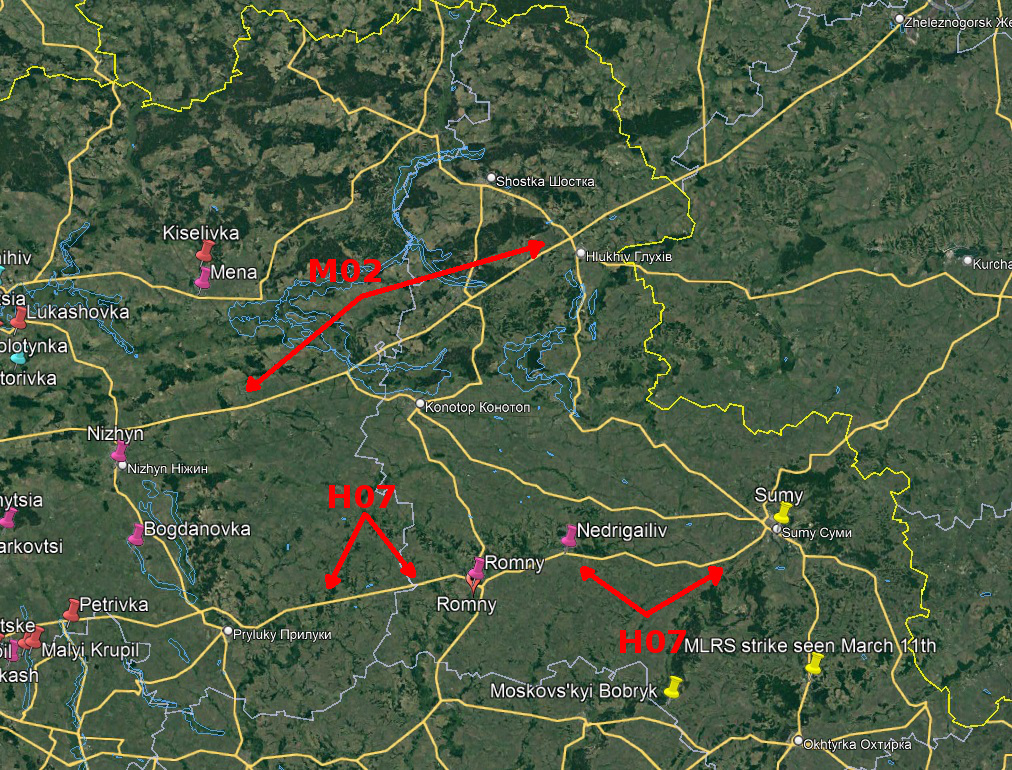
The M02 should be solidly in Russian hands (excepting local irregular TDF activities, of course) but to reach Russian operational areas east of Brovary they’d have to run through Nizhyn (on the P67 southbound) or take it all the way to the E95 running north-south near the banks of the Dnieper. The next furthest north/south connection to the less exposed H07 runs through Konotop, which is also the major rail junction in this area. There’s been little news from Konotop since the infamous visit by a Russian negotiator who had to walk through a crowd with armed grenades in each hand to guarantee his safety, aside from yesterday’s footage of knocked out Russian IFVs, so I presume it is still denied to Russian passage. Given the above it is no shock that the United Kingdom’s Ministry of Defence openly seconded the Ukrainian MoD’s assessment that Russian forces are shifting large numbers of troops to defend their supply lines, limiting their offensive potential. They either need to take Chernihiv, or take Sumy and Konotop to stop the attrition of their supply lines and logistical vehicles. Given the shifts of forces from Kharkiv towards encircling Sumy (and UMoD’s reports that Sumy is now indeed under preparatory bombardment and probing attacks again) it’s most likely that Russian forces east of Bovary will try to hold the area till operations further East are completed.
I take pains to note that lines on maps are always arbitrary and don’t ever perfectly represent “controlled area.” The fighting is fluid, the reach of artillery is long, and infantry can be very sneaky.
k AIzyum-SeverodonetsOO
No big changes in Kharkiv reported or rumored either officially or unofficially; likely due to reported shifts of Russian forces northward to deal with Sumy. UMoD specifically noted intensive ISR efforts around Kharkiv with Orlan-10 drones. UMoD specifically reused their wording vis a vis Brovary area for the areas around Izuym, i.e. “trying to act” but expressly not engaging in offensives. UMoD also specified that Izuym is still contested. The Siverskyi Donets river is a good 50m wide where it winds through the heart of Izyum and the Ukrainians will have had those bridges wired to blow by now; I’d hazard a guess that (at worst) Russian forces are in northwest Izyum and Ukrainian forces, southeast, with the river between them. As demonstrated by footage of Ukrainian artillery blasting a truck park just south of Izyum on the 16th Russian efforts to bridge the Donets and flank Izyum have obviously been in progress. In other words, even if Russian efforts around here have paused for resupply and regrouping, the actual frontline situation here is pretty fluid. All prior points about the reach of artillery and the sneakiness of infantry apply here.
UMoD has stated explicitly that Rubizhne is still contested, with Russian forces gaining a foothold in the northwestern parts of the city. Settlements marked with the red ! were noted explicitly as the focus of Russian offensives and the arrows identify the three most prioritized goals of Russian forces – Rubizhne/Severodonetsk and Popasna. (Popasna was under incendiary shelling on March 14th as established by geolocated footage.)
While there’s little to confirm it, if we take UMoD’s latest report at face value, the (scattered) evidence of heavy fighting around Izyum and photos of apparently captured documents showing the 26th Guards Tank Regiment present near Izyum, which should be up near Sumy, (thus implying commitment of an operational reserve to Izyum,) this would all suggest that Russian forces near Izyum have exhausted their immediate capacity for offensive action. Whether Russian forces have consequently shifted their focus to open areas southwest of Rubizhne/Severodontesk and Popansa to encircle the city there, or if those efforts were simultaneous already I cannot say.
Dontesk-Mariupol, Southeastern AOO
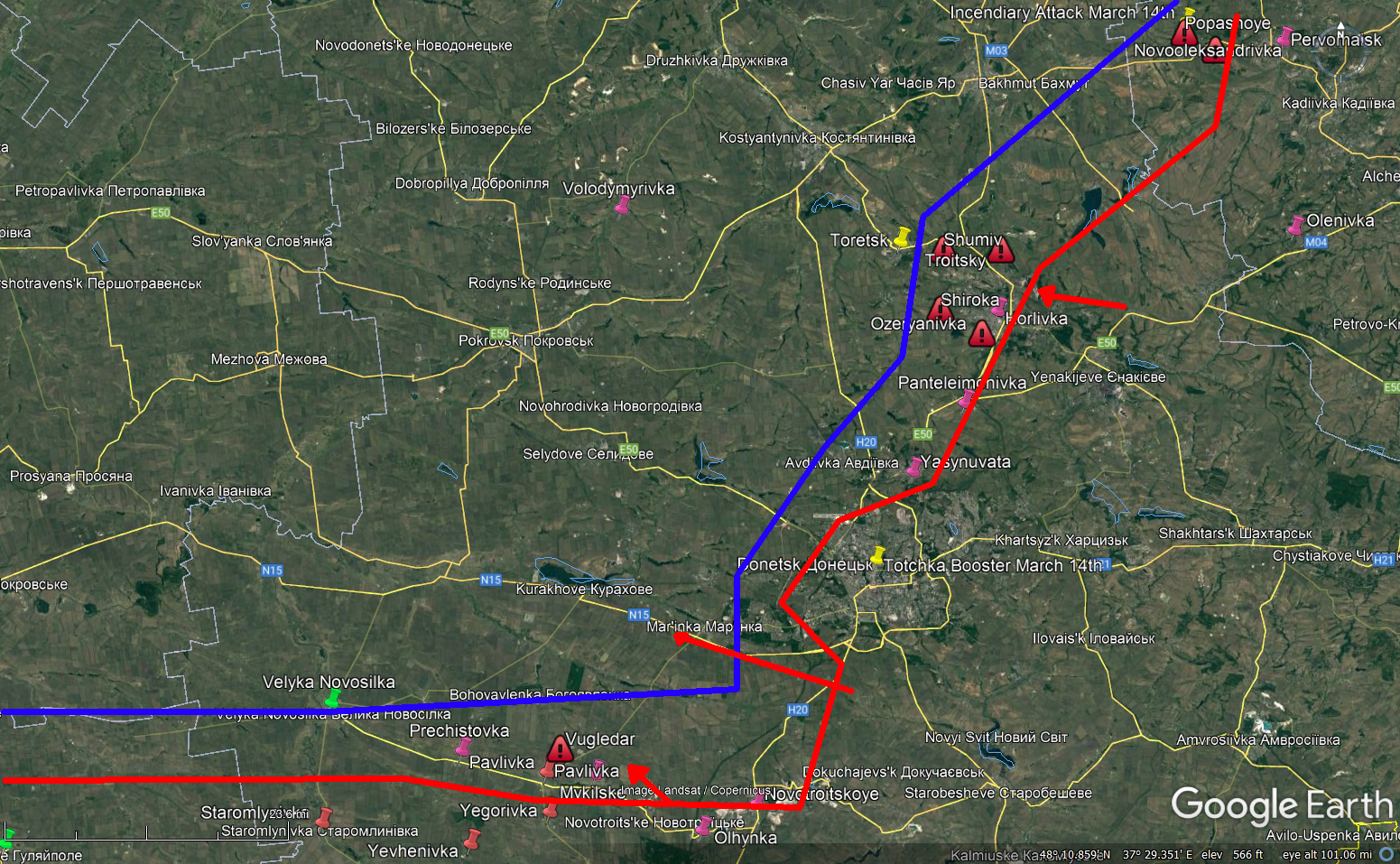
Around Severodonetsk UMoD identifies the ! marked settlements as areas of Russian assaults and notes that enemy offensive activity; including shelling and smaller scale probes are active throughout the entire region. In addition, recently geolocated video shows Russian troops in Maryinka, southwest of Dontesk city proper. As for Yasynuvata, this is very near where the video of a Russian tank hitting a mine on the 15th was geolocated to. The area was the frontline of the Donbas conflict, and since the city was a major center of gravity for that the Russians may be pushing towards Toretsk more to avoid the problems of the heavy entrenchments near the city.
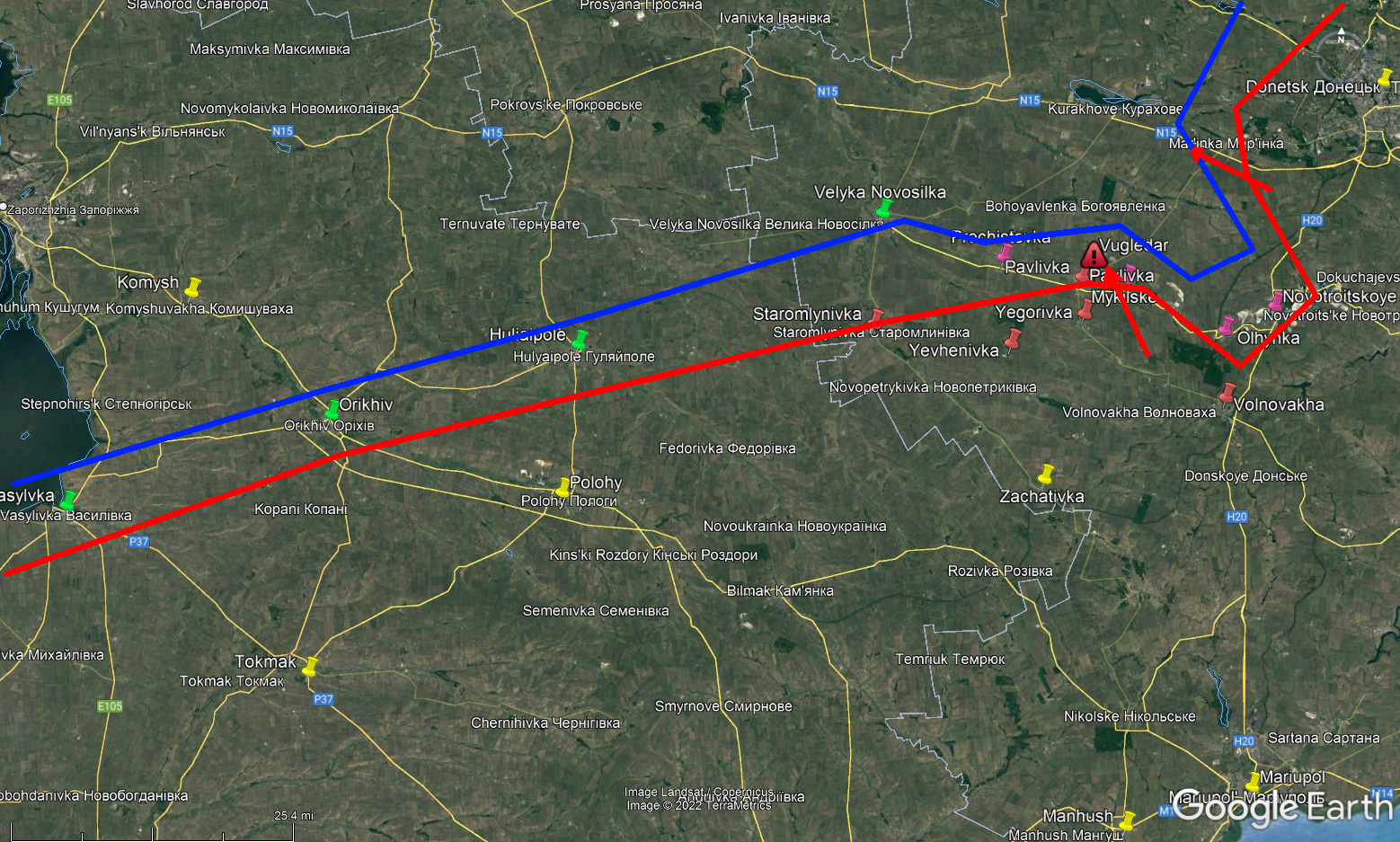
There’s still very little direct evidence to confirm it, but there’s at least some social media chatter from locals (or those who know a guy who thinks he knows a local etc.) indicating this is the current defensive line in the south. UMoD says that only harrasing attacks and shelling are taking place around Orikhiv and Huliaipole, with the settlements indicated in purple here being contested and Vugledar being the primary point of the assault – perhaps to encircle the crossroads at Novotroitskoye. I’ve seen mention of civilian evacuees from Vugledar on Twitter dating to the 15th; aside from that, no direct evidence of operations around here.
Also, Mariuopol is still Ukrainian, though that’s not a surprise at this point. I suppose Chechens aren’t as good at city fighting as they thought.
Kherson AOO

Yesterday UMoD specified that Russian forces retreated from Mykolaiv on the evening of the 17th, and as I’ve previously said, this makes sense for them to do. Given the many good reasons for them to not attack into cities if they can help it, they would either invest Mykolaiv or withdraw to around Kherson, as the terrain doesn’t reward forward defense here. The Ukrainian probe to Possad-Pokrovske yesterday would’ve been impossible if Russian forces were investing the city. Of interest are these images of a few knocked out Russian thin-skinned vehicles allegedly knocked out while leaving Mykolaiv for Kherson, yesterday. Whilst this can’t be geolocated it definitely matches the terrain around Mykolaiv and the previously observed trend of long-range artillery assets in rural areas around the city being knocked out by Ukrainian forces. In other words, given that the area around Mykolaiv have obviously been effectively contested by Ukrainian forces, hitting Russian rear areas significantly outside the city, it’s plausible the Russians would just cut their losses and defend Kherson.
Red-pin marked settlements are where the UMoD today said the Russian advance has been decisively halted. The red line running up the TI505 road is giving Russia the benefit of the doubt. Theoretically they should be able to protect that LOC with their airpower, drone and artillery advantage, especially in such open terrain with little cover. Practically, with 50 helicopters at Kherson, at least some of which were attack birds, they were unable to stop Ukraine from running some MLRS up into long range and plastering their airfield, so who fucking knows? The TI505 is only a two lane road, so they may have opted to use surface roads a little further east to exploit the barrier of the Inhulets River to help protect their flank from any counterattacks. The rail line from Kherson is just west of the TI505, (and thus the river) as well, though. tl;dr everything I said about logistics around here days ago still applies.
Conclusions/Caveats
- Actual direct verification of action or the character of it in most of these areas continues to be incredibly scarce compared to what we’d obviously prefer, but it all passes the sanity check at least.
- Some village names just don’t survive Google Translate, still others share their names with multiple others and I have to guess which one UMoD are talking about, and on occasion Google directs me to a village with a different name than the one I searched for, which, upon investigation, turns out to have been re-named in 2015 as part of a general shedding of Soviet-era nomenclature. I am missing some things that natives won’t.
- UMoD continues to be sparse in their force assessments and rarely names specific Ukrainian regiments involved in action in any of these areas.
- Minor note: I have reversed my prior policy and am now spelling it “Kyiv” specifically because it annoys copeniks.
I’m going to add some more in-depth “analysis” of exactly what the fighting/maneuver options along the Donbas front are a bit later today if at all possible.
D+24 Operational Analysis – What Ukraine Will Do Next
I believe it’s time to move past summary of possible ground facts and listing theoretical options to make some more concrete predictions. However, there are a few significant developments in the terms of Russia’s operational abilities that have yet to be covered, and must be to put together the complete picture.
Let’s talk about roads and bridges.
Most of what the United Kingdom’s Ministry of Defence publicly states about the progress of the Ukrainian war is no surprise; it’s mainly useful as confirmation that the trends noticed through the narrow window of OSINT are indeed an accurate enough sampling. But on the 17th the UK’s MoD pointed out something that I hadn’t seen evidence of via OSINT: that Russia had limited bridging capabilities.
The more I thought about it, the more it fit. And when added to the rest of the picture, it changes everything.
The Art and Science of Military Bridging
Ukraine was quite obviously not expecting Putin to seriously invade with maximalist aims, as their government’s failure to initiate full mobilization till the very eve of war shows. This was responsible for many early setbacks, the most damning being the quick capture of the Kherson and Nova Kharkova bridges before serious efforts could be made to wire them to blow. Since then, however, the Ukrainians have clearly adjusted their tactics; wiring major river crossings for demolition ahead of time and engaging in a spree of destruction against smaller bridges throughout the country. Much like the mud, I thought this would prove a hindrance, but not a show stopper. Because just like mud, blown bridges are the norm in warfare, and while they slow an advance, they will not substantially stop one. The art and science of military bridging has been a necessity since ancient times when men fought with sling and steel. Demolishing bridges is due diligence for any defender, and it’s due diligence for the attacker to be prepared to deal with it. Like everything else when it comes to attack versus defense, it’s easier to create a problem than to surmount it; the natural friction of war that any attacker must plan for. With Russia having such an overall materiel advantage, I never thought about it past that – as I’ve said many times in my prior updates, rivers are obstacles, but not insurmountable ones.
But that does not mean it is easy.
The most common bridge in the history of warfare has been the humble pontoon bridge, and it’s much the same today. The definitive modern version is a Soviet invention, the PMP floating bridge, a design so clever America simply copied it wholesale, with the rest of the modern world soon following. It’s an elegant design that incorporates the road deck and the sealed float (“pontoon”) in one package that’s hinged to fold up compact on the back of a truck. A bridging battalion backs their trucks up to the river and dumps them off one at a time, and men can either wrangle them together in the shallows, then swing the completed length over (letting the current help) to reach the far shore, or use small motorboats (also unloaded from trucks) to nudge them together across the river. With the boats lashed to a few pontoon sections, they can also form rafts for ferrying vehicles across open water. He’s the US Army Reserve demonstrating the system in action.
There’s other options, of course, such as wheeled amphibious vehicles with built-in pontoons that can drive into the water, swim into a conga line and rotate their built-in road decking to interlock with each other. Or that delightful British invention, the Mexeflote, a folding pontoon system that comes with a modular motorized attachment to become a self powered raft, an idea others immediately and shamelessly stole.
All these marvels of combat engineering have one thing in common – they’re basically boats, and if you poke holes in them, they sink.
Your enemy will be trying extremely hard to poke holes in them – and every weapon in the modern military arsenal, starting with a 9mm pistol on upwards, is quite capable of doing it.
There’s other bridges, of course; made of steel girders with nary a float involved. But they take a long time to set up and a long time to take down and relocate, and once they enemy figures out where they are, they’ll dump artillery fire on it. Even if the bridge survives, the soft-skin trucked moving over and past it won’t be so lucky. The pontoon bridge defines bridging ops because of its speed. It’s the only real option for maintaining speed of advance and freedom of maneuver. An army using girder bridges will be outmaneuvered and outflanked by one using pontoon bridges.
Thus, bridging ops revolve around letting nothing shoot at the bridge. Stealth is of course the most potent asset here, aided greatly by the system’s speed. Together these equal time; time to move forces and sufficient supply over the connection before it’s found and destroyed. Then there’s space; as your vanguard force widens their bridgehead to find, fix and push the enemy further from the river, as well as gaining and securing additional bridging sites for your bridge to move to – standard doctrine for “pulsed” bridge ops varies with army, era and situation, but every two hours is the one I’ve heard – gain the space before then, lest you run out of time. And of course the last aspect of war, force. When the King of war is pitched against something as delicate as an aluminum float, the results are inevitable. Attack helicopters must roam far and wide, hunting down and destroying enemy artillery, and should they open up on the bridgehead your tubes must be firing counter-battery before the first enemy shell has even landed.
In other words, river crossings are friction, and like any other friction, overcoming it depends on mastery of the same operational elements that dictate any other military action – time, space and force. If you cannot control space, if you cannot buy time, if you cannot apply force, you may muddle on when things are going your way, but when a real test comes you will pay, and you will pay in blood.
And that’s exactly what is happening to the Russians.
Friction Bleeds Force
Ukrainian forces are blasting Russian bridges left and right, when they’re not ambushing the bridgeheads. They’re setting up bridges inside Ukrainian artillery range and leaving them there till they’re found and destroyed. They’ve got all the drones and attack helicopters anyone could ask for, but still can’t keep their major forward tac-air bases from being plastered, much less conduct effective counterbattery before MLRS nails their bridgeheads and scoots away. They have a shortage of infantry dismounts for conducting aggressive patrolling and while they’ve some tactical vehicleborne EW systems they’ve no man-portable jammers to counter the small backpack drones they themselves employ and should have been expecting. Nor have they adapted their tactics for the reality of a war where both sides have good frontline ISR due to a surplus of drones and a paucity of effective EW counters. From what little footage of their own operations they’ve released, they fire precious (bulky and costly to ship) MLRS rockets (unitary warhead, no less) to engage single squads, rely on laser-guided munitions when attacking stationary targets, and are apparently using their TOS-1 thermobarics more often against targets in the field than against cities, which they instead pepper with frag-only sub-munitions. And on top of all that, even if they learn to properly protect their supply convoys their movements will still be given away by the same hilarious lack of secure communications capability that’s already seen one Russian general slain by a prompt Ukrainian artillery strike, making it unlikely they’ll be able to surge sufficient vehicles over a bridge fast enough. And even when they do they stop and are promptly shelled by accurate Ukrainian tubes instead of keeping on the move.
And there’s a lot of rivers in Ukraine – in the south and eastern areas especially. They are big and small, and while the small ones can be crossed more simply with a vehicle-launched bridge, they also tend to be found where rivers split and wind, and as the snowmelt continues and spring precipitation starts in earnest those wet marshy areas will become veritable bogs, requiring road building with materiel they did not bring and cannot efficiently collect with tools they do not have – how many chainsaws did they pack, if they’re issuing expired rations and ERA bags without the ERA?
Wherever there is friction this story repeats, and the Ukrainians have committed heavily and fully to creating as much of it as possible.
And only going by what we have actually seen, verified, and counted as destroyed, the Russian’s loss rates are clearly unsustainable. Even if you posit that the Ukrainians are losing forces – both personnel and equipment at similar rates – it still won’t save Russia, as the attacker is always the one facing more friction. Hence why attackers must mass more something to win; they need to overcome the built-in friction defenders can generate, especially defenders in their home territory. They’re bleeding force fast, time is not on their side, not with their nation embargoed by a world that’s gleefully pouring money and resources into their enemy’s unassailable rear areas, and they are gaining space so very, very slowly.
Blyatkrieg Redux
Now that we have the full story of the battle of Voznesensk we can appreciate Blyatkrieg in all its moronic glory, with the bridges completing the picture. When that single BTG was first reported has having dashed up there I saw it as another attempt at a stolen march, the “blitz” part of the blitzkrieg they were going for; rebuffed in part by defense in depth ( Territorial Defense Forces and mobilized reserves garrisoned nearby) and a very tenuous supply line (TDF + Mykolaiv in artillery range of their MSR.) And subsequent operations explicable by recon; the same reason vehicles were running around singly or in twos earlier on; compensating for a lack of aerial ISR as they searched for a good crossing point over the Bug for follow-on forces.
Instead, we know know, this single BTG attacked Voznesnsk rigorously for two days, and a combination of local Territorial Defense militia, on-the-spot civilian volunteers and resistance and regular Ukrainian forces (including a small SOF recon element with Javelin missiles) completely crushed them. All this, apparently, to try and take a bridge that had already been destroyed. One-fourth of their personnel killed (perhaps) and a staggering 30 of 43 vehicles (assuredly) destroyed. They did not properly assess the situation and use their mobility to retreat to friendly forces. By the time they realized they were outmatched they had already been routed. Whatever unit that was, it’s combat-ineffective now.
Given this, the claims of an entire BTG being rendered combat-ineffective near Izyum scan true. Plenty of things in the WSJ article scan true to what we’ve seen elsewhere – Russian soldiers looting for food, prompt and accurate Ukrainian artillery and effective counterbattery, and now – a bridge the enemy apparently needed worse than we could’ve known at the time. Even with the paucity of information and the skew every account will have, a pattern’s emerging and it’s undeniable. And now it’s clear why the Russians are advancing so very, very slowly in the south.
A modern “map recon” of the southern and eastern (Donetsk) fronts, using google Street View to put overhead imagery into context, makes one realize that the Ukrainians can defend this terrain, especially against an enemy channelized by roads and mud. Water is frequent in this terrain, and it tends to coincide with habitations, settlements, and treelines. There is cover, sometimes very good cover: berms of irrigation channels reinforced with concrete, sunken ground, low brick walls that seem popular in Eastern Europe, etc. No matter how wide the fields are, there’s plenty of places that will slow an advance; obstacles that require tactical acumen to suppress, negotiate and/or bypass without taking undue casualties or sacrificing momentum, acumen the Russians demonstrably lack. They must have the roads, and that makes them, moreover, predictable; allowing Ukrainian defenders to predict their second and third options for advance. The road is always ambushed, the easy way is always mined, and the hard way is through close terrain bristling with RPGs.
The loss of operational momentum also affords the defenders time to entrench, made easier by massive civilian support and fighting in their home territory – their earthmovers are on-hand and come with trained, motivated operators, unlike the enemy which must bring everything with him. Because the Ukrainians will also be practicing limited “scorched earth,” they’re aware the Russians are seeking to capture in-situ supplies. I doubt a gas station is left in the occupied territories with a drop in its tanks or, failing that, intact. They can, and are, making the Russians bleed for every inch, even in the most favorable terrain the enemy could ask for.
How To Win
I’ve never formally studied the operational science of war, but what I sense of the art says this enemy – unable to mass cohesively against single points, operating with divided forces lacking internal lines of communication, unable to maneuver cross-country, and unable to maintain operational momentum when faced with complex barriers – should be attacked, ruthlessly and swift.
But the mud takes no sides, and the brutal math of attrition is clear. The only reason Russia’s making any progress on the southern and eastern fronts is a better supply situation; multiple road (and most essentially) rail links; one each through Crimea and multiple from Dontesk. Additionally there’s no TDF militia to gnaw upon their lifelines in Dontesk due to eight years of occupation.
I earlier said that the Ukrainians would soon have to make a choice as to where to commit their reserves; especially the three reserve tank regiments we’ve yet to see or hear of as conclusively committed to action. I was half right. They will need to choose, but nowhere near as soon as I thought. Russia bleeds for every kilometer taken; and while operational momentum was spent long ago they still lose everything as they advance tanks, artillery, (due to consistently excellent Ukrainian counterbattery) pontoon bridge sections, supply trucks, and LOC efficiency (more distance through hostile territory teeming with TDF.)
It’s entirely possible the enemy will eventually shatter themselves on this bulwark and the timing of counterattack will be dictated more by their collapse than by road conditions. In addition to the hints of a Russian operational reserve being committed to Izyum this morning brought evidence of VDV units fighting there as well; and yet the area remains contested and the enemy assault stalled. If these units cannot break through, than who? Even if the Russians retain combat power they’re unlikely to achieve a breakthrough that maintains the momentum needed to encircle and isolate the Donbas flank. This is exacerbated by their strategy – due to having occupied Donbas at their back and Mariupol mostly occupied, they have sufficient lines of communication to rapidly shift forces from Dontesk to the southern front. (The rail yard in Mariupol is north of the city proper; have they no counterbattery at all?) If they drove up through Velyka Novosilka or Huliaipole they could cut Ukraine in two; perhaps even invest Zaporizhzhia and Dnirpro’s eastern sides; use the Dniper’s chokepoints against the Ukrainians. Instead they batter against the eastern flank; attacking into Rubinzhe and Severodonetsk directly when all their force should be against Lyman and Popansa, avoiding urban areas that negate their advantages and enhance their enemies’.
So, Ukraine can and should wait till ground conditions allow freer operational maneuver. The enemy slowly learns, but many crippling problems (lack of reliable and secure communications) remains, and others will get worse (i.e. high leadership attrition, available engineering assets etc.) The enemy has divided his forces among multiple fronts that must work along very long external lines of communication. The question now is how to use Ukraine’s internal lines of communication to isolate one part of these forces and annihilate them. These are the options I can see:
1. East of Kyiv. Russian forces in the northwest are densely massed, very close to their base of supply in Belarus, and already digging in for siege. With Chernihiv and Kyiv still Ukrainian this force’s path around the Dnieper is long. Combined with their substandard ISR it should be possible for Ukrainian forces to cross the river south of Kyiv – e.g. at Cherkasy – and drive north for an attack at Prylucky. Motorized regiment(s) could hold the terrain around Ichnya, where it’s highly favorable for defense, and the armor could turn west and attack; crushing Russian forces against Kyiv and Chernihiv as anvils. The usefulness of this depends on how many BTGs are there to be destroyed.
2. North out of Kharkiv, pushing north of Sumy as far as possible to cut supply lines (leaving blocking forces behind for this purpose) then west. There are few good roads leading north into Belarus in this area and the main ones go through Chernihiv. I am not schooled enough to grasp if this scale of maneuver is more suitable than possibility #1 given the forces involved but if the Russians are still dispersing three whole divisions through this area to secure their lines of communication, this seems doable. It could be combined with a lesser commitment to #1 (or perhaps a drive up through Romny to Konotop) to constrain enemy maneuver, preventing them from massing forces and allowing the Ukrainian counterattack to defeat them in detail. (This could also be the main axis of the assault; benefiting from more distance from Russia proper.)
3. A breakthrough at Nova Kakhovka. UMoD stated today that Russian forces are shifting regular troops out of Kherson and substituting police forces instead; most likely to both pacify the population and to exploit the benefits of urban defense to free up badly needed military units for other fronts. Nova Kakhovka is a much smaller town and the bridge runs atop a dam; a much harder structure to demolish. Blocking forces could move south and cut off the police units in Kherson while the main force grazes Melitopol (hitting the airfield and rail yard there, with massed long range fires if possible,) then driving to Tokmak and on, seeking to drive Russian units against the southern defensive line. This could be combined with a drive south from Dnipro, but splitting forces like that is very risky.
There are other possibilities – such as a drive from Kharkiv through Kupiansk and Starobil, or an encirclement of the main force northwest of Kyiv – but they are insanely risky and would depend on a careful weighing of factors that require information only the Ukrainian general staff has. As it stands, these are the possibilities that seem most probable to me. I welcome the input of anyone who has more education in the Science and experience in the Art; obviously, you have my email.
D+24 & 25 (March 20th and 21st) Update
General Update:
Strategic:
- Serious and growing indications that Belarus is going to join the war:
- As the above collation of reports shows, Belorussian military columns are already in the far-western part of the country. UMoD fears an attack in the Volyn region of Ukraine; the furthest north-west corner of the country. Russia’s maintained a token force (a motor rifle brigade, at best) in this area since the invasion began; likely to keep some Ukrainian reserves pinned in that part of the country.
- Invading here would be incredibly risky for Russia given the very close proximity to the Polish border. Russia’s threats against Poland will likely backfire, given that the Russian army’s prowess has been demonstrated to be a fraction of what it was presumed, Poland’s immediate security interests in not having two Russian puppet states on its border, and cultural factors (Poles loathe and despise Russia for very good reasons.) Furthermore the terrain this far west is far more rugged than in the East and even local TDF personnel and reservists could make reaching Lviv to cut the Ukrainian supply line from Poland impossible.
- There’s been persistent indications that Belarus’s dictator is unwilling to stick his dick into this meatgrinder and given persistent rumblings of Belorussian civilian dissent, plus the demonstrable failure of Russia’s attack and the potential of Polish involvement it cannot be presumed that Belorussian military morale is much better. It’s entirely possible this is a feint to attempt to draw away Ukrainian troops from the battle zone.
- This could also be a feint to draw attention away from an attack by Belorussian forces already in-situ near Mazyr, who might push south on the P28 highway to help secure the Russian LOC’s western flank, and/or contribute personnel to the main efforts against Kiev. If Russian forces NW of Kiev continue digging in, however, this becomes less likely. I doubt the Belorussian military will be expected to sustain a serious advance all the way to Zhytomyr on their own, given the competence Ukraine has demonstrated so far.
- Russia’s ships in the Med have left Tartus, and seem spaced out to provide optimal radar coverage over the sea. This is useful from an intelligence perspective as it lets Russia see when NATO ISTAR sorties are flying out of Italy, Greece, Turkey or the major American regional base at Qatar. This is no threat to NATO assets – even without land-based missile and airpower the three carrier NATO task force in the northern Aegean right now could wipe this fleet with a sneeze.
Personnel and Materiel:
- Recent UMoD statements about Russia drawing on Naval Infantry units to provide replacements is being borne out by increasing sightings of Naval Infantry obituaries in local Russian media. These guys supposedly were being held in reserve for actual naval landings, but with an unsupported landing effectively suicide Russia seems to be committing them.
- Increasing reports of higher level Russian officers being killed in Ukraine. I’m not interested in dickering over exactly how many generals and of what rank were killed; it’s enough to observe that some or most of them are almost certainly actually dead, and this attrition of trained, experienced career officers is going to have a serious impact on Russian operational competence. Observe that the death of this engineer corps Colonel occurred while setting up a pontoon bridge near Izyum. (See prior discussion of military bridging etc.) If units need hand-holding from experienced officers to accomplish important tasks like that, the loss of these personnel is going to hurt a lot.
- I’ve seen several more Tochka-U boosters fired at Ukrainian targets, and most tellingly a new batch of Tochka-U launchers showed in in Belarus on a Russian heavy airlifter. As others have observed, their rough looking condition indicates they were probably just pulled out of storage, which makes sense as Russia formally retired the Tochka-U from active service years ago. Russia must be running short on long-range precision munitions; either ones they’re willing to expend or the entire stockpile in general.
- The use of a Khinzal missile may also indicate overtaxed PGM stocks, as employment as such claimed by Russia is a waste of the resource if anything else is available. The Khinzal is literally just an Iskander that’s launched from a plane. There’s nothing fancy about it. Any ballistic missile is innately hypersonic. We have had hypersonics since the fucking V-2. Journalists are too stupid to understand this.
- Related: Lviv’s crucial airframe repair depot was finally attacked, but, incredibly, commercial satellite imagery shows only four weapons impacted and they were not optimally aimed. (Local officials said six cruise missiles were fired, but two were intercepted by air defenses.) Furthermore, one missile was directed at a parking ramp that any asshole with Google Earth could determine was mostly occupied by long out-of-service MiG-23s (and two Fishbeds.) It is unclear to me how much vital equipment could be stored in a single hangar, but in general such repair depots are rather sizeable and take multiple munitions to put out of action. Given the attack on the parking ramp I find it plausible that Russian forces were attempting to hit active-duty MiG-29s that had been flown in for rapid repairs and return to service – in other words another sniping attack on airframes, not a serious attempt to destroy Ukraine’s long-term capacity to make war.
- A nice example of the high-quality equipment the Ukrainian SOF has received to complement their Western-assisted training. Note this soldier’s holding a weapon reportedly favored by the SOF (and seen often in videos of them in combat,) a domestically-built bullpup rifle, which also highlights Ukraine’s rather advanced domestic arms industry.
- The first confirmed Russian gun truck has been seen (and captured.) Note the rifle ports and the open top. The angled sides are a nice touch as well. Seems they found at least one welder.
- More and more sightings of older Russian tanks in Ukraine. The B model is 80s vintage. This is roughly akin to seeing a National Guard M-60 on the frontline. It’s not as ancient as the A model however, and a few of those have already been seen, as previously documented.
- Additionally, multiple very rare T-80UK tanks (models that were intended for export, very high-end) have been seen in Ukraine; either knocked out or captured. Also, the one-of-a-kind T80UM2 tank – a prototype for testing the Drozd active protection system – was destroyed in Sumy Oblast. Additionally yet another ancient T-72A was just captured by Ukrainian forces. Russians are scraping the bottom of the barrel for materiel.
- Increasing civilian participation in the war effort, such as civilians applying the now-classic middle eastern trick of a small consumer quadcopter dropping hand grenades. The previously seen conversion of 1950s era RKG-3 anti-tank grenades to air-dropped munitions by adding 3D printed guidance fins has already yielded results. While Middle Eastern fighters are no less inventive, the people now turning their hands to war have access to more technology and the entire stockpiles of their national military to work with.
- I am still seeing multiple instances of Russian supply trucks being captured intact with their ammunition. How much of a difference this is making I cannot say, but given the low ammunition stocks Ukraine started with, every bit helps. It’s more significant in that it shows that Russian supply lines continue to be subject to interdiction.
- I’m seeing a lot less Territorial Defense Forces securing wins against Russian supply lines. But I’m still seeing SOF ambushes and regular forces hitting supply vehicles on the regular.
- First sighting of a Russian Tornado rocket; roughly analagous to the American M31 GPS-guided “70 kilometer sniper rifle.” UMoD alleged that Russia had recently ordered production of this system to go into round-the-clock work; (like with most of Russia’s most modern weapons, they typically can’t afford many and have limited stockpiles. Where’s the T-14 Armata, again?)
- This Russian-released video looks an awful lot like a thermobaric weapon going off. Area targets are a valid use for the TOS-1 thermobaric, but given we’ve yet to hear consistent reports of thermobarics used against urban areas, one wonders if the Russians aren’t using this for counter-battery because of larger accuracy issues with their artillery.
Operational
- The decline of video evidence of TDF destruction of supply convoys likely owes to increasing Russian efforts to provide them with proper protection. That this effort has already diverted almost three divisions from frontline duties is a success. However I think I’m seeing Ukrainian SOF adapt to this as I’m seeing more and more frequent evidence of mines laid along roads and command-detonated explosives. These allow for incredible destruction without leaving the ambushers very exposed at all. The incredible effort the US and its partners had to make to deal with IED attacks in Iraq illustrate the challenges for Russian forces nicely.
- A little more confirmation that Russian forces are now focusing on their efforts in the south/east based on casualty numbers from various fronts.
- A recent Russian strike on a shopping mall garage illustrates both the challenge imposed by both sides inability to effectively engage small recon drones, and the cost to Russia of Ukrainian air-denial tactics. The mall’s garage was being used to hide and reload MLRS vehicles between strikes. You can see the Russian drone follow them back to their hideout, allowing the destruction of both the launchers and their ready ammunition stockpile. But the Russians had to expend an Iskander to engage it (far too accurate for a Tochka-U.) Weapons costly as the Iskander (or a cruise missile) are best served by reaching far into hostile rear areas and engaging big ammunition depots located in enemy “safe” territory. This target needed a 500 pound LGB or perhaps a guided MLRS munition. Apparently neither was available.
- Persistent aerial surveilance capability by both sides, with neither side being able to effectively and routinely counter it, seems to be turning this into an artillery war even more than normal wars. Ukrainians continue to demonstrate impressive accuracy with old soviet quick-fuze shells (note the burning T-72,) and the Russians continue to lose logistical elements and entire columns to Ukrainian artillery attack. Obviously, this isn’t one-sided. But at worst Ukraine seems to be making very good use of their limited assets in this regard.
- Ukrainian Tochka-U strikes continue.
- I am continuing to see evidence of both Ukrainian and Russian aircraft shootdowns, indicating both forces are still active. Obviously the Russians are more active and taking more casualties. The value of the Ukrainian Air Force’s continued survival is obvious from this KA-52 lugging six air-to-air missiles; that’s payload space not devoted to air-to-ground weapons, but made necessary by either Ukrainian drones in the AO, or even Defensive-Counter-Air sorties by UKA MiG-29s. Failure to gain ubiquitous air supremacy – or perhaps even air superiority – is blunting advantages that Russia desperately needs to break the stalemate.
Maneuver
No major changes yesterday or today, hence the combination update. UMoD claims will be cited where applicable.
- I can’t believe I missed this the other day: this ambushed convoy was said to be hit near Snihurivka, 45km north of Kherson... along the TI505. The mad bastards are actually using that road and getting the expected results. So it wasn’t retreating from Mykolaiv, but the Russian front trying to push on Kryvyi Rih. Phenomenal... if it’s actually from there.
- None of it can be geolocated (because of the barren terrain) but I’m seeing an awful lot of footage of destroyed or captured Russian assets said to be around Mykolaiv (which in practice probably means the entire oblast,) most of them on the side of a road. (I saw a few on the 17th and 18th, several more by the 20th and today they’re practically pouring in!) Note the command vehicle; yet another rear-echelon asset that wouldn’t typically be exposed too close to the hot and heavy fighting. (See also this. The 126th is said to be the brigade that the BTG defeated up in Voznesensk was from, so this is likely Mykolaiv area too.) Given this I’d say news of a serious counteroffensive towards Kherson is real. A lot of this equipment may be from the forces that pushed north, too, who are now hastily retreating down the TI505.
- As noted in my big effortpost, the first possible evidence of VDV involvement in the assaults on Izyum. UMoD says the town is still in friendly hands. The video Russia released a few days back claiming the town was taken showed a railway bridge that had clearly been rendered unusable by demo charges, and I’ve seen no Russian propaganda videos showing off Izyum yet, so I’m sticking to my theory that the river is complicating their attack. The fact the city is still most likely contested despite them throwing operational reserves and VDV into the fight is not good news for the Russians.
- Imagery dropped today of hundreds of shell craters just south of Izyum. Checking this area on google maps shows it’s fairly well wooded. There also is (or was) a village there. The village of Snizhkivka is just north of the Donets river here, one of the ones UMoD indicated was of enemy interest. I suspect this was suppressive fire on area targets to try and support a crossing of some sort.
- As UMoD noted yesterday there’s visible signs of Russian troops around Kyiv digging in. As I said in my artillery post, digging in is not a bad thing and units of any sort will do it whenever possible. However, given the Russian’s have displayed an obsession with blyatkrieg, the fact they’re actually bothering to dig more thorough earthworks for a change is probably more significant than normal.
- Just be aware that simply digging revetments doesn’t make for trench warfare. Many military vehicles come with a dozer blade attached so they can scrape their own protection. It only indicates that they’re not planning on an offensive in the very short term.
Ko-fi link because someone keeps yelling at me to it was already on the tumblr ffs
D+24 & 25 (March 20th and 21st) Supplemental Update (@11PM March 21st)
- The Azov “BTR-4 go BRRR” guys are back at it again, and this time they took out a BTR-82 and a god-damned T-72. With 30mm. How even?
- A Russian state media mouthpiece admitted to literally over nine-thousand KIA in Ukraine before the article was deleted within minutes. Naturally it was already archived. Given standard high intensity war ratios of 1/3rd KIA, that’d mean 27,000 casualties. With ~190,000 personnel in Ukraine, and a tooth to tail ratio of one to one (which is insanely and unrealistically low) that means 90,000 frontline combat soldiers to start with. So that leaves them 63,000 troops... to conduct urban fighting with... against at least equal numbers of Ukrainians. And remember, Ukrainian reserves and TDF include about 50,000 combat veterans of the Donbas war. The Donbas “rebels” are likely better soldiers than some Russian contract servicemen simply because average training is easily outweighed by poor training + combat experience. Conscripts (in any army) can do very little and require constant supervision to achieve even basic logistical tasks like unloading trucks or traincars. And remember – 9K is the massaged number a Russian media outlet thought safe to admit to, before someone else who knows the ratios above rushed to kill it.
- The United States military cannot determine who the top commander in Russia actually is, which, given how much of their communications are unsecured with American SIGINT assets overhead, means there likely isn’t one. This is staggeringly incompetent and makes better coordinated Russian strategy a very unlikely prospect.
- This 3M-51 “Alfa” anti-ship cruise missile being used against a land target (it has a secondary land-attack capability) is further evidence Russia is running out of missiles. This is an expensive missile to use when there’s dedicated and cheaper options available. The fact we’re only seeing them used now is also a hint. It’s still bad for Ukraine that it had to absorb the majority of these attacks and couldn’t shoot a bigger number down; however given the strike on the mall (and the use of the Khinzal against a barn near the frontlines in Eastern Ukraine, that had already taken shelling) it seems that a good number of these strikes may have been employed against tactical targets, greatly lessening the strategic/infrastructure impact. Russia has also failed to focus these strikes very well or use sufficient munitions to achieve decisive results, e.g. against airfields. This also means they will not have many weapons available for the tactical targets they’ve been hitting up till now.
- More Russian diplomatic threats.
- LOL
- Someone used geolocation to establish that the TB-2 drone observation of the Kherson airfield MLRS strike was done from 48 kilometers away. While the TB-2 is almost Predator-sized (and priced) this does illustrate that larger, more capable drones can carry larger, more capable optics and thus effectively conduct ISR from distances that make them more difficult both to detect and engage. A quadcopter is already hard to shoot down, but a good shot with a 10 gauge shotgun can still deal with them, or a simple shoulder-“fired” directional jammer. The Orlan-10 costs between 90-120,000 dollars, and a Stinger missile, 40,000. A proximity-fuzed Stinger fireable from a Javelin (to use the Javelin’s CLU to find the drone against the sky) has been trialed. This gives you an idea of the challenges both armies face right now – even leading armies are still playing catch-up to develop countermeasures that are properly scaled for aerospace threats that have expanded to fill a previously empty part of the spectrum, and it’s a wide enough space that there’s few (if any) one-size-fits-all SHORAD solutions.
- Another officer killed while overseeing bridging operations. It would seem the Ukrainians are very good at hitting those bridgeheads, and every time they do the Russians lose both pontoon sections... and the people capable of wrangling the cats to get them set up. Geethatsucks.png
- A Russian tactical map was found in one of those captured command post vehicles, this likely shows operations around the 10th of March. Should help OSINT trackers clarify the order of battle greatly.
- Very interesting thread from yet another anonymous DoD source, but it does track well with everything we’re seeing with our own eyes. The detail about air ops on both sides picking up is telling; I’m willing to bet this revolves around the heavy fighting around Izyum.
D+26 (March 22nd) Update Part 1 @ 8PM EST
Sitrep: Maneuver/OOB
Kyiv AOO + Analysis
If you are new and unaware of the “Finnmap,” it’s the best and most up-to-date front-line OSINT tracking I’ve seen.
- Makariv is undeniably in Ukrainian hands. A formal claim was made to this yesterday, but now there is a wealth of geoconfirmed footage from the town to demonstrate it: [1] [2] [3]
- There seems to be a general Ukrainian counter-offensive NW of Kiev underway. This released footage of drone-observed Ukrainian artillery strikes has been geolocated to a point not 600m south of the E-40 highway (50.4237968, 30.0169103) on the south-east outskirts of Berezivka village. See also this video geolocated to 50.4302299, 30.0207238 not 300 meters east of the town on the main highway. Note this is north of the furthest southern attacks reported by UMoD a few days back against the town of Motyzhn. There is also this video from Berezivka, (which has not been geolocated yet to my knowledge.) The Finnmap authors report that there’s persistent rumors in (native language) social media that Ukrainian counterattacks have proceeded to and through Borodiankya, but as he notes there’s no solid proof of this yet. I am also unable to find any imagery or even official statements pertaining to this as well. Additionally pressure is still being kept on the Kyiv suburbs vs. Kyiv proper front; as this geolocated Ukrainian artillery strike in Irpin shows. (Note this hit the railyard in Irpin, more on this in Sitrep:Operational.) Additionally, the village of Moshchun proper is confirmed to be retaken by Ukrainian forces via geolocated video. I’ve previously reported Ukrainian troops fighting near Moshchun, but as internet rumor attests and the timeline + video seem to confirm, the fighting was on the outskirts of Moshchun for a solid two weeks (UMoD claimed to have retaken Moshchun on D+14, March 10th or so,) possibly changing hands a few times.
Analysis: This could either be a major counter-offensive aimed at encircling Russian forces or a limited/methodical one to put pressure on the enemy, inflict higher casualties, and force them to withdraw. Obviously given my earlier analysis I favor the latter explanation, but as I said, I am privy to only a fraction of the information required to make that decision. One of Ukraine’s reserve regiments, the “Jagers” have received special training in operating in this wooded northern area, as well as handling the swamps near Chernobyl. As the shelling of a Russian truck park along the P02 highway not 20km south of Belarus at Poliske a few days back shows, the Russians still lack sufficient defensive depth on much of their flank; it’s not unreasonable to think that Ukraine could counter-attack further north to cut supply lines; using light infantry tactics. Proximity to Belarus makes this risky in multiple ways however (possible Belurussian involvement; high proximity to Russian tac-air etc.)
The main Russian force concentration NW of Kyiv is fairly dense; an area of 40x40km or so. This means they have a lot of massed firepower (20 BTGs worth, even if they’ve proven inept at using it in more than regiment strength) but also not a lot of space or strategic depth. With the role indirect fire is playing in this war that matters significantly. Recall my D+19/20 update, on the Russian pontoon bridge over the Teteriv River at 51.03762, 30.12761 (at Orane, bypassing the destroyed road bridge at Ivankiv 20km southwest.) That point is 50km from Moshchun. Ye Olden Grad rockets of USSR vintage can push 45km range (9M521.) (Ukraine has some Smerch systems and a few domestic 300mm that can push further but these are more scarce assets.) This is what Ukraine can hit with their most plentiful long-range artillery system from Moshchun:
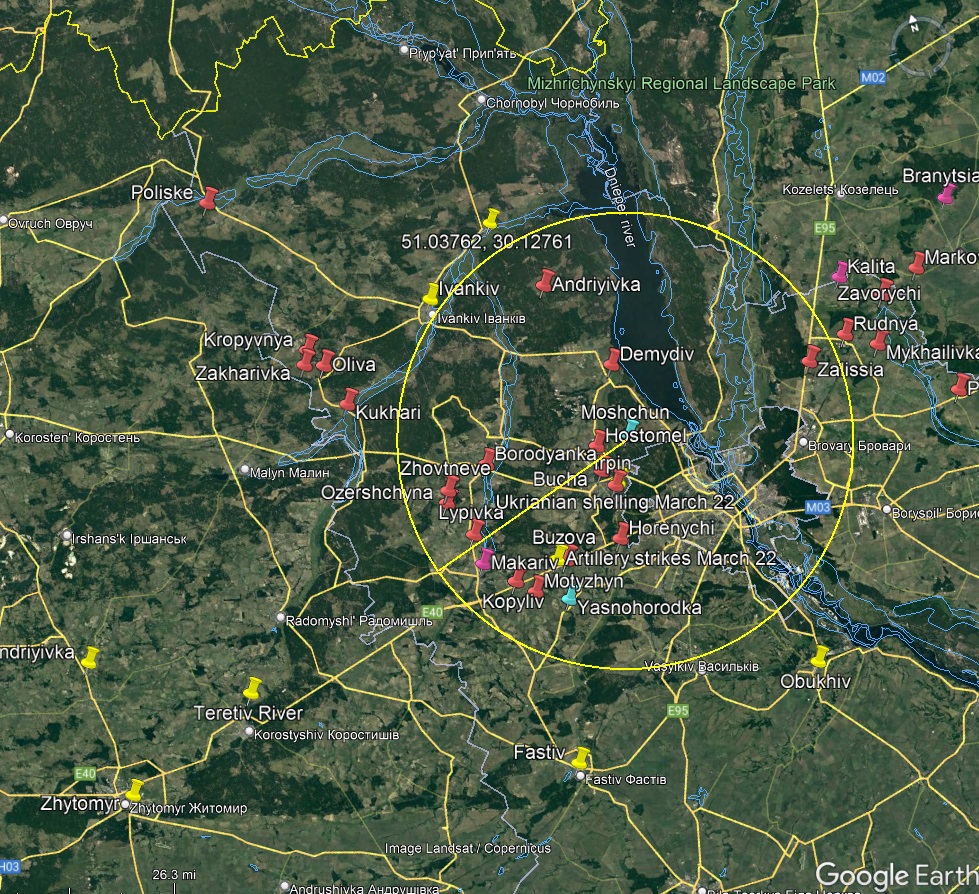
As you can see, it’s pretty much the whole contested area. And of course this works both ways. This is the problem with encircling this force. The entire point of maneuver is to defeat the enemy in detail, i.e. concentrate a great amount of force against a smaller amount of his, and thus destroy it utterly. As Sun Tzu said, “with the few I can defeat the many for the many with whom I do battle are restricted,” or alternately, “to attack and surely win, attack where the enemy is weakest. It is like throwing a grindstone against an egg.” (Think of Sun Tzu as “Baby’s First Army” Golden Book for dumbass court politicians and Clausewitz as the post-grad course on the same fundamentals.) In modern war the emphasis on “fires” is due to them reaching a good 45km+ like this; you can spread out your force a lot further and still concentrate it in a few seconds. To destroy this force in detail would require great local superiority, and given the numbers in this war this’d be tougher for Ukraine to generate.
The penalty for not having greater defensive “depth” (i.e. space) is what you see in that image above – the Ukrainians don’t have to encircle the Russians (and risk tons of firepower being concentrated on that blocking force, destroying it,) they just have to bring their rear areas into artillery range. And they have; I am seeing a lot of images of Ukrainian artillery hitting supply depots/trucks and performing counter-battery; not nearly as much tank sniping. Now let’s consider the floodplain north of Kyiv that’s literally underwater due to Ukraine blowing some dams:

As you can see, the floodplain is pretty obvious, following the Irpin river. Note that it makes the land impassible starting just south of Demydiv. Given the problems Russia has had throwing bridges over even modest streams, in the face of Ukrainian counter-strikes, the only way they’re projecting force over that mess is with air or artillery.
Here’s what Ukraine could reach from the tip of this flood-protected salient:
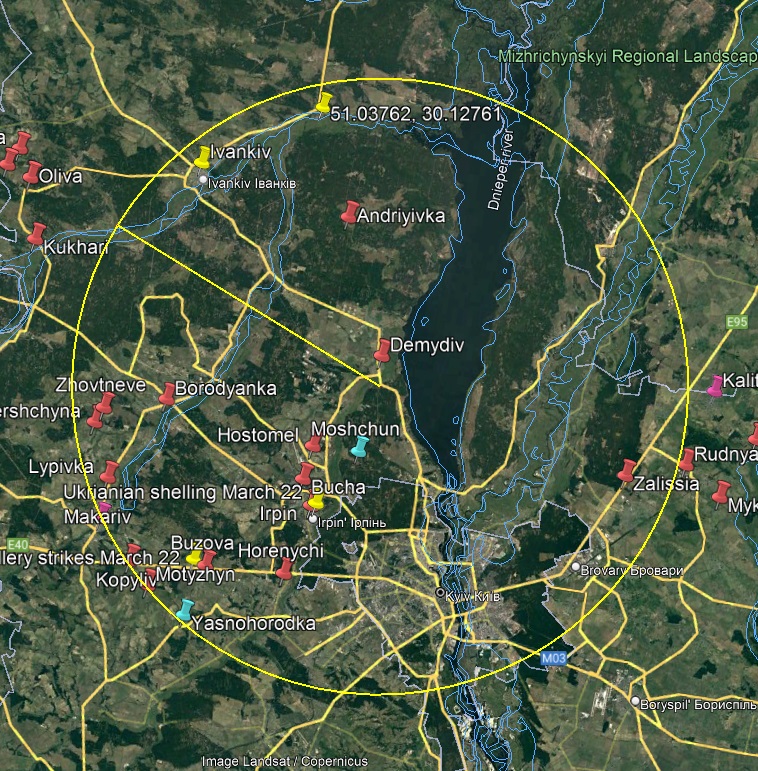
Remember, counter-battery is no joke and the Russians have plenty of well-wooded places to hide their guns in, too. But you only need one good swipe at a pontoon bridge to blast it, and given the ubiquity of drone ISR we’ve seen they’ll probably get that swipe. The Teteriv river is going to be very difficult to cross for the Russians if the Ukrainians keep pushing north; and this effectively closes down both main highways running south from Belarus, as the Ivankiv crossroads are north of that river. The whole length of the river as concerns Russian operations will be in Ukrainian artillery range.
Remember, the point of maneuver is to apply firepower, and because of how compact Russia’s front in this area is, it means Ukraine can apply firepower to their rear area and supply routes with relatively restrained maneuver/advances. This will actively interdict Russia’s ability to resupply, repair, rehabilitate their forces, and reinforce; with sufficient artillery (and ammo) assets to break through the siege of Kyiv. A grand masterstroke of maneuver is not necessary here to start punishing the Russians.
Oh jesus that was just the west um also:
- UMoD indicates further attacks on Brovary have bounced off; they likely weren’t big or serious. Eastern Kyiv is in no serious danger for now.
- UMoD indicates that Russian offensive action is also lacking around Chernihiv.
Sumy/Kharkiv AOO:
- UMoD says nothing happening here aside from continued bombardment of Kharkiv and I’ve seen nothing but obligatory shelling from Russians on social media and other sources.
Dontestk AOO:
- Serious fighting for Izyum reported:
- UMoD reports on this area at approximately 8AM EST indicated Russian forces around Izyum were not taking offensive action still, so the rumors now coming out about heavy fighting at Izyum are probably Ukrainian counter-attacks in progress.
- Also reported: a repelled assault at Yampil, a village just north of the Donets river and 31km south-southwest of Rubinzhe; this helps delineate the frontline further:
- The attack against Maryinka (south of Dontesk) that was confirmed by social media video of Russian troops in this town, was reportedly repelled,
- Enemy priority objectives remain Rubizhne/Severodonetsk, Popansa, Vugledar, and Mariupol.
- Translation: Russia is still trying to close a pocket around Severodonetsk but simultaneously trying to turn the “corner” of the eastern and southern fronts’ flanks where they meet at Vugledar. Pick ONE, Ivan.

- UMoD reported shelling in Kramatorsk; this is a crossroads 70km west-southwest of Severodonetsk and a likely forward supply/line of communication hub for Ukraine. This further signals a shift in strategy visible elsewhere; see Sitrep: Operational for details.
- Mariupol: Recent geolocated imagery from Mariupol (the last one originally released by Russia, claiming to be TOS-1 fire,) shows that fighting seems to be active in the northern and eastern parts of the city. Ergo, while Russian forces may have pushed close to the city center from other directions, significant chunks of other parts remain in Ukrainian hands.
- Remember we don’t know when these images/video were taken, so this might give an incomplete picture, but it does fit everything else we’ve seen regarding the Ukrainian’s willingness to fight for every block.
- Perhaps making the Azov battalion the centerpiece of “All Ukrainians Are Nazis” campaign and promising to skin them alive and shit had the opposite effect than desired on Azov’s willingness to fight. Hmm.
Kherson AOO
- Still seeing an awful lot of Russian equipment (including rear-echelon assets) captured in the Mykolaiv oblast: [1] [2] [3] The stream of such media continues to pour in. My confidence that Russia is being forced into a retreat from their northern advance along the Dnieper’s west flank grows.
- See also: the destroyed bridge recently shown in Mykolaiv Oblast has been, by some genius, geolocated to 47.365417, 32.261694. This is quite far west; 50km north of Mykolaiv city itself, over a branch over the Inhul river. Note the normal road bridge nearby that was destroyed (by Ukrainian forces presumably.) This seems to indicate a broadening of front by the Russians that would have definitely protected the TI505 highway north. That it’s being filmed by Ukrainian troops (and given destroyed Russian vehicles were reported at a village ON the TI505 the other day) this would suggest Russian forces have been pushed back a good 50km, not just from Mykolaiv to Kherson, but along the entire area between the Inhul and Inhulets rivers; north to south.
- The captured tactical map of this area from about March 10th has been fully analyzed; OOB assessments are here.
I’ve been working all day and need to eat, but there’s also a lot more to talk about. Operational, Strategic and Materiel/Logistics sitreps yet to come. Please stand by.
D+26 Update Part 2 @ 11:30 EST
Sitrep: Materiel/Logistics
- Unverifiable scuttlebutt says that this system is already in Germany, it was only publicized well after Russia had no chance to deliver a missile strike against the system and deny the West an intact example of one of their crown jewels to study.
- AHAHAHAHAHAHAHAHHAHAHAHAHAHAHAHAHA
- Note this is not necessarily unusual. Even American weapons like the Tomahawk have a failure rate of 5% or so. These are complex weapons, and occasionally things go wrong. I have also been told by Engineers that a higher failure rate for nations that are not the United States is not unusual. The Tomahawk was built in the 80s and has undergone many upgrades and refinements over the decades to render it the advanced, state of the art weapon it is today, and has also been fired many times, and there’s 4,500 in inventory right now, not counting thousands fired in previous wars. Russia has not done these things, (as have most anyone who is not America,) so this is not a surprise.
- This also makes it curious that people who would know these things are still commenting on it. Mayhaps their failure rates exceed what would be expected even with these concerns. Bigthink.png
- A recent sighting of knocked-out Ukrainian T-72s at a roadblock near Chernihiv. **This may indicate commitment of Urkaine’s reserve tank brigades, as they are the only ones who operate T-72s. The 3rd and 5th reserve tank brigades operate T-72s exclusively.
- These may have been thrown in as replacements (which is considered part of the point of the reserves) but it may also indicate a greater commitment. The 1st Tank brigade was deployed to the Kyiv/Chereniv region; committing the 3rd or 5th could free them up for offensive operations.
- Russia has deployed the SA-17 “Grizzly” to Ukraine. This is the “M3” iteration of the Buk system. Given that prior incarnations of this system were given the NATO reporting names “SA-6” and “SA-11” it should give you some indication of how much more modern and advanced this missile system is. The SA-17 is honestly an impressive system; it’s modernized with an AESA radar and, like the SA-11 before it, has at least one TELAR per battery – a combination radar and missile launcher vehicle. It also has significantly longer range than its predecessor SA-11. The fact that it is only being publicly deployed to Ukraine now probably suggests they are available in very limited numbers, like a lot of more modernized Russian weapons. Russia released a propaganda video informing the world of its deployment to Ukraine.
- AAAAAAAAAAAAAAAAAAAAAAAAAAAAHAHAHAHAHAHHAHAHA BITCHES
Sitrep: Operational
- There has been a (possible?) shift of Russian tactics to targeting logistical line-of-communication hubs, some deep in Ukrainian territory. Specifically, rail yards. See this strike on Savyansk (geolocated,) Kharkiv (geolocated), and Pavlohrad. Note Pavlohrad is a key junction deep in Ukrainian territory on the way to the Donbas front, (requiring a cruise or ballistic missile to reach) and Slovyansk is jus tnorth of Kramatorsk; i.e. near the area between the Severodonetsk front and Izyum. I’ve seen Russian shelling of the railhead at Chereniv before but attention to rear-area rail junctions I have not noted before.
- Given the importance of rail to Russian logistics and the general “blyatkrieg” attitude that characterized their early efforts before they were clearly stymied, this might (if the trend is real and not an artifact of sampling bias) indicate acceptance of a shift to a much more methodical and costly advance. Targeting forward area railheads makes sense; it doesn’t require precious long-range munitions and can easily hit unloading areas, destroying materiel without necessarily blocking rails by destroying rolling stock to the point it cannot, well, roll, (requiring more intensive clearing efforts involving heavy equipment.) To really jam up a line, you want to do that. Hitting rear areas implies Russia knows they’re not going to be blyatkrieg’ing up those rails deep into enemy territory anytime soon.=
- Drone-captured footage of Russian troops looting civilian homes (geolocated to 50.562110, 30.271274, southeast Hostomel) serves as third-party confirmation of the reports in the Wall Street Journal story on the battle of Voznesnsk of similar behavior (not just stealing food, but valuables from locals.) An army that thieves and loots is highly unprofessional. I have lost track of how many battles in antiquity and even into the gunpowder age turned on a dime because victorious troops found a stash of booze during their sack of a city and got falling-down drunk, only to be unable to resist devoted counterattacks later on.
- I am seeing many videos involving drone-observed Ukrainian artillery fire on Russian rear echelon assets (not just counterbattery, but supply trucks.) Despite increasing use of natural cover, they keep taking losses even so. I cannot say if Russia is not applying lessons learned or if co-ordination issues are keeping them from moving supply dumps further back and making more frequent forward supply runs, or if the fuel supply situation precludes this, or if they have and it simply hasn’t helped.
- Note the frequency with which these strikes are observed by quadcopters may indicate this forward observation is being done by SOF teams carrying drones into the field, but Ukraine’s prewar gamut of drones; including volunteer kitbashed ones that later entered serial production, could well include some larger and longer-ranged quad (or sexto, or octo) rotor designs. Nonetheless aggressive SOF recon elements/w backpack drones would be an extremely difficult combination to defeat.
- Territorial Defense Forces are still actively operating. [1] [2] Note the last one is from Sumy. Whatever the Russians are doing to deal with the threat there, the locals are still making active sorties into the countryside to take the fight to the enemy.
- A rare look at Ukrainian T-64s in battle, this time defending a wide boulevard in the north-northwest. So far, aside from the glimpse of a T-64 company deploying along a road in the SE near Kherson/Crimea in the opening day of the invasion, I have only ever seen Ukrainian tanks operating singly or in two’s. I am informed that Ukraine’s tank brigades had already switched to a Western style of organization by the time the war broke out (two-tank elements, four-tank platoons, three platoons to a company + a two-tank command element,) and the tank complement of mechanized brigades was still Soviet-style organization (three three-tank platoons and a single command tank.) The Ukrainian national guard is apparently independent of army organization, so we are possibly seeing a tank element of the 12th National Guard Brigade’s tank battalion fucking shit up. (Thanks to Butch R. Mann on the-sietch.com for this information.)
- Russian strike efforts against Ukrainian airbases continue. Note that there are three impacts. This continues the trend of very small salvos involved in Russian attacks. Do not discount the cumulative impact of these strikes; Russia has done damage to Ukraine’s military infrastructure. But it has been very much spread out between a lot of targets. Remember, it can easily take 50+ weapons on a single airbase to properly put it out of action. Also, we know that the Russians have expended at least some of these weapons against 1. airframes that have been out of service for decades decorating a ramp and 2. tactical targets that should have been serviced by artillery. In short, Russia is doing too little damage across too many targets, and allowing Ukrainian forces too much time to repair or otherwise deal with the damage inflicted to their infrastructure.
- Are these motherfuckers for real.
- Both UMoD statements and actual video evidence show that Russian landing ships are now arriving at the port of Berdyansk. See also this statement from the Kyiv independent about Russian tugboats clearing the piers at Berdyansk. It would seem that, with a breakthrough over the Southern Bug river now impossible, Russia has conclusively given up on their breakthrough efforts, transferred their embarked Naval Infantry ashore as replacements (UMoD indicates mostly around Izyum) and are now using their amphibious ships to make supply ferry runs across the sea of Azov, as I predicted.
- Just, you know, like two weeks later than anyone with a realistic view of their chances of reaching Odessa would have.
D+27, D+28 and D+29 (March 23/24/25) (Posted March 25th @ 4PM EST)
Sitrep: Maneuver
Kyiv AAO:
- Continued combat in Irpin. [1] [geolocated] [2] [geolocated] [3] The fact that Irpin is still contested even as Ukrainian forces take back territory elsewhere NW of Kyiv does not bode well for Russian forces.
- Further evidence of the fighting in Makariv contines to trickle in; likely from the 23rd, 22nd or earlier: [1] [geolocated] [2]
- A claim of the liberation of Lukyanovka, a village 40km east of Brovary. (Link provided because Google has the name as belonging to a district of Kyiv; the village’s “proper name” according to Google Maps is Luk’yanivka.) This is confirmed by the following:
- This was a beautiful church.
- This war memorial overlooking two destroyed Russian tanks is probably from the village but Google Earth imagery is too poor resolution in this area for me to geolocate it from overhead, and the village (like most of Ukraine) has no Street View data. I will try to locate this via the text on the monument’s plaque.


- I assume Velyka Dymerka is still enemy held as no news to the contrary has emerged. Thus this amounts to proof of a 4km advance into this Russian-held salient, one that threatens to cut the H07 east-west highway. Paired with the assault on Velyka Dymerka it shows that constant pressure is being applied to Russian forces in this area.
- See also this reported destruction of a bridge over the Desna river just south of Cherenihiv by Russian airstrike. (Geolocation to 51.4584818,31.3004786) This is a serious attempt to interrupt communications between the city and the areas south of it, and there are no other bridges over the Desna other than one that is in Russian control. (A pontoon crossing is very possible but would have to be made further east to be safely out of Russian artillery range.)
- Given a dearth of Russian bridging ability they have proven loath to destroy bridges themselves in most cases. Combined with the fact that their last reported positions should still invest the E95 highway from Kyiv, this attack is likely as much to deny the city’s defenders a supply route as it is to deny them the ability to supply forces fighting south of the city from supply dumps in the city.
- Bearing in mind how little information we have on this area that is third-party verified, given what is in hand it seems that Russian forces are being hard-presssed on three sides in this area. (Remember, these forces main line of supply is from the east, as the only good crossings over the Dnieper are all either in Ukrainian hands, or within easy range of Ukrainian artillery.) If Russian forces are not retreating from this possible salient up to nine, perhaps more Battalion Tactical Groups will be encircled.
- Drone footage showing the severity of flooding in the Moshchun area.
- Presumably recent evidence of very heavy combat in Borodyanka, north of Makariv. [Gelocated.] [Second video, from a vehicle observer’s perspective.] [Geolocated] Remember, this is a crucial crossroads 20km north of Makariv.
- On the eve of the 23rd I heard rumors of fighting near Teterivske on Twitter, which was later reinforced by this curious statement by UMoD regarding Russians trying to take that town back and failing. However, this village is a solid 15km east of the villages of Kropyvnya, Zakharivka, Oliva and Kukhari, which the UMoD previously reported as being Russian frontline defensive positions. Note this area is a good 40km north-west of Borodyanka, which is itself 20km north of Makariv. Previously, observing the map, I identified this general area – only slightly further north than Malyn’s latitude – as an ideal place to for a counter-attack to encircle and cut off the Russian forces NW of Kyiv. I didn’t even think to mention it in my prior analysis as I figured the specific UMoD mention of Russian defensive efforts in this region was reflective of Russian realizations of this. The reason it is a good place to attack is 1. it is roughly equidistant between the furthest southern Russian advances south and the Belorussian border; ergo it gives some space from the artillery concentrations of the main Russian assault on Kyiv and the airpower lurking over the Belorussian border, and 2. contains a main highway running east to the ever-important crossroads of Ivankiv. This also makes it crucial for Russians to defend – note the Teteriv river anchors the southern end of any line there, and the forests south/southeast of the river would make a good “rear” area for the forces pushing on Kyiv (out of artillery range of Kyiv and offering lots of cover from aerial observation.)
- This would mean Ukrainian forces have advanced 13~km east of their previously reported frontline.
- Teteriviske is only 15.5k due south-west of Ivankiv. That puts the crucial crossroads of Ivankiv well within 152mm range.
- If these reports are true and Ukraine has the force to hold this town, they can interdict the P02 highway and Ivankiv crossroads with artillery quite easily. They can move around the Teteriv river using their own interior lines of communication further west. There is a real possibility they could push on to Ivankiv, and then along the river’s north bank clean to the Dneiper and effectively encircle the Russian force. This will be hard slow fighting but favors the advantages Ukraine has – more light infantry and good terrain in this AOO with which to use them.
Analysis (Kyiv AOO):
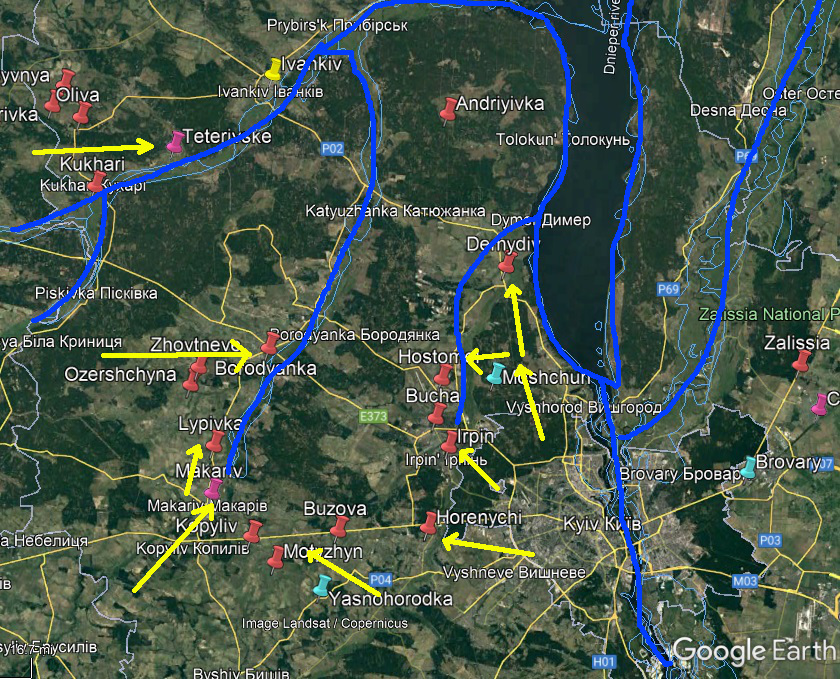
Russia has obvious and previously-described difficulty in conducting bridging operations due to ubiquitous drone surveillance and highly competent Ukrainian artillery employment. On the above map I have highlighted the course of local rivers of significance as well as the flooding north of Moshchun as well. Recall that Demydiv, north of Moshchun, the entire curve of the Teteriv river is within long Grad MLRS range (and is well within the range of 300mm systems like Smerch, of which Ukraine has some, already.) Gold arrows indicate known Ukrainian counterattacks against Berezivka, Makariv (taken,) Borodyanka, Irpin, Moshchun (taken) and likely counterattacks against Teterivske (allegedly taken, but at least indicates attacks in this direction even if not,) Horenychi and Hostomel (possibly from the east with light forces and swimming IFVs, if not then after (if?) Irpin is retaken.)
It should be obvious from this map what is happening – the rivers divide the AO into sections that are very problematic for an army fighting in an environment of heavy artillery usage and ubiquitous drone observation for both sides, that is also extremely vehicle-dependent due to their usage of “BTGs” which give a regiment’s worth of artillery to a battalion-sized maneuver force. Against this, they are fighting an enemy with a superiority in light infantry numbers in terrain that favors them, who are pressing them on all sides, pinning their forces and making the shifting of forces from one flank to another difficult. If Russia does not have the strength to rebuff this assault, they will have to shorten their lines; either giving ground on their western flank, and endangering their supply lines, or giving ground in the eastern flank, the suburbs of Kyiv they have fought so bitterly to take multiple times.
Kharkiv/Sumy AOO
- UMoD says only that Sumy is under bombardment, but not ground attack yet. Kharkiv is noted to be under very heavy bombardment.
- This tweet by UMoD offers a rare glimpse of frontline positions in this AO as it identifies the city of Okhtyrka as being in Ukrainian hands despite constant assaults. This city is about 70km directly south of Sumy. This serves as some confirmation that this part of the Finnish Scribblemap is still accurate:
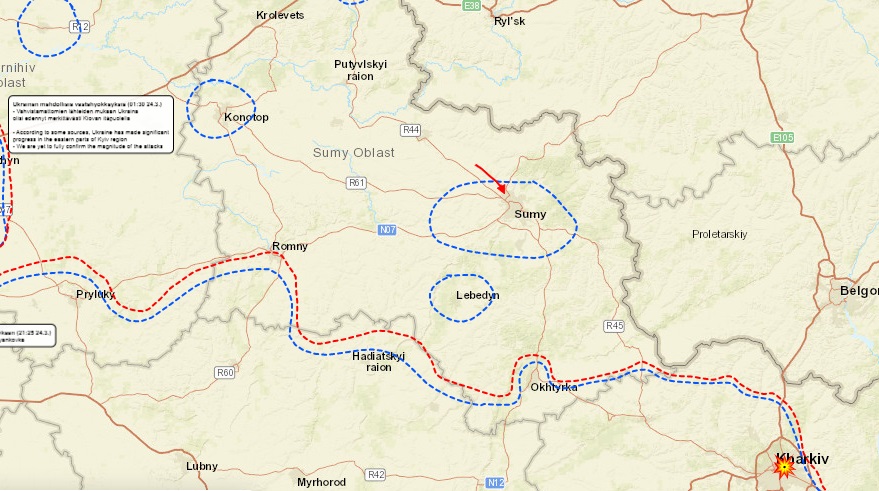
Donetsk/Luhansk AOO:

This hillside overlooking the Donets river is either wooded, or has significant structures all along its length; this would make it a very commanding position over not just the river, but the wooded areas north-west of it from which the Russians would have to attack. Shelling this area – a structure, specifically, as the post claims – strongly suggests that southern Izyum, where it’s protected by the curve of the Donets river, is still in Ukrainian hands.
- Note also this video geolocated to 49.19721, 37.27790. Note the heavy concrete or brick apartment buildings here. Note that these overlook an open soccer field not 230 meters away from one of the bridge crossings (a footbridge, it seems) over the Donets river:
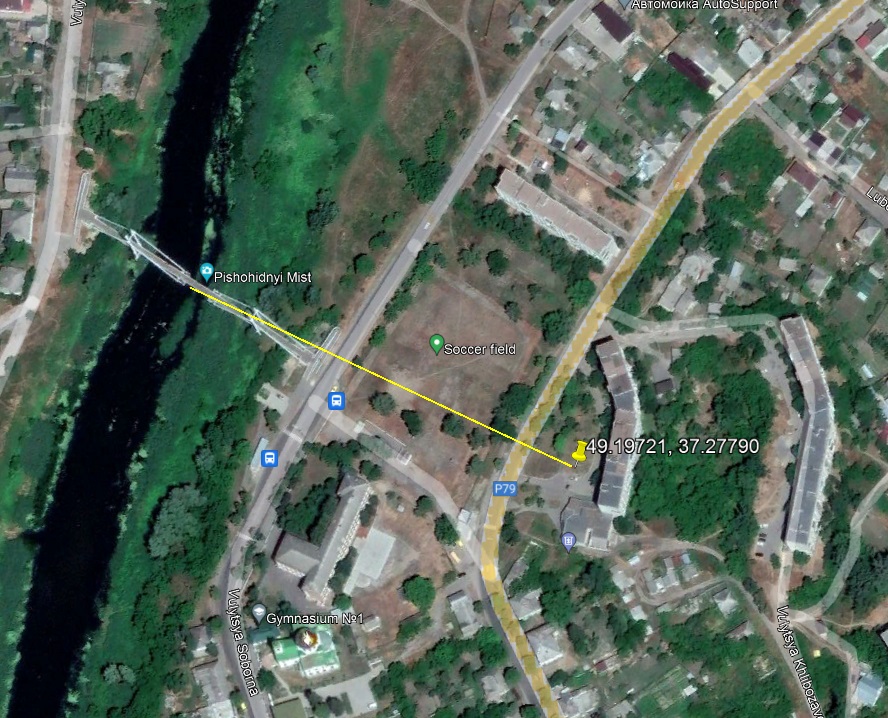
Obviously, an assault took place here. The fact that no defenders are still visible and civilians are filming the area could mean the enemy has withdrawn, or that the Russians were able to cross and take ground. Either way, the heavy shelling southward implies resistance continues along the road south out of the city, and/or attempts to cross at a point further south to flank defenders that are resisting assault in urban fighting in the city proper.
- This propaganda broadcast has been geolocated to 49.034081, 38.373498 in northwesternmost Rubizhne. Presuming they wouldn’t let their canary too close to the frontline, this implies the Russians are (as UMoD has previously stated) established in north-west Rubizhne, but not in the center of the city yet.
- Fighting in Marinka continues, according to three geolocations done on damage to the city posted on the 24th. Prior video evidence of Russian troops probing here and UMoD statements of repelling assaults in this area make this no surprise, but indicate the Russians are not making much, if any, progress. Marinka is 20km south-west of Donetsk city proper.
- Recent UMoD statement from the 24th simply says Izyum is still repelling Russian attacks. The night before (still the 24th in the US,) UMoD reported attacks in Donetske (a village 10km north of Slovyansk and in the general area along the Donets river that anchors the salient up to Rubizhne/Severodonetsk) and Kam’yanka, directly along the H20 highway 10km directly north of Donetsk city. They also noted that Russian forces are (still) concentrating their efforts on Popansa (which anchors the southern flank of said salient), Marinka, and Verkhnyoteretske, which is most likely what Google thinks is “Verkhoyanskaya Vu,” a southwestern suburb of Donetsk and up the road east of Marinka:

- I can’t be sure that prior purple pins further east around Donetsk indicate the Russians have been gaining ground, because as long as I’ve been tracking UMoD statements the frontline has seemed to be right along the H20 highway, north of the city. Given the prior reporting by UMoD of Stepnoe being attacked (implying it’s being defended,) Marinka seems like the furthest thrust, but given the claimed attacks on Verkhnyoteretske it seems the Russian incursion into the line in this area isn’t so much south of the city as it is hugging the city limits as they advance along the furthest western extent of Donetsk’s suburbs – with those suburbs still being held by Ukrainian forces as stubbornly as they hold any urban area.
- See also this claim making the rounds that a much-hated rebel was killed by a sniper, reportedly “Near Avdiivka in Donbas province,” which is just west of Kam’yanka.
- No information I can find on Vugledar, where Russian forces were previously reported by UMoD as trying to turn the flank. This may be indication that the Russians are finally focusing their efforts more. Trying to break through north and south of Donetsk and around Izyum makes sense as these are the two pincers needed to encircle a large bulk of Ukrainian forces. However, continuing to smash their heads into Rbizhne/Severodonetsk in heavy urban fighting when this city could be encircled instead, then invested and assaulted, is moronic, esp. given that the eight-year occupation of the Donbas region means they should have fair control over those lines of communication, and thus don’t need to hold those cities like they do Sumy, Konotop etc.
Southern Front (Zaporizhzhia to Mariupol) AOO:
- UMoD simply says that the “Tavriya direction” (village northwest of Tokmak, indicating the entire defensive southward facing line) is quiet.
- Mariupol: I have made an attempt to quantify the distance Russian forces have pushed into the city with geolocated data: [1] [2] [3] [4] [5] [6] [7] There is already a map being provided by this account, which you can view here, but I mapped it myself to utilize the most recent data that is evidence of direct fighting (direct fire, or artillery in support of units directly in contact):
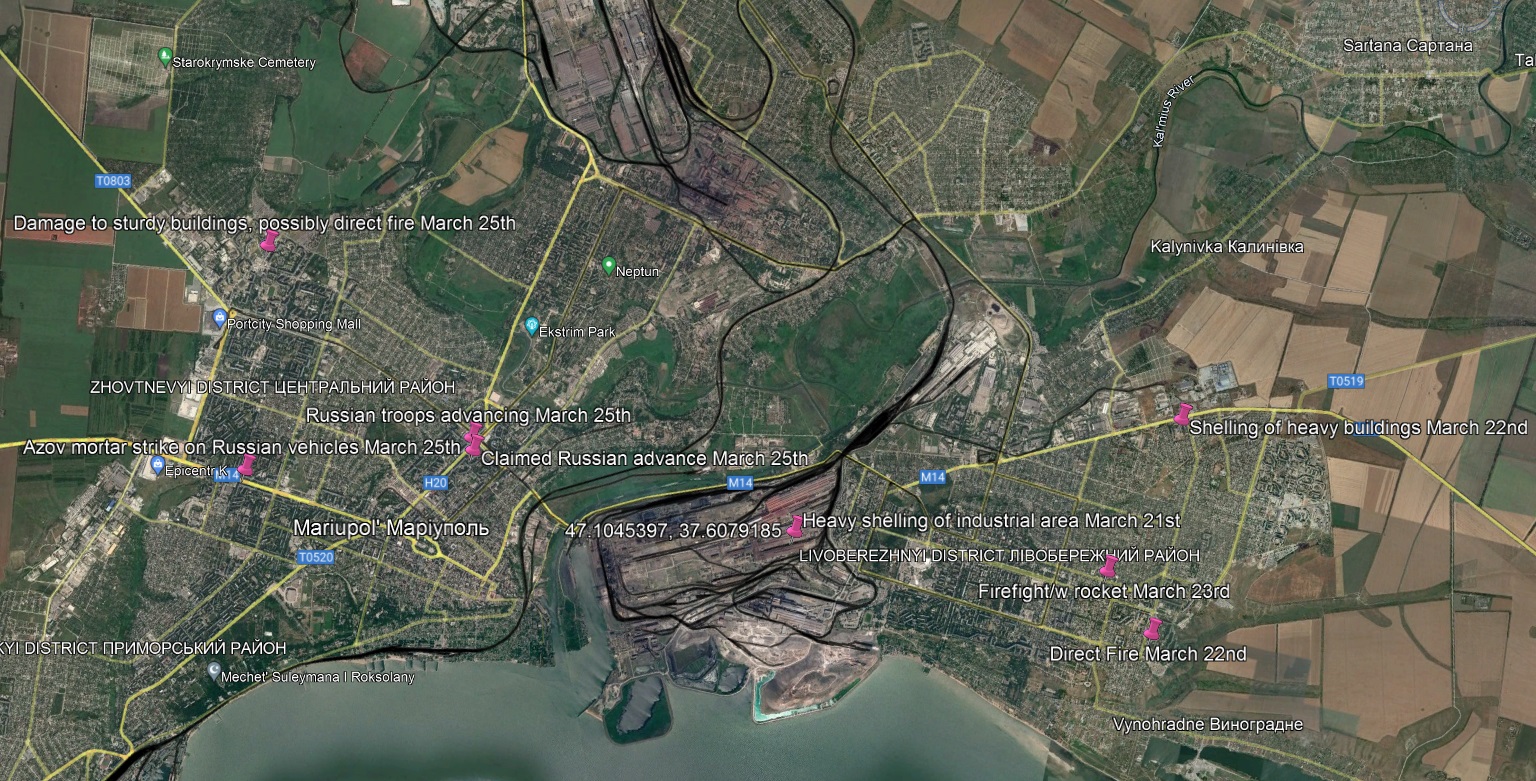
- As one can see, all that can be said for sure is that fighting has reached the interior of the city. Extrapolating from this how much of the city is truly controlled by either force is still an open question. Given the Ukrainians are apparently fighting for every block (given the thoroughness of destruction being seen in media) it’s clear that they have plenty more blocks to go before they'll be hard-pressed.
- Watch for a Russian attempt to take, or at least control by fires, that center section of the city along the river. The bridge will likely be blown as well. The heavy shelling of the industrial area on the 21st was probably related to this; either suspicion of centrally located defender’s stockpiles, or in support of an assault from the north. The patrol boat that ate an ATGM was likely reconnoitering this area.
Kherson AOO
- The last reported shelling in Mykolaiv was on March 21st. This strongly implies that Russian forces are no longer in artillery range (40~km for most MLRS) of the city – which, if you have been following me, is no surprise.
- I have seen many claims that the Russians have moved helicopters into Kherson airbase and had them hit by MLRS fire by Ukrainians – not just the two confirmed incidents, but up to ten times. I doubted this. However it seems the airport has been hit a third, confirmed time on the 24th, given this video that certainly looks like MLRS (the bright flashes in the air might be unitary warhead rockets being engaged by surface-to-air missiles.) This has been tentatively geolocated as being in Kherson and looking towards the airport. There is also this video from outside the city, likely taken by Ukrainian soldiers. See also this second video from within the city that also shows the same pattern of detonations and lights/explosions higher in the sky. The audio/video of this one makes it very plausible that at least one attempted surface to air interception was attempted, but as you can tell from the weight of the barrage, it was a futile effort. I expect geolocation of this one will not take long.
- This means Ukrainian forces are within 40~km of Kherson, so they’ve at least pushed out of Mykolaiv proper by 7~km or so, and have done so without (serious) worry about counter-battery attack. I strongly doubt that Russian forces are still investing Mykolaiv in any serious strength.
- I am seeing strong rumors of a heavy Ukrainian counter-attack in this region, but as usual, there is nothing to back it up yet.
Sitrep: Operational
- This New York Times article (best viewed on Youtube) combines crowd-sourced Russian radio intercepts with geolocation of areas mentioned in their transmissions in the clear to paint a very damning picture of Russian operational failures. For once, the New York Times has done excellent work. This information dates from around Feb. 27th, during the first assaults on Makariv. Some interesting observations:
- Motyzhyn put up enough resistance that Russian troops retreated from it. UMoD’s statements gave this as the furthest-south area ever being held by Russian forces. This tracks very well with the radio intercepts indicating great resistance. More of a maneuver update but w/e
- Communication difficulties do indeed make combined-arms efforts a real nightmare for Russian forces; calling in supporting fires is badly delayed when they need it the most.
- The Russians (were) frequently giving away their positions and plans in the clear.
- Note, Their frequent use of code-phrases and Chechen code talkers they now use to address their open communications are neither very effective (the Ukrainians have Chechens too) and further exacerbate the delays in calling in supporting fires.
- Russian forces were taking heavy casualties at this time, and were frequently low or out of critical supplies, esp. fuel, with vehicles stalling in the road.
- Russians are indeed using cell phones more.
- As one wag on my discord put it; “it’s like a video game; kill enough Russians and a Russian General appears to fight you like a boss battle!”
- This video showing Russian forces clearing IEDs was geolocated to 46.157853, 33.602842, which is nowhere fucking near Kherson, just in the oblast. It’s along the E97 highway out of Crimea, only 30km north of the peninsula proper! (This illustrates the importance of geolocating data!) This is indication that Territorial Defense Forces/local resistance is still active all along the Russian supply route, even in terrain that makes armed ambushes difficult.
- As this photo shows, IEDs are now being seen/talked about more frequently. This is not the first IED I’ve seen. This style of IED – wiring two (or sometimes three) large-caliber artillery shells together has long been a staple of insurgency operations in the Middle East. The sheer weight of explosive is easily enough to destroy or at least mission-kill a tank – sometimes by flipping it clean over.
- Naturally, this is a hideous warcrime.
- These destroyed Russian vehicles have been described as an infiltration attempt, but given they were ambushed before the Z painted on the side was eliminated I suspect these civilian vehicles were commandeered simply because the Russians had no other vehicles to use.
- This geolocated video of an S-300 TEL in Kyiv being found and engaged by a Russian drone surprised me – I’d have expected the Ukrainians to keep their S-300s further from the frontlines and use their long reach to threaten Russian aircraft at a distance. The fact the Ukrainians have gotten away with positioning theater-defense assets as far forward as Kyiv itself (using the city’s infrastructure to hide them) shows very bold and aggressive use of their assets. I say they have gotten away with it because, if the Russians had managed to find and attack an S-300 in or around Kyiv before this, they absolutely would have released this video sooner, given how much an impact the state of Ukraine’s air defense system has on public audiences in general (as you may recall from my D-Day/SAM posts.)
- The continued heavy editing of Russian releases strongly suggests to me their artillery has dogshit promptness and accuracy unless it’s laser-guided. And even the United States’ stockpile of Copperhead rounds was minuscule compared to its dumbfire stockpile... for a reason.
Sitrep: Materiel/Personnel/Logistical
- At least one LST is absolutely and properly fucked. See these two videos in which very loud secondaries are quite clearly audible. Note also the second LST de-assing that pier for that exact reason. The burning LST was clearly filled with enough fuel and munitions for a decent party, meaning:
- This vessel will soon be a fire-gutted total loss,
- This vessel was sank at anchor by its crew to flood the lower hold and prevent catastrophic damage, in which case it’s probably still a total loss (saltwater in every machinery space + fire damage above) but will have to be re-floated before tugs can drag it away and open that berth for unloading activities again.
- It was a Ukrainian Tochka-U/w sub-munitions strike that did this. This is very likely video of the strike. Note the primary target seems to be the larger tank farm further up the pier; you can clearly see a spread of sub-munitions going off, as well as the spent after section of the missile flopping into the water further on (the parent body will go long; it has more mass and isn’t slowed as much by wind resistance as the bomblet cloud.) While this seems like it hit too far forward to do the damage, if it caused a leak in the tanks at the more distant fuel farm, (as prior strikes with this weapon have reportedly done) there would be no immediate fire, but fumes that would likely ignite in a hurry. Or another weapon could have impacted shortly thereafter, or, incredibly, this could be an earlier strike and unrelated to the destruction on the 24th.
- In addition to establishing that Russian forces in every Area Of Operations continue to have supply lines interdicted, and for establishing that Ukraine has even more reloads for their captured TOS-1, these images of a destroyed truck and captured thermobaric MLRS rockets somewhere in Chernihiv oblast make it obvious just how bulky MLRS rockets are. They impose an even greater burden on the supply chain than tube artillery does, both in the bulkiness of their ammo and the speed with which they can dispense of it.
- Did I mention the Russians seem to be leaning very heavily on MLRS?
- Given the terrain this seems to be yet another example of lost rear-echelon equipment in the Kherson AOO. Recovery/engineering vehicles like this are ones Russia can scarce afford to lose.
- Izyum area continues to eat Russian engineering officers. Note this is the third engineering officer, the second in the Izyum area, and the second colonel to be lost; this one was likely killed overseeing pontoon bridging operations just like the other two.
- More confirmation that Naval Infantry are being deployed by Russia as reinforcements – these have been seen in action in Mariupol.
- To the shock of nobody, NATO officials have confirmed (~anonymously~) that no, the Russians did not “get hacked, bro” and the likely figure of 30-40,000 battlefield casualties for Russia so far seems to be in the ballpark. Reminder, that would be about 1/3rd of their frontline combat troops, given a very generous tooth-to-tail ratio (and given how shittily supported their logistics are, their having it at only 1:1 seems to check out.)
- Further reminder that Ukrainian SOF are getting extremely nice toys from the US.
- Some hints that Zelinsky’s recent request for anti-ship missiles may be entertained, which would be a massive boost to their combat potential and could end the de-facto blockade of Ukrainian ports, allowing for more food shipments to enter the country in bulk. Indeed this may be the motivating factor behind NATO’s consideration of the request.
- And just for fun, another win for the tractor brigades.
- Less hilariously, expect them to also prioritize earth-moving equipment whenever possible. Also expect local operators to be competent at sabotaging this equipment in ways that are reversible – if you fix it before you turn it on. Oil-soaked rags wrapped around an engine block that will get hot, etc.
Sitrep: Strategic
- Note these amount to about two regiments of troops in total, but 1. they are in addition to the native forces, 2. will possess technology and capabilities the native troops often don’t have and 3. with 75% of Russia’s combat power tied up in Ukraine and garrisons being robbed to pour the rest of it in, there’s no serious land threat to these nations that these forces, plus the locals, could not repel.
- See also this (recent) discussion from a Russian TV show (i.e. state approved media) which makes the same argument. Unfortunately there is more truth to this than not; assuming Russia’s stated policy goal is to confront NATO for regional dominance, then failure to take Ukraine will mean the failure of the Russian state. In case it still isn’t obvious, this is, in fact, Putin’s stated goals, and it remains to be seen whether he will recalculate and accept a guarantee of existential survival as provided by Russia’s nuclear arsenal.
D+30 (March 26th) (Brief) Maneuver Update:
Important things are happening so here’s a brief update on evidence of continuing Ukrainian counter-offensives. By tomorrow more geolocation-confirmed data should be available.
Sitrep: Maneuver
- This town is only 50km south of Sumy, itself still not in Russian hands and a famously persistant thorn in the side of Russian forces long, overtaxed supply line.
- Note the complete lack of overhead camouflage, the fact that we are looking at very clear satellite photography provided by a company that publicly announced they are providing this to Ukrainian high command for free, and recall that Ukrainian artillery has been witnessed picking off individual Russian tanks with direct hits already.
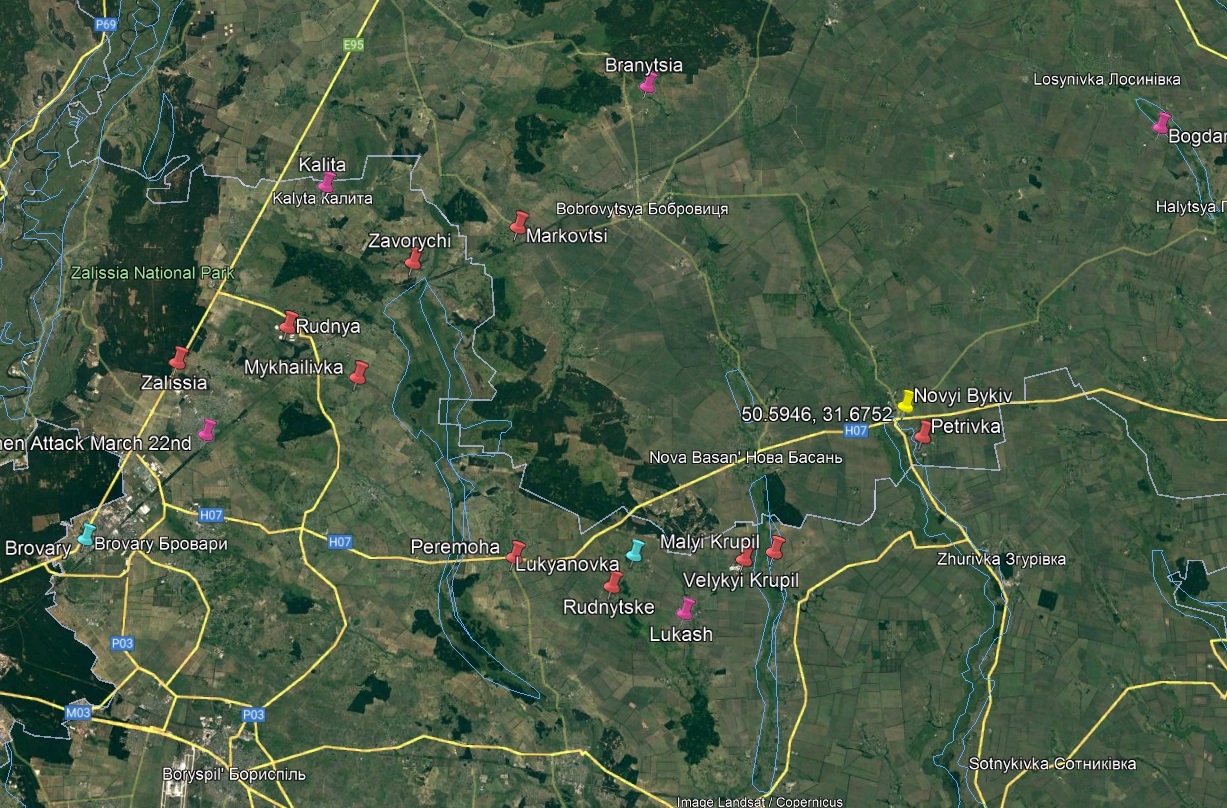
Ukrainian forces are clearly maintaining pressure on the Russians across the entire front.
- Russian attacks on Avdiivka, north of Donetsk, continue, as evidenced by yet more use of thermite incendiary weapons by the Russians.
- Russian propaganda video shows TOS-1 MLRS fire against targets in Kamyanka. You will recall this village lies directly astride the H20 highway 12km north of the edge of Donetsk city itself. Avdiivka is not 3.5km southwest of it, another town frequently mentioned as the frontline.
- Ukrainian forces are advancing out of Kharkiv. These three videos show Ukrainian forces advancing on and fighting in the village of Vilkhivka, about 8km east-northeast of Kharkiv’s outskirts. Note that Ukrainian forces took the town of Chuhuiv (a crucial crossroads) some 21km down the M03 highway over a week ago, but Russian forces were still hugging the outskirts of Kharkiv and have been bombarding the city nonstop, despite not launching many serious attempts to attack the city.
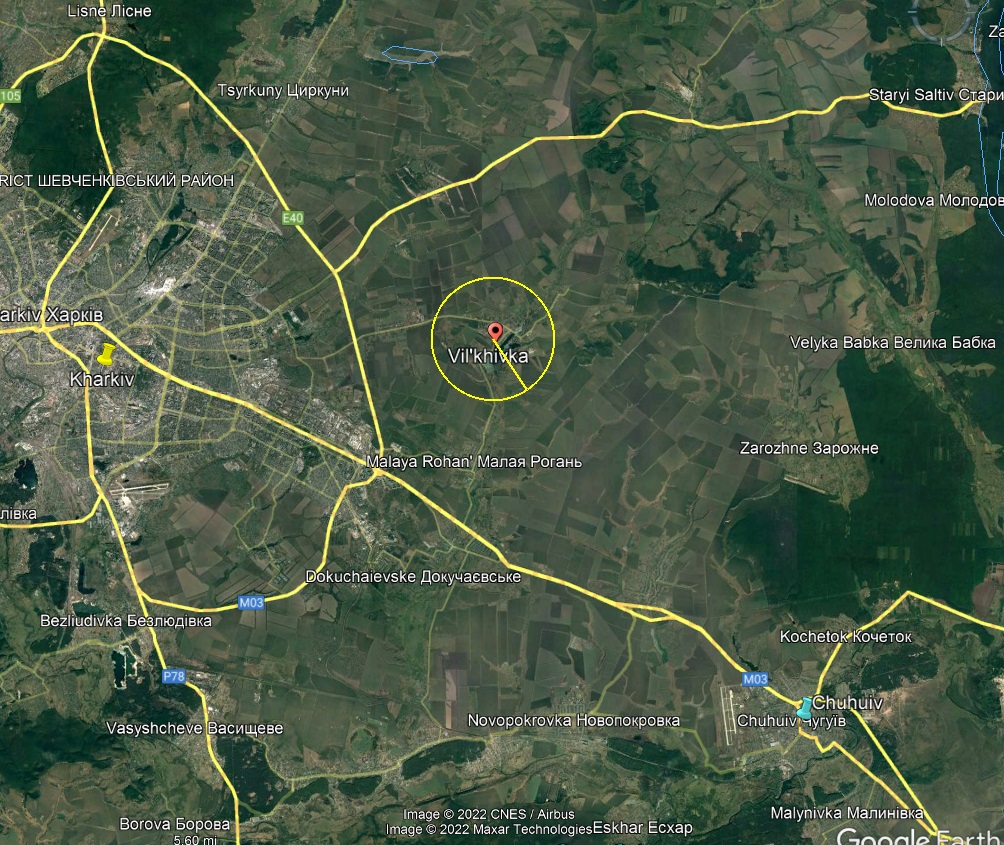
- Russian troops are reportedly entering Slavutych, a village near Chernobyl and almost 33km due west of Chernihiv. This village – which is barely four square kilometers in volume, according to google maps – has been behind Russian lines almost since D-Day. I will try to find more information on this town’s status as a probable “mini-Sumy.”
- This should illustrate the power of local militia forces; simply by forcing the diversion of frontline troops to rear-area security, they greatly inhibit enemy operations.
- Recent video of gunfire heard on the outskirts of Nova Kakhovka. The town offers much less urban depth than Kherson does, and as it lies at some distance from the city, it makes for a much more easily assailed hard crossing across the Dnieper. This would allow Ukrainian forces to move down the eastern bank of the river and cut off Russian forces in Kherson from resupply. This is a very tempting target.
D+30 and D+31 Update (March 27th/28th, posted 10:50PM EST on March 28th)
Note for the new: “UMoD” means “Ukrainian Ministry of Defense.” Since Facebook is once again blocking people from viewing this without logging in I am now linking directly to UMoD posts on the Ukrainian government’s own website.
Sitrep: Maneuver:
Kyiv/Chereniv AOO
- While solid confirmation is yet to come, given overall trends and the heavy fighting for Irpin seen in the last few days, this seems credible.
- UMoD statements on the Kyiv/Chernihiv AOO:
- UMoD has stated that Russian troops are withdrawing to Russia proper in this area to resupply, regroup, and presumably absorb replacements.(UMoD stated on the 27th that at least two BTGs’ of the Russian 106th Airborne division were withdrawn to Belarus for the same reason.)
- Naturally, UMoD also noted Russian forces were not conducting offensives northwest of Kyiv on the 27th or 28th.
- Specific claims of Russian forces using the Chernobyl area as a headquarters area, transit route for ammunition, and logistical hub; including claims that they’re storing ammunition in the city of Chernobyl (near the abandoned city of Pripyat.) They specifically note that Russian forces are now using older, poorer quality ammunition from older stockpiles. More on these points later.
- Specific claims that Russian forces have destroyed bridges in the areas of the cities/towns of Snovsk, Konotop, Stara Rudnya, Smyach, Maly Dyrchyn and Velykyi Dyrchyn. All these settlements are east or north-east of Chernihiv.
- Russians were said to have attempted some sort of counter-attack or maneuver east of Brovary, but were halted. It was specifically noted that they continued to shell the recently liberated village of Lukyanivka.
- Regarding Lukyanivka (aka Lukyanovka,) combine earlier video/images from the town (the destroyed remnants of a church, clearly the Church of the Ascension by photos on Google Maps, and the destroyed Russian tanks right in front of a WWII “grave of the unknown soldier” style war memorial,) and combine them with newer footage, one gets a better look of this entire battlefield: [1] [2] (note the captured tank outside the still intact Church of the Ascension), [3] [4], [5] (these stills from [5] give a new angle showing the relation of the destroyed armor to the war memorial,) [6], [7], [8], [9] (note this is the American volunteer’s own twitter account he’s posting to), [10]. The gutted red brick building seen on the left in [3] is briefly glimpsed in the distance in 5, and the stills show an angle putting it behind the war memorial’s statue. Sadly, Google Earth imagery of this area is of such poor quality that I’d need to pay for commercial imagery to stand any chance of locating where this battle was in the village in relation to the Church of the Ascension.
- I mention this to illustrate 1. how difficult geolocation can be, and how some of the people doing it are spending money on it, god bless them, 2. how much of the temporal aspect of conflict is lost through these glimpses; the church was still standing after the battle, and thus was presumably leveled in retaliatory shelling by Russian forces later, and 3. how widely spread out and tiny the little glimpses of these battles are that we’re getting. The amount of video taken in this area is astounding, compared to most things we see coming out of this war, and yet it’s split up among several different people filming, the clips are very short, and they’re sometimes taken at different times, before/after some vehicles are moved.
Kharkiv/Sumy AOO:
- Images of the fighting in liberated Trostyanets are now confirmed by geolocation: [1] [2] [3]
- Note the number of prisoners taken. Note also this is the location of the much-circulated (and much doubted) video claimed to be of Ukrainian soldiers shooting Russian POWs in the legs. While the video is suspicious, it’s also true this wooded area would be prime real estate for concealing artillery batteries, and given the weeks of hellacious and indiscriminate shelling of urban areas conducted against Kharkiv, I would not want to be a Russian artilleryman captured alive in this area.
Donetsk/Luhansk AOO:
- Ukrainian forces have retaken the village (and crossroads) of Husarivka. [1] [2] [3] [geolocation] This village lies west-northwest of Izyum by 40 kilometers and is 54 kilometers south-southwest of Chuhuiv. UMoD last mentioned this village (and the nearby village of Volobuivka, as well as the crossroad town of Balakleya 12km north of it) on March 19th as an area of active enemy operations, but without offensive operations while attempting to resupply and regroup. It is unclear if the town was in Ukrainian hands before and taken sometime in the last week; either way this does indicate a Ukrainian offensive success in the Donetsk region.
- One of the captured vehicles includes a 9S932-1 SIGINT/CP vehicle, part of the “Barnaul-T” system. This can network together various mobile self-contained maneuver SHORAD SAM systems and allow them to operate greater than the sum of their parts (e.g. offboard cuing and slew-to-cue; see my SAM post.) This is not a system you would leave to be present in a direct firefight; unlike at least some of the SHORAD SAM’s that accompany it. The number of more valuable and/or rear-area assets I’m seeing captured in these counteroffensives – especially the containerized ground-based EW system recently captured NW of Kyiv and the multiple command-post vehicles – strongly implies that Russians are not withdrawing from these assaults in good order, but are being flat-out defeated. Knocked out tanks and fighting positions indicate a defeated rear guard that nonetheless did its job – captured command vehicles and high-value assets are not.
- Note this is the fourth such system to be captured.
- Geolocated imagery of an apartment block heavily damaged by some sort of strike indicates offensive (or imminent offensive) operations near Milova village; which lies not 13km north-west of Husarivka. This strike could have been done by either side; large apartment blocs – especially of the characteristic “Concrete Looks Awesome” style of Soviet design – make excellent defensive structures (naturally, evacuation of civilians is typically done beforehand and such structures are not engaged until fire is taken or enemies observed in them, if you’re not treating the Geneva conventions as a handy to-do list.)
- UMoD statements from the 27th and 28th say the following:
- Popasna and Rubizhne continue to be enemy priority targets,
- Enemy shelling all along this front continues to be ubiquitous,
- Generalized statement of continued combat around Izyum,
- An assault in the direction of Terny on the 28th was attempted, but was repulsed and the Russians retreated to Makiyivka, (see map below for implications of what this suggests for the northern line defending the Rubizhne/Severodonetsk salient,)
- Two assaults on New York, (“Niu-York”) were attempted and driven off,
- An attempt on Verkhnotoretske was defeated on the 28th,
- An attempt on Krasnohorivka was defeated on the 27th.
- An assault on Marinka on the 28th was repulsed.
- New York and Verkhnotoretske are new mentions, though very close to villages mentioned in previous reports as areas of active fighting, and Krasnohorivka was on my map already. To illustrate:
- Recall that all purple pins are settlements UMoD has previously identified as being contested, under attack, or the object of Russian designs. In the south, this seems legible; Ukrainian forces still hold the edge/suburbs of Donetsk city, and a Russian advance out of the city’s north-west side was stopped in the vicinity of Krasnohrivka. It’s less clear with New York. The locales surrounding Horlivka marked with red “!” symbols were mentioned on D+23 (March 17th) by UMoD as being objectives of major Russian assaults (see my previous report here.) If they are now fighting in New York, that makes for a 15km Russian advance over 11 days.
- This is also known as “slow.”
- A last note. This very low level, close-up drone footage of one of the Russian pontoon bridges near Izyum was recently released – by whom, I’m not sure. Note the knocked-out IFV on the right, likely sunken tank on the left and debris (from wrecked pontoon sections?) lying by the near bank. Note also that the bridge was set up in close proximity to a dead-end road to shorten the overland travel distance required. This bridge is at 49.152741, 37.250156. The extremely low altitude of the drone and the cinematic flyover makes me think it was a Russian propaganda release; but repeatedly advertising the location of a bridge who’s location was known to the enemy since the 24th (and obviously shelled) seems unwise at best. Given I have seen absolutely zero reports of fighting anywhere further than 2.75km from this bridge’s location, it is easily within 81mm mortar range, much less proper artillery. Hell, it’s within 60mm mortar range.
- One wonders if this bridge still exists. If not, it could be reason for releasing a propaganda video at this time (to imply otherwise.)
- These images from the 25th, showing a closer view of the more westerly pontoon bridge (at 49.148388, 37.234572) show something curious. This does not look like a modern pontoon bridge at all, but rather an old-fashioned kind; where pontoons (literally open-topped boats or inflatable rubber rafts) were lined up side by side, and a road surface affixed atop them. The modern style of “ribbon bridge,” as exemplified by the Soviet PMP bridge (which the US efficiently and shamelessly copied as the Improved Ribbon Bridge) replaced this ‘round the 70s. However, (as you can read for yourself in TC 5-210,) the US Army still retained its older WWII style pontoon bridges as war reserves well after the introduction of the IRB (see page 40 of the PDF; the WWII era M4T6 raft-based floating bridge.) Compare this to the bridge shown in commercial imagery:

Bridges like this can be constructed for both infantry and vehicular traffic. However, for infantry traffic they’re typically built with far fewer pontoons that are spread out more. For vehicle bridges, they are built with the pontoons touching side-to-side across the whole span. Without knowing the resolution of the image it’s hard to say how wide the trackway is. In either case, this could either be a dedicated infantry crossing (with extra pontoons added for whatever reason,) or it’s a vehicular crossing, using very old stockpiled equipment. The implications for the state of Russia’s engineering equipment could be significant – if anyone has more information on this, please contact me.
Kherson AOO
- Little of substance to report at this time.
Maneuver: Analysis
The obvious takeaway here is that Russian forces are attempting to redeploy units from other fronts to the Donetsk front; giving up on unattainable objectives and instead trying to annex the entirety of the Dontesk and Luhansk oblasts before seeking terms. This is likely the reason why Ukrainian advances around Sumy have been so rapid, as well as the unprecedented destruction of many bridges in the area east-northeast of Chernihiv. This is likely also why Russian forces have started striking at rail depots deep behind Ukrainian lines and have recently directed cruise missile/ballistic missile strikes not at avgas reserves on airbases, but towards general oil/fuel distribution infrastructure (see Operational section below), in order to inhibit Ukrainian forces’ ability to rapidly shift reinforcements using their internal lines of communication. That this is happening faster around Sumy is not surprising; the distance to the Donetsk front is shorter. Destroying bridges NE of Chernihiv is likely an attempt to slow Ukrainian advances in this area that could threaten rail lines in southern Belarus (even if only by use of long-range indirect fire.) Alternately, it could just be to cover their own retreat as they haul for the Belorussian border.
The efficacy of this strategy depends on 1. NATO and the EU being lackluster in providing logistical support (such as diesel fuel and even tanker trucks/rail rolling stock to help move it) and the Ukrainian forces simply letting Russian forces disengage. The constant pressure being applied to Russian forces – northwest of Kyiv, especially – clearly shows they are not going to let the Russians go easily. I do not envy Russian forces trying to move towards Belarus when they have to go through the Ivankiv crossroads and past the “Egg of Death” in that roundabout, given the Ukrainians are likely putting as much artillery on that miserable place as humanly possible. This is the scenario of internal vs. external lines of communication now in practice – the Russians must somehow avoid being those who are “held by the nose and kicked in the ass.”
I do not believe the Ukrainians will release their nose anytime soon – and they have something like 12-13 BTGs (effective) at a minimum held northwest of Kyiv. Moreover the Ukrainians have a specially-trained “Jager” infantry brigade specifically meant for operations in the forested, marshy areas north of Kyiv, such as the swampy areas in/around the Chernobyl exclusion zone specifically. If Ukraine decides to take advantage of Russian force reductions in this area to slam the gate to the Kyiv AOO closed, they have an entire brigade especially trained to do so.
Sitrep: Operational
- Also speaking of mines, Russian forces recently released a propaganda reel showing an artillery-delivered minesystem in use near Kharkiv, further reinforcing the fact that they are now on the defensive on all northern fronts.
- I have not yet undertaken an extensive review of light recon drone downings because it’s typically impossible to tell the difference between a drone knocked down by microwave DEW/navigation interference EW and a simple malfunction (not uncommon for smaller, cheaper drones) but this ORLAN-10 seems to have been hit by a laser. While nothing has been said publicly, likely for OPSEC reasons, there are a good number of commercial and military systems on the Western market aimed at defending against small drones (from quadcopter to model-airplane sized) and it’s almost certain Ukraine has been provided with some.
- This cockpit/HUD video allegedly from a KA-52 evading a Stinger MANPADS around Izyum is very informative as to the effect Stingers are having on Russian tac-air operations. Note how the pilot lifts his nose and salvos off his rockets at almost a 25 degree angle; repeating the same maneuver we’ve seen before; sacrificing all hopes of point-target accuracy to avoid approaching a target area too closely. Despite this, the pilot has to enter a hard diving break-turn to (presumably) avoid an incoming Stinger.
- In other words, the Stingers seem directly responsible for forcing Russian pilots to launch inaccurate area barrages from standoff distances. To say this degrades the utility of Russian tactical air is a vast understatement. Unguided rockets are one of an attack helicopter’s best weapons; cheap, plentiful, yet reasonably accurate... if they can get close enough. Stingers represent an anti-air threat that can’t simply be eliminated with guided weapons from standoff ranges. Compared to MLRS systems, this kind of area bombardment is effectively useless... and extremely expensive, in terms of the cost of flight hours and the risk to hideously expensive assets, compared to old Soviet-era Grads.
- Incidentally, a Russian SU-3X of some mark was just shot down near Izyum.
- Russian MoD claims this drone video of a Ukrainian Buk “SA-111” TELAR (Transporter, Erector, Launcher, Radar) was engaged by an Iskander missile. While generating the target planning fast enough to hit a mobile asset is impressive (or alternately, careless on the Ukrainian’s part) expending a precision-guided SRBM to attack a single SHORAD unit is incredibly wasteful, and is not something the Russians will be able to afford for much longer. The absolutely massive size of the blast makes it likely that it actually was an Iskander…
- If the video was actually real. Russian state TV has previously shown footage from ARMA 3 (a videogame) and passed it off as real combat footage from Syria. The Russian Ministry of Defense itself has previously passed off game footage of “AC-130 Gunship Simulator: Special Ops Squadron” as combat footage from Syria, as well. (This is the incident to which a US spokesman famously replied Russian allegations were “about as accurate as their air campaign,” a statement that has proven prophetic.) Given the consistently poor nature of released Russian drone footage (very short, poor resolution, heavily clipped and almost never showing munitions impacts if it’s unguided tube artillery,) I’m beginning to wonder if some of these clips aren’t faked. The Iskander would make more sense in that context, as it’s one of Russia’s most heavily propagandized weapons (as it represents a capability with no direct NATO equivalent yet in service.)
- This HAS been geolocated. Whether or not the explosion is real, I cannot say.
- As previously noted, Russian forces are now demonstrating a shift in long-range targeting priorities from aviation fuel storage on airbases/dual-use airports to oil refineries and oil/fuel storage locations across Ukraine. This is likely aimed at inhibiting Ukraine’s ability to redeploy forces and/or conduct field counter-offensives.
- This destroyed Grad MLRS and its ammo truck were likely the victim of a TB-2 drone strike (or a quadcopter dropping the “RKG-1600” munition converted from an RKG-3 anti-tank hand grenade.) The Grad is clearly in firing position; launcher angled and aimed and support equipment out and strewn about. There’s no shrapnel damage visible on the Grad, but 9/10ths of the vehicle clearly burned up. Likewise, no shrapnel damage is visible on the ammunition truck, and the destruction is top-down; note the intact rear fuel tank. This suggests an attack on the fuel truck itself, who’s destruction (and subsequently strewn-about chunks of solid-rocket fuel) ignited the Grad launcher nearby. This is not the first time we’ve seen drone strikes against ammo vehicles take out artillery; recall the entire D-30 howitzer battalion put out of action near Mykolaiv two weeks ago.
Sitrep: Materiel
- This recently released propaganda reel of Russian VDV airborne soldiers operating a 120mm mortar reveals just how deeply the Russians are digging into ancient Soviet weapons stockpiles. The technology you see in this video is painfully old – 1960s era shit. Modern mortars are not laid with a map and a fucking slide rule, but with a mortar computer, and the extra charges added to the shell take the form of solid little semicircles of propellant that are simply clipped onto the tail of the projectile, without needing to tie fucking cloth bags on by hand (see this American 120mm mortar for an example.) Also note the rust on the exterior of the mortar shell – this is direct evidence in support of the UMoD’s claims that Russian forces are using older, more unreliable ammunition. That a VDV airborne team is using such antiquated ammunition speaks volumes about the supply situation the Russian army faces.
- This also lends great credence to the UMoD’s point regarding the especial danger of Russian forces locating rear-area logistics and ammo dumps near the Chernobyl nuclear reactor, vis a vis the risk of explosion.
- This further raises the very real possibility that Russian forces are deliberately locating ammunition dumps near the New Safe Containment over Reactor #4 to prevent Ukrainian forces from targeting and destroying those supplies. We have already seen there is no evil the Russian military is unwilling to embrace if it can aid their ultimate victory.
- The Russian army has been seeing using Technicals in the back of Toyota and Mitsubishi pickup trucks near Mariupol – Z identifiers included.
- The British Defense Secretary confirms that the first shipment of Starstreak MANPADs have been delivered to the Ukrainian military, and most importantly, that it will be deployed with “Ukrainian units already trained with the system.” This implies they were trained on it pre-war or in the last few weeks.
- A glance at some of the captured Russian tanks that have been serviced, had battle damage or whatever their cause of abandonment was repaired, and are now being put into service with Ukrainian markings on them.
- As widely reported elsewhere and echoed by the UK Ministry of “Defence,” US DOD sources (off the record) have claimed that observed failure rates of Russian cruise and/or ballistic missiles have approached a staggering 60% on some days. While Russian munitions are not as robust and oft-tried and tested as the American Tomahawk system, this is still a staggering rate of failures that would not be expected of any such system. Recall that the Pentagon is able to observe all these launches from beginning to end thanks to an ever-present AWACS presence over Poland and Romania, so their ability to discern individual missiles in salvos dropping out well earlier than their mates is not in question. If true, this has serious implications for the effectiveness of Russian long-range precision strikes.
- An excellent, must-read thread on why the oft-cited statistic of “Ukraine/Russia are 25% of wheat exports” is misleading; esp. in light of how many dumbfuck vatniks I’ve seen claiming the US (with its massive midwestern/great plains breadbasket) is going to “starve” without Russian wheat exports.
- Two brand-new Russian supply trucks that look like they just came out of the shrink-wrap have been captured near Chernihiv oblast. Russia has relatively few assets this new. Note the poor attempt at improvised armor over one vehicle’s grille. Attempts to protect engines are taking priority over the crew compartments.
- See also this recently captured mobile counter-battery radar system. Assets like these are very expensive and not great in number in any army. One of the most valuble contributions the United States provided Ukraine with during its 8-year low-intensity war in Donbas were a handful of counterbattery radars. Even one more is a boon.
- An interesting look at civilian/commercial off the shelf supplies and tools being purchased by Ukrainian regular forces with civilian-sourced donations. Things like these generators and commercial drones matter; there are nonprofits in the US who have had to source everything from generators to silly string (for finding tripwires) for American soldiers in Afghanistan and Iraq because the military requisitions system was too slow.
- Russian soldiers are apparently stealing civilian’s cell phones from them to place calls, both for military and personal reasons, which results in those calls being surveilled as soon as the civilians report the theft (and the number of the phone) to their government; (even in occupied areas, the internet is available.) The SIGINT boon to Ukraine is obvious.
Sitrep: Strategic
- There is a very real danger that Washington, eager to have an end to the “crisis” insofar as it threatens them, will pull the rug out from under Ukraine to force them to accept such a deal, that would leave a massive chunk of Ukraine’s natural resources and industry permanently in the hands of Russia.
D+32/D+33 (March 29/30;) D+34 (March 31st) Preliminary Update (posted 3:30PM March 31st)
Sitrep: Maneuver
Kyiv AOO:
- Increasing evidence that Ukrainian forces have taken the majority of Irpin, the suburb city of Kyiv to its northwest. See these geolocated images: [aftermath of shelling] [civilian casualties] [artillery impacts in Irpin] (note freshness of craters), [damage to school building], [damage to houses on Pushkin Street]. These are concentrated in the center/south of Irpin, consistent with a Ukrainian advance northwest from Kyiv.
- Of minor interest, two videos showing Russian forces in Ivankiv. Not breaking news, but nice to have confirmation.
- Preliminary reports of a more general Russian withdrawal from Kyiv’s suburbs such as Bucha, and some alleged images of Russian losses during the retreat. I doubt these reports until more evidence is in hand, given other considerations.
- Ukrainian forces have retaken Sloboda, as shown by this geolocated image of a burning Russian tank. Sloboda is aboug 17km south-southeast of Chernihiv, and about 6km north-northwest of Viktorivka, which Ukrainian forces were seen to be entering on March 11th.
- Ukrainian forces have retaken Rudnytske [geolocation.] This village is only 3km south-west of the recently liberated Lukyanovka; it was likely liberated on the same day, or the day after given the proximity.
- Preliminary reports that Ukrainian forces have liberated the towns/villages of Ploske, Svetilne (probably “Svityl’nya” according to Google) and Hrebelky (“Hrebel’ky”) a triangle of villages about 11km square lying about 20km east-northeast of Brovary. Reportedly, a Ukrainian assault on Nova Basan is occurring as I type (1PM EST) as well. (Nova Basan lies directly on the H07 highway 12km northeast of Lukyanovka/Rudnytske.) There are some scattered images coming out on Twitter, as the link shows, but nothing is confirmed yet.
- For completeness’ sake, more unseen imagery from the liberation of Lukyanivka.
- One odd mention. UMoD hasn’t had much to say about this AOO on the 28th and 29th but that Russian forces were 1. redeploying a bit, 2. not undertaking offensives and 3. as usual, shelling the hell out of everything. UMoD gave precise locations of Ukrainian-occupied settlements west/northwest of Kyiv that Russian forces shelled, and while most of these were no surprise (naming villages etc. all along the known line of contact) three stood out. Kapitanivka and Lisne are two villages just north of the M06 highway west out of Kyiv, laying 11 and 16km down the road from Kyiv’s outskirts, respectively. Kapitanivka is north of Horenychi by 3km, (that city lying south of the M06,) and Buzovka is 5km west of Lisne and just south of the M06. Both Horenychi and Buzova were remarked as in enemy hands by UMoD over a week ago. As the multiple geolocated imagery of artillery strikes on the outskirts of Buzova show (with the earliest showing up March 22nd) Buzova has likely been in Ukrainian hands for several days at least at this point, to say nothing of Horenychi. This is the first time UMoD’s statements have suggested this modest northward advance, however, and only by implying it in passing instead of stating it outright. Hopefully this clarifies how maddening interpreting UMoD’s statements are; they explicitly advertise their advances almost as rarely as their retreats.
- The third odd mention in the list of Russian targets was Romanivka. The only Romanivka I can find in Kyiv oblast is village 25km north-northwest of Ivankiv itself; deep in the Russian rear area. Most likely I have simply missed a village closer to the frontlines with a similar name. However, given UMoD’s peculiar approach to detail conservation as outlined above, I cannot rule anything out.
- In any case, this is moot till we get some actual evidence. I still have not seen video evidence of the advance to Teterivske, either.
- Alleged Russian withdrawals/redeployments in this AOO: I have seen anonymous DoD sources reporting this as a major shift in strategy (implying a significant shift of forces from the Kyiv front to the Donbas front) even as the Pentagon publicly takes a more conservative stance. UMoD’s take is moderated as well; they note that the Russians are still fighting to hold their forward positions in Kyiv’s suburbs (which were very hard won, I will note,) and are agnostic on whether or not the withdrawals are being done to reconstitute line units, or to shift them to new fronts. Evidence-wise we do have evidence that VDV units are redeploying: see this geolocated video of a sizable VDV column (these vehicles are distinctively BMD airborne tanks) in the Belorussian city of Gomel allegedly heading towards the Russian border. Gomel is about 37km west of the Russian border and the same distance north of Ukraine’s. See also this geolocated video of VDV armor headed north into central Gomel on the M10 highway, as well as the follow-on video showing them marshaled for loading onto rail. Without this second video, a video of VDV armor in Gomel could have indicated a possible redeployment to an area north or north-east of Chernihiv. With this second one I find it likely this is an actual long-distance redeployment of VDV forces certainly to the Donbas front. VDV troops are Russia’s best; it’s logical to redeploy them to a front with active assaults and use regular mechanized infantry BTGs for static defense of forward positions near Kyiv. (Most likely all VDV units are being redeployed; one claimed sighting put the vehicles in a column at over seventy.)
- See also this video of Tochka-U launchers and Tochka ammo transports headed towards Gomel from Rechitsa (which is to the west of Gomel and due north of the Kyiv/Chernobyl AOO.)
- Note that current evidence shows VDV forces and artillery (SRBM) brigades redeploying, nothing else. While Russia might cede areas in their Kyiv salient further south to shorten their lines, at present they seem intent on holding their forward positions near Kyiv.
- I am absolutely baffled as to why they are making such a long overland movement instead of loading up at a railhead further south-west. Gomel is certainly the closest rail yard but it’s not impossible to unload a train right off the tracks in the middle of a field, much less to lay a new dead-end siding long enough to unload a sizable train in peace without blocking the main line to traffic. This may be a desire to not clog up a forward unloading area still busily sending supplies forward to Russian units still in they Kyiv AOO, but part of me wonders just how far the capabilities of the Russian “railway brigades” extends. I have been unable to find any significant detained literature on Russian military railway logistical capabilities, esp. as regards their equipment, planning and doctrine for building forward unloading areas.
Kharkiv/Sumy AOO:
- Russian forces apparently advanced south along Kharkiv’s east outskirts to cut the M03 highway to the town/crossroads of Chuhuiv, which Ukrainian forces took some time ago. Geolocated data [2] [3] and a UMoD official press release together confirm that this incursion has been driven out; specifically in the town of Malaya Rogan.
- There is increasing evidence that the Russians took heavy casualties in the battle of Trostyanets. See associated imagery: [New angle of the battle site at the town square, showing the damaged T-34 and monument pedestal,] [more accounted losses,] [another T-80 and a forward ready ammunition dump.] See especially this media interview with residents of the town that shows extensive camera footage of the battle area. Russian forces clearly fought hard for this area; as evidenced by both knocked out/abandoned tanks and SPGs in what look like defensive positions along the roadside (the SPGs likely engaging in direct fire.) Notably this interview includes civilians saying, on-camera that Russian forces robbed them at gunpoint with abandon. Note also the mention of tank ammunition; this would make the observed size of the ammunition stockpiles more significant (tank ammunition is smaller than artillery; the same volume goes further.) Note the end of the video from directly in front of the T-34 monument looking back shows the building with the high sloped roof seen in the earliest images from Trostyanets. Note also the dirt berm pushed up along what looks like the edge of this town square area. This would seem to indicate the heaviest fighting took place in this area, the town square, rather than the fight being characterized as a running battle or harried retreat.
- ORBAT trackers (who work off of sparse Ukrainian and Russian official statements, but mostly by noting unit markings on live or knocked-out vehicles) put the 4th Guards Tank Division as active in this area. The 4th Guards are one of Russia’s best tank divisions; which is why they operate the less-plentiful T-80, one of Russia’s best tanks. (The T-90 is just an upgraded T-72; the T-80 is a more refined machine.) As this ORBAT tracker points out, most T-80 losses (and allegedly every T-80U variant) recorded as lost by @oryxspioenkop were allegedly from this unit. (Oryx’s lists are complied with photographic evidence linked to each loss claim, which enables such analysis.) Oryx’s list currently lists 52 T-80U’s as confirmed to be lost by Russia, the most advanced variant of the T-80 and thus the one favored by the 4th Guards. The Division has two tank regiments. This gives it seven tank battalions (three each for the tank regiments and the one battalion supporting the mechanized infantry regiment.) Assuming the 4th Guards has one battalion out of every regiment formed entirely of conscripts, as is the norm in the Russian army, this gives it 4 effective tank regiments. As the Wikipedia graphic shows, Russia uses three-company tank battalions for dedicated tank units, and a four-company battalion for attached infantry support (so one company of tanks can be attached to each mech. Infantry company with the fourth company serving as a mobile reserve.) With ten-tank companies (3 platoons of 3 + command tank) and a command tank for each battalion, this means 31 tanks. Presuming the mech. Infantry’s supporting tank battalion is not conscripts (as they need that battalion) this comes to an estimated 134 T-80s across four battalions (three of 31, one of 41.) Schlottman says tanks from all three regiments have been seen lost, so presume the losses are evenly spread across these units. That puts confirmed losses at about 13 tanks per battalion, or a company-plus. That’s 1/4th to 1/3rd of the maneuver combat power of each presumed Battalion Tactical Group effectively gone. With their highly trained crews, mind; while the T-80 is seemingly less prone to exploding when hit than T-72s, they still do it often enough that crew losses will be bad. Long story short, approximately one-third of one of Russia’s best tank units is gone – and if actual losses exceed what have been visually documented, which is almost guaranteed, it could well be even worse.
- It is highly probable, given both heavy Russian losses inflicted by Ukraine and the withdrawal of some units (according to UMoD the 1st Tank Division) to reinforce the Donbas line that Sumy has already been relieved. Indeed I am seeing claims to that effect in various places and by various map-makers. The source of these claims is unclear, as neither UMoD has stated it, nor any video evidence corroborated it. It is probable, but unproven.
Donetsk/Luhank AOO:
- This UMoD report indicates Russian airstrikes are focusing on Barvinkove, a crossroads town 40km south-southwest of Izyum; and thus important for forward logistics of Ukrainian forces in this area. It also mentions that combat is underway in Kamyanka and villages near it (a town just south of Izyum. Note there is another village also the site of active fighting just north of Donetsk named Kamyanka as well. What fun we have when we OSINT! I know for sure they’re referring to the Kamyanka by Izyum as another report from that same day indicated securing Kamyanka and Topolske were objectives, in the same sentence, and Topolske is also just south of Izyum.)
- See this media interview with Ukrainian troops south of Izyum. Note the tank those soldiers are sitting on is a T-72AMT, operated by two of Ukraine’s three reservist tank divisions. Once again, this could indicate they were dribbled in as replacements (as is often the point of reserve divisions) or that they were committed wholesale as a division. This would put one reserve division in the Kyiv AOO around the Chernihiv area (reinforcing the 1st Tank Division) and one in the Izyum area, reinforcing mechanized infantry units with heavy armor.
- The article confirms that Izyum is encircled, which isn’t a surprise given observations of the past few days. Note that Topolske and Kamyanka sit on the P79 and M03 highways respectively; a southwest and southeast branching of the main road heading north into Izyum.
- Given precedent it’s quite likely southern Izyum is still occupied by some Ukrainian defenders, with attackers largely bypassing the city and now fighting for the area south of it. They won’t need the city proper for roads/logistics till the front moves more than it’s present 7km distance from the city.
- Note the tank is dug into a revetment; they are prepared to receive Russian attacks, or at least shelling.
Southern AOO:
- After several days of UMoD claiming this area is quiet, they now mention Russian forces are digging in and sowing minefields around Luhivske and Novokarlivka, which are both along the main road about halfway between Orikhiv and Polohy – as well as right along the Konka river. This seems pretty solid proof that Russian forces are focusing their efforts entirely on the Donetsk/ Luhank AOO.
Kherson/Mykolaiv AOO:
- Aside from some rumored/claimed local successes in the north I have no real information on Russian dispositions northward along the west bank of the Dnieper river, or what the madmen hope to achieve by holding those areas instead of retreating and consolidating their lines of defense.
I’ll try to post an updated maneuver update for the 31st once the day is done and more information has come in about possible developments, along with an operational and strategic update. Note Tumblr is still refusing to let me post my last update directly to the site. This is likely not a glitch but their usual censorious horseshit in action. Unfortunately the Google Docs will have to remain the primary document for my updates.
D+34 (March 31st) Supplemental Update
Sitrep: Maneuver
- Serious indications of a full Russian retreat from both the areas north-west of Kyiv and the Brovary salient to the east.
- A recently taken video by a civilian low-level drone seems to show Hostomel Airport has been completely abandoned by Russian forces. This is corroborated by (only recently available?) commercial satellite imagery showing no Russian presence (i.e. vehicles) visible as early as this last Monday (the 28th) and these geolocated images presumably taken by either local civilians or Ukrainian military personnel on the ground in the vicinity.
- This almost certainly means Russia has moved out of Bucha, as well, as with the Ukrainians in Moshchun, not holding the Hostomel area would leave their left-rear flank exposed.
- Geoconfirmed information indicating Motyzhyn, the furthest south-west extent of Russian presence in this AO ever reported, has been retaken by Ukrainian forces.
- Ukrainian government is apparently claiming that Russian forces have retreated from the Chernobyl area. The media, as fucking usual, keeps conflating this with the earlier claims by the Ukrainian Ministry of Defense regarding Russian troops being evacuated for radiation poisoning after digging fighting positions in contaminated ground. According to the AP, the specific claim being made is that Russian forces have ceased their occupation of the Chernobyl NPP area specifically, which does not mean they have necessarily withdrawn from the city of Chernobyl or the environs of Pripyat.
- Observe the map; arrows show recent gains in the last 72 hours; lines; general areas of Ukrainian presence as pre-established by prior mentioned/claimed offensives or defensive actions:
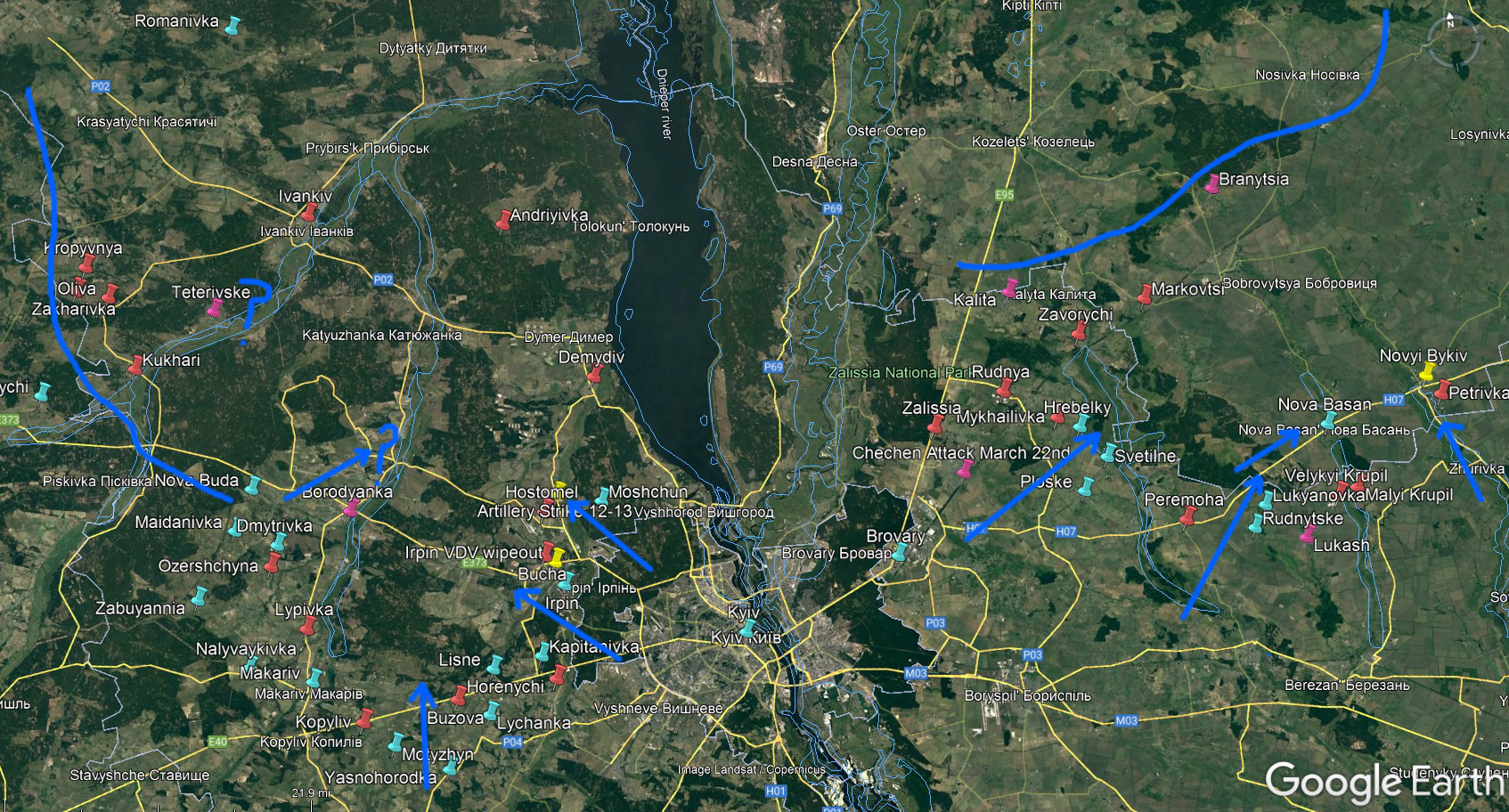
Ugly as sin but this makes the picture clear. It is hard to believe at this point that Russian forces are going to fight overmuch to maintain their positions in either the Brovary salient or what is now a salient north-west of Kyiv, except as a rearguard action. The recent rate of advance east of Kyiv does not bode well for Russian forces; moreover with their repeated failure to actually press the attack into Kyiv proper from this direction one wonders why they would try, especially with Ukrainian gains (and Russian retreats) around Sumy effectively ceding the integrity of their supply lines. Meanwhile, on the west side of the Dnieper it seems Russia’s position has become extremely tenuous; a salient some 40km long but only 15km or so wide. As you can see from the map view, this terrain is heavily wooded; good for defense, but not as good as the urban areas they’re slowly being forced out of. Worse they are clearly vulnerable to having their supply lines cut by a determined commitment of Ukrainian reserves at the right place further north.
Nonetheless it is possible for Russia to hold some ground here, stubbornly, as the Ukrainians have done. The better question is why. Russian forces may opt to use the Zdvyzh River (which touches the eastern side of Borodyanka,) as a fallback line if they’re forced out of the settlements west of it, and defend the eastern side of this wooded area by employing direct-fire assets (viz. tanks) in dug-in positions over the wide-open fields to the east. However this will barely put them in very long Grad range of Kyiv’s city center. (Note that their most prolific ammunition stockpiles, the old Soviet ones they are credibly said to be leaning on heavily, will be mostly Grad munitions.)
But given that mass bombardment is clearly not having the desired effect on Ukrainian morale or will to resist, the main reason to stay in artillery range is to continue hitting targets of military or industrial importance in Kyiv without having to use increasingly scarce long-range assets like Iskander or Kalibr missiles. This can be done from positions further north-west (allowing for more consolidated defensive lines requiring less troops to cover) using their 300mm Smerch systems. One presumes these targets would have been hit already, but the Russians have demonstrated a tendency to dribble out their missile attacks instead of hitting crucial infrastructure across the country all at once, once the decision is made to attack said assets. Even considering limits on salvo weight (available VLS cells in the black sea fleet/pylons on strategic bombers etc.) this makes no sense. The most likely limitation is a staff/planning one; limiting their ability to plan these strikes (recall the missed Iskander shots from day 1 mentioned previously.)
In any case the Russians have been within 152mm range of Kyiv for almost a month now; it taxes the imagination to suppose that even they have failed to hit any significant industrial or infrastructure targets in Kyiv in that time. The smart thing here would be to bail on the entire Kyiv region entirely. The fact that I did not predict them doing this, this morning, owed 1. to a lack of evidence that they were actually doing this (and this is only modified to a lack of sufficient evidence by the latest developments, mind,) and 2. the demonstrable fact that Russians have done anything but the smart thing so far.
There is also the continued Russian presence around Chernihiv to consider. There are only two good reasons to contest or even invest the city – 1. to provide flank protection for the Russian rear, as the Dnieper (and other rivers) are quite crossable with pontoon equipment up here and the P35 highway (part of one of two highway routes available to Russian forces that run to the Ivankiv crossroads) is very near that river; i.e. a presence eastward is needed to keep it out of artillery range. Reason 2. is to take the city, as it controls all road and rail links in this area, and thus to support serious logistics based out of Belarus (instead of all the way from Russia, through hostile territory going past Sumy) requires holding Chernihiv. (In this respect the contribution of Chernihiv’s defenders has been gravely under-remarked by most.) The Dnieper and its tributaries are the decisive factor here; it divides this AO in half and Chernihiv is the gateway to the east bank of the Dneiper. Given the Russians blew the only bridge south out of Chernihiv days ago, we can safely say they have given up on this.
One last possibilty is that Russian forces will withdraw from the Kyiv area, but maintain a presence in Chernobyl and environs south of it as a latent threat against Kyiv to force the Ukrainians to maintain a defensive presence in the region, so they cannot allocate those forces elsewhere. To evaluate this I mapped out the locations of the villages mentioned as having had bridges destroyed by the UMoD a few days back; placing the red “B” markers on the likely bridges themselves:
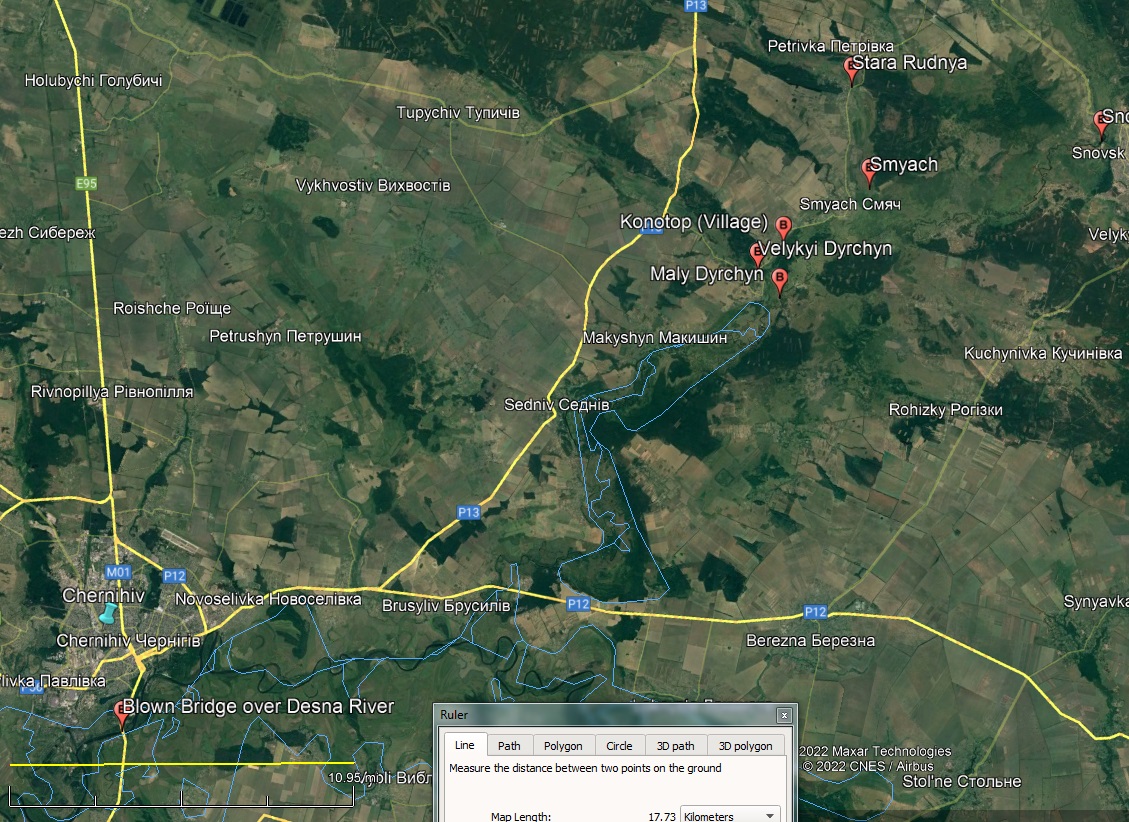
As one can see, if the P-12 highway bridge is also blown (and it likely is) then blowing these bridges does indeed make for a decent defensive barrier along the Desna and Snov rivers. To the West, the Uzh river runs just south of the Chernobyl area clear to Poliske (in enemy hands at last report) and past. This there is the possibility of Russia retaining a shallow, but wide front with a force concentration near Chernobyl, less to the west, and light forces to the east which exist mainly to drop artillery on any pontoon bridging attempts until a “flying” force can be moved to plug the gap:
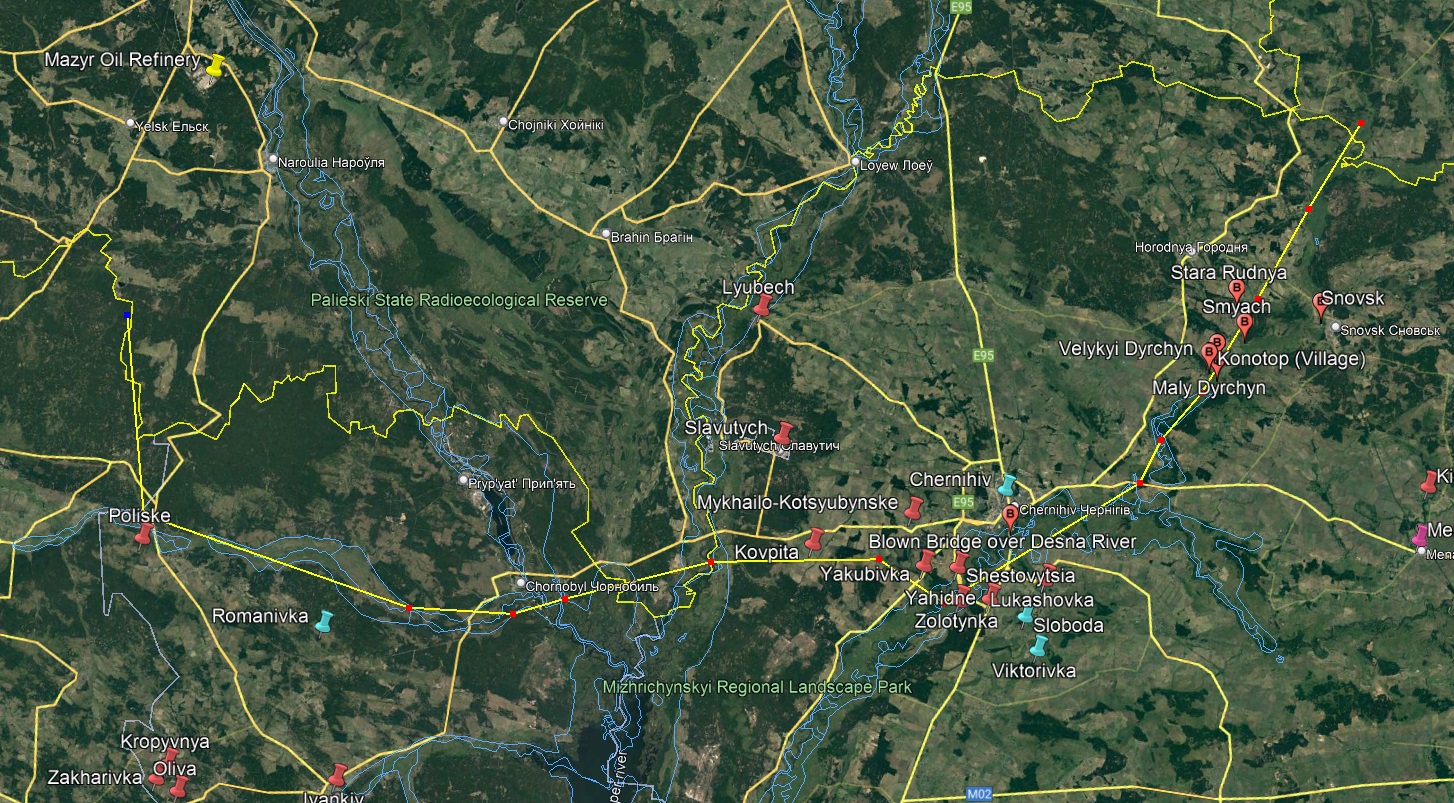
This is possible. I would personally weigh it as not very bright. Ukraine’s leadership – and indeed, anyone with two IQ points to rub together – is keenly aware of the cost to Ukraine of losing its eastern regions, and the fact that Russia’s more limited goals are now, most likely, to grab as much of Eastern Ukraine as possible and try to annex it. Thus the Ukrainians have powerful incentive not to over-protect Kyiv at the expense of vast tracts of their sovereign soil. Moreover, as Ukraine has just amply demonstrated, the terrain around Kyiv is the most ideal for defense, and even if Russia was to reach Kyiv proper at last, they’d have a very ugly fight on their hands in a city that’s been fortifying for it nonstop for four weeks straight. East of Kyiv, the Desna/Snov as a barrier works both ways. Ukraine will end up with more freed-up forces for redeployment than Russia will, when all is said and done. It makes more sense to pull everyone out and send them to the Donetsk front, and accept that Ukraine will do same, given that the terrain in that AO plays to Russia’s strengths in armor and artillery to a far greater degree.
Given the previously observed blyatkrieg, however, there’s no telling what they’re going to do.
Sitrep: Operational/Strategic
HAVE YOU NO AWACS, RUSSIA? HAVE YOU NO BARCAP? 1.21 ZIGGAWATS ALDAGHWEDG
I’m done for tonight. I’m done. I can’t even fucking believe this.
D+35 (April 1st) Update (Maneuver, Strategic, Operational) (posted 4:20AMblaze it April 2nd)
Sitrep: Maneuver
Kyiv AOO:
- Russia appears to be in full and unrestrained retreat in the area north-west of Kyiv. The UMoD (late on the 31st) continued to describe the Russian retreat prudently and soberly; calling it a “partial” retreat, pegging the number of units already in Belarus at 5BTGs, (out of an assumed 13 in the AO) and noting that “elements of the 1st Guards tank army,” one of Russia’s best divisions, are providing a rearguard. Nonetheless the UMoD’s mid-day list of settlements officially claimed liberated on April 1st are staggering: Demydiv, Dymer, Lytvynivka, Gavrylivka, Kozarovychi, Zhovtneve, Hlybivka, Yasnohorodka, Talakun, Sukoluchchya, Lypivka, Gavronshchyna, Makovyshche, Mykolaivka, Khmilna, (to the north/west of Kyiv) and Rudnya, Shevchenkove, Bobryk, Stara Basan, Nova Basan, Makiyivka, Pohreby, Bazhanivka, Volodymyrivka, Shnyakivka, Salne, Sofiyivka, Gavrylivka (to the south-east.) Of these villages I was unable to locate: Garylivka (either one,) Hlybivka, Talakun, or Sukoluchchya. The rest I have marked on the map with green pins (unless they were already marked by a blue one) to illustrate the scope of the new revelations. (That a few blue pins were mentioned indicates settlements UMoD only hinted or implied were in Ukrainian hands before, and are now making an explicit statement to that fact). Note the omissions in these claims are even more significant when compared with other information now in-hand.
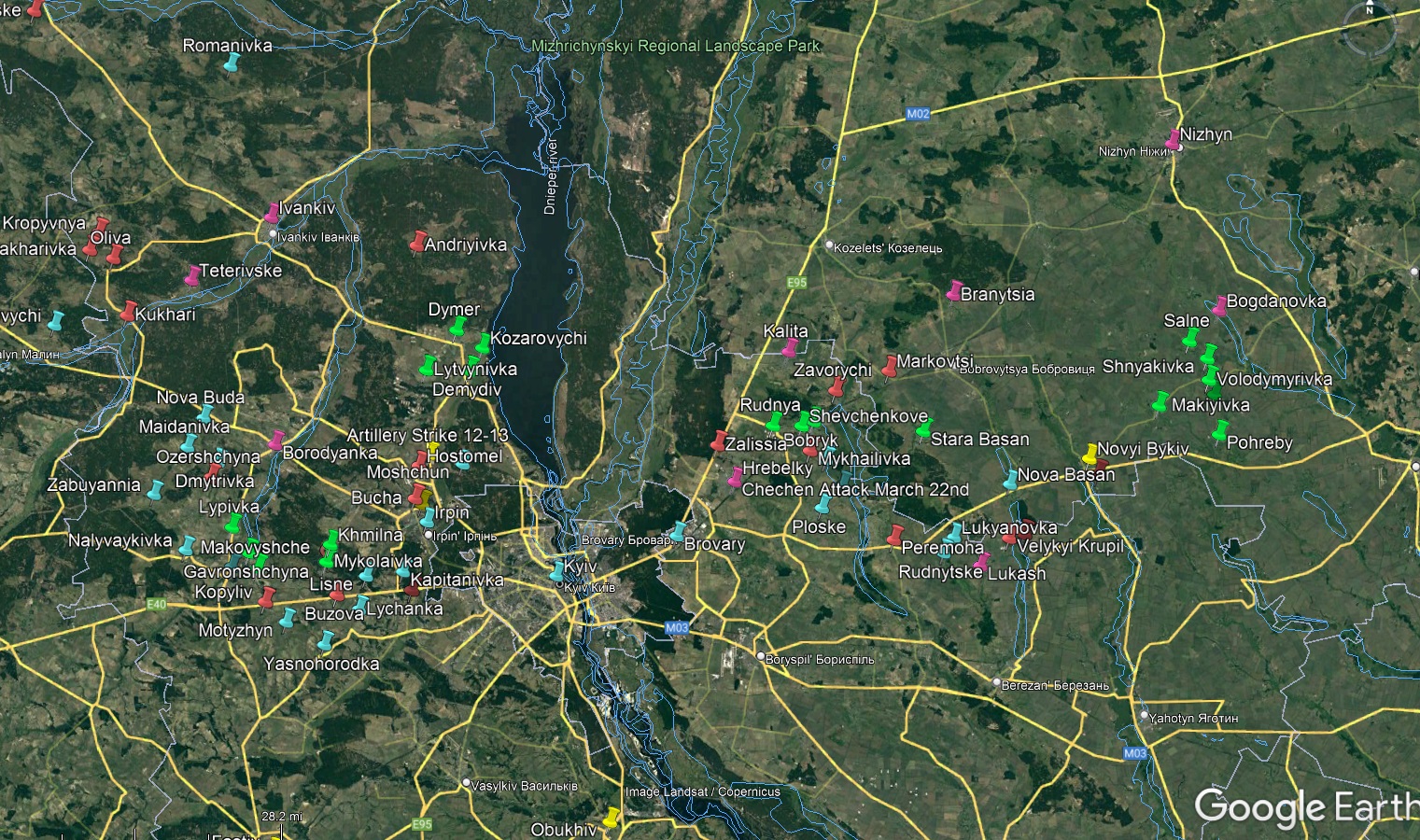
- Given the vital importance of this town, it’s very curious that the UMoD is not mentioning it.
Analysis: (AKA Anatomy of a Clusterfuck)
The obvious question now to ask is: how many Russians were able to retreat before the door was slammed on their retreat at Ivankiv? And my answer is, we do not know. However, I can hazard a guess as to the nature of this retreat – this does not appear to be a fighting retreat in good order, but the Russians running like hell.
The first hint is the speed. VDV units pulling out is one thing; fighting was still active in Irpin around the time we got our first inklings that was underway. But since we got our first hint that the withdrawal was involving regular line units it was... two days? Maybe three, at the outmost, if one accounts for OSINT lag? As I stated before, this is a very very very short amount of time to withdraw a force so large it jammed up a highway for over a week during its initial movement south (to already secured frontlines, no less.)
The second hint is the lack of any reports of active fighting – I’ve been glued to Twitter all damn day, even while eating, on my phone, and I’ve seen little to no mention of any intense combat operations; just the occasional claim that Ukrainian forces are searching for Russian soldiers in plain clothes trying to hide, or the like. Most significantly I’ve heard nothing of heavy fighting at Ivankiv. One of the biggest reasons I didn’t expect Ukrainian counterattacks in NW Kyiv AO is because it’s not enough to simply cut off a force, you also have to crush it in detail, i.e. mass far superior firepower against it to obliterate it. A force that knows it’s on a strict time limit due to cut supply lines will immediately try to extricate itself. Given the terrain characteristics this would/should amount to Ukrainian forces, with favor given to infantry and ATGM teams, digging into southern Ivankiv and the woods around it and holding on like ticks as multiple Russian BTGs try to bulldoze over them (and get devoured piecemeal as their chronic inability to maneuver offroad or coordinate maneuver at larger than regiment scale bites them in the ass.) Instead I see nothing.
The third hint is that we are seeing casualties. @oryxspioenkop, the Turkish OSINTer whose tirelessly cataloging every verified vehicular loss in the war (cross-referencing to rule out the same vehicles seen from new angles, or photographed from the air, and then the ground,) says that just today almost one hundred new photo/video of Russian losses have been queued up for review – none of them from his previously existing backlog. If we bear in mind that the OSINT window is only a sampling (and a biased one, at that) of what is being seen, it means that there’s most likely significantly more destroyed materiel being photographed. Naturally, most of it is said to be from the Kyiv region. Some of this will be equipment knocked out weeks ago in artillery duels that was behind enemy lines and thus simply not photographed till now – but not all of it.
The fourth hint is this absolutely spectacular demonstration of thorough OSINT detection work by the @Geoconfirmed team which, by use of geolocation, was able to associate two different video clips from Ukrainian propaganda reels as taking place in the same area, as part of the same battle, involving the same Russian column. Note the long white buildings they geolocate to 50.4565173, 30.1718725. I looked for the small square house with the brown roof and tan walls visible by the Russian tanks when they’re on the road in column formation engaging something to their front-left quarter and found it at 50.45466417556569, 30.170671396479488:
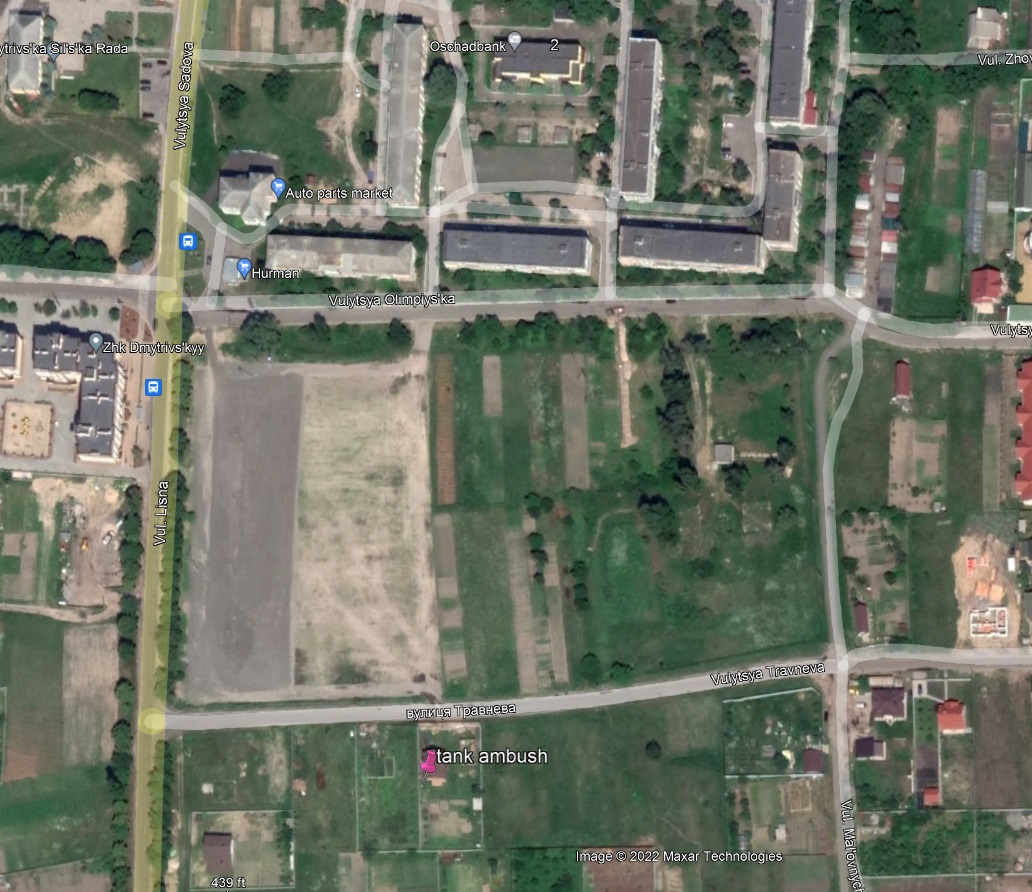
The buildings north of the road are about 200m distant and are large, heavy structures; the upper windows would be ideal for positioning ATGM gunners for an ambush, or even just observers. Only 400m up the road (at 50.4547393, 30.1762231) is where the third part of the video takes place. This was confusing until my friend @spuddus noticed the characteristic yellow streak overshooting the BMP that he’s noticed tends to coincide with NLAW usage. Ergo the engagement looks like this:
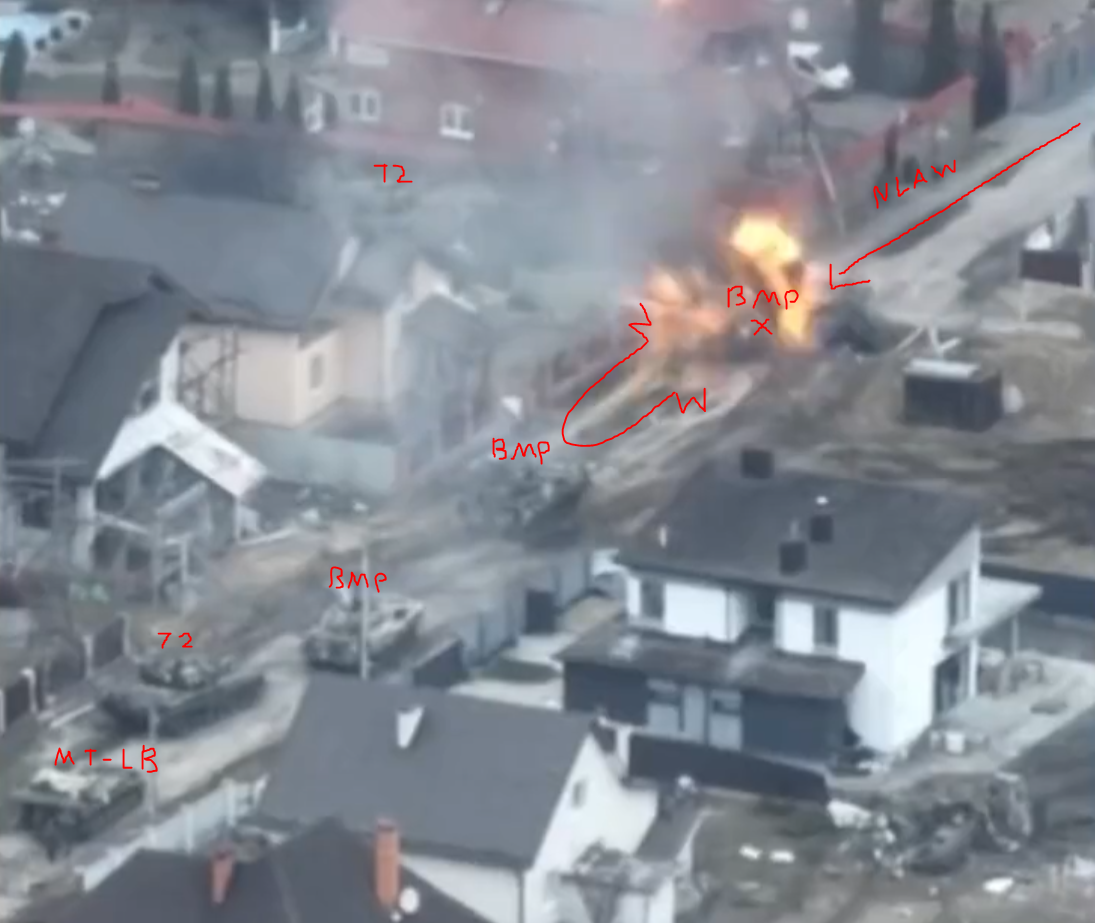
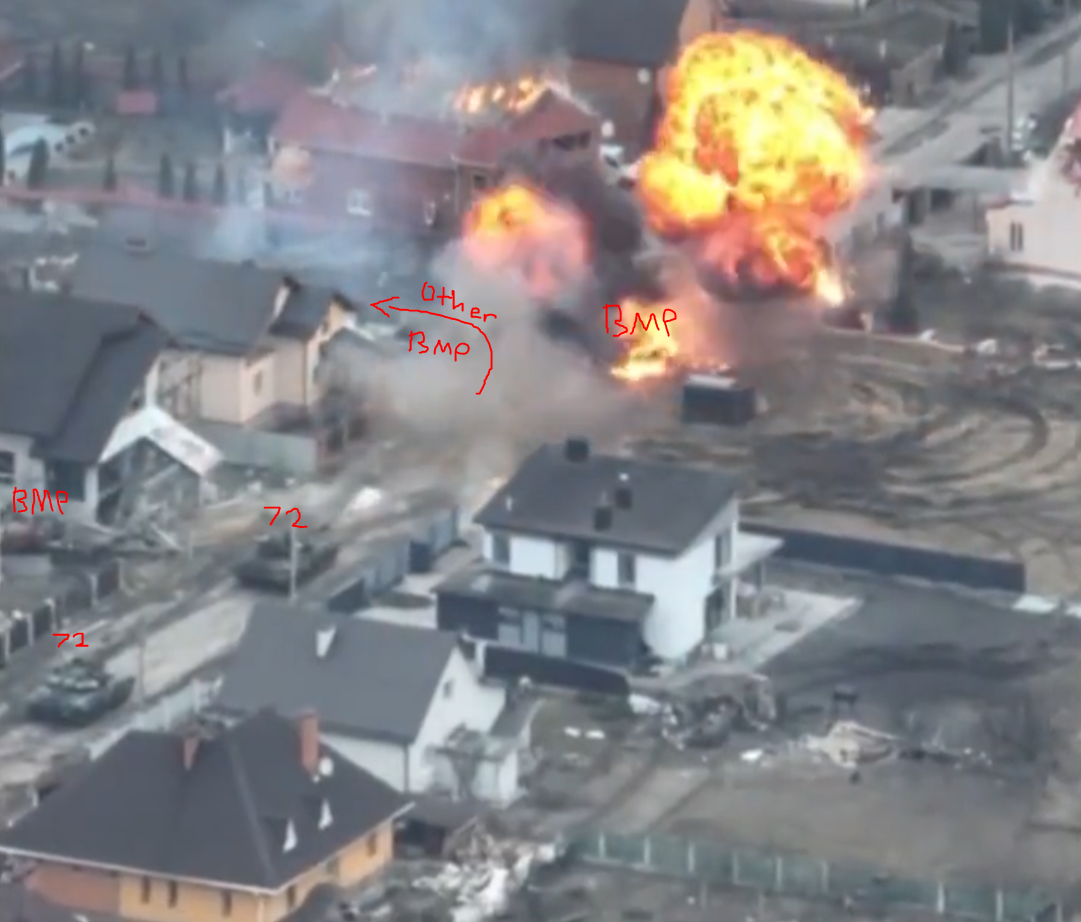
The reason the T-72 hits the disabled BMP with the crew bailing out is simple accident; it’s attempting to return fire over the BMP, down the road against the ambushers. As geolocated aftermath photos from the ground show, one of the tanks here was also knocked out a little ways down the road to the south of this intersection (see link for source, I did not geolocate this:)
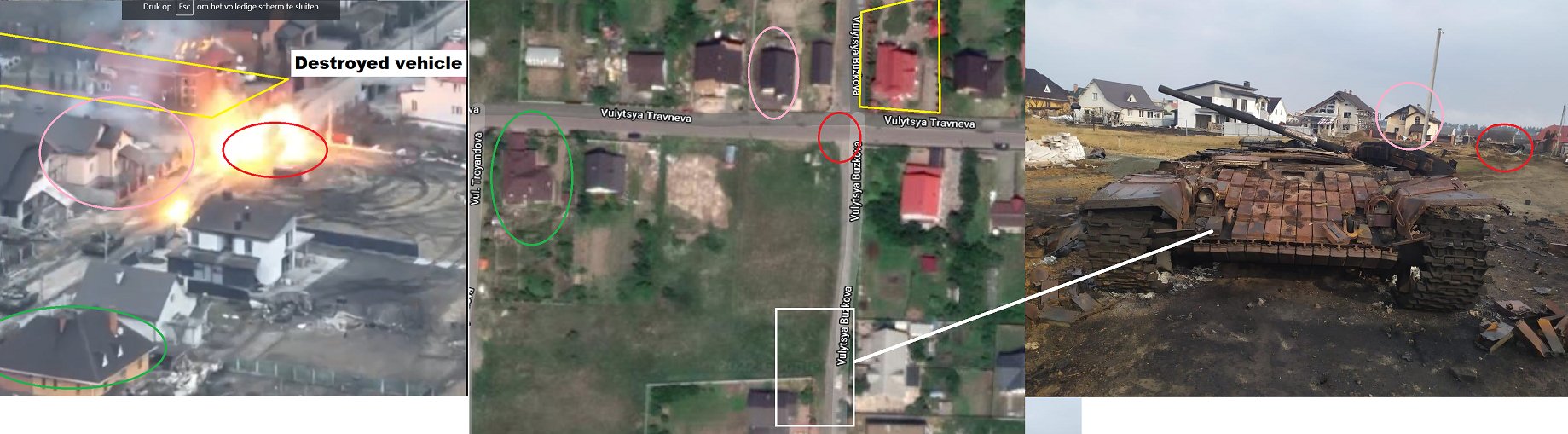
800m up the road, at 50.459464, 30.182701 is where this video takes place; where a tank fires from about 150m down the road and nails a BMP as it tries to move through an intersection where at least one other vehicle has already been knocked out. The video’s author also implies this is a blue-on-blue; again there’s nothing I can see to prove that at all. This exact same intersection is visible at the 0:05 second mark in the first video, from a different angle. Note the same building just to the left of the building with the red peaked roof and white walls is on fire, as well as a knocked out vehicle just to the left of the intersection, and if you look closely you can actually see the (most likely Ukrainian) tank still there. Compare: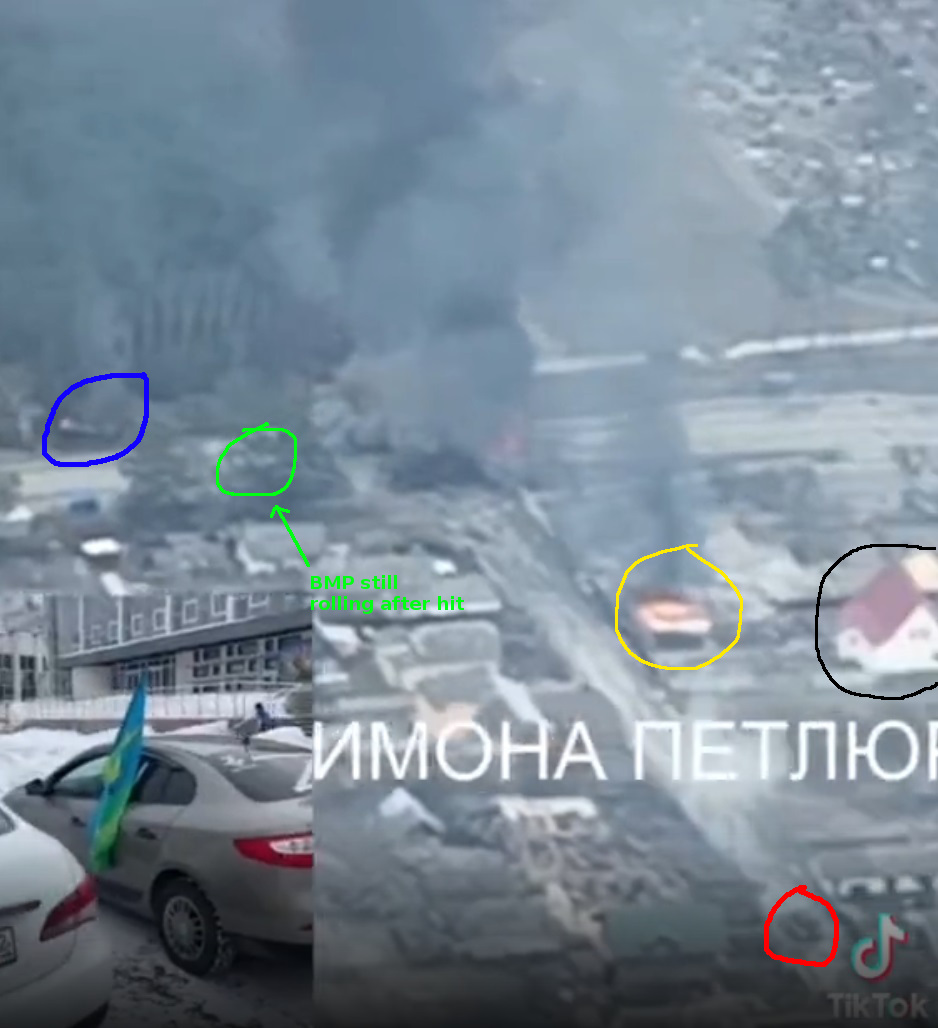
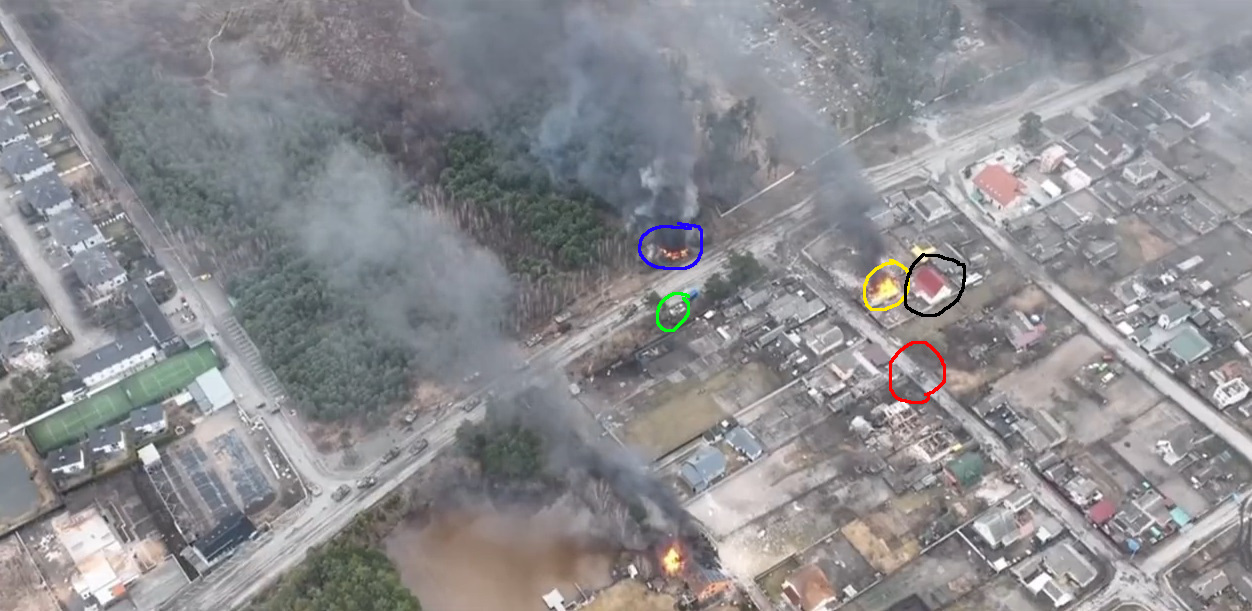
Note the Russian vehicle/tank column that has already passed the intersection. Note also how the BMP keeps rolling after it was hit.
Now note ground level photos of the aftermath: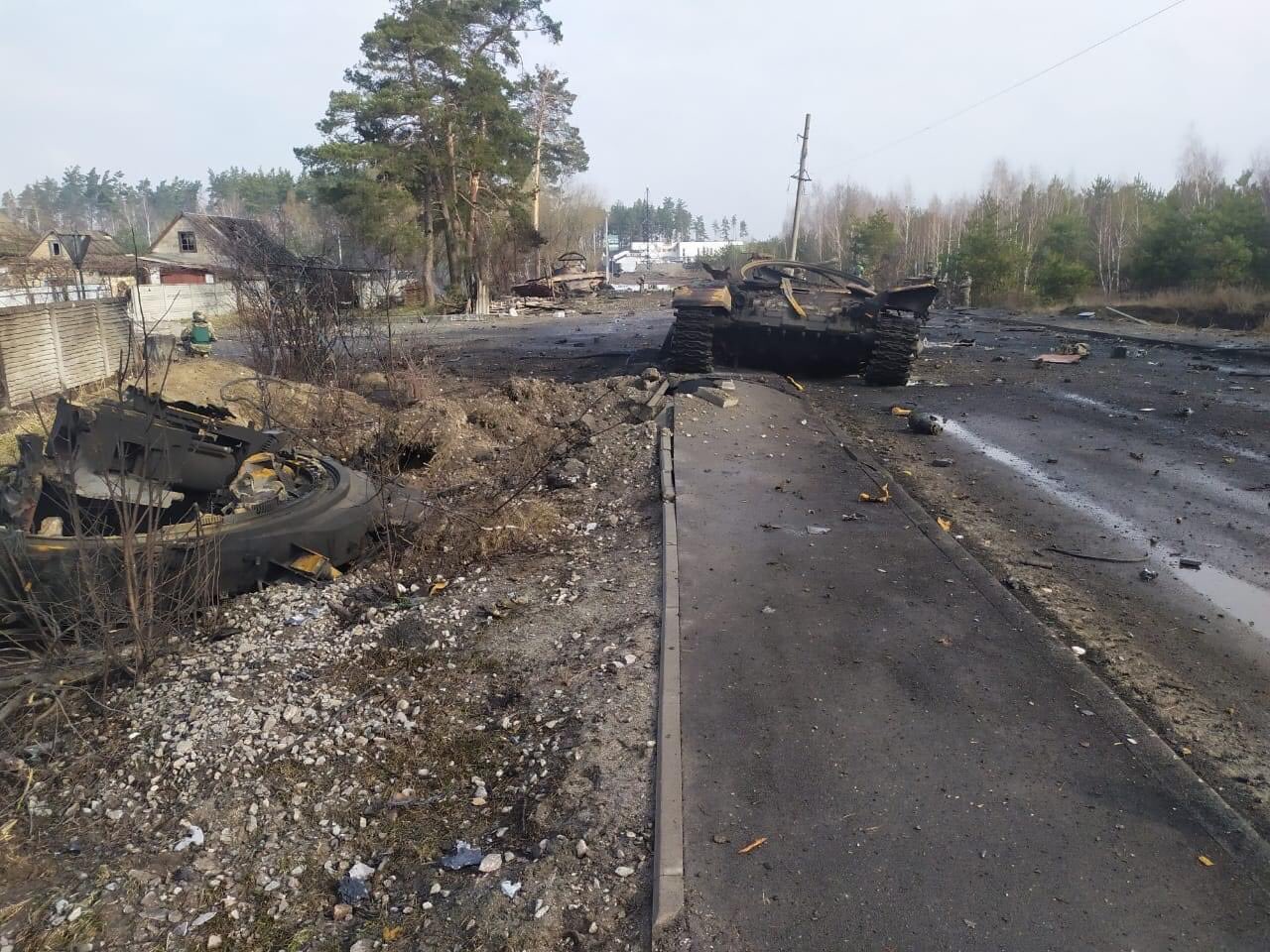
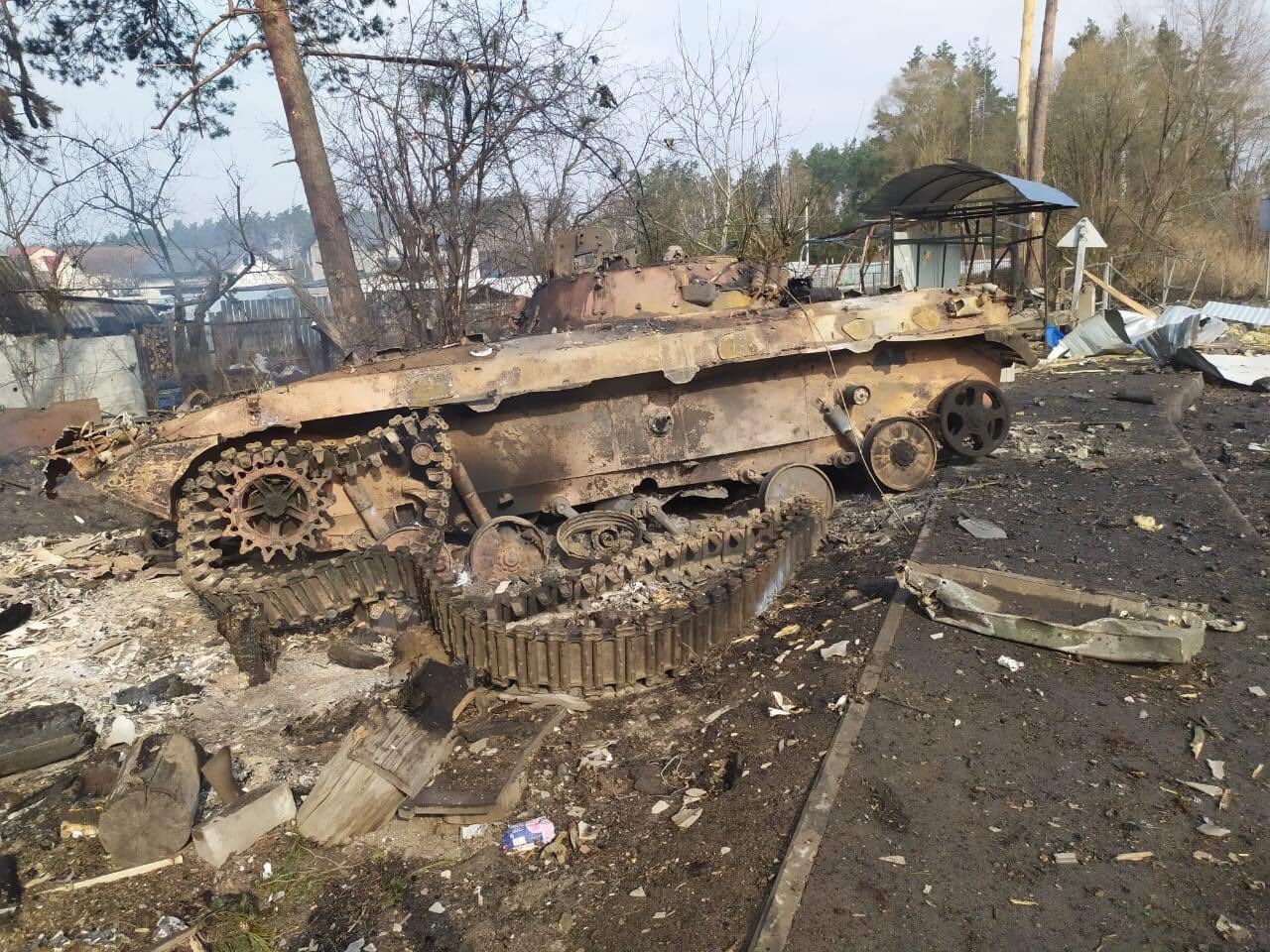
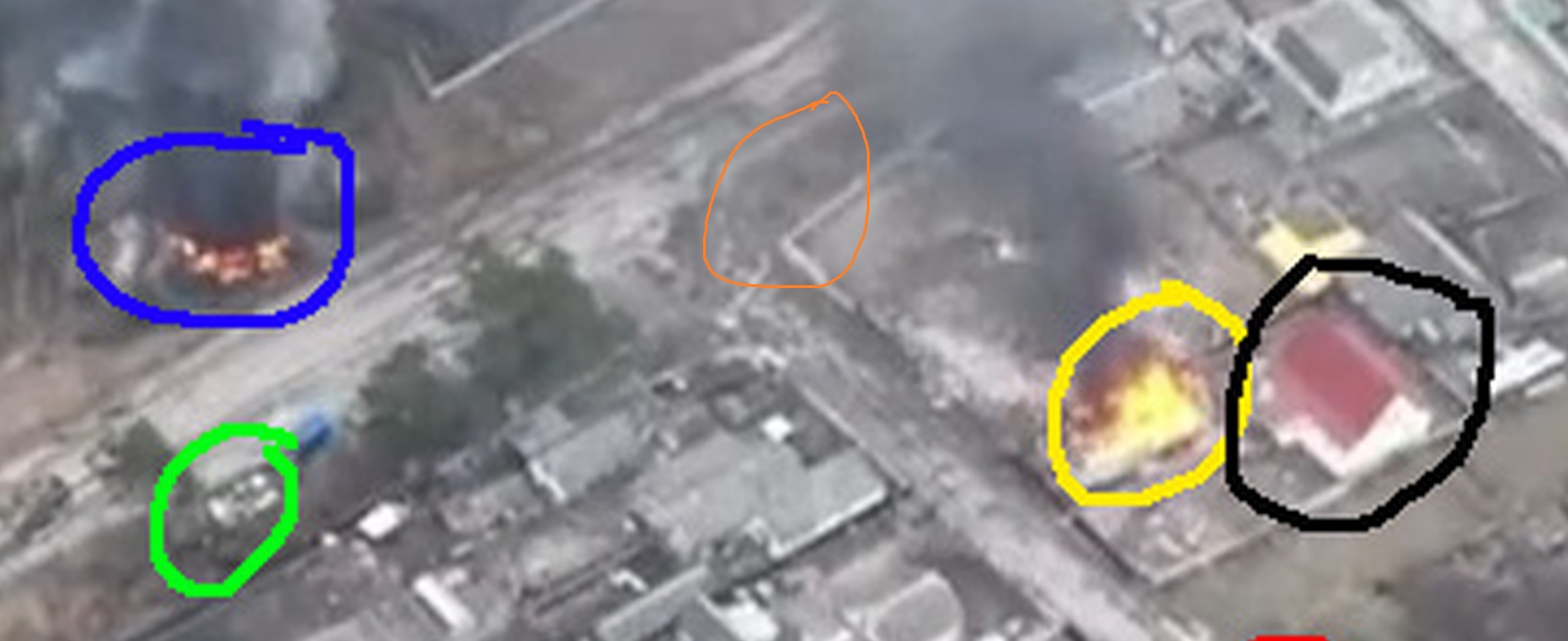
Orange circle – the knocked-out T-72 in the first photo is the vehicle burning at the corner of the intersection in the awful TikTok video. In the second it’s already burned out and thus blends in with the asphalt very well, but you can just discern two circles – that is the turret ring of the tank hull and the ring of its own destroyed turret. In the ground-level photo you can even see the knocked-out BMP on the left side of the road, where it swerved after being hit.
Of course, it is further up the road where the true carnage begins, around 50.4636391, 30.1823188. This is the general area of the killzone that you see in the first part of the video. (This separate video shows where the rest of that column came to grief all at once.) At approximately the 0:29:50 mark of the video (with the awful superimposed trollface) you see a flash from the lower-right corner of the screen and an almost simultaneous impact on the rear of a Russian tank as it moves through this area (with the treeline on the west):
I thought this to be an RPG attack from the treeline at first, but @spuddus believed it to be a tank cannon. Given the blast on the right looks more like a muzzle blast than a backblast, and the geometry of the area, he may well be right. Consider:

Note Vulytsya Myru road and how it provides an almost straight shot to the very area the Russian column was engaged from. From the place it bends north-east is only 250 meters. It’s highly probable that the observed tank and/or its section mate exploited this lane of fire. It’s also highly likely that additional Ukrainian fires were waiting in the treeline some 600m east of this area, firing across the open field on the road.
Now consider the entire area and sequence of events:
1. Russian tank column moving along road engages something in those long white buildings 200m north of them.
2. 400 meters down the road, a leading BMP is nailed by an NLAW. The second BMP hangs a left to clear the lane of fire for the tanks. A hasty return shot from the foremost tank hits the BMP. An attempt to bypass the intersection to the right/flank the ambush resulted in a dead Russian tank a little ways down the road to the south.
3. The Russian column manages to defeat or bypass this ambush, and reaches the main north-south road on the east side of the village of Dmytrivka 400m west, then begins moving north (towards the Russian rear.) 700m directly north-east of the second ambush intersection they drive into an ambush by a single Ukrainian tank watching the intersection from 150m down Vulytsya Lisna road. Three vehicles are knocked out here; one T-72, one BMP and one (probable?) BMP. (This last vehicle is the one seen exploding at the very beginning of the main video in question.)
4. The column (hesitantly) proceeds up the road where they are engaged by further assets and are completely destroyed.
Consider also what little we saw of this armored column in action; especially later near the final kill zone – hesitant to move, holding still after being engaged in multiple directions, etc. Finally, this panning shot (combined with the prior analysis of kills in the intersection) shows us the force size (marked mostly by @spuddus:)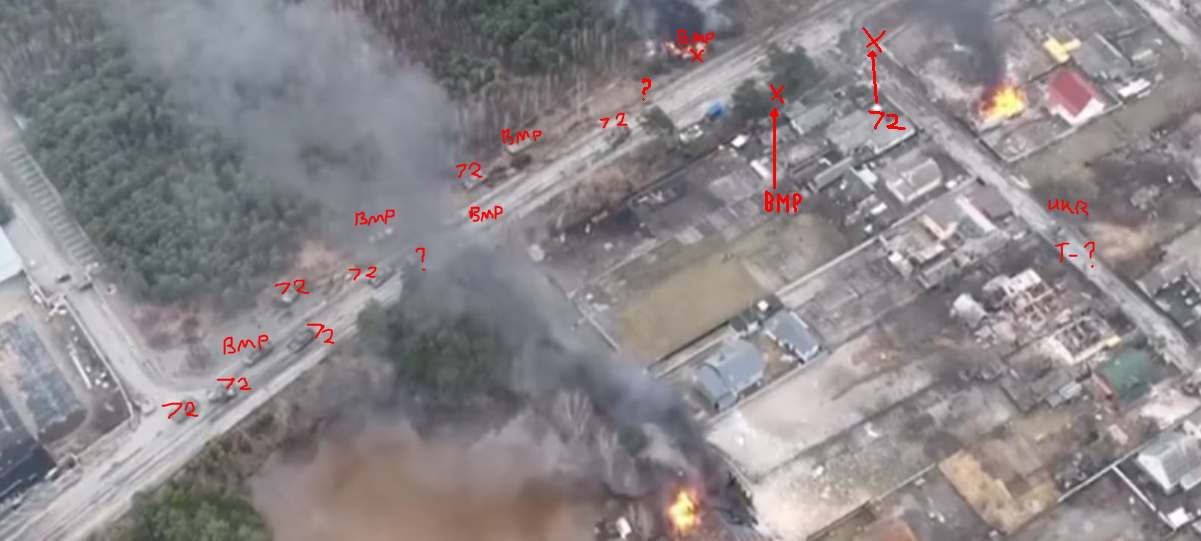
Considering the T-72 and BMP knocked out in the earlier intersection and assuming the two unknowns here are T-72s, that gives us ten T-72s and at least seven BMPs. That’s a full tank company with most of an attached mechanized infantry company.
Putting this all together: A two-company combined-arms maneuver force attempted to retreat from the village of Dmytrivka, which (was) the southernmost frontline of the Russian advance, being just north of the E40 westward highway out of Kyiv. While attempting this retrograde through the village, they were engaged no less than four times by Ukrainian forces already in the village. The first encounter they bypassed without trouble, but it cued additional Ukrainian elements to close on their position, costing them two vehicles at the second engagement. By the third they had at least a Ukrainian tank section waiting for them, and following a confused and uncertain response (including no attempt to engage the tank that had ambushed them at the T-intersection) they were presumably halted by fire from the front and right flank. They were quickly engaged from behind by the tank section they had tried to bypass and were promptly destroyed in detail without even managing to move off the road to engage their attackers.
In sum, this Russian unit was running for their lives, trying to fight through enemy units already behind them, without any artillery or air support, and were destroyed before making it three kilometers from their likely frontline position. Their unwillingness or inability to move directly north out of the village over fairly open ground, and instead to advance up an obvious main road (despite having an all-tracked force) further doomed them. If this was a rearguard force it was a sacrificial one. There was no attempt at a bounding, fighting retreat; the rest of their BTG fled as fast as they could, and they were unable to catch up before Ukrainian forces caught and obliterated them. This was an unmitigated clusterfuck.
It’s tempting to read too much into a single engagement because of the amount of work (from many people) it takes to decipher it. Alas, this is the only engagement we have to hand for analysis. When taken into context with every other point, however, I believe this all paints a picture of an unmitigated clusterfuck of a Russian retreat. The lizard only escaped the trap by giving up its tail.
Final observation - note that two of these engagements were presented as lol blue-on-blue, whereas only one of them was technically blue-on-blue and that against an already disabled and abandoned vehicle. Moreover the video was cut up out of any chronological or spatial order. From propaganda can be gleaned much, but this was presented as propaganda - not for our convenience.
Sitrep: Strategic/Operational
- More and more evidence continues to roll in, including in the form of direct testimony, of Ukrainian civilians being forcibly deported deep into Russia, especially from the city of Mariupol. Russia claims to have “evacuated” almost 380,000 people in this fashion. Forced deportation to distant barren hellholes in Siberia were, of course, standard Soviet doctrine for suppressing and crushing dissent and was used specifically against the Crimean Tartars of Ukraine. It mirrors the mass incarceration of Uyghur muslims being performed by the Chinese Communist Party for a reason – the goal is the same, namely, genocide. Not “cultural genocide,” but straight-up genocide, as there is no other name for a policy wherein Uyghur women’s husbands are put in prison camps before a Han Chinese man is assigned to live in their home, sleep in their bed, and rape them till they are impregnated with a half-Han child. Refusal to submit results in the wife being sent to a prison camp as well, where she will be raped repeatedly anyways, and likely forcibly sterilized so she cannot give birth to new members of the undesirable race. Given the well known history of the behavior of Russian soldiers and the outright wanton murder of civilians, in person, face to face that Russian soldiers have been not only credibly accused of, but caught on video doing, it taxes imagination to suppose that thieves, looters, and murderers are not also raping as well.
- Understand that the point of these barbarities, in Mariupol especially, goes past the usual motivations previously discussed. The point is to depopulate Mariuopol; a per-emptive application of the only strategy that has ever reliably suppressed insurgencies – genocide. Whether by outright murder before the muzzles of Russian artillery or by deportation en masse to be prisoners and hostages in a distant land, Russia desires no resistance that would endanger the land bridge to their precious Crimea, holding, as it does, the mighty naval base so essential to a mad dictator’s delusions of Soviet grandeur.
- If you want to know whether or not Ukraine will accept Russian occupation of a single inch of their soil after the barbarities and unforgivable crimes against man and God inflicted upon them by the Russians, here is your answer.
- The implications of these two data points are so staggering they tax credulity – however, the incompetence of Russian blyatkrieg taxes the imagination to explain without such conclusions. To wit; Russian mandatory conscription terms only last one year (most countries with the practice require two, as Russia used to.) It takes six months just to complete basic + combat training, (and it’s better to take even longer if possible,) leaving very little time to actually use those barely-competent kids. To send them into a war with a near-peer opponent is begging for defeat. To hide it from the dictator of the state, even, requires a Defense Secretary that not only mixes the cool-aid with lies and falsified reports, but then turns right around and fucking drinks it.
D+35 Supplemental and D+36 Updates (April 1st and 2nd) (Posted 6:30PM EST April 2nd)
Sitrep: Maneuver
Kyiv AOO Supplemental:
- More evidence of a hasty retreat that went badly is coming in. Reminder that much of the imagery (like most of the things in this thread) are fresh evidence of heavy Russian losses incurred in this AO before they began their retreat. However these images ([1] [2] [3] [4]) show multiple vehicles, on roads, in column formations, that were destroyed apparently within seconds of each other. I believe this is strong evidence that the massacre at Dmytrivka was not a lone incident as these losses indicate similar circumstances – sizable forces attempting a fast retreat being ambushed and utterly destroyed. This is not the steady attrition of a few vehicles here and there during a retrograde movement, but total wipe-outs.
- Given all this, I believe Michael Kofman’s summation is on-point: this wasn’t a rout, (i.e. destruction of the bulk of the force) but the losses Russia incurred during this retreat definitely qualify this as a significant military defeat.
- Note also: in addition to defeats of significant maneuver forces altogether, the haste of Russia’s retreat means much disabled or damaged equipment that is otherwise repairable and returnable to service was most likely abandoned for lack of transport capacity. We are already seeing this and I expect a lot more to pour in come the following days. (See also the Mykhailo-Kotsyubyns'ke entry further down.)
- Claims of the liberation of Stoyanka, a town not 2500 meters east of Dmytrivka, went up March 31st and are interesting because images of this knocked-out BMD-4M, a VDV airborne vehicle, accompanied it, which is odd as earlier indications were that the VDV were shifting fronts, but line units were not. Note the penetrations and the dings where the armor defeated penetration – this was likely engaged by a .50 caliber or 14.5mm HMG or perhaps even a 30mm autocannon firing AP rounds. The BMD-4, like most Russian IFVs, has armor rated to stop only 7.62x51mm AP rounds. In other words this vehicle could have easily been knocked out by an anti-materiel rifle (though I feel the spread of hits is more consistent with being hit by an autocannon or low-rate-of-fire MG, such as an M2 Browning.) Determining caliber can be difficult because the aluminum armor on airborne vehicles deforms more (leaving bigger holes) under impact.
Kyiv AOO: New
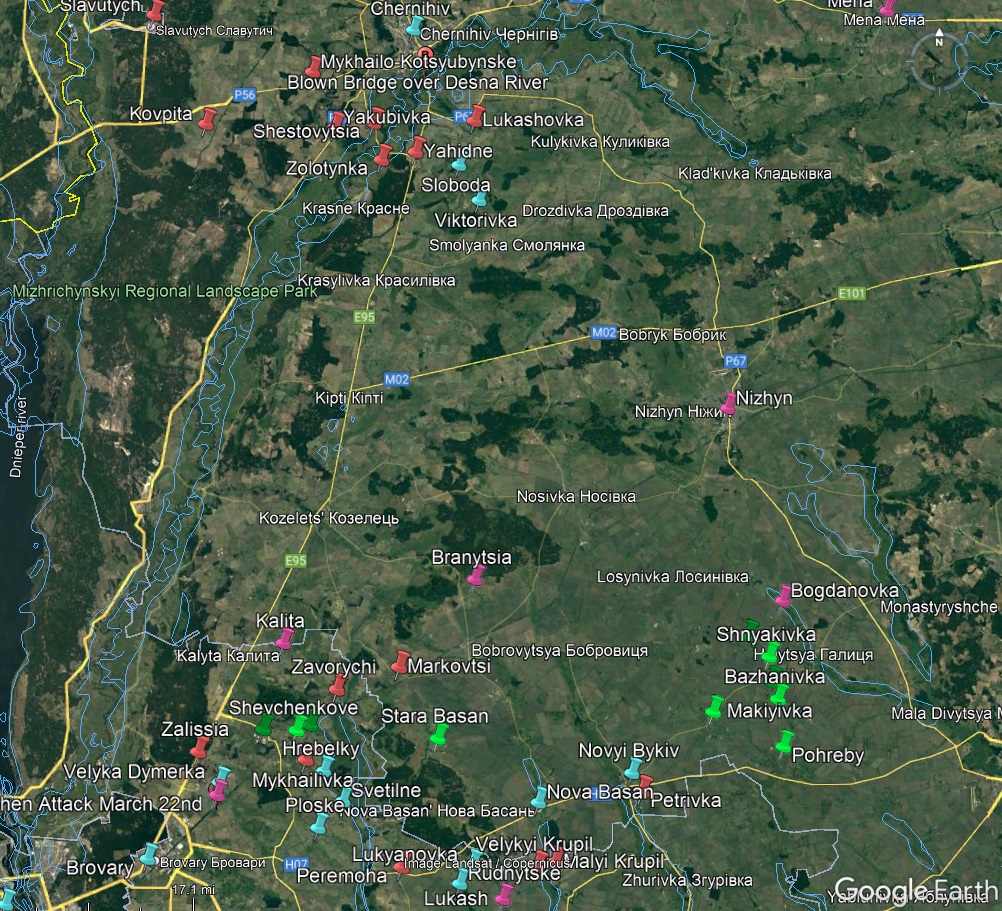
- This possibility is greatly increased by the presence of the 1st Tank Regiment, one of Ukraine’s two active-duty tank regiments, being confirmed by this media report as having defended the city of Chereniv itself from inside the city itself, not by operating in the environs around it. Note this may be the motivation for Russia blowing bridges over the Desna and Snov rivers; to prevent this potent maneuver force from striking south from Chernihiv to cut off Russian forces south of the river before they can retreat. (Article is excellent reading; also confirms Ukrainian dispersal of forces before initial assault negated Russia’s attempts to destroy them with preliminary massed barrages.)
- The 1st Tank is keeping busy however as Mykhailo-Kotsyubyns'ke, a village 10km west of Chernihiv, has been liberated by Ukrainian defenders. This matches (unconfirmed) reports I’ve seen before about Chernihiv’s defenders pushing out of the city in all directions.
Sumy/Kharkiv AOO:
- The town of “Malaya Rogan” (aka Malaya Rohan) on the east-southeast outskirts of Kharkiv that Russian forces took to close the M03 highway to Chuhuiv, which was then taken back by Russian forces, is now known to have been a much stiffer fight than previously realized. See these tweets for new imagery of just how many Russian vehicles were destroyed in this battle. [1] [2] [3] [4] [5] [6] [7] [8] [9] [10] [11] [12] [13]
- Ukrainian forces claimed 11 T-72s destroyed, one BTR-82A, 12 MT-LBs, three DT-30 tracked supply carriers,, 4 2B16 Nona-K SP gun-mortars. As the above linked tweets exhaustively document, photographic evidence confirms numbers very close to Ukrainian claims. Apparently the Russians were holding a 2-kilometer long position in a treeline along a slight ridgeline that allowed them to control the M03 highway to Chuhuiv. The assets destroyed here amount to a full armored company and the transport for a reinforced mechanized rifle company (the MT-LB can seat eleven plus two crew whereas the BMP-2 seats seven plus three crew.) Ukrainian forces claimed elements of three BTGs were present for the defense. Without their tracks it’s questionable how much of that rifle company was able to retreat; it depends on how strong the Russian force was total, thus how many retreating tracks were available to jump on top of.
- Given Russia’s shift of forces away from Kharkiv to the Donbas front, this strong attempt to close the M03, with positions so close to Kharkiv, is odd. Ukraine can redeploy to that front as it pleases using internal lines of communication further from the front and Russia should be able to do likewise. I cannot think of any tremendously important reason to allocate significant forces to investing this line of communication. The only good purpose I can think of is to prevent an attempt at a deep raid behind Russian lines by the 4th Tank Regiment, perhaps aimed at Kupiansk, which is a major road and rail logistics hub crucial to supplying Russian forces on the Donbas front from the forward logistics concentrations around Belgorod. Until the muddy season passes, holding roads is a decent way to guard against massed armor assaults, especially in the wet and river/creek prone NE area of Ukraine.
Donetsk/Luhank AO:
- City official in Izyum claims that Izyum is fully in Russian hands now. Given that Russian forces already bypassed the town days ago and have been fighting for villages immediately south of it, this is of limited significance, (especially since the defenders blew both bridges across the Donets river in the city) but it does mean Russians can hide artillery assets in the southern urban areas.

As you can see from the purple pins indicating where UMoD has indicated previous fighting, this doesn’t seem like much of an advance, but just a continuation of what’s seemed like a fluid, back-and-forth struggle in this area for quite a while.
- Heavy fighting still present in Marinka, the furthest tip of the suburbs that move west 20km from Donetsk city proper like a tail along the N15 highway. Despite some obvious staging of this Russian propaganda clip, it gives a good look at the kind of terrain they’re fighting in – very, very close. Light infantry country.
- If the Russians are relying on leveling these areas yard by yard with heavy artillery barrages to make their advances possible (which seems to be the case from previous video shown, including the above linked Russian video from Verkhnotoretske,) we should question just how long Russian ammunition stockpiles will hold out. Even Soviet hoarding has its limits, and as they dip into older and older ammunition stockpiles their average effectiveness will drop (worse accuracy, higher rate of incidents and blown breeches, more chance of ammo dump oopsies, etc.)
Southern Defensive Line AOO:
- Mariupol remains Ukrainian.
- In case it isn’t abundantly clear, the defenders of Mariupol – which include some of the most elite troops in the Ukrainian military – are likely going to fight to the death for the city. Their role has been and will continue to be that of attrition. This is extremely ugly to contemplate, but the damage Mariupol’s defenders are inflicting may well prove decisive later in this war, when Russia badly needs soldiers that are buried in a city that took them to hell with her.
Kherson/Mykolaiv AOO:
- The reported liberation of Novovorontsovka (good luck pronouncing THAT one) was mentioned a few days ago by the UMoD but mentioning it just slipped my mind. On the 31st we finally got some image evidence of the recapture, including two re-liberated Ukrainian T-64BV tanks. Not surprising to see them on this front; the heaviest Ukrainian losses suffered at one time seem to have been incurred during the withdrawal from the Crimean defensive line, as Ukrainian forces taken somewhat by surprise had to attempt a rapid retreat to the Dnieper in very open, flat terrain very close to Russian airbases in Crimea. (See the “highway of death”.) Coupled with the loss of Kherson and it’s military base/depots, Russia likely had some repairable (mobility-killed) T-64BVs and some equipment/spares stockpiles to service them. Note that Novovovovvovooooooo... w/e is right on the west bank of the Dnieper river and also the closest point in the reported Russian frontline to the H23 highway:

- After several days of saying that Russian forces in the Kherson AOO have been quiescent as they regroup and resupply, UMoD indicates they have begun offensive operations yet again. Why they persist in spreading out forces like this when they should consolidate a defense around Kherson and shift these BTGs further east is a mystery. UMoD’s wording is interesting: “the enemy is carrying out assault operations in order to reach the administrative borders of the Kherson region.” This is the same wording they use to describe Russia’s efforts on the Donetsk/Luhank front (while also explicitly acknowledging the attempts to encircle Ukrainian military forces there as well.) The significance of reaching the administrative borders is that it would allow Russia to lay claim to the region entire for effective annexation. As UMoD has noted repeatedly and I’ve noted in these reports before, Russia has (and still is, even though I’ve been too focused on purely military matters to properly document it in these reports) attempting to suppress the population of Kherson with policing actions (whom are responding with ever more fervor against their occupiers) as well as building a puppet state infrastructure identical to those seen in Donbas and Crimea.
- Even after giving up on regime change and taking Kyiv, Russia is still trying to grab as much of Ukraine as physically possible.
D+37 and D+38 (April 3rd and 4th) Update
Sitrep: Maneuver
Kyiv AOO:
- Russian forces have completely fled the Kyiv AOO as of sometime April 3rd. Ukrainian forces have published an image of the Ukrainian flag flying at Chernobyl NPP, with the New Safe Containment building visible in the background. Likewise, the border checkpoint in the northern outskirts of Chereniv is back in Ukrainian hands, as this geolocated imagery shows. UMoD stated that Russian stragglers are still present, either in hiding or attempting to exfiltrate the AO.
- It is almost certain that Russian forces have also withdrawn from anywhere near Chernihiv, as well, but I have not seen UMoD statements to that effect, nor photographic evidence to suggest it.
- Images continue to pour in showing the absolutely staggering amount of Russian equipment abandoned in their undignified retreat (see Materiel section in next update.)
Sumy/Kharkiv AOO:
- Russian forces are in full retreat in and around Sumy. UMoD stated on April 3rd that their retreat was ending in this area (“Siversky region”), so by now, April 4th, it’s likely that no Russian presence remains anywhere near Sumy or north of it. There have also been videotaped sightings of these withdrawals in force. It is almost certain that Sumy is no longer encircled, but I have not seen formal statements to that effect yet.
- UMoD reports from the 3rd and 4th state that Russian forces are still investing Kharkiv to the best of their ability, including with nonstop indiscriminate bombardment. This is likely because this area represents the northern flank of what is now one of only two fronts remaining to them in Ukraine.
Donetsk/Luhank AOO:
Kherson AOO:
- Ukrainian forces are on the offensive in this oblast- on the 3rd UMoD stated that Russian forces are trying to “maintain occupied positions in the area of the settlement of Alexandrivka.” Google interprets this as “Velyka Oleksandrivka,” a village hugging the east bank of the Inhulets river. Note this town is a solid twenty-five kilometers behind previously reported northernmost Russian locations here (Krasnovka, Zagradovka, Knyazivka, Mala Shesternya, Vysokopillya, and the now-retaken and bafflingly named Novovorontsovka.) It’s also twenty-three kilometers east of Russia’s westernmost reported capture on this front in Krasnovka. This most likely indicates Ukrainian forces advancing from the west to cross the Inhulets river and either cut off the Russian route of retreat south – using the vast and very unbridgeable width of the Dnieper river in this area to trap their enemy – or to force their expeditious retreat by threat thereof. The failure of Russian forces to withdraw from this area and shift to the Donbas front is frankly baffling.
Russian Operational Redeployment: Analysis
There’s plenty of imagery emerging showing Russian AFVs on traincars being moved around for redeployment, especially (unsurprisingly) in the Belorussian city of Gostomel. However, do not think this means they will be entering combat near Izyum anytime soon. It’s not simply a matter of shuttling them from one front to another; these units have just exited over a month of grueling combat with very capable and relentless defenders and have taken serious casualties.
For an example of what I mean, see this image of BMD airborne vehicles on traincars in Gomel. The fact they’re placed in open-topped wagons instead of flatcars strongly implies they’re non-functional (typically tanks can just drive from one flatcar to the next after loading onto the rear via a ramp.) Note these vehicles are also missing their autocannons and all their hatches, including engine hatches, are open (probably following inspection. Leaving them open for snow and rain to get into the engines is peak blyatkrieg, as well.) Combined with evidence of combat damage on some, and you can tell these are on their way to rear areas in Russia proper to be repaired or, in some cases, stripped for parts. These vehicles are not going to be fighting fit anytime soon.
See also this video showing a staggering amount of Russian personal equipment simply dumped along the bank of a small river, including uniforms, plate carriers and fully functional rifles. Russian soldiers very clearly dumped everything heavy, including their weapons, before swimming over the river. Those men will need more of everything before they can redeploy. This video also underlines just how disorderly the Russian retreat was; and why we’re seeing such scads of abandoned equipment left behind (see the Materiel update later for this.) A lot of soldiers who rode in on tracks probably rode out on trucks – or even on foot. Before they can be redeployed they’ll need to be re-equipped – that is, if they can be re-equipped. For starters it takes time and effort to un-mothball old kit, check it out, verify everything works, and provide any servicing required for whatever may have decayed or rusted while in storage. Plus, it’s questionable whether or not there’s anything left to send. We saw ancient T-72As in Ukraine weeks ago, and even the one-off prototype of the Drozd APS system in Ukraine – quite destroyed. Russia was robbing warehouses for one-off prototypes to throw into front-line combat, in addition to moving (old) equipment from as far away as the Russian Pacific coast.
Even if the equipment is available, whether or not those troops will actually deploy is quite another. I have generally refrained from repeating claims of disunity, poor morale and/or outright refusal to fight by Russian forces, as these claims almost always come from Ukrainians themselves and are unverifiable by third parties. However, there’s now plenty of reasons to believe it.
The first and most obvious, of course, is that these soldiers from the Kyiv/Sumy AOOs were actually present and witnessed the ferocious asskicking their soldiers just got, to say nothing of the hasty and ill-ordered retreat. They’ve taken heavy casualties, lost a lot of buddies, and spent over a month in the mud, snow, and blood. They know good and god-damned well that the attack there was no “feint” and that they got their asses handed to them. They are not going to be eager to wade back into combat, and even if they wish to, they’ll need at least a little time to rest and regain their strength, to say nothing of being re-equipped and absorbing replacements – assuming any replacements are available, as Putin has not opted to keep last year’s conscripts when he signed the bill to induct the next round on April 1st. More likely many units will be liquidated and combined with other units to bring them up to strength. Such units will require at least a little time to familiarize their personnel with each other and practice operating as a unit. If they’re rushed into combat as replacements, they will work poorly with their fellows as well as suffering from exhaustion and low morale. UMoD claimed that VDV paratroopers have been flown directly from Belarus to the vicinity of Belgorod for immediate redeployment, an indication that Russia is already rushing things.
The second reason to believe that redeployed Russian soldiers won’t perform well after shifting fronts – if indeed, they show up at all – has to do with their looting. Yes, the looting. The crimes against man and God now coming to light in Bucha, Irpin and other cities is a topic all its own, one so hideous I’m still working up to covering it in detail and properly in this document. But the topic of systematic Russian looting has operational and strategic implications that must be raised now. While countless instances of opportunistic thieving have already come to light, it’s the scale and focus that are significant. There is a big difference between individual soldiers snatching small, high-value items that they can fit in their pocket and backpack, and cramming their fighting vehicles to the brim with as much loot as they can carry. CCTV from the office of a Belurussian courier service (likely found with one of the many search engines that exist to locate cheap security cameras with internet access features that were left on the default password) was combined with facial recognition technology to positively ID Russian soldiers cramming the business as they mailed stolen possessions home. But what stands out more than anything else is the photograph of a destroyed Russian military truck with washing machines in the back. A military asset, being sent to the rear, carrying not the bodies of slain Russian soldiers (whom they apparently just left to fucking rot,) but rather washing machines. Obviously the soldiers couldn’t go to the rear to ship them themselves, so the looting must be organized and orchestrated.
The UMoD recently claimed that Russian recruiting efforts are trumpeting the possibility of looting of just this sort as an incentive to join up, and given the preponderance of photographic evidence now available, I absolutely believe them.
What this means is that Russians are effectively identical to barbarian armies of old, with their main motivation for invasion being to rape and pillage. I have heard rumors that intercepted cell phone calls from Russian troops have revealed many of them telling family members how astonished they are at the number of paved roads and streetlamps in Ukraine; that Ukraine must be a wealthy country. After the washing machines, I believe that one, too.
Barbarians who’s primary motivation is sacking a city for personal profit make for poor soldiers. If you can stomach it, here is a video showing Ukrainian forces near Hostomel airport around the 29th or 30th of March coming across dead VDV troopers still lying where they fell, and it’s pretty damned obvious those men were not recently killed. Soldiers who know that their mates care more about sending a washing machine home than the bodies of their own comrades will not stand their ground and fight when hard-pressed. They will not trust their “comrades” to watch their back very far, and they certainly will not give their life for a cause. A new washing machine is not a cause. If Russia’s atrocities to date left any room for misunderstanding, a Russian propaganda outlet has helpfully spelled out Russia’s intentions for Ukraine word for word just today, making it explicit that Ukraine will be subject to mass rape, genocide and an eternity as slaves to the Empire.
Thus, the barbarians who fight for washing machines and laptops have done absolutely everything in their power to galvanize resistance from every Ukrainian, male or female, who are old enough to walk. With soldiers fighting for property, they will now have to strive against people fighting for their very existence – for the survival of their wives and daughters, for the survival of their very people.
We can expect the Russians to get exactly what they fucking deserve.
D+39 and D+40 (April 5th and 6th) Update
Sitrep: Maneuver
Not much to document here, so I’ll be taking advantage of that to get out some other updates that I’ve delayed (Operational, Materiel, etc.)
It’s possible Russia is conducting a fighting retreat from this area (which is what anyone sane would do) but if they are the Ukrainians should be advancing significantly faster – limited, but steady gains every day. It’s possible a rearguard is holding the frontline while they attempt a comprehensive withdrawal of equipment and personnel.
- On the 5th the UMoD reported the first significant gain of territory by Russian forces on the Donetsk/Luhansk front in two weeks with a seven-kilometer advance made south of Izyum to the village of Brazhkivka. 7Km down the T2122 highway puts their prior positions at just south of Topolske and Kamyanka, which is where the UMoD reported fighting happening before. UMoD also said an attempt on the nearby village of Sulyhivka was attempted – specifically by a tank BTG of the 1st Tank Regiment – but was repulsed. Sulyhivka is about 2.5km east of Brazhkivka, and would require movement directly away from the north-south T2122 road. In other words they haven’t been able to widen their front, and this advance’s flanks are still precarious.
- Aside from this, UMoD and all available third-party evidence indicates that no changes in the frontline are in evidence and that grueling fighting is still underway.
Sitrep: Operational
- I must confess to a major failing of research, as I have just learned that Ukraine has a laser-guided artillery shell. Astoundingly this is the first time I’ve seen any journalist or commentator point out this capability existed. Hilariously, the “Kvitnik” exists because Ukrainian defense firms helped develop the Russian laser-guided 152mm artillery shell (the “Krasnopol”). Even more importantly, weapons like this are relatively affordable and the Ukrainian armed forces adopted them in 2012, so they likely have an operationally significant stockpile. This absolutely explains a lot of the incredible direct hits on Russian tanks we’ve seen.
- Far from all of it, however. Direct hits on armored vehicles, or shells landing directly in trenches with no evidence of prior near impacts are likely examples of these laser-guided shells in action. (See also the April 2nd shelling of Russian forces in Novyi Bykiv.) Contrast this video released by the Ukrainian 54th Mechanized Brigade [2] of shelling against a Russian convoy using 120mm mortars. If you’re unfamiliar with 120mm mortars, this recent Ukrainian propaganda reel shows you the size of the weapons – they are stout. Note the impacts are close, but not direct, and that the Russian column is, bizarrely, holding still. Consider also the well-known footage of a Russian BTG taking artillery fire as they tried to push into Brovary, and the tail end of the Nova Basan engagement mentioned below. It is absolutely possible to put a shell directly on a target, “steel on steel,” but it will typically take a few tries and should be impossible against a single moving target. The tell-tale for a guided weapon engagement as opposed to a normal dumb-fire artillery shell is direct hits with the first round and only a single round impact rather than a fast barrage.
- It’s interesting that some probable Kvitnik engagements were filmed via quadcopters with no HUD visible; either these were the designation platforms and the footage is recorded independently of the HUD overlay the operator would see, or another platform (drone or ground team) is providing designation.
- Mortar ammunition were among the things the United States has previously said were being provided. Mortars are extremely simple weapons, so even if old Soviet style mortars are incompatible with American ammunition despite their shared caliber, simply providing American mortars to go with the ammo is no great training/familiarization hurdle. This means Ukrainian forces could be operating XM395 guided mortar shells from the US. As noted above, 120mm is a sizable shell; close impacts are quite capable of mobility (and thus mission) kills against tanks.
- Finally, recent examples of Ukrainian artillery counting coup.
- This absolutely stunning display of fearless aggression by a Ukrainian T-64 ambushing a retreating Russian column from barely 100 meters distance shows that the ambush at Dmytrivka was no one-off event. This attack took place in Nova Basan at approximately 50.564327, 31.497733. You can look it up and measure the distance yourself. As I noted in my “analysis of a clusterfuck” post concerning the Dmytrivka engagement, in a fairly zoomed-in view of Russian armor you can see what looks like a muzzle flash at the lower-right corner of the screen. I did not strongly commit to classifying that as a tank cannon at the time, because (while the road layouts in the area definitely permit it) the idea that even the boldest of Ukrainian tank commanders would race up to fire into an entire Russian column’s rear from nearly point-blank range seemed quite unlikely, even with the evident confusion and ineptness on display in those brief glimpsed of drone video (with the Russian column largely failing to maneuver or act effectively as they were engaged from multiple angles.) After seeing this video – in addition to the ambush at the Ivankiv crossroads three weeks ago – I think the (scant) evidence in hand points to Ukrainian tank commanders being very confident and bold; perhaps bolstered by the seeming incompetence of many of their enemies. Incredibly, there is google street view imagery available of this area that shows an improbably high mound of dirt in the vicinity of the barn near the T-64’s position (part of a drainage ditch, it seems,) that shows how the tank commander’s chosen position shielded his track from observation from most of the road – a perfect “keyhole” ambush.
- Nova Basan is a town 45km+ east of Brovary; what you are watching is a headlong retreat by Russian forces from the Brovary salient.
- Note the combined arms nature of this battle. The Russian BTR-82s are suppressing with autocannons to left and right; even if it’s just pre-emptive lashing out at any building with a vantage point it indicates they’ve already taken fire from same. Note the white building 150m up the road from the intersection; it’s clearly on fire. The bright sparks that leap from the upper story windows to bounce on the ground outside is ammunition of some sort cooking off. Note also the small outbuilding to its right is on fire. This was likely a position held by Ukrainian infantry with RPGs that was suppressed by heavy autocannon fire.
- Note also the use of artillery strikes on the moving convoy. True to form, Ukrainian artillery is accurate, but just as importantly it is fast; it arrives in time to land well within effective range of the tail end of that convoy. Given that the ambush forced the Russian infantry to dismount, one can appreciate how effective coordinating such an ambush with artillery strikes can be.
- Images from the ground show the Russians took pretty heavy casualties as they evacuated this town. Many vehicles were not destroyed outright and were captured; likely either repairable or at least good for parts to repair others: [1] [2] [3] [4] [5] [6] At least 10 BTR-82s destroyed – an entire mechanized infantry company’s worth. Phenomenal.
- The Russians are now using self-propelled guns in a direct fire role in Mariupol. As I’ve previously said, this is standard doctrine for reducing strongpoints in urban fighting. However, note that the vehicle drives up, fires one round, then retreats – clearly, the risk of return fire still exists, so shoot-and-scoot is still mandatory. SPGs are only armored against shrapnel so even an anti-materiel rifle could threaten them.
- A word on Russian training: it seems to be poor, even with their “regular” units and armored vehicle crews. In addition to ongoing sightings of Russian tanks that fell into rivers while trying to cross narrow bridges, we have things like this. (Another angle.) Accidents with AFV’s are not unusual in any military, even in peacetime training, and tankers under fire are often forced to take risks with their maneuvering they wouldn’t contemplate otherwise. (A great deal of the destruction visible in these villages is just from tanks driving through light structures and outbuildings; as recent media interviews in Lukyanivka show.) However, the number of these losses being seen is making me wonder.
- Another possibility is that Russian tankers are simply being forced into more aggressive movement by the threat ATGMs are posing to them. One detail that stood out in the WSJ’s story on the battle of Voznesensk was the role of Javelin missiles. “As Russian armor caught fire—including three of the five tanks in the wheat field—soldiers abandoned functioning vehicles and escaped on foot or sped off in the BTRs that still had fuel.” This is neither poor training or cowardice – if your armor is being taken out rapidly by weapons you have no good response to, and you know your track is almost certainly going to explode and kill you when it’s hit, bailing out makes perfect sense.
- Haven’t previously mentioned any of this because of a dearth of evidence. Until more comes in this is just speculation.
- Ukrainian forces (presumably north of Kyiv or even near Chernihiv) used civilian speedboats to land light infantry behind Russian lines (presumably) to intercept a retreating Russian convoy, capturing three APCs. The interesting thing here is they didn’t simply perform a river crossing, but actually navigated upriver to reach their desired point, a classic brown-water amphibious operation.
- The takeaway from this is that Russia’s retreat from the Kyiv/Chereniv AOO was likely not characterized by decent air cover, as fast boats pulling wakes are very visible from the air. Russia was allowing Ukrainian forces freedom of maneuver that their assets, on paper, should be easily able to prevent.
- This Ukrainian BUK engagement posted March 30th (and likely filmed on the 25th or before, during the overcast that covered much of the country at the time) was almost certainly against a drone, as the missile detonates very quickly and at very low altitude. This shows just how close smaller drones can get to air defense assets.
- This kit-bashed Russian SAM decoy built on a civilian car is a clever tactic in keeping with Russian doctrine, but shows that Ukrainian forces are effective enough with SEAD/DEAD that the Russians are having to adapt to it.
- To-date, there are only three confirmed shootdowns of TB-2 drones by Russian forces. The expected threat vector against air defense vehicles is/was by “backpack” quadcopter sized drones dropping hand grenade sized munitions. (Ukrainian forces recently released footage of such drones/modified anti-tank hand grenade munitions in action.) Russia’s continuing difficulties in seeing off TB-2s is very bad for them because a drone that size is something traditional SHORAD vehicles should be perfectly suited against. Either their equipment is too dated against this threat, their doctrine is insufficient, or perhaps both.
- Not much of note was disclosed by that interview (as in, verifiable or concrete information) for obvious reasons. It mainly served to confirm what I had already guessed was the case – the UAF is keeping their assets dispersed and mobile (operating from rough fields if necessary, which the MiG-29 is designed to do,) is largely sortieing in response to Russian activity, and is utilizing nap-of-earth (NOE) flying and night sorties to deal with Russian theater-range SAMs and BVR advantages. While they can’t rack up many kills on their own, there mere presence in the airspace obligates every Russian aviator to watch their own ass, rather than focusing on their primary mission. Having a devoted CAP is no guarantee that strike elements will not be engaged and their sortie disrupted, as American experiences in Vietnam show. This is why American training of UAF pilots matters so much; the UAF has been taking lessons from the air force that’s learned them the hard way.
- These photos showing a bucket-digger being used to recover badly mud-bogged Russian T-80U tanks demonstrates why and how heavy equipment – even civilian equipment – is valuable for military operations. Contrast this to recent revelations that Russian looting even included farm tractors, who’s rightful owners are able to track their stolen equipment to agricultural areas in Russia with their built-in GPS systems. The reason Ukrainian farmers recovering abandoned Russian AFVs with tractors is so common is because tractors are uniquely suited to it. Ukrainian farmers have to plant their fields around this time, so their tractors are, naturally, equipped to deal with these muddy conditions. And even they have to use two tractors pulling together to recover heavier vehicles like tanks sometimes, as seen in this recent video. In short, Russian forces aren’t just expending fuel to loot washing machines from Ukraine, but are sending home assets of significant military value that could be put to work right there in Ukraine. I consider this very good evidence that UMoD claims of Russian recruiting stressing looting opportunities to be credible; as they would not be doing things counter to their military interests unless it was necessary to maintain morale among the troops. Looting is apparently one of the prime motivations for Russian soldiers.
- I’m frequently seeing images of Russian vehicles with logs haphazardly tied to their sides to provide some minimal protection to the vehicle. [1] [2] I’m also seeing more effective efforts using actual armor, too. (Note that armor cover was probably scavenged from a knocked-out vehicle.) As previously documented we’ve even seen quite nice examples of welded-on protection, including a quite well designed gun truck. But by volume the most common uparmoring I’ve seen has been of the log variety. It’s not that Russians don’t know what’s needed, but that they simply can’t get enough of it to where it’s needed.
Sitrep: Materiel
Some significant developments on this front.
- According to a journalist citing an anonymous “Western defense official,” the US is not interested in supplying Ukraine with Western MBT’s directly because of their “offensive dimension.” If this is true, it’s emblematic of contemptible cowardice by the United States government.
- While the BMP-1s are indeed old and their primary armament is not very effective compared to a 30mm autocannon, they are still useful as APCs, allowing infantry advances even when under artillery or mortar fire. Consider also this video showing Stugna-P ATGMs being mounted on pickup tricks by Ukrainian forces. This isn’t a mode of employment limited to the poor or desperate, it’s effective enough that wealthy armies have done it as a matter of course (e.g. TOW launchers on US Marine HMMVs.) However, as far as ATGM platforms go, a tracked, armored APC is certainly more viable than an unarmored HMMV (which have also been provided to Ukraine.) I wouldn’t be surprised if they’re (hastily) modified to make them more effective ATGM platforms.
- Australian-made Bushmaster MRAPs have been photographed being delivered to Ukraine.
- Ukraine will be supplied with ten Switchblade 600 expendable drone munitions to augment the hundred Switchblade 300s already sent. Such a pathetically small number is confusing and the numerical claim should be regarded with suspicion. The Switchblade 600 is significantly larger than the 300; while much has been made of its anti-armor capability compared to the 300 (the 600 carries the same warhead as the Javelin missile,) the real significance lies in its superior range. The 300 can reach 10km plus a 15 minute loiter. The 600 can reach a staggering 40km with a 40 minute loiter time. This weapon is effectively a man-portable cruise missile that can also perform its own reconnaissance and target identification. Given the evident shortcomings of Russian SHORAD in this war, this makes the Switchblade 600 hideously dangerous to Russian artillery units. Just one of these can find an artillery battery at range, identify its ammo dump, and destroy it, putting the battery out of action.
- Donations from across NATO are continuing to address another significant weakness of Ukrainian TO&E; insufficient machine guns. Most importantly, NATO is also donating ammunition to go with these guns.
- Estonia is sending ATGMs, anti-tank mines, recoiless anti-tank guns (most likely weapons like the SPG-9,) grenades and howitzers. Private enterprises in Estonia (in cooperation with their government) are reportedly providing body armor, communications equipment, drones, night vision devices, laser rangefinders, medical supplies and even protective clothing for fighting under chemical attack.
- Ukrainian forces are utilizing civilian garages, junkyards and other civilian facilities to service and repair armored vehicles, according to this article in Forbes magazine. This isn’t just to work around damage to dedicated military facilities done by Russian strikes; it’s also effective dispersal of the capabilities to reduce the impact of future long-range precision strikes. Civilian garages etc. have limits on what they can do (e.g. no cranes big enough to lift turrets out of tanks) but as the article also notes there’s other civilian facilities where equipment like that can be sourced. When these are combined into ad-hoc repair facilities, using civilian equipment and/or military (and western-donated) equipment, these will take the form of multiple small facilities, not a few big ones.
- Note also that Poland has servicing facilities for Warsaw-pact armored vehicles as they still operate quite a few of them, including the T-72. It’s highly likely that Ukrainian armor and captured Russian vehicles are being sent clear into Poland for servicing and repair.
- This photograph of a damaged Russian truck that was carrying DJI Mavic 3 quadcopter drones shows that Russia – despite having proper military equivalents of drones like this (which will have hardened communication links and everything else required for a military drone) are still resorting to using commercial off the shelf drones. As usual, Russia has cutting-edge kit, but not nearly enough of it.
- This means that commercially available anti-drone systems will be very effective against Russian forces.
- A quick rundown of Russian materiel losses with a focus on the northern AO’s they’ve just retreated from:
- An entire company worth of abandoned VDV airborne infantry fighting vehicles,
- Yet another Russian supply column that was hit by artillery while on a road,
- BMP-2s and an another battalion-level air defense C3 asset abandoned in flooded areas north of Irpin,
- This thread showing some losses that were picked off singly,
- Two obliterated SPGs,
- An abandoned Buk SAM TEL,
- Completely intact BMD-2s of the VDV abandoned in Bucha,
- A very long thread of significant Russian losses around Kharkiv, including two loading vehicles and another Tor SAM,
- Target cuing/sighting equipment for use with MANPADs,
- A towed and self-propelled gun, one each,
- An operable BMP-2 with an ATGM launcher,
- A mobility-killed TOS-1 launcher with track damage, another undamaged TOS-1 being towed away by tractors, and at least one more transloader for the TOS-1, which carries ammunition. Russia doesn’t have many TOS-1s, and I’ve literally lost count of how many TOS-1s and their transloaders have fallen into Ukrainian hands. All told they should have at least a few operable vehicles and a modest amount of ammunition for them.
- And a Ukrainian claim of destroying over 40 vehicles via artillery strike on a Russian rear base from April 3rd or so has been confirmed by new images.
- I haven’t dared check OSINT feeds more today, as I’m sure there’s even more images/video rolling in. The scale of loss was tremendous.
Aside: The value of armored vehicles
I haven’t commented on the claims now going around that the Russo-Ukrainian war to-date demonstrates tanks are obsolete in the age of the ATGM, as I’m trying to document the actual situation day to day rather than explore lessons learned. However, now that Ukraine is on the offensive and deliveries of fresh armored vehicles are actually happening, the question has analytical significance. Long story short, tanks are not obsolete because of ATGMs.
The most important thing to understand is that we are watching cutting-edge anti-tank guided missiles being used against 1980s tanks, which is why the missiles are winning. ATGMs are nothing new, they’ve been around for many decades. Most of those ATGMs were of the SALCOS variety; “semi-automatic command to line of sight;” and the launchers were fairly heavy, requiring a tripod mount. They were (and are) the modern equivalent of an anti-tank gun; not much use for attack, but very cost effective on defense. This clip from an upcoming tank combat game neatly shows how tanks fight back against these weapons – they engage the infantrymen using it with their coaxial machine gun and HE fire from their main gun, while moving. If the missile crew is suppressed (going prone to avoid death) they can’t attend their sight and compensate for the tank’s evasive movement. And of course, if the crew is killed and/or launcher destroyed the attack will be foiled. Tanks are still around because bullets and cannon shells are a lot faster than missiles.
Now consider the Javelin missile. It can be aimed and fired by one man from the shoulder, and since it is a self-guided weapon, it is “fire and forget.” This filmed firing of one by a Ukrainian soldier a week or so ago neatly demonstrates how incredibly lethal this makes the weapon – not only is a single, mobile infantryman much harder to detect before he fires, but once he does he can immediately take cover. Standard anti-ATGM tactics are completely useless against Javelins. Ukraine’s domestically-built Stugna-P, despite being a traditional SALCOS weapon, is similarly effective because of the remote operation ability. Like AT guns of old, the most vulnerable part of an ATGM team is the personnel – they’re a significantly bigger and squishier target than the launcher itself. We’ve previously seen a demonstration of this. Removing the crew from the vicinity of the ATGM launcher makes it significantly more difficult to knock out with coaxial fire, and a tank crew won’t always have HE loaded as the ready round if they’re expecting an armor threat. Both of these weapons demonstrate why the modern ATGM threat requires modern countermeasures – i.e. active protection systems. And tanks, coincidentally, have the power and volume required to mount such systems. Note also that Russia’s armored forces seem to mostly or entirely lack said active protection systems (“APS.”) There’s an obvious “bomber problem” here; (i.e. tanks so equipped are much more likely to survive and thus we don’t see pictures of them,) but judging by the sheer number of Russian tanks being knocked out it’d seem that APS has not been deployed by the Russian army at large enough scale to be significant. The results are thus entirely unsurprising.
Note also that Russian ATGMs are not as modern. They’re good weapons! But the mainstay ATGMs in Russian service, the Metis-M and Kornet, both lack the remote operation feature that makes the Stugna-P so lethal. And the Russian army still has the Fagot and Konkurs missiles in service. Much like the BGM-71 TOW they’ve received upgrades to keep them relevant, but to the best of my knowledge none of those have included remote operation capability. Long story short, traditional anti-ATGM tactics will work just fine against Russian ATGMs defending against Ukrainian advances. This means actual main battle tanks are going to be important and useful assets for Ukrainian forces on the attack. They can (and will) utilize vehicle-mounted ATGMs as well, but they’ll be at a disadvantage against tanks, because cannon shells are faster than missiles. Even the Javelin has its limitations; while it actually can be used on the offense due to its portability, the missiles are large and heavy. Attacking in this fashion is still best done with the aid of a vehicle, both to transport sufficient ammo and to get the infantry to the fight in a timely fashion to begin with. Against an enemy fighting mostly with 1980s equipment, 1980s tanks are absolutely useful weapons, and Ukraine needs as many as NATO can get them.
Sitrep: Strategic
- Note that I pointed out a genocidal purge of most of the upper levels of the Ukrainian government was Russia’s likely plan almost from day one, as you can see here in this document. That much is not a surprise. The tactics herein described, and their goals, are straight out of the Soviet playbook; they were used against Poland after WWII, and were used against Ukraine itself in the 1930s (the Holodomor genocide, in which five million Ukrainians were starved to death, despite living in one of the most agriculturally rich places on Earth.) In case there was any lingering doubts as to what strategies a dictator with an obsession with the “Soviet Glory Days” was intending to use, while his troops invade flying the Soviet battle flag, I trust they are now abolished.
- Incidentally, someone should tell Travis to avoid retweeting dumbfuck takes like this one before he embarrasses himself.
- Zelenskyy is officially out of fucks to give, as this scathing comment directed at Merkel and Sarkozy shows. Any possibility of a negotiated end to this war involving Ukrainian territorial concessions is now dead after Russian massacres have come to light – Zelenskyy said as much in an interview with fox news, in as many words.
- Satellite imagery shows Russian troops digging hundreds of new graves in a Kherson cemetery. As I’ve previously reported, Russia is clearly applying their usual suppression and puppet state tactics to the Kherson region, and that means the mass-murder of dissidents, local political leaders, etc. is likely ongoing as well. Now that the massacres around Kyiv have made this crystal clear, I expect that liberation of Kherson will become a priority for the UMoD, moreso than it would be for strictly military reasons.
- Russian long-range attacks continue to focus on Ukrainian fuel infrastructure.
- Germany is still useless.
- This thread by Michael Kofman offers a good rundown of the difficulty Russia will face in generating reinforcements. To wit, if Putin continues refusing to call the Russo-Ukrainian war a war, he has no legal ability to actually mobilize reservists and conscript civilians. Long story short, the manpower Russia has now is all it’s going to get.
- Despite early indications of public objection it now seems that the Russian people, by and large, support the war. Anecdotes abound of Ukrainian civilians recounting crimes by Russian soldiers to relatives in Russia, only to be told flat-out that they must be lying. It is terrifying to contemplate, but Russian propaganda is apparently working on their people. However, this is a double-edged sword, as it means the Russian population also believe the bullshit stories of the “special operation” proceeding “according to plan.” If Putin begins a national mobilization that will clash very badly with the narrative pushed for over a month now. Also, as economic and trade embargoes take their toll on the Russian population, and the true extent of the catastrophe in Ukraine becomes apparent from men returning maimed and men who don’t return at all, we can expect this support to sour. But for now it doesn’t look like the Russian home-front will be a significant factor in this war as-is. Rather, the underlying realities of it have already shaped the space this war is happening in.
A few notes: I’m going to make a big update just documenting the warcrimes; I intend for this to be a stand-alone update so people can easily link it in conversations with others. Because, unfortunately, that seems to be something we need.
Also, a surprising number of people have donated to my ko-fi on account of this work. I deeply, deeply appreciate it, but always remember my work isn’t contingent on those donations and you’re under no obligation or expectation to donate. Thank you all very much!
Russian War Crimes Catalog
Last update: 3:01AM EST, April 7th (Initial post)
The purpose of this catalog is to document evidence of Russian crimes against humanity in Ukraine, and to lay out the extensive context concerning Russia and its use of warcrimes to achieve policy goals, dating from Soviet Union genocides from before WWII right up to the Chechen war in 1991 and Russian war crimes in Syria in just the past several years. The point of this document is to provide a simple reference resource to link to people who allege either that the evidence of Russian barbarities is scant or questionable, or those who opine that Russia committing barbarities such as this is unexpected or unusual and thus a high standard of trust is required.
This is the only part of this document that I will be updating significantly as time goes on. I am maintaining my own archive of all the video/photographic evidence (and geolocations) that I link herein as the gruesome nature of the imagery makes them very prone to being taken down by social media sites or otherwise censored (Twitter has lately begun limiting some flagged content to be view-able by only those with an account.) I will upload this folder to my Drive and link it here in the coming days.
WARNING - DUE TO THE NATURE OF THIS DOCUMENT THE IMAGES LINKED HEREIN ARE EXTREMELY GRAPHIC. DO NOT CLICK IF YOU ARE UNPREPARED FOR THIS. I am deliberately seeking out the clearest, most detailed and most uncensored images I can find of each confirmed civilian casualty as these are the most clear, direct, and informative evidence concerning these crimes having happened, the manner in which they happened, and the timeline of when they happened. I make no apologies for this. You have been warned.
Deliberate indiscriminate shelling of civilian areas and/or shelling deliberately targeting civilians:
This has been ongoing on such a massive and constant scale since the war began that documenting it would be a project unto itself. Fortunately there is a group of people doing just that. This map shows all their collected data regarding the sustained and nonstop shelling of civilians.
Photographic evidence of deliberate murder of civilians:
- Photograph of a humanitarian volunteer who was executed with a gun shoved in his mouth in Bucha.
- Dead civilian photographed on the sidewalk in Bucha.
- Body of a civilian in Bucha with discarded Russian MRE wrappers nearby.
- Civilian car riddled with bullets and the driver decapitated. See also this video of the same vehicle and victim. Geolocated to 50.545114, 30.190326.
- Multiple images of the bodies of an entire family that were burned. Geolocated to 50.546694, 30.247951.
- Elderly woman who buried her murdered daughter in a shallow grave in her yard. Geolocated to 50.560606, 30.212652. (Bucha.)
- Photo of car clearly riddled with artillery shrapnel on a highway near Kyiv. Likely from the same area as this video of a highway crowded with destroyed civilian vehicles, bodies still inside many of them, reportedly near Motyzhyn.
- The mass grave visible in this Polish public broadcast service report has been gelocated to Bucha as well. (Further geolocations.)
- The oft-seen picture of three men shot dead near pallets of construction materiel, one with his hands bound, has been geolocated to 50.542382, 30.231752 as these victims are also visible in this video taken from a moving car. See also this video taken on the 25th of March showing Russian soldiers near that very spot as this geolocation shows.
- Multiple images of murdered civilians, two of which clearly have their hands bound behind their backs.
- Multiple atrocities from Trostyanets in this video. One victim who was bound and blindfolded, another dumped in the inspection pit of a garage and defecated upon. This video has been geolocated.
- Murdered motorists, with at least one body having been burned, in Vorzel, near Kyiv. These have been geolocated.
- Many bullet-riddled cars and dead civilians on the road in Mala Rogan, near Kharkiv. Geolocated.
- Geolocated image of a dead civilian in a field near Bucha.
- Shot up cars with bodies inside in Bucha. Geolocation.
- Multiple bodies, many with hands tied behind their backs, in Bucha. Geolocation.
- Murdered cyclist near Kyiv with his dog still by his side.
- This car was crushed by a tank with the driver still inside. Geolocation. Video of same clearly showing the corpse.
- Multiple civilians with hands bound behind their backs who were forced to kneel before being executed in a basement in Bucha. Reportedly 18 bodies found here, some of which were tortured and mutilated pre-mortem. See also this, this and this.
- This BBC news reporting from a highway outside of Kyiv shows multiple bodies that have been burned; some of them have tires stacked on them, presumably in preperation for burning that never took place. Russian fighting positions have been dug nearby. This photo shows the same bodies with the tires on them, now covered by a blanket, and claims the bodies are of women who were entirely naked. Note this is probably the same highway where a Russian tank crew were videotaped murdering a civilian motorist who had his hands in the air two weeks ago. (Scroll down to see the embedded tweet, it has the full video in it.) (Geolocated.) His wife was taken away by the soldiers afterwards – she may be one of the naked bodies found on the road with tires piled over them.
- Lest we forget, this video from a few weeks back showing a Russian BMP-2 murdering an elderly couple in their car for no reason near Makariv.
- The Ukrainian ambassador to Estonia formally stated that a three year old girl was raped and murdered by Russian soldiers, her body found dumped on top of her seventeen year old sister, who was also raped and murdered. There is photographic evidence of this. It’s the first photo in this link. It seems her mother and father were killed too, as there are four bodies in that image.
- A Ukrainian politician posted an image of a swastika branded into the belly of a female corpse, claiming the victim was also raped before she was murdered. These horrific images can be seen here.
- Russian propaganda accounts claim this was done by the Azov battalion in Mariupol. Naturally there is zero evidence of this.
- This link also contains two images of burned bodies on the side of a road that are not previously documented in the links above.
- There is only one reason for soldiers invading a country who’s civilian population very much hates them to be carrying condoms.
Ukraine: claims by eyewitnesses
- Russian soldiers commit warcrimes in areas where internet/cell service has been knocked out, and thus there’s little to no risk of their crimes being broadcast to the world.
- Russian soldiers were shooting civilians out on the streets for any reason or no reason at all – presumably just because they could.
- Efforts to round up and murder every man in a town were made.
- Russian forces deliberately position themselves near occupied civilian buildings to use them as human shields.
Evidence of looting
Ukrainian eyewitnesses have been alleging that Russian soldiers are looting and robbing almost since day one. [1] [2] [3] [4] [5]
See also the scale, scope and organization of the looting: CCTV of Russian soldiers sending stolen goods home via a courier service in Belarus, large appliances like washing machines being sent back to Belarus on Russian military trucks, and Ukrainian farmers using the GPS systems in their stolen tractors to track them to locations in Russia itself.
Contextual information on Russian plans and previous warcrimes:
- Note that I pointed out a genocidal purge of most of the upper levels of the Ukrainian government was Russia’s likely plan almost from day one, as you can see here in this document. (To achieve Putin’s stated goal of removing the “illegitimate” Zelensky government would require eliminating any replacements for Zelensky and clearing his administration loyalists from the government beauacracy. Without doing this, that government is still effectively in power; Trump’s experience as President demonstrates this.) That much is not a surprise. The tactics herein described, and their goals, are straight out of the Soviet playbook; they were used against Poland after WWII, and were used against Ukraine itself in the 1930s (the Holodomor genocide, in which five million Ukrainians were starved to death, despite living in one of the most agriculturally rich places on Earth.) In case there was any lingering doubts as to what strategies a dictator with an obsession with the “Soviet Glory Days” was intending to use, while his troops invade flying the Soviet battle flag, I trust they are now abolished.
- Ukraine is historically and rightfully a possession of Russia,
- Ukraine was never a state or a nation in its own right,
- The government of Ukraine consist of Nazis who are backed by Western powers,
- Putin views Ukraine as part of a larger conflict with NATO, and NATO as an enemy that wants Russia destroyed.
- This thread documents the long history of the Russian army conducting genocide, mass rape, and other barbarities. Most important are the crimes of the Soviet state conducted during and after WWII in conquered lands – the Katyn massacres in Poland, the mass rapes in Germany, the mass rapes in Poland, mass murders of civilians in Germany and Poland, the immediate postwar abductions and mass murders in northern Poland, the massacres during Russia’s occupation of Afghanistan (Laghman, Kulchabat, Rauzdi, Padkhwab-e Shana massacres,) warcrimes during the Chechen War which included mass deportations, torture, gang rape as a torture method, the 2006 forced deportation of ethnic Georgians from Russia, indiscriminate bombing of civilians with cluster munitions in the 2008 Russo-Georgian war and Russia’s most recent spate of warcrimes in Syria, including a hospital-bombing campaign so sustained, deliberate and prolific that it has its own fucking wikipedia article.
If the picture is not clear, allow me to summarize: Putin, a dictator who adores the Soviet Union, is using Soviet style brutality, implemented by soldiers raised in a culture that produced the soldiers who performed prior Soviet warcrimes, to achieve the goals that the Soviet Union once did vis a vis suppressing and controlling neighboring states it wished to conquer, including Ukraine. Anybody who thinks it is unexpected or unusual for Russian soldiers to be committing these crimes is a fucking idiot.
D+41, D+42, D+43 (April 7, 8, 9) Update (posted April 10th 11:38PM EST)
My deepest apologies for the delay in this update; illness prevented me from sleeping for a solid 48 hours, and so I lost yet another day mostly unconscious afterwards. I was able to at least browse Twitter and organize some information while half-dead, however. I will catch up on the few details not in this update later, and I intend to produce an update to the war crimes document tonight or tomorrow evening as well.
Sitrep: Maneuver
Kharkiv AOO:
- Ukrainian forces continue to (slowly) push Russian troops away from the city of Kharkiv. See this drone video (geolocated) showing Russian forces withdrawing from the villages of Kutuzivka and Prelense, 8km northeast of Kharkiv. As the map shows Ukrainian forces have slowly pushed Russian troops back from the outskirts of Kharkiv in a semicircle all along the previous line of contact. As UMoD has noted for the last two weeks, Russian troops have kept Kharkiv under a constant bombardment this entire time, so pushing Russian forces out of artillery range is the ultimate goal.
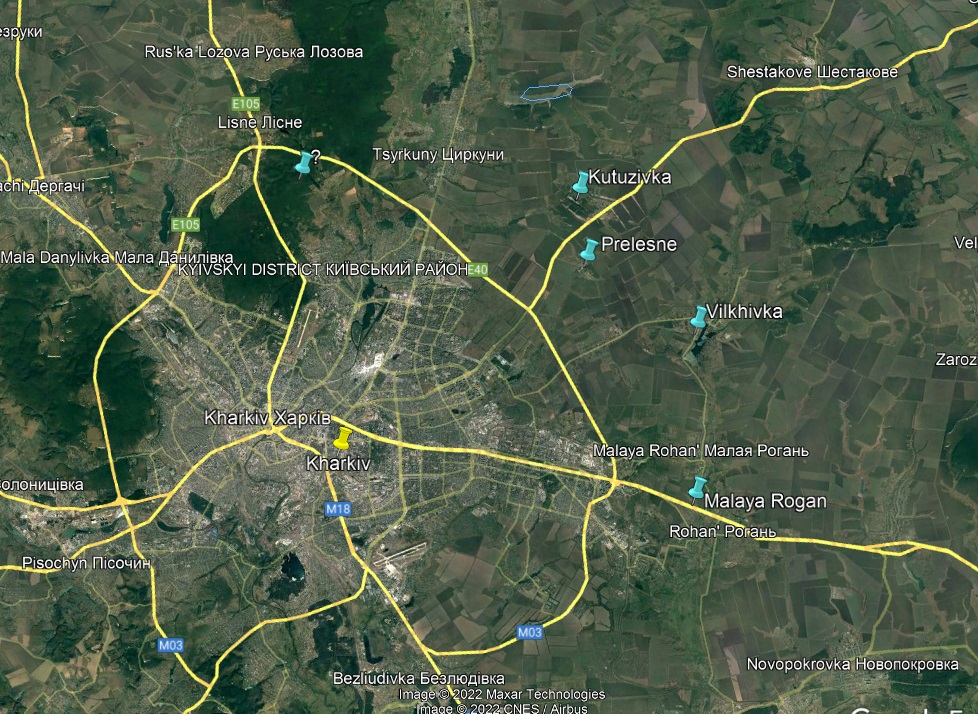
Donetsk/Luhansk AOO:
- New Russian propaganda reels are lingering lovingly on the previously reported pontoon bridge over the Seversky Donets river near Izyum. In contrast with the earlier flyover drone shot, these two videos show, from multiple angles, wrecked pontoon sections and knocked out vehicles, including a BMP and a T-72 that went for a swim.
- This bridge is only 14km or so from Brazhkivka, the furthest reported extent of Russian advance. It is very much within 152mm range, much less MLRS. Please note this is the exact same bridge, in the exact same location, as seen in my D+30/31 update because it’s been present at least since March 26th and likely earlier, (early as the first reported crossings on the 14th,) as the sunk vehicles/wrecked pontoon sections show the Russians took shelling there and opted to simply repair the bridge instead of shifting position. It’s possible this is old footage, but note the position seems to have been chosen due to proximity to a nearby road; between Russia’s demonstrable disinclination for overland movement, lack of witnessed field engineering in general (pierced steel planking roadways etc.) and general blyatkrieg displayed so far I find it likely they actually haven't moved it, and are content to proudly show video of vehicles crossing their wonderful little bridge.
- Ukraine allowing this farce to continue is interesting. Factors in play include Russians learning not to cross the bridge in large convoys and marshalling large forces nearby in preparation of same, the narrow width of the river crossing (meaning a relatively small number of pontoon floats will be wrecked by any one strike, reducing the overall materiel impact and increasing the number of strikes required to generate it,) and perhaps, above all, the desire to not interrupt an enemy while they are making a mistake. See this eight mile long Russian convoy captured on April 8th by commercial satellite imagery (geolocation) most likely destined for the Izyum AO. Normally I would think that even Russians aren’t stupid enough to ram a big convoy through a bridge link they’ve been using constantly – and even broadcast propaganda of – but I didn’t think they were stupid enough to repopulate Kherson airfield with helicopters for Ukraine to dump MLRS on more than once, either.
- UMoD statements from the last few days indicate no real Russian gains throughout this AO at all anywhere else, and continued heavy fighting largely near Izyum, at the bases of the Rubizhne/Severodonetsk salient and north and south of Donetsk city.
- Some pictures from Topolske, a village just southwest of Izyum, posted by Russian forces. Shown are earthworks (perhaps Ukrainian-dug,) what looks like a “rebel” operated T-64 or perhaps recently remarked one abandoned by Ukrainian forces, and a Russian BMP on a low ridgeline overlooking the area. This is confirmation that Russian forces have indeed taken Topolske,though that was implied by the reported advance on Brazhikivka. Note the last photograph in this tweet; it really gives you a good “ground-level” feel for what the terrain in this area looks like.
- This geolocated video of “rebel” troops in Rubizhne puts Russian forces at 49.02367, 38.367086, 1.2km south of their previously seen advances on March 23rd.
- This Russian drone video of Russian artillery hitting Ukrainian positions has been geolocated to 47.9358727, 37.5297079, i.e. the town of Marinka. This town was first mentioned by UMoD as on the frontline a good two weeks ago at least. As it lies right outside of Donetsk city proper, it’s also been on or near the frontlines of the eight year long Donbas war. This video, which shows Ukrainian troops advancing through a trench line as they take artillery fire, neatly shows how the heavy fortifying of this frontline for over eight years has greatly hindered Russian efforts in this area.
- There’s some more general lessons to be learned from this video. For one, it’s an excellent demonstration of how effective digging in can be against traditional unguided artillery. The spread of the large impacts seen in this video (likely 152mm caliber) are about average for the expected Circular Error Probable of such weapons. Getting a shell directly into a trench requires either guidance, or multiple attempts.
- Secondly, note this video is taken by a quadcopter, as one can tell from the stability and the way the camera pans. Most released Russian video has been from fixed-wing drones, most likely Orlan-10s. Note also the 152mm fire mission does not shift to follow the observed defenders moving down their trenchline, but the lighter impacts (almost certainly mortar fire,) do. 152mm batteries are a brigade level asset; mortars are a platoon level asset. A quadcopter – be it a proper military backpack drone or a commercial-off-the-shelf DJI Mavic, as we’ve seen the Russians are also using – is a company/platoon level asset, as are 81mm mortars. This is a little more evidence for my previously stated theory that the awful state of Russian secure comms availability means that fire missions are being directed by long-range ORLAN-10 drones operated by the units themselves; they are not getting real-time feedback by drone-equipped spotters in the field.
- Rumors from locals on Twitter say Russian forces are on the offensive in Bakhmut, It’s a decent-sized city 58km north of Donetsk and 28km west of Popansa, where Russian attacks against the Severodonetsk salient have been focused since at least March 14th. Bakhmut controls a major road junction and notably would let Russian forces drive up the M03 highway all the way to Izyum. It’s a much better place to try and close the salient than Popansa; Russia’s favor for closing a line in closer proximity to Severdonetsk itself has also been shown in persistent UMoD reports of Russian attacks near Donetske, Tenry and Torske. This might be due to the challenge of taking (yet another) dense city.

- Speaking of, this video from Kreminna, a suburb town some 10km west down the P66 highway from Rubizhne, was the location of this video posted by the Ukrainian 128th Mountain Assault Brigade on April 8th. This shows how closely Russian forces are trying to press the twin cities on all sides; I can only presume to be able to invest the escape route from them by fire. In this video, at least, you can see Ukrainian infantry fighting in dense woodland and apparently assaulting light Russian earthworks.
Southern Defensive Line AOO:
- As this geolocated video shows, Russian forces have apparently taken the M14 highway bridge that crosses the river in central Mariupol, as I predicted they would attempt. The point of this is to cut lines of communication between the city’s defenders in the dense western urban/commercial districts, and the huge Azovstal industrial zone in the east.
- The upshot here is that Mariupol’s defenders enjoy wide freedom of maneuver across most of the city, even areas Russian forces should have locked down weeks ago. This means that instead of being trapped in an ever-tightening pocket by Russian forces, the Russians are apparently playing whack-a-mole. While the Ukrainians may be posting old imagery, the Russians have incentive to boast about how deeply they’ve advanced into the city; ergo showing off a port facility on the southernmost outskirts of the city, now, lends credence to this all being recent action.
Kherson AOO:
- Rumors of Ukrainian advancement in the Kherson region towards the city of Kherson proper continue to circulate but there’s no hard information. For instance, this Canadian volunteer fighting in Ukraine claims they’re fighting on the outskirts of Belozerka, a suburb of Kherson on the river only 10km west of Kherson. One of the finnmap authors reports rumors of fighting in this general axis of advance too, only 25km west instead of 10. As he also notes, rumors of Ukrainian advances are all over the place and vary widely, with some making incredible claims, but the truth is probably more restrained. The difficulty of establishing the “frontline” in this area is natural not just due to OPSEC surrounding ongoing battles, but also the nature of the terrain. As the Canadian volunteer accurately points out, “terrain is brutal and you cherish every defilade.” This is especially true in land as flat and open as the Kherson oblast. As I’ve said previously, while it looks like there’s no cover in such terrain, there is; but it’s scarcity requires belly crawling. Even a slight depression can suffice to put a prone man out of LOS of enemy guns. This is why even slight elevations of only a few meters superiority, not even marked on prewar military maps, became objectives of major significance in the static warfare of WWI, and why the slightly better handling of the BAR versus an LMG made a difference in the kind of terrain a man could advance through and take up a sheltered position in during the trench warfare of Korea on open, stony hillsides. Of course, this kind of advance is painfully slow and the lack of concealment makes artillery devastating, even if one has a slight defilade, as one of the primary benefits of indirect fire is its ability to fly over one’s cover and land inside with you. See also this man’s commentary from the 8th that “it’s difficult to hold ground here because of the terrain,” “so territory has to be held strategically.” What this means is that open ground works both ways; so even though you cannot stand on it, you can effectively control it either by fire (direct or indirect) or by mobile counter-assault. So where troops are in terrain like this is more loosely connected to what they control. Contrast this to city fighting, where the restrained lines-of-sight mean that a .50 caliber HMG team near an upper story window can control only one intersection; whereas in the plains of Kherson, with a .50 cal, he could control everything out to 2 kilometers.
- Early on April 10th this volunteer posted two videos alleged to be from the Kherson area. The first is clearly a civilian in the city filming two smoke palls on the horizon; the volunteer ID’ing them as BTR-82s obviously implies his unit was involved in their destruction, hence his knowledge of the smoke’s source. The second one is actually from Ukrainian soldier’s perspective, but shows very little that could allow for geolocation (and thus confirmation of the claims of the fighting being so close to Kherson.) However, the geolocators on Twitter have stunned and amazed me before with their ability to locate imagery even in this flat, featureless region, so we will see.
- On April 9th the UMoD’s brief commentary on this area noted something interesting. The villages mentioned as receiving Russian shelling are either fairly recently liberated or behind known Ukrainian frontlines, except for the village of Novohryhorivka. This is a godo 21km south of the previously known frontline of the Russian northern salient (where three villages were reported liberated on April 6th, see the map in my relevant update.) It’s also 21km due east of Velkya Oleksandrivka, a town UMoD suggested multiple times was under Ukrainian assault. It lies astride the Inhulets river, which makes for a natural fallback position for Russians receiving Ukrainian pressure on their west flank. I may be the victim of a translation barrier and the UMoD was speaking of a more northerly village with a similar name, but similar oblique mentions by UMoD have later proven accurate. This seems characteristic of their communications.
- At any rate this suggests the Russian salient north along the west bank of the Dnieper has either retreated due to the vulnerability of its flanks and rear or been forced to retreat by successful Ukrainian exploitation of same.
- This could be a desperate attempt to draw forces away from the eastern Donbas front, or it could even be preparation to simply withdraw the token Russian forces arrayed there for use in the east, where they are badly needed.
- Moldova obviously has an interest in retaking their sovereign soil that’s been occupied since 1990, and Russia is very much too busy right now to realistically do anything to stop them should they try.
Sitrep: Materiel
- For starters; evidence of the staggering amount of materiel lost during their catastrophic and ultimately fruitless invasion of the Ukrainian north continues to pour in:
- This radio or jamming vehicle, destroyed and abandoned,
- Another BMP-2 towed away by a tractor, (note the blood on the seat inside and what looks like a bloody rag that was used to clean up the insides sitting on one of the crew hatches,)
- A captured BMP-3 with a single, neatly-placed hole in it which shows how crewmen in the seats pictured in the above image could come to fill their positions with blood like that,
- Several images showing what happened to Russian forces that tried to retreat over the flooded areas north of Moshchun, including an engineering vehicle and pontoon bridge sections that came to grief and multiple destroyed VDV BMD airborne vehicles, and even more lost pontoon bridge sections along with their transport trucks,
- A knocked out BMP-2 near Brovary,
- A mobility killed but very serviceable Ukrainian BTR-3E that Russian forces captured, but were unable to exfiltrate with,
- Knocked out fuel trucks near Chernihiv,
- A BTR and a 152mm towed howitzer, with the gun still under its camouflage net,
- Ground level images are now available of that supply dump/truck park just over the border from Belarus, near Poliske, that Ukrainian artillery blasted the hell out of because Russia doesn’t understand what a flank is,
- And last but definitely not least this incredibly apocalyptic scene of Russian vehicles at Hostomel airport. As I said in the early days of the war when the airport was being contested, even if Russian forces took it, they now owned a big wide-open flat spot within 152mm artillery range of Kyiv, meaning that even with the most aggressive counter-battery in the world they had little chance of bringing in IL-76 airlifters to quickly reinforce their forward position without shelling vaporizing those planes on the tarmac. Apparently this didn’t stop the insane bastards from using that site (which, as with most airbases, is a big flat place devoid of much cover or concealment) as a convenient truck park. This happening at Kherson airbase was at least somewhat understandable as it was distant enough from Ukrainian forces that they might risk bringing in supplies, quickly unloading, and flying out again, with the vehicles still occupying the tarmac when those devastating Ukrainian MLRS bombardments caught them with their pants down. There was no such excuse here, esp. given that the fuel storage at Hostomel was burning for days and days since the initial raid (translation: no in-situ avgas to utilize.) The thread shows even more equipment, including MANPADs, plate carriers, even wallets/w credit cards and ID, all left behind by Russian troops.
- How an artillery centric army can fail to comprehend the consequences of massing too much force too tight together I will never understand. Suffice to say the casualties Russia suffered in this northern misadventure are drastic and will seriously impact their ability to conduct even limited offensives in eastern Ukraine.
- See also this account in Esquire Magazine (complete with copious pictures) detailing an alleged ambush on Russian forces as they withdrew from Nova Basan (one of the villages east of Kyiv.) Obviously, the claimed slaughter wouldn’t have been possible had the Russians been standing to fight; their withdrawal allowed opportunity for an ambush. Russians are not very good at retrograde action, it would seem.
- The close-up view of this captured Russian T-72B3 tank in Sumy Oblast gives an excellent look at the serious rust present on the inside of the tank’s gun barrel. This is not trivial for a weapon supposed to fire saboted APFSDS darts at muzzle velocities of 1,700m/s to accurately engage moving targets at distances of up to 2,000 meters or more. This is shockingly bad maintenance that will have consequences for the vehicle’s utility in combat, and shows how poorly Russia maintained their huge stockpiles of Soviet-era equipment.
- Slovakia has confirmed they’ve donated their S-300PMU SAM battery to Ukraine, although as I mentioned over two weeks ago when a Patriot battery was videoed by motorists heading towards Slovakia, this transfer likely took place well before now. As footage of the system on rail cars and in transit suggest, ammo transporters were included, so likely the battery’s whole stock of 45 missiles was included in the donation.
- Slovakia is also reportedly about to sell Ukraine it’s entire compliment (16 vehicles, i.e. two batteries) worth of ZUZANA 155mm self-propelled howitzers to Ukraine. This is especially notable as Slovakia also operates the predecessor vehicle, the 152mm DANA, and moreover has 25 more ZUZANAs on order as it begins to transition away from Warsaw pact weapons and towards NATO compatible standards. In fact, Ukraine placed an order for 26 of the older DANAs from the Czech Republic back in 2020 though I can’t find any information on whether those deliveries were completed. Thus this reported sale has some interesting implications:
- Slovak media quoting their government (apparently, lol paywalls) put training/familiarization time at one “or more” weeks, confirming my gut instinct that artillery cannons do not take long for already competent artilleryman to familiarize with,
- That there’s serious interest in NATO in supplying Ukraine with NATO bloc weapons so the Ukrainian ammunition shortage can be resolved by supplying from deep NATO stocks, rather than scrambling to dig up scarce Warsaw pact stockpiles of whom the last operators in NATO either suffered losses to pre-war Russian sabotage or need for their own defense,
- That transfers of arms to Ukraine are greatly eased by the very generous financing NATO has made available to Ukraine. For instance, Slovakia was hoping for export sales for the ZUZANA but only 12 units were sold to Greece. Slovakia has 136 152mm DANA to replace, but only Slovakia’s budget to work with (hence the remaining on-order vehicles only amounting to 26.) Increased sales volume lowers unit cost; ergo export sales play a big factor in allowing nations of Slovakia’s size and budget to modernize their forces. The NATO Patriot batteries are being stationed in Slovakia so Slovakia has some air defenses until it can replace the single S-300 battery it had with something else. Like many small eastern European countries Slovakia’s been shopping to modernize its dated air defense systems for years, (and eyeballed Patriot among other things,) but has been pinched by both lack of funds and simple time-to-delivery. PATRIOT is in high demand not just by US allies, but by the US itself as it realizes it needs more, and highly advanced sensor/missile systems are not trivial or quick to build. Thus the positioning of PATRIOT batteries from other NATO members in Slovakia to make up for the lack until their own orders can come in – likely enabled by generous financing agreements offered by the US they wouldn’t be getting otherwise.
- That there are much quicker, faster ways to get novel and powerful capabilities into Ukraine’s hands than by donations of high-end weapons systems who’s scarcity impacts even backfilling capabilities to enable donations of older equipment (compare to the successful Slovak S-300 donation to the absolute clusterfuck of asking Poland to cough up 1/3rd its active frontline fighter force.) Contrast that to the quick sale and one-two week training time of getting 155mm SPG’s into Ukrainian hands, which means that NATO can supply smart weapons like the “SMArt 155” guided shell carrying two high-reliability EFPs that enage tanks from above, the M1156 Precision Guidance Kit which cheaply improves the CEP of a standard 155mm shell from 267m to a mere 50m, and especially the M982 Excalibur. While this latter weapon will take more training than the screw-in M1156 “smart fuze,” the Excalibur is effectively a rocket-boosted, gun-launched glide bomb (crews fire it more or less straight up and have to de-ass the area so the spent booster doesn’t pop someone when it lands.) Rounds now in-service can reach a good 40km, meaning this can reach out to a Grad MLRS at its maximum range and ram a 155m shell right up its ass. This opens the door to helping address Ukraine’s deficiency in long range precision tactical fires.
- The UK has confirmed its commitment to sending Ukraine MRAPs, as well as a wealth of other useful equipment including 800 more NLAWs, more Javelin systems, (implying more CLU launchers, not just missiles,) additional loitering munitions (additional? First mention made of such systems, from the UK,) more Starstreak MANPADS and more vital personal equipment such as body armor and night vision goggles.
- Australia has identified the size of their Bushmaster MRAP donation as twenty vehicles.
- A hand-launched fixed wing recon drone made in Turkey, the “mini-Bayraktar,” has been see in use by Ukrainian forces.
- As the exhaustive cataloging of OSINTer @Danspiun shows, Russian forces really got their asses kicked at Husarivka in late March. This is the same OSINT account that verified the Russian losses aroudn Malaya Rogan, and once again the verified losses are very close to those claimed by the Ukrainian brigades in question. The extensive documentation is simply too exhaustive to reiterate here; read his thread. (If you open it in private/incognito mode it blocks Twitter’s fucking awful nag screen that prevents you from scrolling threads.)
- This is why OSINT is important – he’s not just demonstrating how ugly Russian losses on the Donetsk/Luhansk front have been, but that Ukrainian battle damage claims are, by and large, honest.
- A knocked-out example of one of those smol UAZ vans all the weebs are making anime girl memes about allows me a good segway into this civilian review of the same van sold on the civilian market from 2015. Timestamp on this link brings me to my favorite part, where an entire fucking SMAW welding rod that stuck to the metal was just left danging there and painted over by the clowns manufacturing it. Needless to say, the rest of the vehicle reflects the same quality standards. Note also the Chinese manufacturer sticker on an underbody component.
- These are the people who thought they were going to take Kyiv.
- See also this mention in a background briefing from the US Department of Defense (transcript on the DOD’s own website, yes, they refer to their own staff as “Senior Defense Officials,) of the importance of the millions of rounds of small arms ammunition being provided to Ukraine. That is where bulk matters – not in equipment, but in sustainment. See above comments on 152mm vs. 155mm ammunition stockpiles.
Sitrep: Operational
- From the cockpit this seems like an MI-8, to me.
- Russian forces have concluded, to the surprise of nobody, that the destruction of the ammo depot in Belgorod was caused by a saturation attack by Tochka-U missiles. Apparently the munitions required to saturate an S-400 battery is... three.
“In the temporarily occupied city of Izyum, representatives of the so-called "DPR" perform the functions of the local "police", carry out illegal checks of documents, searches of persons and premises of the local population.” This is the same kind of behavior seen in Kherson, and as others have pointed out, is symptomatic of Soviet era tactics and techniques for suppressing possible rebellion and partisan activities in the area. This is why we are seeing persistent accounts of Russian forces having lists of names and people to look for and searching people and demanding identification documents – these are not just related to, but coterminous with the atrocities. According to eyewitness/survivor testimony, the bound men who were summarily executed seen in this oft-circulated image from Bucha were murdered if they had any prior service in the Ukrainian military (as thousands of conscripts did due to the eight year war in Donbas) or even a national or military related tattoo. That’s why the searches went past lists of names of former Ukrainian servicemen and devolved into abductions of anyone accused by local traitors/collaborators, with the victims being barbarically tortured before being murdered. See, they were just carrying out their orders to find “enemy soldiers and partisans,” and if they committed inhuman acts to “extract a confession” from them, who cares? They’re all fucking Nazis anyways!
This unity of barbarism extends across the scale. This Washington Post article on Izyum sheds new light on the extent to which mass bombardment of civilian areas is tied into Russian strategy. It’s not simply done to reduce the defensive value of structures in entire neighborhoods. Nor is it simply to terrorize and cow the population into submission so they won’t engage in partisan activity, nor to force their government to capitulate or accept terms to stop the slaughter. I assumed much the same before and I was wrong. The point is all of these things, simultaneously. They conduct targeted raids against political and civil officials to consolidate control, but also snatch any able-bodied male off the street regardless of age, violently torture them and then murder them. They destroy power, water, transport and food supplies so hundreds of thousands of people are starving, freezing, dying of thirst, but then shell evacuation routes so they can’t leave; the better to use them as human shields, as mentioned in the articles linked above. In short, the hatred is the point. The military objectives and the barbarities indistinguishable because the military objective is the barbarity. This is not just to cow the population, but to punish them for turning their back on Mother Russia, for daring to live apart instead of as Russian slaves.
This through-line of intent is visible wherever you look. For instance, these booby traps in structures, (which any liberating force will have to clear to ensure no enemies remain at their back,) or this IED by a roadside, have a military point – to slow pursuing forces while one retreats. But the widely reported booby-trapping of murdered civilians’ bodies, and using artillery-delivered, time-delayed mines on civilian areas far from any known frontline forces, are not. The same tactic, deployed in the same way, but treating the civilian populace identically to the enemy – to the Russians, they are the enemy.
- Obviously, Russian forces continue to target rail yards in an attempt to interdict Ukrainian redeployment of troops and supply movements. While the hideous murder of dozens of people by the linked attack have garnered all the attention, it’s where and why the Russians hit this locale that matters. The Tochka-U’s CEP is about 100m, which means – for this rail yard in Kramatorsk, at least – an attack on the main rail area where trains would be parked for unloading could indeed also hit areas outside the passenger terminal building if they were unlucky. However, note that Russian propaganda accounts noted the target was an ammunition train (the detonation of which would certainly waste any civilians in the area,) but more tellingly, that it was an ammo train that had “arrived yesterday evening.” For people who know they’re in range of enemy fires and very much know that a train yard is a big target at a known location, it does not take all night and into the afternoon to unload a fucking train. It’s also standard practice to not be loading passengers onto evacuation trains when there’s a big explosive military target parked nearby – that’d be done before and/or after said target arrives or leaves. In short, Russia’s careless and slow strike planning based on dated intelligence is what produced this tragedy.
- As discussed above, they don’t give a fuck.
- Two instances of Ukrainian SOF being involved with the destruction of some of Russia’s newest SAM systems, in at least one case by calling in artillery after locating it. This is a good example of how Ukraine is using SOF forces to compensate for a lack of higher-end equipment usually used to approach tasks like SEAD/DEAD.
- Ironically, heavy use of SOF to overcome high-end disadvantages in hardware was one of the Soviet Union’s late Cold War focuses.
Sitrep: Strategic
- As many others have said, including the Ukrainian MoD, Russian units withdrawn from the northern Ukrainian AOOs are badly mauled – the DoD official goes so far to say that “some units are literally, for all intents and purposes, eradicated,” and others that are down 30 percent of their manpower. (Combining survivors of destroyed units into new ones is a doctrine in every military but brings with it severe morale and command/control penalties; to say nothing of the exhaustion and mental trauma of the fighting that so devastated the unit to begin with. The “band of brothers” motif exists for a reason; correspondingly, when the band is broken by most of the brothers being dead, the survivors are typically not in good shape.)
- Russia still hasn’t solved their logistics or sustainment problems,
- Russian force concentration in eastern Ukraine has gone from 30 to about 40. Given that about 40 BTGs were estimated to have been devoted to the twin attacks on Kyiv from Belarus itself (not counting the push west from Sumy) this gives you an idea of how many BTGs either no longer exist or aren’t immediately redeployable.
- Russia is mobilizing up to 60,000 reservists. (This is going to be hard to explain on the domestic front. I’ve seen other sources mention they’re men who were former contract servicemen; 10 year veterans etc. People of that age tend to have jobs and families to go back to – I doubt the promise of loot and rape is going to be very motivational for them, though they won’t be useless soldiers like rank conscripts are. How Putin will work around the legalities of deploying them, much less square it with Russian propaganda, remains to be seen.)
- US DoD estimates Russian combat power at about 80% of its prewar strength – that means a loss of 20% of their assets; vehicles, aircraft, missiles, infantryman etc. That’s staggeringly high.
- Javelin missiles were mentioned as being especially important for the Eastern front. Given the mobility and utility of the Javelin blows traditional SALCOS ATGMs out of the water, this makes sense, esp. in the flatter, open terrain in much of the Donbas region.
- Stating the obvious, but there’s clear potential for this war to last for a good long while.
- Finland is moving rapidly towards joining NATO.
- Many people have reported on the appointment of an overall commander for the Ukrianian war by Russia. As Michael Kofman points out, the more significant question isn’t the man in charge, but the size and quality of his managerial staff. There’s a reason that “flagships” in navies come with extra accommodations – that boils down to office space for the small army of white-collar office workers – excuse me, I mean “staff officers” - who handle the extensive work of organizing the movement of hundreds of thousands of men and millions of tons of materiel. I am given to understand that a big problem in the Soviet army was a failure to invest properly in operational level command staffing, and their late Cold War reforms in that direction were stymied by the collapse of the Soviet Union. If anything we’ve seen of Russia so far is any indication – especially deficiencies in strike planning, an inability to coordinate large air campaigns, or to coordinate ground forces at larger than regimental scale – Russia has not addressed this in the decades since. If they attempt to do so now they will be learning on the fly.
D+44, D+45, D+46, and D+47 Preliminary (April 10, 11, 12, 13) Update
Sitrep: Critical Resources
Once again I must apologize for tardiness; other responsibilities have made it hard to play catch-up, and I have a lot to catch up on; a warcrimes update and an update detailing what we know of the drone war in a bit more detail. In that vein I wish to share some invaluable resources you can check yourself when I’m tardy, or just whenever you feel like it.
- The first is this map I call “the Finnmap,” as it’s a map of the Ukrainian war’s frontlines run by a few Finnish OSINTers. Their data has repeatedly proven to be pretty accurate, and they tap into local sources posting about the war on Twitter I just don’t have the time or intimate knowledge to keep track of.
- The second is this friendlies ORBAT tracker at Militaryland.net. This is invaluable for keeping track of the (officially) reported positions of various Ukrainian units. Note this site also has an invaluable listing of the Ukrainian order of battle, including the unit emblems for many brigades, making it possible to identify the general area a video was taken in just by identifying the unit that posted it.
- This is complemented by this more recent resource, an enemy ORBAT tracker for Russian forces run by @HN_Schlottman. Schlottman uses various clues from OSINT data, such as markings on knocked out vehicles, patches on uniforms of dead/captured soldiers etc. to paint a clear picture of where individual Russian units actually are.
- This map is an archive of everything covered by the @Geoconfirmed Twitter account. Both map and account are invaluable resources; collating geo-locations of imagery and video so they can be demonstrably proven to have happened in one AO or area rather than another. A great deal of the conclusions drawn from OSINT data is only possible due to this hard confirmation, and enables follow-up “map recon” of the area to put the imagery in further context.
- Lastly, the Institute for the Study of War posts a daily update in the evening concerning the war. While they are overly reliant on Ukranian General Staff updates, they are experienced and intelligent professionals and they are paying attention to social media OSINT, even if they don’t link them all as exhaustively as me. Their assessments have been pretty solid so far.
These resources have proven invaluable to me in collating these reports and I feel you will find them of great value as well. See also The Warzone at The Drive, these journalists are the absolute best defense journalists I’ve seen and have not only great command of the basics of military conflict and combat aviation, but are also skilled at explaining them to the layman. Excellent background articles to be found here.
Sitrep: Maneuver
- Ukrainian forces are on the offensive in the Donetsk/Luansk AOO (the Donbas front.) Ukrainian General Staff updates do not indicate this, but I’ve seen claims of small/local counter-offensives on Twitter (unsourced; likely drawn from the Facebook pages of individual brigades,) and combat footage that’s emerged over the last 72-96 hours definitely bears this out:
- This video from a Ukrainian drone spotting for indirect fire against a Russian defensive position has been geolocated to 49.04946384837041, 37.21717077485729, the town of Brazhkivka, Kharkiv Oblast. This is the town about 9km down the southward T2122 that the UMoD reported as taken by Russian forces on April 5th, only to report it as fending off a Russian attack on April 9th. As I said in that previous update this likely indicated Ukrainian forces retook the town; with UMoD’s failure to mention this explicitly being characteristic of their mercurial communication patterns. Note this video shows (when looking further up the road in the wide shot) at least ten BMP’s and two T-72s (likely three, as the larger vehicle by the lower-left corner of a white building at the top of the wider shots looks the same size as the blobs we know to be T-72s from the close-up,) so this is most likely a Russian mechanized infantry BTG, which will have 40 IFVs (BMP’s or BTR-82s, allegedly two companies of the former and one of the latter) backed up by a company of ten Main Battle Tanks. Note their defensive position along a road/treeline and what looks like some minimal digging in on the part of at least one T-72. Note this video is shot from the north, looking south; this position is 700m directly north of the town facing west. Note also the destroyed building and the extensive, widely-spaced impact scarring all over from prior MLRS bombardment. Now consider the wide-shot of this area:
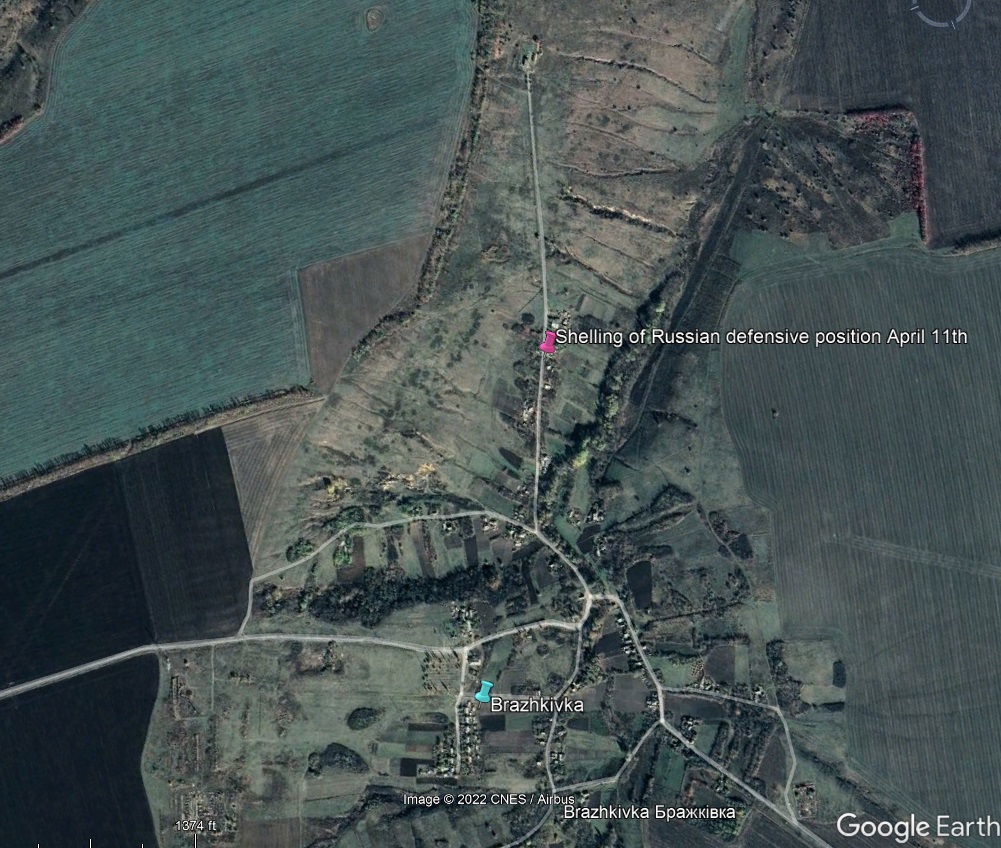
- The treeline east is only 150m distant and lies in a depression but the approaches are wide-open fields that lie in the likely line of fire of another company’s designated defensive sector. The ground west slopes steadily upwards towards the TI2122 1.5km distant. The treeline to this position’s west is 250m distant and 100 feet higher. This would be the superior defensive position, with nothing but open fields for 1,000m, but keeping the armor back allows them quick access to the road to shift flank and reinforce other defensive sectors of the village (an important consideration given the soft ground conditions) and allows the armor to either utilize a reverse-slope defense/w the treeline as a barrier or advance the short distance to the treeline to support the infantry dismounts positioned there as needed. It’s definitely the best general defensive position on the north side of the town.
- This video from the Ukrainian 30th Mechanized with a variety of engagements, including drone-spotted artillery fire against Russian IFVs dug into revetments. (Note the 30th Mechanized is currently north of Horlivka, according to the ORBAT tracker.)
- This video showing a close-range RPG attack, at night, against a Russian tank, along with follow-up pictures showing the slain T-72 to be sitting in what looks like a “tank scrape” in a treeline. This was posted on the 57th Motorized Brigade’s facebook page; according to the ORBAT tracker they were last reported as fighting in the Izyum area. Note this strike took place at night – this illustrates the serious advantage that night vision devices are affording Ukrainian troops.
- Video of Russian vehicles in a treeline getting hit; not sure what munition was employed (laser-guided artillery or direct fire.)
- Russian defensive positions (earthworks) taken in Kamyanka village (the one in Donetsk oblast) posted on the 11th.
- Another dug-in T-72 killed. These pictures were posted by the 93rd Mechanized, who were last reported as holding the line south of Sumy. They’ve almost certainly been redeployed by now; Russian efforts to grab more territory southwards in Northern Ukraine were not nearly as focused as their efforts to push west to attack Kyiv and relieve the roadblock of Chernihiv, so the 93rd was likely intact enough for fast redeployment.
- And lastly, this video from my last update, by the 128th Mountain Assault Brigade clearly advancing on Russian positions around Kreminna.
- Taken together, this all points to Ukrainian forces engaging in local counter-attacks at best, and at the very worst, hugging enemy forward positions and applying constant pressure on them.


Finnmap actually seems pessimistic; from this it does not seem Horlivka is in Russian hands. Horlivka has been one of the settlements under “rebel” occupation for the last eight years of the Donbas war; it was rumored to have been retaken by the 95th Mechanized on March 1st but I’ve seen no real confirmation of that at all, so Finnmap’s authors were likely being soberly conservative. Here’s what my map shows:
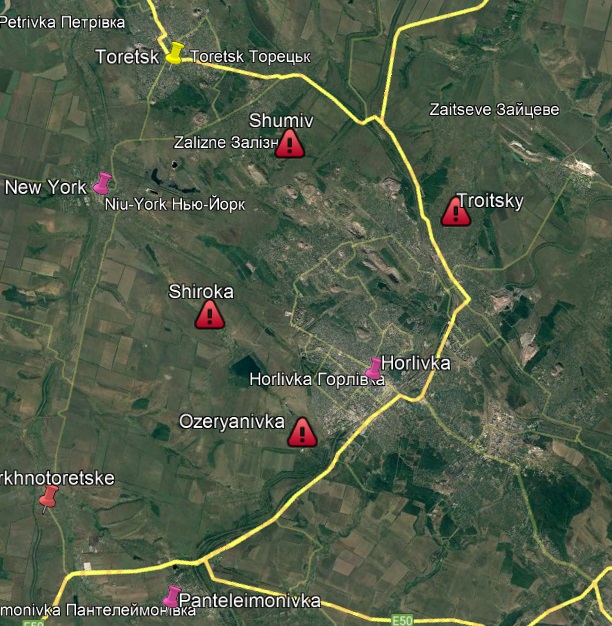
The red “!” is areas the UMoD indicated were under heavy assault a few weeks back, and purple pins indicate UMoD statements stating or implying a contested area. You may draw your own conclusions but I’d say that whatever local sources the Finnmap’s authors are following are pretty reliable.
- Continuing sightings of Russian reinforcements moving into eastern Ukraine:
- This battalion-sized force only 15km south-east of the Ukrainian border clearly on a road march. I counted 34 BTR’s, making this a motorized infantry battalion, and obviously an awful lot of supply trucks. (Mechanized v. Motorized: originally mechanized infantry had armored transport and motorized just trucks; then it evolved to motorized == Armored Personnel Carriers and mechanized == Infantry Fighting Vehicles. Now motorized == wheeled IFVs and mechanized == tracked IFVs; if only because the latter tend to be better armed and armored. Compare Stryker to a Bradley.) The enemy ORBAT tracker flagged this formation as the 155th Separate Guards Naval Infantry Brigade. Google doesn’t even know this unit exists. The state of English-language sources on the Russian military is abysmal. Criticalthreats.org’s order of battle for the Russian Ground Forces shows the 155th Naval Infantry as being stationed in Vladivostok. We first saw indications that Russian forces were pulling from their Naval Infantry forces back around March 20th as casualties showed up in local Russian media obituaries (relevant update). And Russian armored vehicles were seen on trains headed west in the far east around March 15th (relevant update.) The trans-Siberian railway takes a full week to cross (from Vladivostok to Moscow) as a passenger; a laden freight train takes at least two. Given the naval infantry that first started turning up in obits were from units known or suspected to already be in the AO (i.e. units embarked on amphibious ships that were then freed up once it was clear Mykolaiv wasn’t going to fall, thus no landing would occur,) and the increasingly frantic pace of rumored Russian efforts to replace casualties, these guys would have started preparations to ship out two to three weeks ago (depending on how long it took them to prepare for deployment.) In other words they would have gotten their deployment orders around the end of March when it was clear the Kyiv assault was a lost cause. This timeline checks out.
- Russian 4th Tank Division vehicles somewhere in Kharkiv Oblast; the units previously seen south of Sumy that have been mentioned repeatedly by UMoD as being selected to shift flank. Another video, clearly taken by a Russian soldier given the glove on the hand of the cameraman. (A civilian would not be allowed to loiter like this.)
- Commercial SAR satellite data spotted a major build-up of equipment at Klimovo airbase in Russia, less than 20km from Ukraine’s border. (Metal things reflect radar energy much better than the ground so they tend to pop very bright.)
- See also this doubling of combat aircraft at Lipetsk airbase in Russia.
- A VDV battalion reportedly seen on the road in Kharkiv oblast; likely redeployed from the Kyiv area.
- Buildup of equipment and AFVs in Valuyki, Russia, again near the Ukrainian border.
- More SAR imagery of Russian force buildups near the Ukrainian border. As mentioned these vehicles are likely being repaired/serviced, not being staged for immediate deployment given this location isn’t hugging the border.
- While it is obvious that Russian forces are indeed reinforcing the eastern front with units taken from the abandoned northern offensives, beware of room-temperature takes like this one. Note the criticism is directed at the ISW’s very brief thread pointing out that 1. the Russians have no significant reserves of troops to commit (obvious to anyone who’s paid attention for ten seconds since this started,) 2. the units withdrawn from Kyiv have clearly taken heavy casualties (obvious to anyone who’s paid ten seconds of attention to OSINT, even if the most pessimistic bomber-problem filters are assumed,) and that you simply cannot train replacement soldiers in two weeks, to say nothing of the low morale of soldiers who’ve just spent over a month in grueling cold-weather combat, only to be defeated. But hey, we saw a few T-80s moving and one (1) battalion of light-skinned VDV IFVs on a road march so I guess that invalidates centuries of military science relating to how much of a shit kicking a cohesive military unit can or cannot take and for how long and still have fight in them, amirite?
- This guy worked for Janes for a while. While I’m not familiar enough with his work to go casting aspersions on the body entire; (and lack the expertise to do so with merit, anyways,) this does not bode well.
- UMoD stated on April 10th that Russian forces are trying to recapture Osokorivka, a village on the west bank of the Dnieper a good 7km south of the previously furthest reported Ukrainian counteroffensive at (sigh) Novovorontsovka. On the 12th it mentioned Oleksandrivka (the town on the Inhulets river that was apparently lost by Russian forces a few days ago) was under determined shellfire. This matches general statements over the last few days that Russian forces have not abandoned offensive attempts to reach the borders of the Kherson oblast – they are hell bent on reaching those political borders to lend credulity to the puppet state they’re trying to erect in Kherson.
Sitrep: Operational
- See also these radar corner reflectors set up along a road. It’s unclear which side deployed these – it could be either, as both sides use ground-surveillance radar. The US is famously using it’s E-8 Joint STARS aircraft regularly to provide long-range surveillance of Russian ground forces and other platforms (such as our old friend FORTE-21, the callsign of the Global Hawk(s) flying circuits over the Black Sea) also have ground-search and Ground Moving Target Indicator capability; their lack of specialization offset by being significantly newer. Russia uses airborne ground-search radar as well, but uniquely deploys it with their ground forces as well, not just vehicle mounted but even in infantry portable versions as this example captured by Ukraine on March 20th shows. Either way, these corner reflectors – set up to mimic vehicles parked alongside a road – should be reasonably effective decoys from a distance, although follow-up recon with FLIR-equipped drones would give away the game.
- After typing this a friend found this post identifying these corner reflectors as a known Soviet piece of kit, the OMU radar reflector. Small, cheap and effective.
- See also this video of the recently abandoned Russian positions around Chernobyl NPP. While the staggering incompetence of idiots digging defensive positions in badly irradiated soil is a topic all its own, I want to highlight that this is the first time I’ve seen HESCO-style barriers and sandbags in use by Russian forces. They have these things – we know they have these things – but not enough of them (if any) are reaching the solders at the frontlines. They have seriously underestimated the volume and variety of equipment soldiers need in the field.
- Ukraine has had some success recently in attacking Russian rear-area logistical support. In addition to the destruction of both a fuel and ammo depot in Belgorod two weeks ago:
- Note, once again, that this is filmed by quadcopter, not the larger fixed-wing drone one would expect as the source of laser designation. The designation is being provided either by a larger drone that was cued by a ground team using their own drone to localize the target, or even by a ground team. If the quadcopter itself is doing it the software allows for scrubbing of/does not record the HUD overlay the operators would see.
- This engagement of a Russian tank by indirect fire is possibly an example of a Ukrainian guided 120mm shell. The damage doesn’t seem enough for a 152mm shell; it apparent landed just beside the tank (or scored a direct hit on the side) its gun is traversed towards, but a 152mm shell would have either left a crater in the ground and/or effected more significant damage to the tank. Interestingly enough, Ukraine does have a domestically produced 120mm mortar shell. However, unlike the Kvitnik, which was openly adopted by the Ukrainian military years ago, this shell was publicized in 2019. It should also be noted that the accuracy in this video is not impossible for a well trained mortar team firing from closer ranges (as with direct fire, shot dispersion is a function of geometry; the same deviation will produce a wider miss on a target further away.) It’s unknown how many of these shells Ukraine has, or even if it entered serial production, however. It should be noted this accuracy isn’t impossible for a well trained crew at close ranges using normal shells. Still, it’d be very good shooting.
- Also, as previously noted the US may be supplying GPS guided shells. These will have inertial backup guidance, as is typical of anything GPS guided.
- Because I never get tired of it, more examples of Ukrainian counterbattery:
- This FLIR footage from a fixed-wing drone definitely shows a successful MLRS counterbattery attack on a Russian MLRS position; note the big secondaries in the middle of the screen and the characteristic cook-off of MLRS rockets (they do zoom around like that as the fire ignites their solid rocket motors.) It’s hard to tell exactly how far away the shell landed; depending, this is possible for first-round unguided fire from a good gun crew. Either way it wasn’t a direct hit, and very clearly shows how devastating even close misses by 6-inch class indirect blast-frag munitions can be to tanks.
- This video I posted in my last update from Mariupol is, as I neglected to notice, a Russian mortar section. You can see a mortar set up to the left of the trucks. Ergo this is a mortar/counter-mortar engagement.
- This destroyed Russian SPG was likely taken out by a 152mm Kvitnik laser-guided shell – note the blast crater is right behind the vehicle, and there’s no blast craters around it. With unguided artillery you’d start hammering the area with a quick concentration of fire – this is a single round that landed right on the nose. (I don’t think it was hit by a drone with the crater caused by the obviously catastrophic detonation of onboard ammo; the entire vehicle would have been flipped some distance by that.) The Kvitnik shell is definitely the unsung hero of this conflict and I could kick myself for my lax research and not realizing Ukraine had this capability sooner.
- Old loss from the fighting around Kyiv of a 2S1 “Gvozdika,” a gun/mortar system meant for both regular indirect and direct fire (hence the flechettes and HEAT rounds mentioned, but given the quanity of ammo strewn about this was likely an artillery position. Note only one loss and a paucity of shell craters around – likely another drone-cued PGM engagement.
- Another old loss from Kyiv; successful mortar vs. howitzer engagement.
- I’m still seeing new footage of attacks with larger multi-rotor drones dropping modified AT grenades on Russian forces. When attacks like this were first seen in the Middle East, intelligent people concluded that 1. in a full-scale symmetric war the artillery those drones could cue would be a lot more dangerous (as this war is proving,) and 2. the capability demonstrated by kitbashed civilian kit, as worrisome as it was, wouldn’t hold a candle to what a dedicated loitering munition could accomplish. Following that line of logic, consider what the continuing success of these low-tech drone attacks means for the incipient use of Switchblade loitering munitions in Ukraine. (Once again, see the Drone section.)
- This destroyed Russian fuel convoy in Chernihiv oblast is indeed an example of more Russian losses from the Kyiv AOO only now coming to light because they were previously behind enemy lines, but it’s in this section because of the Tochka-U booster lying nearby. Attacking fixed infrastructure sites is one thing, but this shows that Ukrainian recce and strike planning is capable of executing Tochka attacks on relatively mobile rear-area logistics concentrations.
- This successful Stugna-P engagement shows an aspect of the system I didn’t previously consider – even if the remote operation ability protects the operators from return fire, if the enemy can at least locate the firing point and return fire, it can prevent the crew from reloading the weapon for follow up attacks. Thus the low profile of just the launcher itself (as compared to the infantryman operating it, which will also have a bigger thermal signature) is a further benefit of the system. It also means that classic anti-SALCOS ATGM tactics still have some benefit against it, if they can be employed.
- This video of Ukrainian artillery is interesting, not for the Russian troops de-assing the area once their vehicle is hit and about to brew up, but because you can see the spread of the shells. (Note I think some guns are firing on that treeline closer to the camera, hits + scars of prior are too consistent for that to be spread. They’re smoking out both stands of trees.) Note also how the Russian soldiers dive for the ditch on either side of the road as they hear the incoming. This is pretty characteristic of what I’d expect from well-directed artillery, but also shows why advancing in this terrain without armor protection is so ugly.
- An except from a Financial Times interview contains a claim by a Ukrainian soldier that they used cheap foam mats to hide their thermal signatures from drones. (Archive.is link for the article.) You might think this is propaganda but it’s not at all surprising – see this youtuber demonstrating that even an umbrella can do the trick. Infa-red light is still, well, light; it’s just that heat bleeds through anything it’s in contact with a lot more efficiently than visible-wavelength light (as the object itself warms up, it also glows, which is why normal clothing in contact with your body is no help.) Ensuring the standard battle-dress uniform helps mitigate this problem is a consideration for most armies, but for an army that can’t afford to re-equip its entire force with such fabrics – or for territorial defense soldiers far down the priority list for such gear – a simple foam mat is perfectly effective.
- Witness this well-trained Ukrainian solder demonstrating proper employment of a MANPADs. After an aircraft releases a rocket or bomb (almost always in a shallow to medium dive) they will break away to the side to egress the area. The bomb impact in the background tells us the Russian aircraft has pickled its munition and is breaking away to egress; you’re watching the MANPADS gunner tracking the target as he waits for the Russian aircraft to complete its turn and fly past him. The reason is because he wants to take a low-deflection, low crossing-rate, rear-aspect shot, which will give his small missile the best possible chance of engaging.
- This video, more than any other, highlights to me how reluctant Russian forces seem to be about maneuvering offroad. Given the incoming IDF (note the blast scars marring each side of the road) they wouldn’t be sitting so still if they weren’t taking direct fire from the front. They’re covering sectors and you can see gunners panning around looking for targets. Against either artillery or direct fire just sitting on that road is asking for death; any armored company’s first instinct should be to bust off the road and maneuver fast in loose formation over those fields. Stationary targets are dead ones. Note this is likely an older video from fighting in the Kyiv AOO; esp. given the residual snow on the ground. Ground conditions there should at least allow the risk, esp. under fire. Note the unit that ate artillery fire at Brovary, after retreating, then left the road and advanced in loose formation across open fields, per standard tank tactics.
- What the hell is this spacing. This is why conscripts need constant supervision even when just driving supply trucks.
- An ugly first-hand look at the continued bombardment of Kharkiv by Russian forces, apparently just to effect the murder of civilians. This was a 300mm Tornado rocket with a unitary warhead, making it much more dangerous to civilians taking shelter than blast-frag submunitions.
- An odd display of an odd tactic by Russia – firing MLRS artillery from a landing ship’s top deck. This is typically seen done with guided munitions (either rocket or tube-launched) as the lack of electronics meant to compensate for a ship’s roll is a non-factor. This also applies to unguided area rocket bombardment too, of course, but why Russia would bother with this when they have Mariupol surrounded from all other sides beggars imagination. Presumably they want to fire directly at something on the shoreline (like the Astoval steel works) without other buildings getting in the way of the relatively low trajectories of closer-range MRLS positioned on the land side.
- Given they have 240mm self-propelled mortars in the city meant for exactly this kind of problem; applying huge firepower to targets with high-angle trajectories, this is rather odd.
- The undisciplined bastards may simply be drunk. Given the frequency with which empty bottles of looted booze are found at Russian campsites – to say nothing of around where they butchered innocents and civilians – this is unfortunately possible. (More on this in the next warcrimes update.)
- Threat of Ukrainian ambush may be making them drive around “buttoned up.” Tanks are hard to see out of; almost every armored vehicle that can provides a separate hatch for every crewman possible. This almost always includes the driver. If they have to drive around “buttoned up,” i.e. with the hatch closed, seated safely behind armor without their head sticking out for a better view, all they have are the limited vision of their periscope block. This would make driving off the side of a bridge much more likely.
Sitrep: Materiel
- Full list of equipment in this transfer – 18 Paladin 155mm SPGs and 40,000 rounds to go with them, but also ten counterbattery radars (matching the pre-war donation of counterbattery radars in one stroke,) two Sentinel air defense radars (the AN/MPQ-64 is a small trailer-mounted system meant for supporting units in the field; the latest upgrades are quite potent little beasts,) two hundred M-113, 100 up-armored HMMVs, 300 more Switchblades, 11 MI-17 helicopters (note these are the ones previously acquired for the government of Afghanistan but never delivered before the Afghan collapse. These are a big upgrade on the classic MI-8; much more engine power and can be configured for either transport or as a gunship, or both,) 30,0000 sets of body armor, 2,000 optics and laser rangefinders, C-4 explosives, and even Claymore mines.
- Interestingly enough, “anonymous officials” were also revising their Russian loss estimates up from 20% to 30% at around the same time.
- Finally, the breaking news – Ukraine has apparently sunk the Moskova, a Russian guided missile cruiser, in the Black Sea. This claim is corroborated by the Russian Defense Ministry itself. This is a staggering development and was almost certainly the result of a cruise missile attack – which missiles, however, is hard to say yet. If it was Ukraine’s own domestic Neptune missile begs the question of why it wasn’t attempted sooner; if the Moskava has been kept near Crimea they might simply not have been in range, with so much of the coastline west in Russian hands or under Russian aerial observation in very flat and open land. No matter the provenience of the weapons this is a staggering upset against an effectively irreplaceable Russian asset.
- Ship transponder tracking sites seem to show multiple ships in the alleged area of the attack, possibly rendering assistance to crew evacuating the cruiser.
Sitrep: Strategic
- Apparently Russian SEAD efforts do not impress.
- This is definitely related to the 200 M113s and 100 HMMVs we just promised to give Ukraine.
Special Report: Sinking of the Moskva (Pub. April 17th 7:37PM)
The April 14th sinking of the RFS Moskva, the 12,000 ton flagship of the Russian Black Sea fleet, by two hits from Ukrainian R-360 “Neptun” missiles, is one of the most stunning and unexpected upsets of the entire Russo-Ukrainian war so far. Unfortunately, it’s also an event that’s been surrounded by an awful lot of bullshit and speculation; regarding the circumstances of the attack, the capabilities of the ship itself, and the impact it will have on the overall war. I will seek to clarify these to the best of my ability.
Capabilities of the Slava-Class cruiser “Moskva”
To understand the circumstances of the ship’s destruction, we must first understand what she was capable of.
The Slava-class cruisers’ primary capability (of relevance to the Russo-Ukrainian war) is as Anti-Air-Warfare (“AAW”) ships; as they mount 64 long-range air defense missiles; carrying eight rotary-style launchers holding eight missiles each. The missiles carried are the S-300F system; essentially a navalized version of the venerable S-300/SA-10 “Grumble” system, essentially the same one Ukraine fields as its primary long-range air defense system. In a naval application the S-300F is roughly equivalent to SM-2MR Block II, sharing both the range (90km~) the service entry date (1984) and the capability limitations – namely their limited suitability for engaging sea-skimming cruise missiles. As multiple sources report its minimum effective engagement altitude is 25 meters (86 feet), which was sufficient against some anti-ship cruise missiles of its era, but is woefully insufficient against most anti-ship missiles’ terminal attack altitude since the 1990’s and especially more modern weapons, which can cruise as low as 2 meters (10 feet) in calm sea conditions (during terminal attack.) Note also the minimum range of ~5km (sources alternately describe it as anywhere from 4 to 7km.) Identically to the land-based S-300 system from which it’s derived, it uses a single large fire control/illumination radar (the big cone-shaped radar astern). Even though multiple sources cite its multi-target engagement ability as being identical to the land-based version (six targets engaged at once, with two missiles guided towards each target,) another reliable source states that the Volna 3R41 “Top Dome” radar, specifically, can only control “two-three missiles for a total of six SAMs in flight,” whatever the hell that wording means.
The secondary air-defense weapon system is a navalized variant of the OSA SAM system, aka the SA-8 “Geko,” which utilizes the ZIF-112 twin-arm rail launcher, similar in style to the American Mark 26. The launch rails, uniquely, can retract into a drum-style housing for protection from the elements when not in use; this 2018 close-up photo taken on the Moskva herself off of Syria in 2018 shows the system deployed with weapons on the rail. This wider-angle stern image of the Moskva from 2012 shows the ZIF-112 mounts on either side of the ship’s hangar. The OSA system received the 9K33M3 missile in 1980, greatly improving low-level performance by reducing minimum engagement altitude to 10 meters. This was clearly back-fitted to the naval variant given the Osa-MA2 system, cited as introduced in the mid-80s, reduced engagement floor to as little as 5 meters above sea level. Given Moskva was launched in 1979, launch dates often precede actual final fit-out of a ships weapon systems, and the upgraded 9K33M3 was obviously in development by then it’s reasonable to assume the Moskva at least had that missile, even if not the fully upgraded MA2 system (and given it was introduced during the Soviet era, when defense spending was prioritized it probably did get that upgrade.)
The OSA system was surprisingly capable against cruise missiles for its era due to its command-guidance design. Whilst “accuracy” and “command guidance” are not frequently associated concepts, in the context of point-defense against a munition coming directly in (i.e. a co-located point defense scenario identical to the naval use-case) it fared quite well, as a narrow-band doppler fire control radar, coupled with the calculations being done with the launch platform’s own computers, rather than the late-60s electronics that could be crammed into the missile, resulted in a system that can achieve high accuracy; i.e. put the interceptor missile close enough to the incoming weapon that the blast-frag warhead would destroy it. The small missile (meant for an engagement range of about 10km) also accelerates to its top speed significantly faster than a larger SAM, improving its maneuverability and accuracy in point-defense applications.
It should be stressed however that these capabilities are relative to its contemporaries; a.k.a. larger, longer-ranged Semi-Active-Radar-Homing weapons like the Kub (SA-6 “Gainful”) or the S-300 systems on the same ship. Ultimately these are still modestly upgraded 1970s weapons and in no way comparable to modern point-defense weapons of the same size, range and role (e.g. Barak-1, latest marks of Sea Wolf, or the RIM-116 Rolling Airframe Missile.) The most crippling drawback, however, is the nature of its weapon mounts: as you can see under the ZIF-122 tab here the reload time is 16-21 seconds. This is staggeringly poor; the American Mark 26 twin-arm launcher has a reload speed of only nine seconds for a significantly bigger weapon. As photos of the mounts show, on the Slava class both launchers can only be brought to bear on the ship’s rear arc; with only one able to bear on the beams. This effectively means the inner defensive layer gets exactly two shots at incoming vampires, and that’s it.
The tertiary defensive layer is provided by CIWS guns; namely, three pairs of AK-630 30mm rotary autocannons. You can see the gun turrets on the Moskva here and here. Note their MR-123 (a.k.a. “Bass Tilt”) fire control radars, and how only one is provided for each pair of guns; they function together as a battery. With one bow-mounted, superfiring pair of turrets and a pair on each side, the Slava-class can bring two pairs of CIWS guns to bear on either beam, one pair forward, and zero aft (where both OSA systems can engage instead.) In gauging their effectiveness – four 30mm rotary cannons is certainly a very heavy CIWS defense compared to most other vessels afloat, boasting an RoF higher even than the Goalkeeper with its GAU-10 and more than compensating for slightly lower muzzle velocity (and engagement range) with the sheer volume of lead it can put in the air. However, they are still ultimately CIWS guns, which is to say, a “Hail Mary.” CIWS can only engage one target at a time (in the Slava-class case, two,) and only at very short range. They’re a last-chance against “leakers” that have penetrated the outer defensive screens, not a primary bulwark to lean upon. To this end they have the advantage, at least, of being fully automated; as their range is so short that they can be left on automatic engagement mode. Even in the event of a misfire, they’re unlikely to hit friendly ships, and even if they do very unlikely to do any significant harm given the average spacing of warships in combat (e.g. USS Jarret’s experience in Desert Storm.) They’re also typically self-contained systems with their own search and fire control radars; while they can be cued by the ship’s sensors they don’t require it and thus offer a robust, damage-resilient defense that can save a ship that’s otherwise hors de combat.
Circumstances of Loss
With the capabilities of the ship understood, a few things become clear. Firstly, the widely-circulated claims that Ukraine used a drone to distract the Moskva and thus “make it point its radar in the wrong direction” are moronic. The only directional radar on the Moskva was the Volna fire-control radar, which is not used for, nor indeed capable of (for systems of this vintage) 3D, 360 degree air search duties. Area search, i.e. actually finding the target, is conducted by dedicated 360 degree search radars, of which the Slava class has two. This tweet, cribbing posts from a defense forum somewhere, does a good job of of breaking down the Moskva’s radar equipment. The MR-710 Fregat-M radar is the primary air-search radar, operating in the D/E frequency bands, with the older and lower-ranged Voshkod radar backing it up. The Voshkod’s presence is both for task-sharing (with the Voshkod conducting air search while the Fregat-M tracks specific targets, as the poster says) and (unstated) for better spectrum coverage (operating in C/D/E/F bands.) The cooperative nature of these systems is hinted at by the combined pair having the NATO reporting name “Top Pair.”
Note that radars are not incapable of precise tracking of one target while continuing to search airspace for other contacts; this is known as “track-while-scan.” However, these radars use single antennas that rotate (as opposed to AEGIS systems like the AN/SPY-1 which have multiple static panels facing in different directions for simultaneous coverage.) So to devote itself to precisely tracking one target (pinging it constantly with radar energy to keep very close track of its location) in order to keep the Volna illuminator on-target to conduct a missile engagement, the radar would have to stop rotating. This is probably the source of the “180 degrees” claims circulating online vis a vis the Moskva’s radar being “distracted,” as the Volna illuminator certainly doesn’t cover 180 degrees. But that doesn’t account for the Voshkod, which would still be scanning 360 degrees. I’ve seen some suggest that “distracting” the primary radar with better resolution allowed missiles to slip through undetected against rough seas, but the sea state the night of the Moskva’s destruction was gentle; only 1m high waves. Also consider that the cruise altitude of an anti-ship missile is adjusted higher in rough sea states, lest a wave leap up and smack the missile from the air. However even in stormy seas I very much doubt the Moskva would have failed to detect the incoming weapons, even given the 1960s vintage of the radar and the small targets, and that’s because of the short range.
While hugging the sea’s surface (used to) provide some defensive benefit due to surface clutter (radar reflections) the primary reason cruise missiles skim the sea surface is to stay below the earth’s horizon, and thus out of LOS of radars. Horizon calculations are simple and distances at which two objects above the earth’s surface can see each other over the horizon can be found by adding each observer’s distance to the observable horizon together. Now I can’t find the mast height for the Slava-class, so I’ll use the 112 foot mast-height for the Arleigh-Burke class instead (which I was only able to find in the first place in the stats section of DDG Mahan’s commissioning cruise book, which gives you some idea of what a bitch it is to research this shit without selling a kidney for an antiquated copy of Janes.) For a masthead height of 35 meters and a theoretical anti-ship cruise missile making its terminal attack at 5 meters (which is the height the KH-35 “Harpoonski” the Ukrainian Neptun is based off of uses) that equals 29.1 kilometers, or only about 15.7 nautical miles. Now if you consider the implications of the inverse-square law and the fact that doppler analysis/moving target indication was standard tech on most every military search radar by the early 60s, I find it highly unlikely that even small targets moving at high subsonic velocities could pop over the horizon at 30km~ from a radar with power output intended for 200km without being detected. A more substantial analysis is impossible because internet sources on the Top Pair radar system seem nigh-nonexistent (and I haven’t that kidney to spare for Jane’s,) but given broad familiarity with military radar systems in general I’d be very surprised if the definitive answer runs contrary to this.
That still leaves two issues. One is the innate capability of the Moskva to actually engage modern/modernized sea-skimming cruise missiles, which, as the capabilities section hopefully made clear, is nowhere near as formidable as some on Twitter seem to believe. A modern (or even 1990s) Aegis-equipped warship she was not. Her primary surface-to-air system, the S-300F, was not highly capable versus sea-skimming targets, and while her backup point-defense launchers were, they are both dated and possessed of a cripplingly long reload time; given their maximum range of 10km or so, they would be very lucky to get off two salvos. And with only one mount able to bear on either broadside of the ship and only two ready missiles, its capabilities were very limited.
The second issue is the OODA loop of the crew themselves. As I said, the Moskva was no Aegis cruiser; not extensively computerized for the purpose of fending off massed missile assault. The Soviets intended to be the ones delivering such attacks, not weathering them. Thus there is some merit to the “distracting the ship with TB-2 drones” idea; however, the point would be to tempt the crew into beginning an engagement against it with the S-300 system, thus causing them additional communication delay when operators flagged the inbound vampires and they had to abandon one engagement and switch to beginning another. Theoretically this could also be used to bait the ship into pointing its bow in one direction or another; if a TB-2 was detected at further than the ship’s missile range (or within range, but further out than its radars could generate a target-quality track on,) the Moskva would be tempted to to turn in and sail into effective weapon’s range, especially against a drone obstinately loitering for reconnaissance purposes. This could increase the chances of a front-quarter, bow-on engagement for Ukrainian missiles, which would shield both SA-N-4 launchers and the second pair of CIWS guns from being able to bear. However, the ship would be sure to turn hard to unmask those defenses, and it would greatly reduce the ships’ radar-cross-section, making her (dated) decoys and DECM suites more effective.
Any way you dice it, this widely-circulated graphic is bullshit in one aspect or another. The use of TB-2 drones in some capacity is quite likely however, if only as a means of locating the ship so Ukrainian forces knew where to target the missiles. NATO assets, including the ever-present RQ-4s FORTE-20 and FORTE-21, could definitely keep track of these ships in real-time, but whether or not such data is being provided to Ukraine is an open question. The US recently reneging on its promise to deliver some MI-17 helicopters to Ukraine because it could “spread the conflict beyond Ukraine’s borders” is an example of why – general purpose helicopters are not a very high-end long-range strike asset, but the US may well fear a repeat of the long-range MI-24 raid on the oil depot in Belgorod. Dr. Phillip Karber, in his must-watch 2018 lecture at West Point, alleged that the US (and Germany) told Ukraine they couldn’t conduct counter-battery fire on Russian guns slaughtering their forces because “that’d be firing on the homeland of a superpower!” See also this recent AP News report citing multiple anonymous officials who said limits on US intelligence sharing that had limited the specific locations of potential targets in parts of Eastern Ukraine had only recently been lifted. See also this letter sent by Republicans on the Senate Intelligence Committee urging the Director of National Intelligence to “proactively share intelligence with the Ukrainians to help them protect, defend, and retake every inch of Ukraine’s sovereign territory, which includes Crimea and the Donbas,” which all but outright states that the United States was denying this information to Ukraine before this – presumably because attacking Ukrainian soil occupied and claimed by Russia was a provocation equal to attacking their home soil! Nonetheless, despite this recent confirmation that US intelligence hasn’t supported targeting in Crimea, Ukraine was able to destroy a fuel tanker train in Crimea on Feb. 28th, with NASA FIRMS infared satellite data corroborating the location of the strike. Also of interest are multiple reports that Ukrainian forces have successfully integrated Starlink terminals with even small drones. The addition of SATCOM capabilities to a TB-2 are significant; it would allow long-distance control at low altitudes without LOS issues between the ground station and drone affecting commands, even if latency would be longer. This allows TB-2 reconnaissance sorties (which, as demonstrated, have been able to find targets in northern Crimea) to range to arbitrary distances over the Black Sea, limited only by fuel load. It would also allow the TB-2 to descend to low altitudes – of great use if the drone’s RWR detects a warship locking on with high-frequency target tracking radar.
All told, the participation of the TB-2 in the engagement against the Moskva is quite likely, but as reconnaissance for target cuing, with stories of “distraction” being provided by Ukraine to mislead Russian military planners.
A final question remains – why now? The delay imposed by integrating Starlink with a TB-2 can’t explain it, as Russian ships were shelling Odessa and its environs with guns in mid-March, so even if the patrol ship that loitered close enough to shore to invite an MLRS attack wasn’t tempting enough a target, those vessels were. It’s hard to imagine a reason to hold back capable anti-ship weapons when the enemy’s conveniently put them within visual range of shore and are using them to kill your civilians.
One explanation is that Ukraine didn’t have many Neptun missiles to use. The Neptune reportedly entered service with the Ukrainian Navy in early 2021, which isn’t a lot of lead time but would imply at least a handful of missiles given any reasonable production rate. However, according to a Ukrainian parliament member, only three complete rounds were ready by the time of the Russian invasion, with a good number more at some point in their assembly process. She also stressed that the weapons “miraculously” survived the Russian cruise missile strike that hit their manufacturing plant (which is plausible; such industrial sites are quite large. There’s a reason they’re frequently serviced by multiple weapons, which Russia was clearly loath to do given the limited scope of their day-1 strikes. Whilst the weight of the strike was overkill, partially due to political signaling concerns, the 2018 US Tomahawk strike on an alleged Syrian chemical weapon/research facility gives a good look at what truly comprehensive destruction looks like; reinforced concrete building mostly leveled aside from staircases and main support pillars.) Even against the Moskva’s limited defensive capabilities, three missiles is allowing the enemy too much chance of survival if they get lucky; I’d expect four (a full TEL’s worth) at least, possibly six, depending on the exact ECM/DECM capabilities of the Neptun (which is known only to Ukraine at the moment.) If the parliamentarian's claims are true (note the domestic political tensions over defense funding/allocation brought up there,) this could explain why the weapons were withheld – the Moskva never ventured close to shore that I know of (excepting the infamous Snake Island incident) and so targeting her out at sea would definitely await theoretical satcom integration with the TB-2 and/or a perfect opportunity for attack.
Of course, there’s still the question of why the limited inventory of missiles was reserved for the Moskva specifically.
Consequences of Loss
Aside from the thundering propaganda victory of making the Russian ship fuck off for real, the Moskva’s sinking denies Russia something important – the only credible long-distance anti-aircraft missile weapons in the Black Sea fleet. The next-best weapons are aboard the Admiral Grigorovich class frigates Admiral Essen and Admiral Makarov (the Grigorovich herself is in the Mediterranean.) They carry only 24 surface-to-air missiles; Shtil-1 systems which are essentially navalized “Buk” system missiles – the vintage carried having the same range (and likely sophistication, given date of development) as the “SA-11” aka Buk-M1. With a range of only 35km, they’re best though of as a late-block Sea Sparrow (original, not ESSM, which is an entirely new missile;) a decent enough weapon, but more suited for self-defense out to maximum horizon range rather than long-range air denial purposes.
Indeed, the Moskva was spotted on commercial satellite imagery burning at 45.178719, 30.925150. With a nominal 90km range for her S-300F missiles, this put her furthest reach just up against the western Ukrainian shore. Interestingly, this position is consistent with her earlier observed operational pattern, staging not to guard Crimea’s western airspace so much as to extend the denial zone (when combined with land-based batteries on the Crimean peninsula,) over Ukraine’s entire Black Sea coast, from Odessa clear up to Kherson. While dramatic statements have been made about the Moskva’s loss “opening up Crimea to air attack,” these statements aren’t entirely in touch with reality. Not only have TB-2 drones already demonstrated their ability to hit targets in Crimea already, as previously mentioned – despite the presence of SAMs in Crimea itself – but those systems are modernized ones such as S-300PMU2 (aka SA-20 “Gargyle”) and S-400 systems (aka SA-21 “Triumf”) with significantly improved radars, missiles, and overall range. However, there is something to the statement. For starters, the TB-2’s continued ability to operate far closer to air defenses than seems possible for a simple drone of its size continues to baffle, especially with Turkish-supplied ground-based jamming systems and a lack of modernized air defenses on the enemy’s part clearly not a factor in this war, as with prior conflicts the TB-2 shone in. Regardless of which explanation you favor, it’s clear the airframe can operate closer to radars than would otherwise be expected. While Russian forces have likely redeployed their SA-20 and SA-21 systems in Crimea for better all-around coverage (i.e. moved them closer to likely targets they wish to protect) following the strike on the fuel train, there’s little they can do to deny airspace out at sea. As the released TB-2 footage from an earlier round of Ukrainian MLRS strikes on Kherson airbase revealed, the TB-2 can effectively observe ground targets from at least 48km distance. To deny Ukrainian forces the intelligence (or even targeting, should they opt to use Tochka-Us or push close enough to employ guided 300mm MLRS,) such standoff employment of drones could provide, it’s necessary to move the radars closer to the target (again, inverse-square law at work.) Obviously, the Moskva was the best overall tool for that job. Short of the two Grigorovich class ships, the remaining surface-to-air missile capacity in the Black Sea fleet is short-range point defense only.
Then there’s the wider picture – in the entire Russian fleet, only a few of their warships have true long-range anti-air warfare capability. First of course is the three (now two) Slava-class cruisers. Second are the two Kirov-class battlecruisers; of the two active the Admiral Nakhimov has been stuck in refit for many years, leaving only the Pytor Velikiy available in the near future. Both ships have a newer version of the S-300F system; as it can utilize the much newer and more capable 48N6 missile also used by the S-300PMU2 and S-400 systems. Despite being larger ships, they only carry 48 SAMs to the Slava classes 64. Then there’s the Admiral Gorshkov class ships, of which several are building but only three are currently in service, with the latest only commissioned a few months ago. They carry thirty-two 9M96 missiles, a more advanced long-range missile that serves side-by-side with the 48N6 missile in both the S-350 system (basically an upgraded S-300PMU2,) and the most modern S-400 system. In sum this means (before the Moskva’s loss) the Russian Navy had only seven warships with long-range anti-air capability; tentatively eight depending on when Nakhimov emerges from the never-ending refit. Compare this to the Royal Navy, who operate no fewer than six Type 45 AAW destroyers, with their Aster 30 missiles capable of 120km range (comparable to the 9M96 in most respects.) Even the Italian Navy operates four AAW destroyers and ten FREMM frigates, the latter capable of carrying 16 Aster 30s apiece. The loss of the Moskova is not insignificant given Russia’s pretensions to renewed superpower status, no matter how the vatniks may demur.
Also worth mention is the secondary capability of the Slava class: the sixteen massive supersonic anti-ship missiles they carry; originally equipped with the P-500, the latest iteration is the P-1000, reportedly a combination of the P-500’s airframe and the P-700’s advanced avionics and countermeasures.
The P-700’s attack profile was nothing short of remarkable, esp. given it was developed in the late 1980s; the missiles represented an early application of something now again in vogue in the context of small drones, “swarm logic.” The missile salvo would communicate with each other directly, taking turns “popping up” from their sea-skimming flight profile to lock on to the target (presumably a US carrier battlegroup) with their radar and passing the targeting data on to the other missiles before dipping below the radar horizon again. If you consider the titanic size of these weapons compares well to smaller fighter jets, you can start to appreciate these weapons for what they are – more akin to supersonic, autonomous kamikaze drones.
Vatnik chest-beating to the contrary, subsonic vs. supersonic capability isn’t relevant so much from a survivability standpoint (see J.F. McEachron’s 1997 paper in Naval Engineers Journal volume 109 for a full discussion,) but rather from a targeting standpoint – the range anti-ship missiles isn’t determined solely by their flight endurance, but also by how far out they can be targeted against enemy surface fleets that are keeping on the move. If for whatever reason a constant, or at least regularly-updated target track cannot be generated, then supersonic weapons have a significantly longer range than subsonic, as they can arrive at more distant target areas before the target fleet has moved out of the area their built-in target acquisition radar can effectively search. (This is the primary reason the Tomahawk Anti-Ship variant (“TASM”) had a maximum range of only about 160 nautical miles; since the weapon pre-dated Tomahawk datalink technology it couldn’t receive mid-course updates from offboard recon platforms.) In the specific case of the P-700, it was to be cued by the Soviet “Legenda” sea-search radar satellites, who’s infrequent orbital passes meant that no mid-course updates would be available. These targeting considerations are still very relevant to the modern Russian navy – not only due to the difficulty of keeping aerial reconnaissance assets alive in airspace that a United States carrier battlegroup wishes to control, but also due to continued cutting-edge development by the USN aimed at ensuring classic naval deception tactics continue to be as effective against modern foes as they were against the late 1980s Soviet Union. For these reasons, depending on who you ask they would identify the primary capability of the Slava-class as carrying these titanic weapons, not just in the Soviet era but especially now as these weapons have aged far better than the anti-air suite.
Among modern Russian surface combatants, only six surface ships, nominally, carry huge missiles like these – the three Slava class, the two Kirov class, and the single active Kuznetsov-class aircraft carrier. The Kuznetzov is likely never to sail again following the disastrous sinking of a Russian floating drydock while the Kuznetsov was undergoing overhaul within it, The carrier is likely unseaworthy following damage incurred and the floating drydock PD-50 is not only a likely total loss itself, but also the only drydock facility Russia had capable of servicing it. Meanwhile the Admiral Nakhimov’s prolonged refit is intended to remove the huge deck canisters for the P-series missiles in favor of over a hundred VLS cells intended for subsonic missiles, following Western doctrine. This leaves four ships in the entire Russian navy capable of using these potent anti-ship weapons – and one of them was just sunk.
(Note this refit doesn’t imply the Russian Navy no longer has a use for these large anti-ship missiles. The future of Russian Navy power projection was already on the wall even before the Kuznetsov was damaged, given its infamous deployment to Syria a few years ago and the fact it’s MiG-29K’s break something every time they trap, if they don’t just flop into the drink before they even reach the carrier. It’s clearly massed Kalibr cruise missile strikes or nothing if the Russian Navy wants to project significant power against land targets. P-700 missiles are still in service on larger Russian missile submarines, as well.)
Conclusions
While knowing exactly what happened, and how, on April 14th is a story we’ll have to wait for the end of the war to learn – and likely, far longer – this report has hopefully shed more light on the likely sequence of events and the significance of the loss, both in the current war and for the Russian Federation’s fortunes long-term. It also serves as a case study in the woefully insufficient nature of commonly available open-source information, helping to explain – though by no means excuse – the shallow and grazing treatment of such developments many (most!) professional journalists give such topics.
The entire incident also shows how incorrect rumors uttered by the seemingly-knowledgeable can take off across Twitter like wildfire, quickly drowning out analysis by those with basic competency in the topic at hand.
A final note – while neither I (and I suspect few people actually daring to) can offer feedback on currently-circulating rumors about the discipline, training, and general competence of the Russian Navy, it is far from certain that a missile attack has to result in a total loss of a ship. The USS Stark was running under EMCON with radars off when she was attacked by two Iraqi Exocet anti-ship missiles; with her first warning coming from a bridge lookout, she never had time to fire a single round in her own defense. Nonetheless, the little frigate; a fraction of the Moskva’s tonnage, survived and even returned to duty due to the prompt and effective damage control efforts of a well-trained crew. The performance of dated weapon systems and the survival of a damaged ship are both greatly impacted by the training, competence and motivation of the crew, and of the Russian Navy shares any of the fundamental problems witnessed so far among their land forces, it is highly probable they are deficient in those aspects as well.
Addendum May 12th: See update here.
D+48 to D+61 (April 14-27th) Update
Sitrep, General:
The Russians have learned nothing.
By simply waiting a while for the information picture to clarify itself, there is no need to speculate on the veracity of glimpsed hints. Russia has indeed begun their new offensive in Donbas after not even two full weeks of operational pause; throwing composite units into the fray along the entire line of contact instead of attempting to mass their maneuver forces to achieve decisive effects at a few key points (crucial to their apparent goal of encircling Ukrainian forces deployed to the heavily fortified frontlines of the Donbas conflict). Likewise they continue to use indiscriminate MLRS area bombardments all along the frontline, including the heavily fortified Donbas line, rather than massing these fires to support a few key breakthrough points by denying open maneuver area to Ukrainian forces, engaging in blind-fire/pre-emptive counterbattery and other tactics which might extract actual value from their vast stocks of Soviet-era unitary warhead HE-Frag 220mm Grad rockets. They have evidently failed to secure the flanks of their offensive against obvious threats, Ukrainian force concentrations and obvious avenues of advance and are even now engaging in pitched battles just to push those salients back – even as they attempt to launch a major offensive. Despite efforts to reinforce their local C3 capability there’s no evidence they’ve resolved the crippling lack of secure communications, making their C3 nodes little more than targets for Ukrainian artillery as long as NATO ELINT capabilities stay in the air. They have even failed to utilize their (allegedly) state-of-the-art ABM/air defenses to secure obvious logistical nodes close to the Ukrainian border from stand-off attack, even as Ukraine compensates for their inability to do same by leaning on support from NATO.
This cavalcade of errors has continued to cost them dearly in materiel of all kinds even as redoubled materiel support from NATO begins to make good on Ukrainian deficiencies and losses, and Ukraine’s efforts to utilize the massive amount of captured vehicles (both those returned to service and those stripped for spares) begin to bear fruit; again with the assistance of NATO member repair yards in rear areas outside of Ukraine itself. Russia continues to squander precious and irreplaceable manpower pursuing political goals north of Kherson instead of digging in to hold the city, and just the city, and shifting un-needed troops to the prioritized front, even as they continue to waste ordinance on the defenders of Mariupol even after announcing their intent to simply invest the last bastion of resistance and shift the majority of their forces east.
Ultimately, it now seems likely that Russia is sincere about their self-announced May 9th deadline, indicating a sincere belief that Ukraine will accept a ceasefire and not launch a major counter-attack at first opportunity. They seem to believe that Ukraine will be content to suffer barbarities unspeakable in any tongue of Man and to abandon millions more of their countrymen to decades of oppression, rape and slavery by the same state which did same to their fathers and grandfathers and great-grandfathers. They believe this will happen even as Ukraine’s power rises and theirs wanes; even though the drying of the spring mud in a few month’s time will correspond neatly with the time required for Ukraine to fully integrate new platforms and capabilities, reorganize damaged units, turn their new-won combat experience into nascent doctrine and bring tens of thousands of new inductees up to basic competence. They have blown their wad and honestly believe Ukraine has none of their own held in reserve, despite all evidence to the contrary. Thus they will expend the very last of their offensive capability in a desperate last grab, and act very surprised when Ukraine goes on the offensive.
Sitrep: Maneuver
With the benefit of patience we can stitch together multiple Ukrainian Ministry of Defense reports and paint an overall picture of how the fighting in Donbas has evolved since shortly before it began cira the 15th. Throughout this period the UMoD has consistently released two updates a day, one at 0600 hours and one at 1800 hours. The main website is here. For convenience I link every report I’m drawing on below in case you really want to double check me:
April 15th (Early Late)
April 16th (Early Late)
April 17th (Early Late)
April 18th (Early Late)
April 19th (Early Late)
April 20th (Early Late)
April 21st (Early Late)
April 22nd (Early Late)
April 23rd (Early Late)
April 24th (Early Late)
April 25th (Early Late)
April 26th (Early Late)
April 27th (Early Late)
The UMoD’s summaries of the cut-and-thrust (with what scant video corroboration is available) are as follows:
Kharkiv area:

- Finnmapp nonetheless scribed it down and in combination with another counteroffensive that probably never was (see Izyum section below) prompted breathless claims on Twitter of a “double-envelopment” that likely was never attempted. At time of writing (April 27th) Finnmap no longer displays this salient.
- Given that I’ve speculated on the potential of Ukraine ramming an armored regiment clean up to Kupiansk multiple times myself, I understand the temptation to believe, but claims are not evidence.
- This is visible on Google Maps at 49.481111, 36.878056 and seems to be shed storage only, hence the depot being spread out over four square kilometers. In other words, only a lunatic would stand around inside it videotaping it when it’s still in range of Ukrainian artillery.
Izyum area:
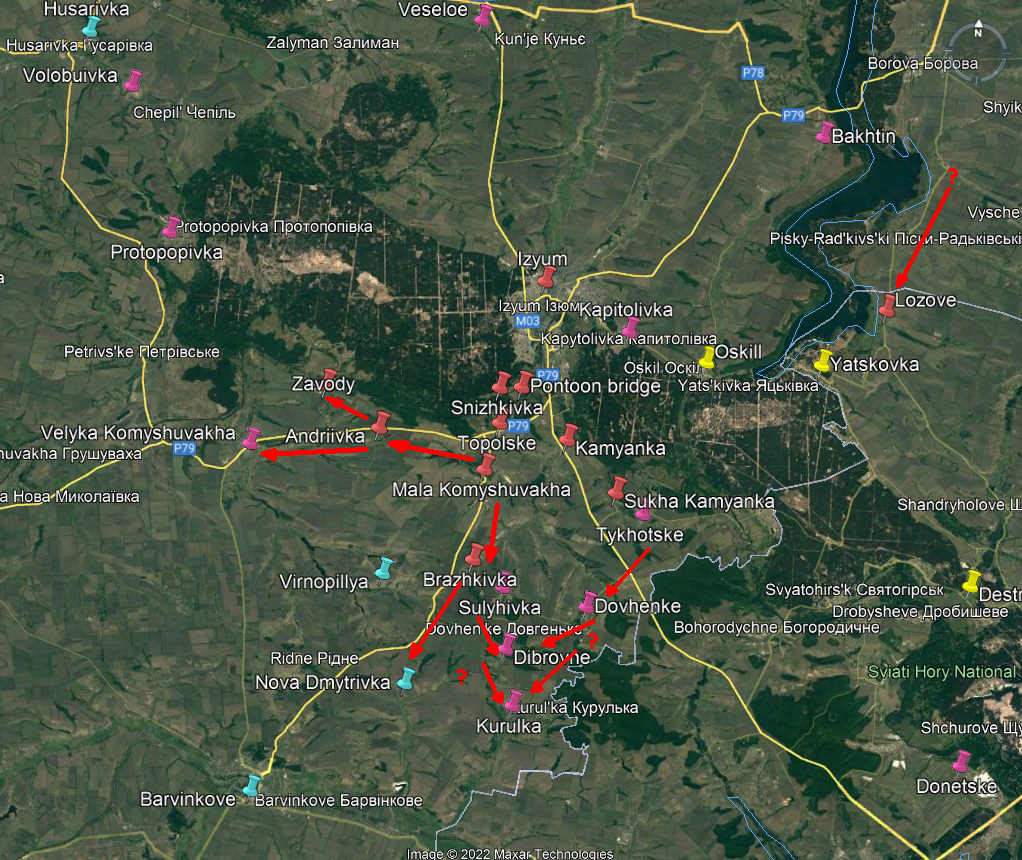
- Velyka Komyshuvakha shelled April 25th with Russians reaching outskirts April 27th.
- Zavody probed April 18th, reported under assault by April 22nd, reported under attack from the direction of Andriivka (thus, down the P79 east/west highway) late April 25th, reported fully taken April 27th.
- Andriivka reported in Russian hands April 16th.
- Mala Komyshuvakha reported in Russian hands April 16th.
- Sukha Kamyanka reported in Russian hands late April 16th.
- Brazhkivka lost April 5th, taken back before April 9th, lost again by April 16th (see prior reports.)
- Sulyhivka reported as in Russian hands April 16th but as being defended by Ukranian forces April 20th.
- Dibrovne assaulted early April 20th, reported under partial control by late April 20th but Russians reported fighting for northern outskirts again by April 22nd.
- Dovhenke assaulted April 16th, again late April 20th. Dovhenke reported under shelling April 23 (so Ukrainian forces held.). Russian assaults reported April 25th towards Dibrovne and Kurulka; unclear if this was towards Kurulka from Dibrovne (implying the latter is taken or more likely bypassed) or of the assault is from the northeastern direction (implied by Russian assaults on Dovhenke and the location of the major highway in that direction.)
- Nova Dmytrivka shelled April 25th and repulsed Russian assault April 27th.
- Lozove (east of Izyum) reported lost April 22nd late. This was reported in multiple places as a new advance (and reflected as such on the Finnish scribblemap) and taken in concert with the alleged counterattack east of Kharkiv to indicate Ukrainian forces were attempting their own double encirclement, but I’m not sure Lozove was ever lost by Ukraine to begin with. I heard no real reports of Russian attempts to cross the river or take territory near there; only south and immediately west of Izyum. According to Jomini Ukrainian forces have been in Lozove long since April 11th at least. Jomini doesn’t show them that far forward April 6th but it’s entirely possible Ukrainian forces were always there and just not positively reported as being there.
Rubizhne and Severodonetsk:
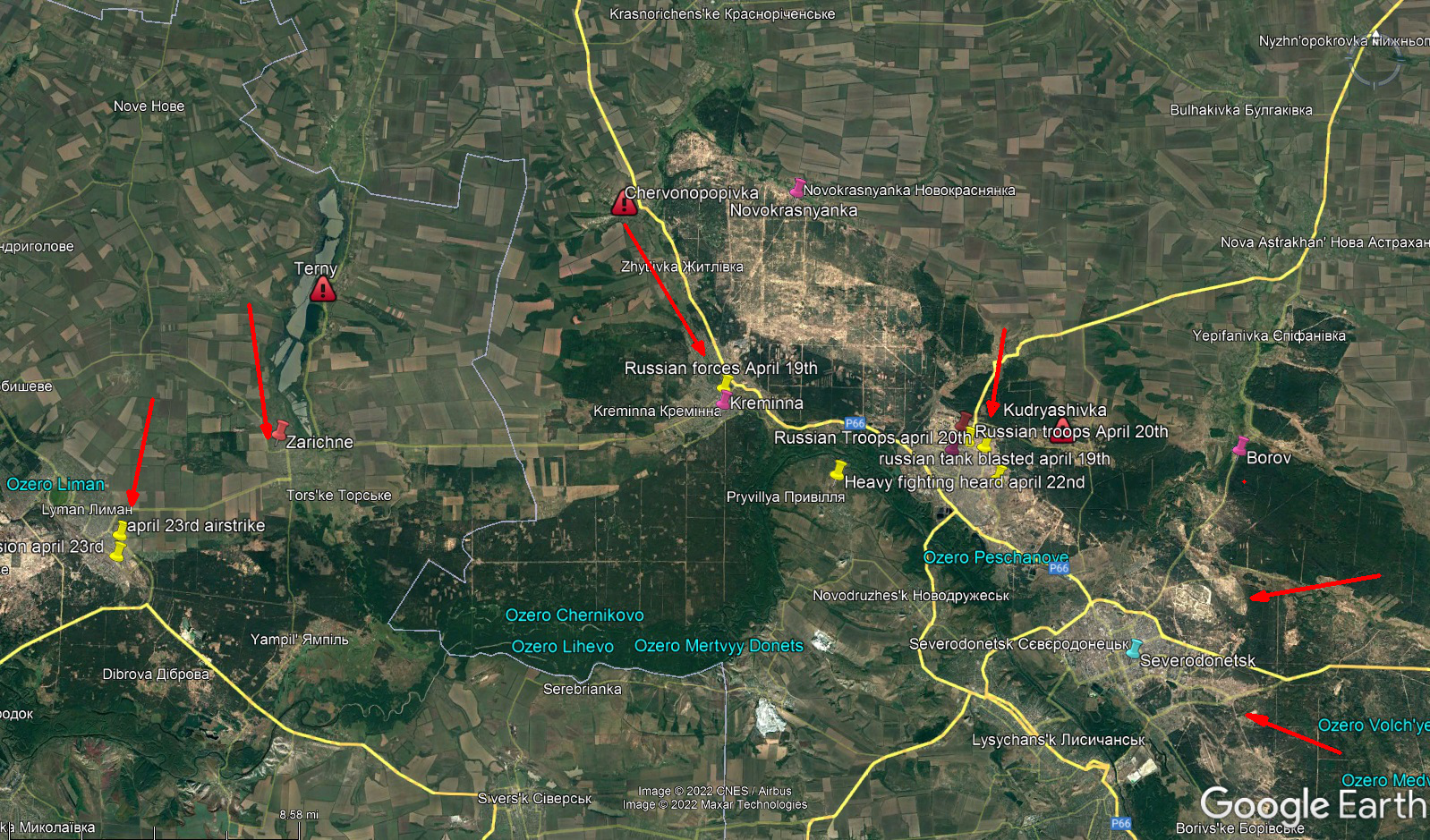
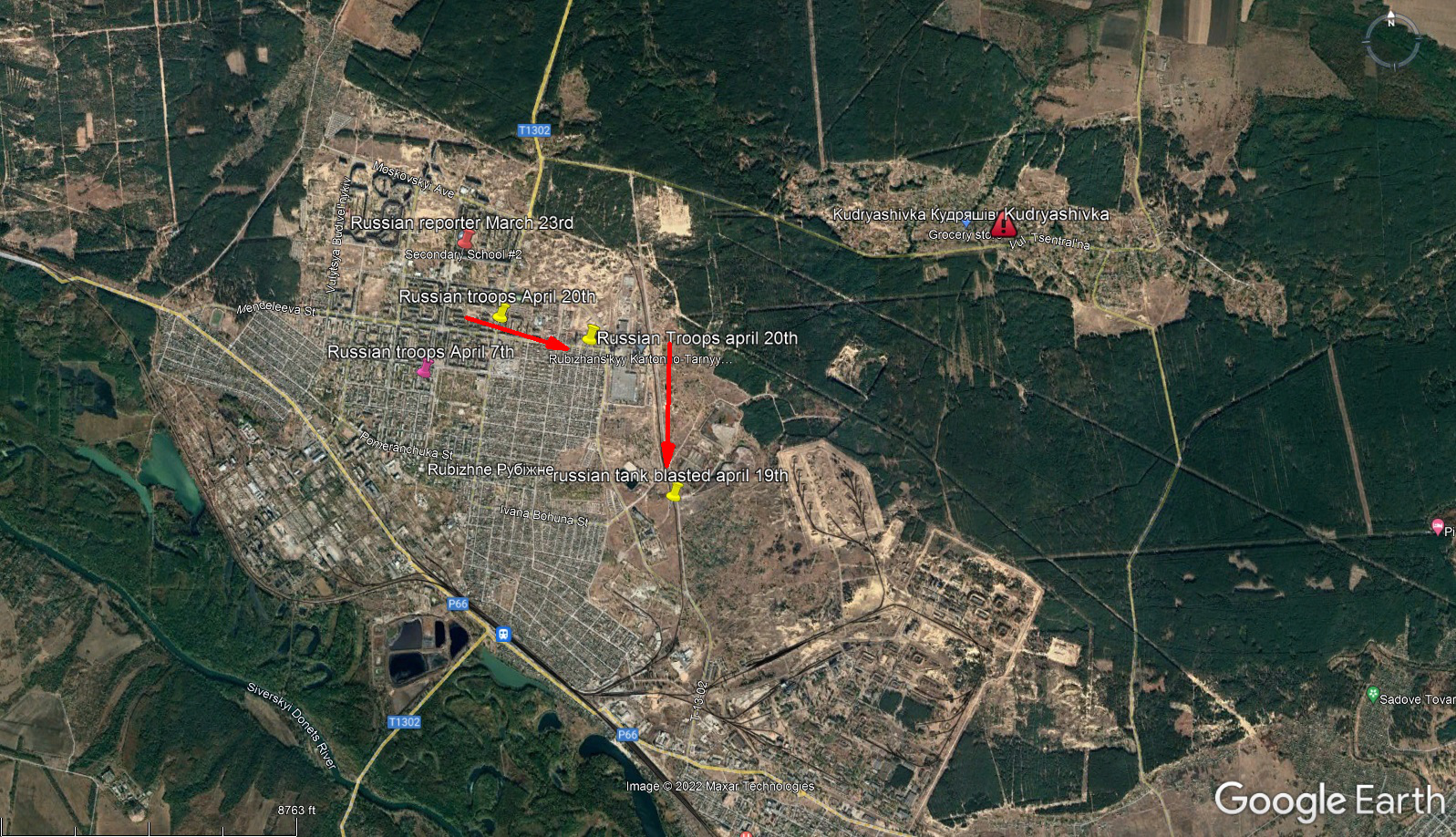
- Airstrikes on Nova Poshta April 23rd.
- Zarichne attacked April 22nd, then again April 24th. Reported fallen April 27th.
- Persistent reports of nonstop Russian assaults on Rubizhne and Severodonetsk throughout this period, continuing reports of same as mentioned in my earlier summaries. Russian forces have insisted on pressing into these cities for over a month now, at least.
Donetsk area:
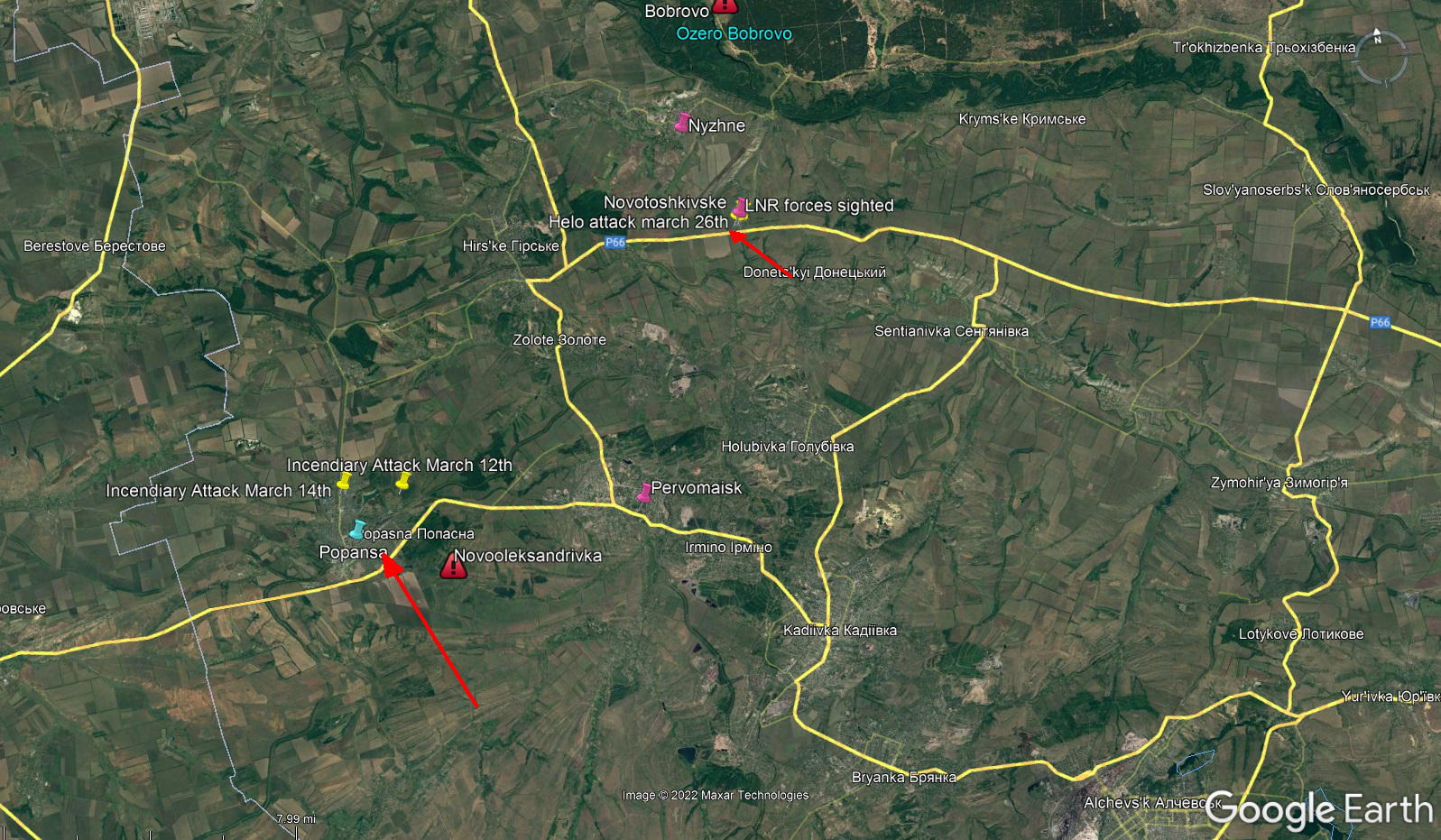
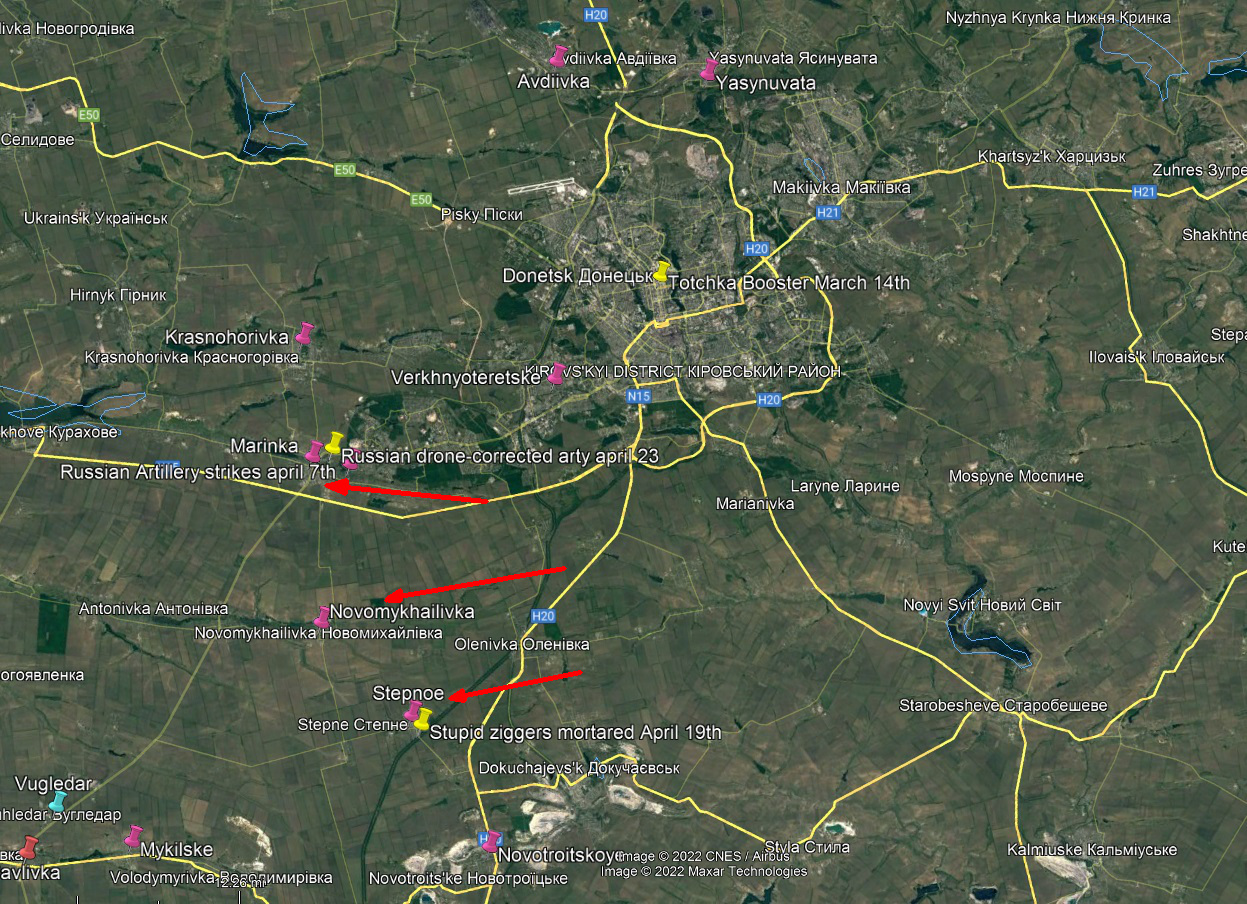
Southern Defensive Line:
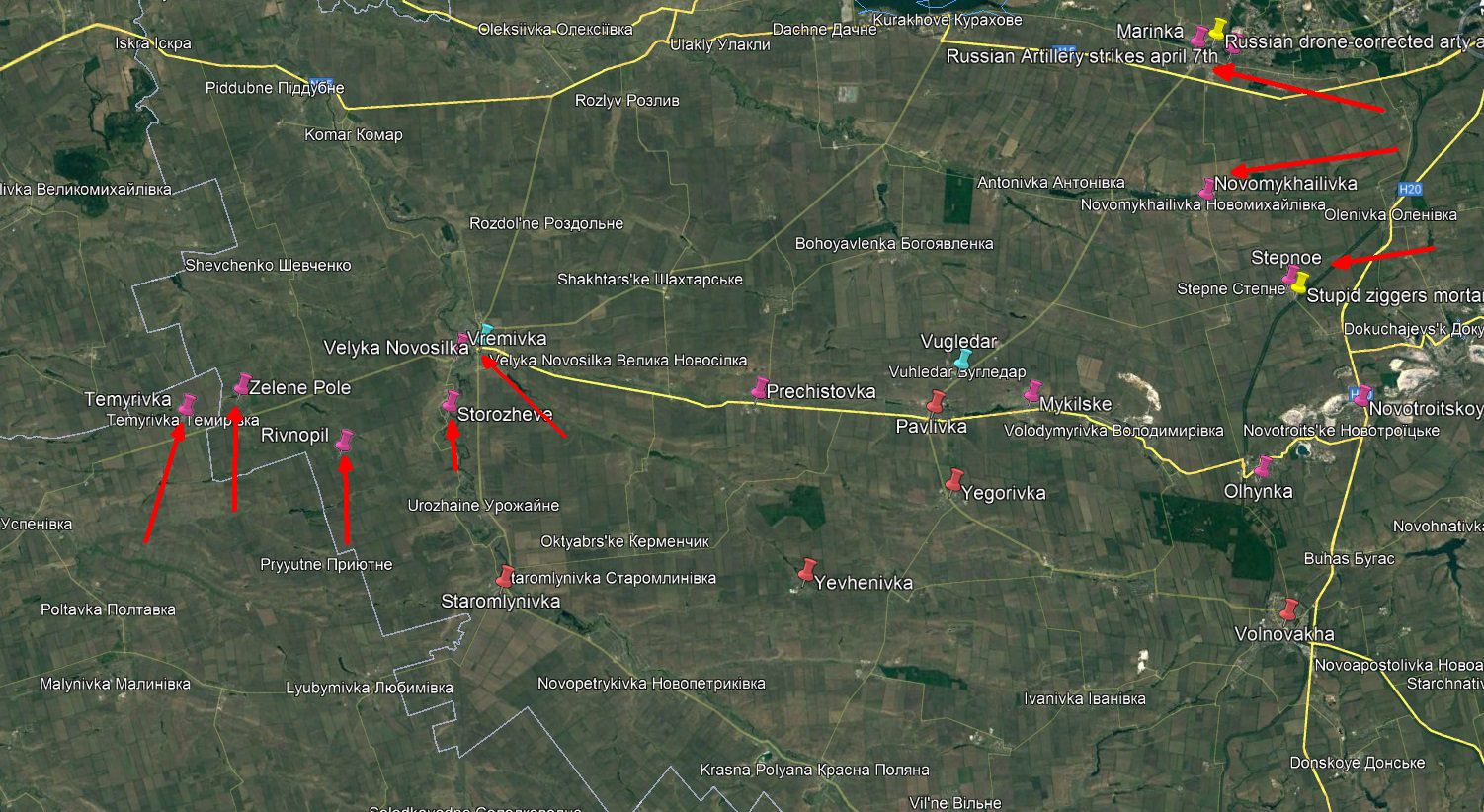
- Velyka Novosilka and nearby Storozheve assaulted early April 20th. Vremivka (between the two just south of Storozheve) repulsed an assault late April 24th, implying Russian forces have not broken through Velyka Novosilka.
- Temyrivka assaulted late April 20th. Zelene Pole just north of there assaulted late April 22nd (apparently in force as UMoD specifically said the attackers were reinforced with units from the 18th Motorized Rifle Division from the 58th Combined Arms Army, and that a BTG of the 127th Motorized Rifle Division of the 5th Army had to be withdrawn from here due to combat casualties.) UMoD specifically claimed an airborne attack on here was repulsed April 24th.
- Rivnopil was also assaulted April 20th.
Kherson:
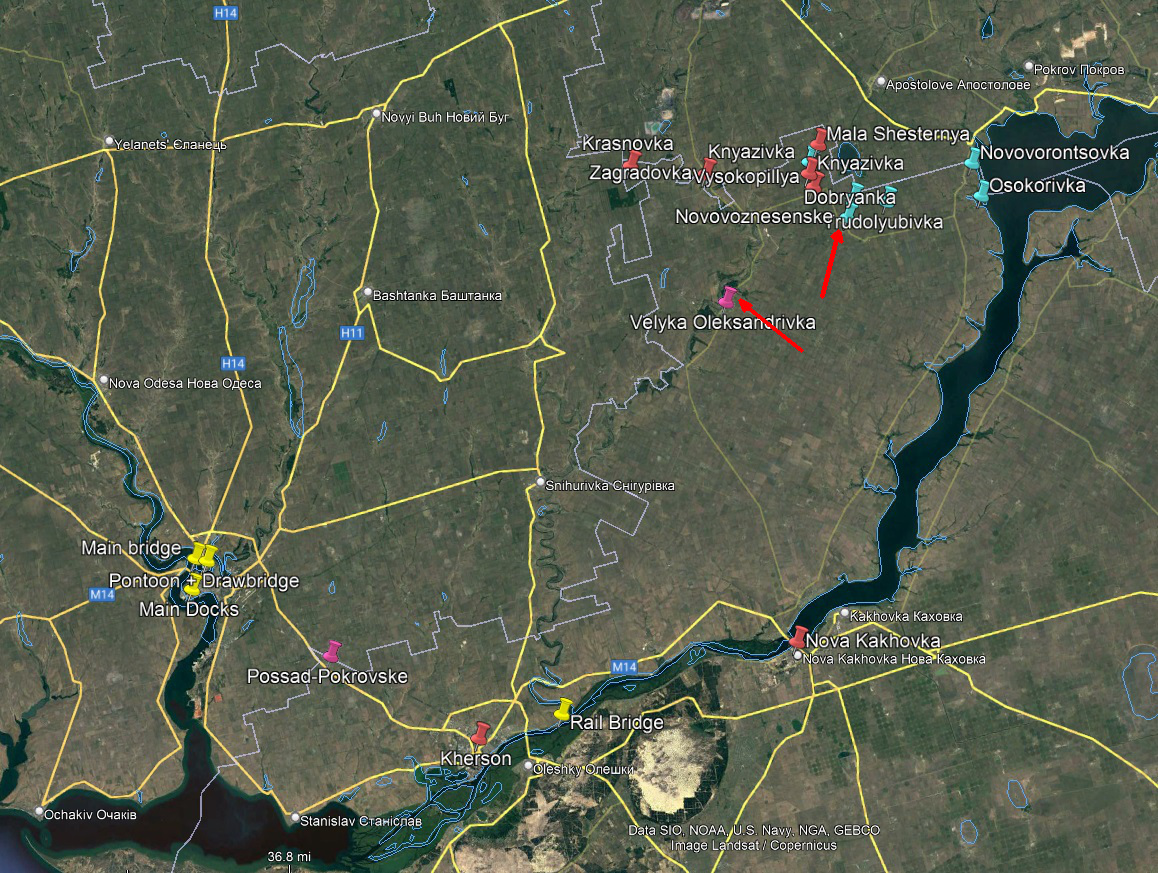
- Unceasing assaults on “Oleksandrivka” in Kherson since the 14th (continuing reports going back to early March, as you can read in my prior reports.) “Oleksandrivka” finally explicitly identified as Velkya Oleksandrivka early on the 26th plus mention of an ammo dump blown there.
- Trudolyubivka probed April 22nd. S300VM said to be deployed early April 23rd near here. Repelled an assault on April 26th.
Mariupol Area:
- They’re still attacking it. This one is getting its own update.
Summary Of Russian Axes Of Attack For The Past Two Weeks:
Overview:
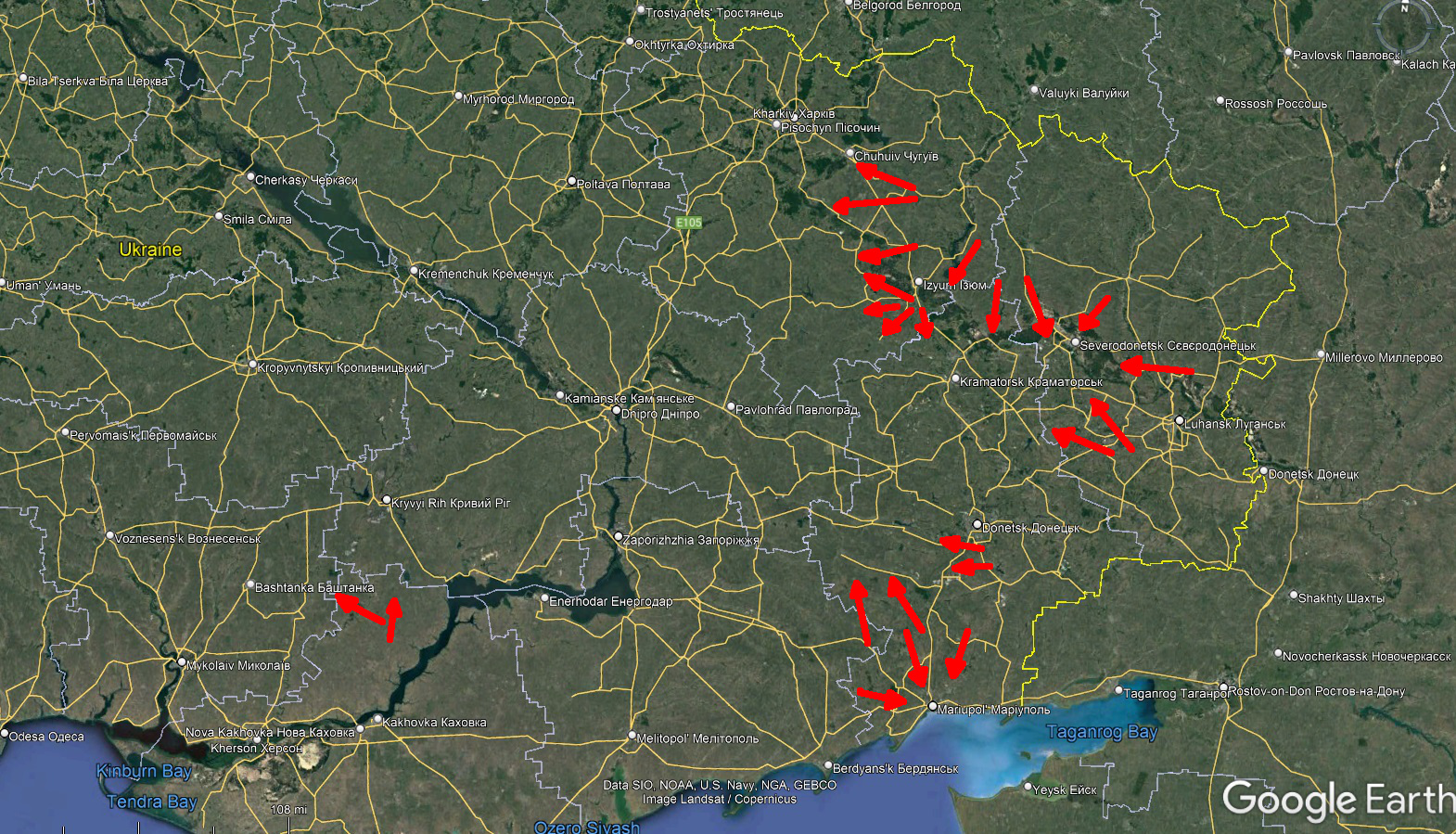
Implications: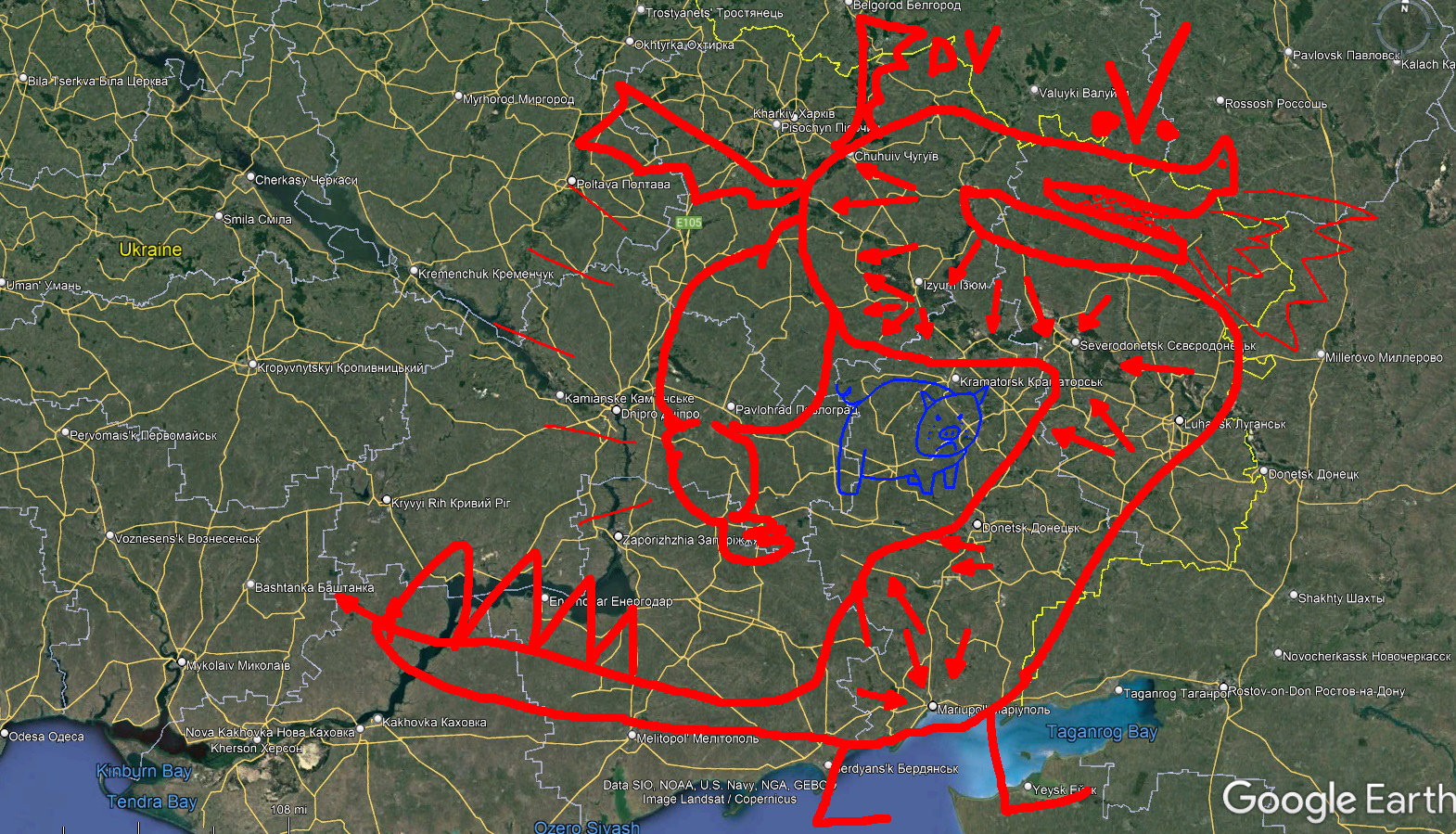
Unironically a better plan than what they’re doing, which is flinging themselves against the entire line of contact like a VDV trooper bellyflopping into the Black Sea.
Sitrep: Operational
Jesus Christ.
- These incidents taken together indicate that Ukrainian pilots have indeed been making supply runs behind enemy lines by utilizing nap-of-earth flight to avoid Russian air defenses. As mentioned in my special report on the Moskva sinking, at low altitude the curvature of the Earth limits the effective radar/line-of-sight horizon greatly. This is precisely why so many SAM systems have a dedicated low-altitude radar that is erected upon a mast, to get a little more height and viewing distance. However, the sheer number of low-level SHORAD air defense systems Russia has means they should be able to completely surround Maruipol with a missile shield. More importantly, the hands-down best countermeasure to nap-of-earth flight is attacking from above, and Russia has both Airborne Early Warning aircraft to detect low intruders with an airborne radar, and plenty of fighter planes with which to attack said intruders with, even from beyond visual range. Russia’s inability to prevent these kinds of flights is a stunning indictment of their ability to conduct aerial operations against any significant opposition.
- Strikes in Bryansk, Russia on April 24th, against a Russian military fuel depot and a nearby oil depot demonstrate Ukraine’s continued ability to inflict damage on Russian logistical infrastructure. Security CCTV video from near the strikes clearly demonstrates (via audio) that the incoming munition was loud and fast – this was quite likely a unitary-warhead Tochka-U missile, as the range (120km) is just enough to reach this area from the Russian border (105km.) UMoD reports reflect Ukrainian successes in both long-range strikes via various means as well as on-the-ground actions by SOF on Russian territory: Russian rear area air defense specifically noted as strengthened on the 22nd, reinforced ELINT/ECM and air defense on April 22 (late), Russian forces reinforcing border not just with border guards but with entrenched positions (!) April 24th) Yet more mentions of border and air defense enhancement April 24th (late). Note also the major fire in Dmitrievsky Chemical Plant on the outskirts of Moscow on April 21st, and the Russian military research facility in Tver, near Moscow, that went up in flames the same day. (These are significant as they wouldn’t be conducted by SOF; they’re too far into Russian territory to go sneaking around in uniform. This would be conducted by very good SOF and/or intelligence agents in plainclothes, that speak Russian fluently without an accent and can stroll up with a dog on a leash, look both ways, then toss a thermite grenade through a window after busting it with a rock.) Also note this coincidental fire at an ammo depot in Belgorod on April 27th and this one in Luhansk, Ukraine the same day. I direct your attention also to multiple recent videos of Russian air defense systems engaging airborne incomings near Belgorod; indicating Russian forces have been forced to increase the air defenses around this city to deal with persistent Tochka-U and/or 300mm MLRS attacks by Ukraine. Please see also this Russian-provided photo of a “mine” planted on rail tracks near Bryansk, which has been identified as an inert training version of the SZ-6 demolition charge. Given the role Russia’s much-vaunted air defense systems have played in their propaganda (which anyone who’s interacted with a vatnik online is well aware of) it’s no surprise Russia would prefer to blame difficult-to-stop saboteurs on the ground rather than a successful standoff missile attack.
- It is true that Russia has drubbed Ukrainian rear-area logistics much more thoroughly with missile attacks than Ukraine has theirs, but Russia is also fighting this war more or less alone, without the bulk of Western Europe – and it’s infrastructure – backing it up.
- This video showing a Ukrainian Skif ATGM launcher taking out no fewer than four enemy tanks is simply astounding incompetence on the Russian’s part. [Part 2.] As previously discussed the Skif’s remote operation capability makes stopping the first shot difficult, but this weapon is reloaded three more times for three more successful engagements (you can tell when it’s being reloaded by the camera feed vibrating as the loader does his work.) If Russian troops were suppressing the launch site (which is pretty damned obvious to anyone with half-decent optics) nobody would’ve been able to scramble out of cover to reload that thing once, much less three times. This is literally why Russian IFVs have autocannons on them. Russian troops either cannot find their asses with both hands and a team of pathfinders waving them in with flares, or they cannot implement standard anti-ATGM tactics that’ve been doctrine since the Soviet era.
- Video evidence cira April 17th of a BMP-3 from the 102nd Motorized Rifle regiment in the company of a T-80BV (not operated by any of the 102nd or it’s parent formation the 8th Combined Arms Army’s units) suggests Russian forces are using composite units; combining remnants of badly mauled units together into new formations or using them to replace losses in others. See also this video of T-8BVMs and BTR-82As, another bastard combo not known to be used by any Russian operational units, together on the same transport train.
- See also video evidence of Russian tanks rolling through Kupiansk on April 22nd, and BTR-82s on April 23rd. Recall that the beginning of Russia’s new offensive push was April 18th-20th or so. Kupiansk is the major railhead in north-eastern Ukraine for Russian logistics, being about 60km from the frontlines from Chuhuiv down to Izyum. Trickling in reinforcements like this might be acceptable if Russia wasn’t clearly scraping for every operable piece of equipment, but they are, or at least damn well should be given they have lost the margin of force superiority essential to ensuring success in breaking through determined defensive lines to achieve rapid encirclement. Once again the Russians refuse, or are unable to, mass their forces and focus them against smaller fronts. See also the UMoD report late April 20th mentioning continued Russian reinforcements trickling in.
- I’ve tried to avoid turning this document into nothing more than a list of “cool war clips from Twitter,” but this does illustrate why I’ve been posting as much artillery employment as possible – to attempt to establish some patterns. At this point I feel it’s safe to say that Russian forces are not effectively suppressing Ukrainian artillery fires by any means, which denies them a great deal of the utility of their own guns. A major factor in analysis of Russian military capabilities for many years has focused on their artillery-centric nature, as it’s natural for a force with a significant superiority in one aspect of combat arms to use that superior mass to destroy the corresponding capability on their opponents part. (Think of how the American air force tends to eliminate enemy airpower from existence within the first few days of a conflict.) The superior capability doesn’t just provide “more of X” than the enemy can, but eliminates that entire span of unique capabilities from the enemy’s portfolio as a significant force, thus fundamentally reshaping the conflict. Much has been said of Russia’s inability to truly dominate the air skewing this conflict well out of order with what on-paper assets and capabilities should produce. I would rate the Russian superiority in artillery pieces as at least as significant as Russian superiority in airpower should have made them, and their consequent failure to perform to expectations, likewise.
- Contrast Russian artillery usage, as evident in this image taken by a drone of an area near the front lines, showing the characteristic area spread of MLRS rockets in the cratering. As previously noted, MRLS rockets, especially the old unitary warhead Grad rockets the Russians seem to be pulling out of Cold War stockpiles, are awful at reducing entrenched defenders. Entrenchment improves the resilience of infantry against bombardment a hundredfold; you either need airburst munitions (and the vast majority of wide areas of cratering I see show craters, indicating unitary warheads, not airburst or submunition bomblet payloads) or direct hits to generate results. This is what you use well-aimed tube artillery (howitzers and the howitzer/mortar tracked systems Russia has) for; to find defenders foxhole-by-foxhole and dig them out. It’s also, apparently, beyond Russian capabilities to do, as this overhead photo from April 17th shows the same area cratering by unitary warhead MLRS bombardment directed at a fortified Ukrainian trench line.
- I allege that Russian forces are indeed relying heavily on massed MLRS bombardments:
- This reporter claims a Ukrainian commander near Donetsk says their positions are being bombarded by Russian artillery for 14 hours a day, i.e. the oft-reported nonstop bombardment is indeed still being used on the eastern front as it was elsewhere.
- In addition to above photos, this time-lapse comparison of fields scarred by area MLRS bombardment near Dovhenke, and this much wider area shot from around Kharkiv back on March 17th and this from Feb. 28th, also Kharkiv area. Note the concentration around treelines and/or structures; strongly suggesting these were attacks on point targets, not maneuver forces in the open.
- Now consider employment. This April 18th video shows three Ukrainian BM-27s demonstrating how MLRS artillery is typically used: you blow your load, then you get the hell out of there. Note they’re in the middle of an open field, not dug in, and have no ammo vehicles with them. Recall this Russian MoD drone video showing a mall they attacked with Iskanders after the drone shadowed Ukrainian MLRS vehicles back to that location, where they were using it as cover to conduct ammo reloads. Contrast to this clip fresh off the presses showing three BM-27 launchers, two trans-loader vehicles and no fewer than five trucks filled with rocket reloads found by a Ukrainian drone before being obliteratd by counterbattery fire. See also this clip from April 27th showing much the same. Also consider this April 20th video of a knocked-out Russian BM-27 position (likely another old counter-battery loss from the Kyiv or Sumy areas). Note the vehicles are dug in and they have a supply (ammo) truck with them as well. Consider also this previously reported destroyed Grad (still in firing position) and it’s obliterated ammunition transport.) Also this video showing a Grad with attendant ammunition vehicle getting whacked. And this one. And these two Grads nailed while clearly in firing position, by what was clearly artillery given the massive damage around the area. And this burned-out Grad also in firing position.
- Taken together this shows a clear pattern of Russian forces setting up MLRS vehicles in a single, stationary position to perform sustained bombardment, much like one would use a battery of towed or self-propelled howitzers, instead of “shooting and scooting” as MLRS vehicles are supposed to. The strength of MLRS systems lie in their ability to dump a tremendous amount of firepower on the enemy in a hurry; in theory they should be impossible to conduct counter-battery fire against unless you can locate their resupply point and hit that. (Note the recent video of BM-27s + trucks getting hit seems to be a firing position, not a reload point – you can see the oval-shaped track that one BM-27 is indeed on over to an area of ground with clear soot/blast scarring from launches; showing how the vehicles drive a safe distance from the ammo dump, launch their rockets, then drive right back around to be reloaded.) The downsides of MLRS is that their rockets are big; not just a logistical issue but also a tactical one as it makes their launching vehicles and transports big. The United States operates a tracked, armored MLRS vehicle (the M270) and is one of the few in the world to do so; most such vehicles are entirely unarmored (like the venerable and ever-present BM-21 Grad) and that includes the huge, wide box of highly explosive rockets they tug around. A dug-in towed gun can be pretty resilient (if they’re not taking ICM) and a self-propelled howitzer has both armor and the ability to begin moving out of the targeted area immediately. You do not use MLRS like a howitzer unless you absolutely must.
- Note that even if you must, even towed gun batteries relocate regularly to avoid counter-fire. Sitting in one place so long that they’ve created a loop-de-loop track in the mud that easily draws the eyes of drones from miles away is incredibly stupid.
- Given that Soviet doctrine determined the force structure of the army the Russian Federation would inherit, and Soviet doctrine was based on being the aggressor during a fast-moving invasion of Western Europe, it’s quite likely Russia does NOT have a choice. Simply put, they’re an artillery-centric maneuver force that are now stuck fighting a slow, grueling advance against entrenched defenders in many places, and so they simply have too much MLRS and not enough self-propelled guns or other weapons suited for point targets. Witness what comes up as they dip deep into their obsolete stocks – these forty-odd “Grad-1’s” recently spotted heading for the front, a lighter 36 tube version of the Grad that can only use older, shorter-ranged rockets. When they go to scrape the barrel, that’s what the barrel has – what the Soviets had, not necessarily what they need. Their 230mm guns, their huge self-propelled siege howitzers, their TOS-1s – these are more niche capabilities meant to deal with a limited number of problems; not something that determines the capabilities of the force on grand scale.
- As previously mentioned, this April 19th video showing Russian soldiers responding to 120mm mortar attack is emblematic of the horrid “training” Russian infantry have received. When a shell lands very close to a building, you can presume the building is being targeted. The worst thing to do in that case is to run into the building. Most wood-frame buildings – such as the ones most residential suburban areas are built of – are very poor protection against anything other than line-of-sight. Utilizing buildings like this in combat requires heavy fortification of their interiors – basically building sandbag bunkers inside the building. In other words, the building is primarily useful for providing concealment and some elevated firing positions – although the latter must be abandoned (no matter how well sandbagged they are) if heavy direct or indirect fire is brought to bear, as the building will come down and bring you with it – and pile tons of roof rafters etc. on top of any sandbag bunkers on the lower floor, as well, trapping their occupants within. Plus, any defensive position – even a single Observation Post – should have some fighting positions dug outside as well, to provide more all-around defensive coverage and a place to run should you take heavy IDF. There is no conceivable circumstance in which running into that building was the proper thing to do.
- Russian forces continue to lose Armored Fighting Vehicles to small attacks by commercial drones dropping anti-tank grenades. It is this precise sort of attack that the so-called “cope cages” were probably intended to guard against, though it doesn’t seem to be stopping Ukrainians from racking up kills.
- Though sadly brief consider the glimpse of fighting in Rubizhne posted by the Ukrainian 4th Rapid Reaction brigade: note the T-64 and BTR-3 engaging together. This is proper employment of armor; you want the autocannon’s rate-of-fire involved in the fight as they’re excellent at suppressing hostile ATGM teams. See also this longer video (provenance unknown) showing Ukrainian forces (likely in the eastern part of the country) conducting an actual proper combined-arms advance, with infantry and armor supporting each other.
- A new detail has emerged regarding the Russian supply dump/truck park on the P02 highway, only 18~km south of the Belorussian border that was shelled because Russians don’t understand how to cover a flank: Ukrainian forces were tipped off to enemy presence there because the owner of the compound, a millionaire who had just finished building his dream home, saw Russian solders walking around his home by remotely accessing his security system over the Internet. The Russians lost a supply depot because they were too stupid to unplug the wi-fi.
- Consider also reporting like this, which alleges that a disproportionate number of Russian soldiers are recruited from rural and remote areas of Russia, where it’s no secret that standards of living are very low. This would explain a lot of the looting and compares well to the general lack of things like, e.g. not knowing to turn off a house’s wi-fi. Compare and contrast to Ukrainian civilians using a smartphone app to crowd-soruce reporting of Russian military movements.
Sitrep: Materiel
Jesus fucking Christ.
The outpouring of materiel support to Ukraine has increased to an unfathomable degree over the last two weeks, to the point where I abandoned all hope of saving Twitter tabs personally and have simply fallen back on Oryx’s excellent summaries. Unfortunately Oryx is not linking sources for these, so I’ll do that myself. (In his defense he is... busy.) The gamut of support is staggering, ranging from confirmed deliveries of many more T-72 tanks to artillery (both towed and self-propelled) and (even more) APCs.
- As I noted up-thread regarding this same base’s ammunition depot, this is all very much in range of Ukrainian MLRS.
- The United states is now providing so-called “Phoenix Ghost” loitering munitions. This donation stands out because I have never, ever heard of this weapon before now. US military statements say it provides “similar, but not exact” capabilities as the AeroEnviroment Switchblade munition, and also that the weapon was developed specifically for use by Ukrainian forces, to Ukrainian requirements, with it being said to be “useful against different types of targets.” My personal guess is that this represents a Switchblade 300 drone re-armed with a HEAT warhead, rather than a simple blast-frag one. The lead picture in the WarZone article shows a mock-up vehicle that is representing a kind of weapon Iranian puppet units have used in asymmetric attacks against US bases in the Middle East before; a common flatbed truck with improvised launch rails/tubes for artillery rockets. (They’ve even been seen installed in the bed of dump trucks that then elevate their beds to fire, a kind of ghetto MLRS.) This gives you an idea of the kind of target sets the Switchblade was invented to deal with; light vehicles and infantry; i.e. an insurgent threat in which the man-in-the-loop nature of the weapon was the whole point. Given this, giving the weapon a warhead optimized for area blast-frag made sense. As Ukraine’s commercial drones armed with re-purposed RKG-3 anti-tank grenades equipped with 3D printed fins have demonstrated, however, even a small High Explosive Anti-Tank explosive charge can be highly effective when directed against the thin roof armor of a battle tank. Given the surplus of small HEAT charges already available to the American defense industry (which has already resulted in such warheads being repurposed for guided munitions) and the fact that the Switchblade 600, which utilizes the sophisticated Javelin warhead, is in short supply as it only recently entered US military stocks, it makes perfect sense to quickly convert extensive stocks of the Switchblade 300 to utilize a different, more anti-armor suited warhead.
- Nobody should be surprised by the Swiss.
- Speaking of, it has been confirmed that the Czech Republic has also donated T-72s to Ukraine, in addition to the BVP-1 IFVs previously reported. Quantities are currently undisclosed.
- America has now been confirmed to have donated ninety M777 towed howitzers, in addition to the previously reported donation of 18 Paladin SPGs. (Many news outlets are phrasing it as “seventy-two additional howitzers,” assuming the previous ones were towed guns and not Paladins, but other sources at the time were saying “self-propelled guns.” As usual, journalists are useless. Safest bet: they’re all M777s.) The M777 is the newest and most advanced towed gun in American service; it makes extensive use of titanium alloy, making it light enough to sling-load under a medium-lift helicopter. Interestingly enough US defense officials have confirmed that training programs have been underway to ensure Ukrainian forces can utilize these American guns. (Note this report from the 20th still cites the “18 guns” figure that was first announced, and notes that the provision of M777s or the older M198 is yet to be clarified.) In either case, nintey M777s are a far greater boon to Ukraine than 18 Paladins. The M777 is the latest, greatest American weapon equipped with the latest digital fire control system; enabling a very low time from unlimbering from the tow vehicle to firing; (it is fast to orient the gun and determine its own position vs. target position.) That same computer system also makes it exceptionally accurate; it can read atmospheric conditions automatically (temperature, humidity, etc) and has pre-programmed in memory the flight characteristics of every type of ammo it can use.
- Canada is sending four M777s as well, but much more significantly they’re donating their M982 Excalibur shells as well. See this update for my past comments on the significance of this long-range precision munition; it’s effectively a gun-launched glide bomb. The Russians are of course jamming GPS signals in Ukraine, but US weapons developers have been working on software integration of home-on-jam capabilities for their PGMs for almost a decade at this point.
- France is sending 155mm CEASAR self-propelled guns, quantity unspecified. While the CEASAR is unarmored, it is also lightweight and fast; a boon given the ground conditions in Ukraine right now.
- In addition to the above comments, almost every nation supplying 155mm tubes is also supplying generous quantities of ammunition to go with them; and mentions of land mines, small arms ammunition etc. are too numerous to keep track of at this point. The economies and arsenals of NATO are being emptied into Ukraine’s lap with mad abandon.
- As I mentioned in my Moskva update, the United States reneged on its promise to deliver MI-17 helicopters to Ukraine because it could “spread the conflict beyond Ukraine’s borders.” This is almost certainly due to the long-range MI-24 raid on the oil depot in Belgorod on April 1st. Dr. Phillip Karber, in his 2018 lecture at West Point, alleged that the US (and Germany) told Ukraine they couldn’t conduct counter-battery fire on Russian guns slaughtering their forces because “that’d be firing on the homeland of a superpower!” See also this recent AP News report citing multiple anonymous officials who said limits on US intelligence sharing that had limited the specific locations of potential targets in parts of Eastern Ukraine had only recently been lifted. See also this letter sent by Republicans on the Senate Intelligence Committee urging the Director of National Intelligence to “proactively share intelligence with the Ukrainians to help them protect, defend, and retake every inch of Ukraine’s sovereign territory, which includes Crimea and the Donbas,” which all but outright states that the United States was denying this information to Ukraine before this – as if occupied soil should be treated as de-facto Russian territory.
- Please compare this to the United Kingdom’s Defense Minister, who on April 27th explicitly endorsed Ukraine’s right to strike targets in Russia proper. Also note that the provision of a staggering 240 Polish T-72s was only made possible by the United Kingdom offering Challenger 2 tanks to backfill Poland’s forces – not the United States, with over 2,000 M1A1 Abrams in storage, and Poland already due to receive an order of some 250 Abrams from the US already.
- This is unfortunately exactly what we should expect from an American administration this firmly in the control of the SecState “foreign policy establishment,” what with a President that’s in office, but not in power. This naked cowardice and insistence on bunting the grenade back and forth as if it can never possibly go off – even after it just has – is emblematic of the bureaucracy that has done so little to truly punish Iran for decades of wanton mass murder, instead insisting on treating Iran as the untouchable proxy of a Great Power that no longer was. This is what we should expect from the Vice-President of a man who responded to the leader of a nuclear-armed ally standing in front of Congress and all but promising to glass Iran before letting them get the bomb by doing his damnedest to tilt the next election and oust him from power. This is what we should expect from a bureaucratic tradition that has never once truly punished North Korea for its decades of terrorism and kidnapping directed against America’s treaty allies, nor the multiple wanton murders, including the shootdown of Deep Sea 129, shelling of Yeonpyeong island and sinking of ROKS Cheonan. It’s a miracle that we’ve sent even the support we have so far, given the administration POTUS used to belong to refused even to sell Ukraine the Javelin missile.
Which brings me to the Strategic update...
Sitrep: Strategic
- Elon Musk’s provision of Starlink for Ukraine continues to be a significant factor in Ukrainian operations. Not only are civilians benefiting from it, but the Ukrainian military is making good use of it for communications as well. The signals are relatively weak and hard to locate compared to military radios and Starlink has proven quite resistant to Russian jamming (after some quick adaptation by the company to deal with it.) This is interesting because the United States has evinced interest in large fleets of low-flying, cheap satellites, especially ones that can be launched quickly, “on-demand,” to harden its space capabilities against the targeted jamming and/or destruction of its few and exquisitely expensive geosynchronous satellites (for example, the MILSTAR birds.) The USAF’s interest in rapid space access with large numbers of cheap low-orbit satellites is a significant factor in investors putting money into such projects as the insanely expensive and absolutely gigantic “Stratolaunch” aircraft. It just so happens that Starlink is a large constellation of cheap, low-orbit, limited life satellites. Not only is it harder to jam due to the much lower altitude of the birds (once again, the inverse square law is king,) but because the constellation, to achieve reliable global coverage, needs many satellites (which is why geosynch or Molniya orbits were mandatory until Space-X’s technology lowered launch costs enough to make mega-constellations possible.) Thus, with a directional antenna (and/or software properly configured to recognize signal interference and aggressively hand off to a bird with a better connection due to its position/LOS) such a network is very hard to jam. Jamming is done either with a directional antenna aimed at one of the two parties trying to talk (the ground operator and the satellite) and with many satellites that requires many individual directional jammers. Omidirectional jamming requires being between the two parties trying to talk, and if many birds exist, that’s only possible by getting close to one of the parties in question (in this case, only the ground operator is available) and that’s where the greater signal strength compared to geosynch sats (or GPS satellites!) comes into play.
- As reported well before the resumption of Russia’s offensive in the Donbas, they were making efforts to address their persistent failings in coordinating forces by bringing in more C3 assets (Command, Control, and Communications.) On April 24th Ukraine claimed that they hit a Russian command post, killing two generals and grievously wounding a third. While I have typically ignored claims like these in the past as being sensational, effectively unverifiable and highly likely to be propaganda, I must stress that this is EXACTLY what you would expect to see when Russian command elements struggling with a shortage of proper secured military communications systems attempt to increase their inter-unit C3 coordination with American SIGINT/ELINT aircraft listening in. NATO is good at this, and the United States especially are past masters at Signals Analysis. Even if the Russian’s weren’t using unsecured radios so frequently, simple pattern (traffic) analysis is quite good at identifying command posts. After that, it’s just a matter of pointing the Ukrainians at the grid square and watching them obliterate it.
- Compare and contrast the state of Ukrainian C3 to Russia’s.
- UMoD places Russian strength at Izyum at 25 BTGs cira April 22nd. On the 18th US defense officials guessed that a good 22 Battalion Tactical Groups were still in Russia proper being refitted for combat. Given the losses they took in northern Ukraine this isn’t a shock, and underlines how moronic Russia’s insistence on renewed offensives are. Consider this video of Wagner group “mercenaries” fighting in Popansa, one of the most crucial sectors Russia needs to break through at. Wagner Group consists of “ex” Russian Special Forces operators hired to be (poorly) plausible-deniable troops in Russia’s foreign adventures in e.g. Syria. Thus they’re not just well trained but have lots of combat experience. Without the C3 needed to properly coordinate force, the artillery competence to mass forces without Ukrainian long-range fires flattening them or even taking the time to properly reconstitute their forces before beginning a major new offensive, their only option is to rely on quality over quantity – and thus dull their absolute best weapons by throwing them into ugly, grueling fights without sufficient support and without the means to actually capitalize on any breakthroughs they might achieve even with such sacrifice.
- As expected, the destroyed Alligator-class LST is still blocking its berth at the port of Berdyansk. More interestingly, the port facilities are no longer in use by Russia, still. The demonstrated threat of long-range strike against it is apparently greater than the anti-ballistic-missile assets Russia can spare for it. This is a tangible example of Ukrainian long-range strike capabilities interdicting Russian supply efforts.
- UMoD mentioned continued reports of Russian forces stealing civilian vehicles for logistics and claimed damaged Russian equipment was still en-route out of Gomel (Belarus) on April 24th, further underscoring just how badly Russia is jumping the gun with this offensive.
- All of this suggests that the deadline of May 9th (anniversary of Soviet victory over Nazi Germany) for the “special operation’s” conclusion, set by the Russians back in late March, is something they’re actually trying to achieve. It certainly matches their frantic efforts to rush through the false pageantry decorating their erection of puppet states in occupied areas and suggests that the Russians really do believe they can call it quits on May 9th and successfully hold on to whatever terrain they snatch before then. They believe either that they can repel Ukrainian counter-attacks successfully, that NATO will backstab Ukraine, happy with the damage inflicted upon Russia and happy to take the “win,” and/or both.
- Even if Russia does something drastic like finally declaring war and beginning mass mobilization of its populace towards a war footing, what Russia is doing now still belies a serious misreading of the situation. The outpouring of heavy weaponry from NATO over the past two weeks – including and especially the greater generosity of the Netherlands, UK and others when compared to the US in key and crucial areas, as well as the UK Defense Minister’s open statement that striking Russian soil is fair game for Ukraine – should be a major clue to anyone with two brain cells to rub together that NATO, especially eastern NATO, are not only taking this conflict seriously as an existential threat to NATO, but leaping at the opportunity to cripple Russia’s ability to threaten their alliance ever again.
I am still working on the drone update and a few other things. Stand by.
Special Report: Battle of Mariupol (Posted May 4th 7:30PM EST)
I’m going to briefly summarize the progression of the Battle of Mariupol since about mid-April till now and talk about what continued resistance here implies for the larger war. As we speak Russian forces are storming the last stronghold of Mariupol.
Timeline of Events
- As mentioned in my prior update, the medivac helicopter that was shot down at the end of March near Mariupol was indeed apparently flying ammo in and wounded out, as on April 19th an Azov fighter was filmed destroying a BTR with a MATADOR launcher; which was only donated to Ukraine in late March, well after Mariupol had been surrounded. The April 22nd downing of a Ukrainian AN-26B cargo plane which hit power lines while conducting Nap-of-Earth flight well behind Russian lines is further evidence that Russian air defenses are unable to persistently deny airspace to Ukrainian logistical air operations.
- While the volume that can be moved by airpower is certainly limited, even a thin lifeline is infinitely better than nothing at all. The MATADOR rockets are a good example; air resupply can mean the difference between having continued AT capability or not. If Russian armor knew they were unopposed because they ceased to take any AT rocket fire, they’d press their attacks far more boldly and achieve much more, much faster.
- Through mid to late April scenes like this were seen quite often; Azov regiment drone videos showing them engaging Russian support positions with accurate mortar fire [geolocation]. As I noted in this update cira April 10th, Ukrainian forces were demonstrating consistent freedom of maneuver all around Mariupol, both with infantry and armored units. This is emphasized by how the port facilities in Mariupol’s southwestern fringe were the scene of heavy fighting over the next several days; given this area is mostly rural northwards of it (it’s not got the bulk of the city to slog through first) Russia’s inability to assault this area earlier is puzzling.
- It’s about this time (April 12th) that a well-known UK volunteer soldier and Ukrainian Marine, who had been fighting for years in the war in Donbas and is known as “Cossack Gundi,” surrendered with “his unit,” (size unknown; this could mean anything from his whole company to just his own squad.) Despite effusive Russian propaganda, it should be noted that as a UK national Gundi (and to some extent his immediate comrades) had more reason to believe they would be well-treated, or at least not executed outright. Cossack Gundi was seen again April 19th, with his captors having dressed him in an Azov regiment T-shirt – clearly for propaganda purposes.
- On April 13th, the Commander of the Azov regiment, Lieutenant Col. Denys Prokopenko, and the Commander of the 36th Marine regiment, Maj. Serhiy Volyna, released this video together. I cannot speak Ukrainian but accounts seem to agree they said some men had surrendered, most had not, and most importantly the 36th Marines had now joined forces with the Azov regiment. This account, the alleged Canadian volunteer in Ukraine, summarized this as a breakthrough staged by the Azov regiment to relieve the encircled 36th Marines.
- Note there has recently been serious reason to doubt the full truthfulness of the account that posted this video, but I am unable to find a non-content filtered tweet with the same video, and the video itself speaks volumes (literally, for a native speaker) hence my uploading it to my own Drive for posterity. (It was probably uploaded to the 36th Marines or Azov facebook pages originally, but I don’t have facebook to check myself.) Given the timing of Cossack Gundi’s surrender the day before, the narrative does check out. Rumors of a “breakthrough” had been flying around twitter all day; it was not an external force relieving the city, but one Ukrainian unit in Mariupol breaking through a Russian encirclement in another part of the city so Ukrainian forces could consolidate and avoid defeat in detail. The Canadian volunteer account stated as much itself and alleged there were actually a few pockets that were broken through to relieve and consolidate defenders.
- By April 17th there was indications that fighting on both sides of the river through Mariupol had moved closer to the Azovstal steel plant. While this video has fallen victim to the usual Twitter bullshit (the @GeoConfirmed account archives all these and does go back and repost them if privacy settings are changed or tweets deleted, but keeping up with it is difficult,) the geolocator’s own “proof” images contain snapshots of the video in question, as well as its location in the city. See also this April 17th drone video showing active shelling/fighting on the very outskirts of the plant itself (47.104998, 37.628085).
- By April 18th the commander of the 36th Marines, Serhiy Volyna, was already asking for Western help to evacuate women and children taking refuge in Ukrainian military bunkers. The Astoval plant had been under bombardment well before this, but on April 19th I saw the first specific reports from the defenders that aerial bombing had been used. (Russia claimed to be using airpower before this, but the strikes filmed could also have been TOS-1 thermobarics.)
- This drone video from the 19th shows some of the damage to the plant, but more importantly puts it in context with the sheer gargantuan scale of the plant. This gives you some idea of the terrain it constitutes.
- Note the aforementioned MATADOR video was also released on the 19th, and showed combat in a commercial district, not on the plant grounds itself.
- The ever-present anonymous US Defense Official source was putting US estimates of Russian troops in Mariupol at around 12 Battalion Tactical Groups around April 18th.
- On April 20th the “Canadian Volunteer” account claimed that another breakthrough was staged by the 36th Marines and Azov regiments to relieve Ukrainian National Police units and withdraw them to the Azovstal plant. Unlike his prior claim there’s no video to go with this one and I’ve yet to see the claim corroborated.
- On April 21st Putin publicly announced that the Azovtal plant should be besieged and invested instead of directly assaulted, (as that would be “impractical,”) which made so much sense that many people instantly doubted the sincerity of it.
- April 23rd Russian propaganda showed Russian soldiers firing at the Astoval plant from about 100 meters away from its north-easternmost outskirts, over some train tracks. (At 47.111163, 37.614824.)
- On April 25th Russian propaganda showed a mine-clearing line charge vehicle using its high explosives to destroy buildings. Interestingly the launch site was at 47.105914, 37.633914, the same place the drone video was taken cira April 19th. In other words, Ukrainian defenders were still violently contesting the outskirts of the Azovstal plant, rather than hiding in the bunkers beneath the facility and waiting for the Russians to come to them.
- On April 29th Maj. Volyna gave an interview to the New York Times in which he stated that civilians were fleeing to the plant as it was the last relatively safe place in the city, with other civilian shelters being destroyed (presumably by indiscriminate or even deliberate Russian attacks, as seen previously in Mariupol.) The War Zone did a significantly more illuminating interview that same day. Numbers were given: about 300 civilians sheltering with roughly 2,000 fighters of the Azov regiment. (Note the 36th Marines and various National Police/TDF forces will likely be present as well. He specifically said that Russian units were utilizing direct fire with armored vehicles and self-propelled guns from as close as 200 meters to the plant, but as of April 29th they had not actually entered the perimeter of the plant itself. He also specified that “from here, we have fire control over the enemy to a depth of 6-8km,” clearly implying that Ukrainian defenders still have access to heavier artillery – at the least 120mm mortars and/or 122mm howitzers. (They could well have 152mm artillery as well, with their effective range limited by the spotting drones they have available to direct them.) He also specifically commented on the extensive nature of the underground tunnels and bunkers under the plant.
- On April 30th Russian propagandists showed video of a self-propelled gun being used in direct fire mode (a common tactic when fighting in urban terrain) while hitting an apartment building that doesn’t seem to be immediately near the steel plant. See also this video from the same day of a tank using point-blank fire against an apartment block. Some time after it ceases fire civilians are seen fleeing the building; presumably having sheltered in the basement. Taken together these would seem to indicate that there’s still pockets of resistance around the city that are not consolidated in the steel plant, and Russian clearing operations must continue.
- On May 1st, an apparently successful humanitarian evacuation of civilians was conducted. Video: [1] [2] [3] As the mayor of Mariupol himself pointed out May 3rd, however, that evacuation only got 100 of the 300 trapped civilians out.
- Early May 4th, reports started to come in that Russian infantry was attempting to storm the facility. At approximately 5PM EST (-5 GMT) the Kyiv Independent reported the commander of the Azov regiment had reported heavy, bloody fighting in the plant itself.
A word on the opposition
Russia has committed their Naval Infantry units to Mariupol (as previously shown in this document,) but have also used their much-storied Chechens and local “rebel” fighters, which seem to be used often as cannon fodder in high-intensity operations. (I have seen very persistent reports that the Russian puppet states in occupied Donbas are forcibly conscripting every able-bodied male they can find, but there is little direct evidence for this that does not come straight from Ukrainian sources. However, after the literal mountain of evidence of Russian forces committing mass genocide and unspeakable acts I see little reason to give them the benefit of the doubt. I have refrained from reporting this before as without evidence I’m just passing a long a rumor. To-date the only evidence we have is this video from two months ago of “rebels” being interrogated by Ukrainian soldiers horrified to learn they were all workers at the same vocational school and were apparently conscripted en-masse. Unfortunately “dudes talking” videos are not very convincing without extensive use of facial-recognition cross-referenced with social media, but at least it’s better than nothing. Make of this what you will.)
In general, footage coming out of Mariupol has not impressed anyone with the quality of Russian troops. Consider this video first posted April 18th or so. The drone gives us a very, very rare clear view of the chaos, intensity and close quarters of urban combat. The Russians are suppressed with hand-thrown grenades and, perhaps not realizing they’re grenades, immediately take cover as they would against mortar fire – only to have a hand grenade tossed directly over the wall next to them. That grenade likely killed or mortally wounded every man present. See also this further clip from the same video showing what happened after – the Ukrainian solder keeps throwing frags, and one of them lands near a Russian hiding under their van. He picks it up and throws it away – in the direction of his own comrades.
The reason this shit-show happened is largely due to the Ukrainian soldiers having an eye in the sky that was in communication with the shooters on the ground – that’s how the Ukrainians knew the Russians were on the other side of that brick wall but not the other way around.
Then there are the much-vaunted Chechen forces, who consistently display a very weak grasp of basic fire-and-maneuver tactics. They also tend to blaze away from the hip like morons. See also this video of Russian troops trying to YOLO across a wide-open corridor without any covering fire and predictably eating shit for it.
It should be noted that the claims/statements about extensive tunnels and bunkers under the Azovstal plant are highly credible. Huge industrial sites like that are typically equipped with warrens of service tunnels – not just piping for water and chemicals, but also power lines and underground access for personnel so they can avoid crossing dangerous areas too often. Moreover, the plant was first built for the Soviet Union in the 1930s – and having studied this period of history extensively myself, I can assure you that few if any nations harbored any illusions about what the future held. Building a massive industrial steel plant was a deliberate strategic incentive, and by the 30s most military professionals around the world fully expected long-range strategic bombing to play a significant role in the future conflict. This is all in addition to the dense warren of titanic structures that crowds the surface of the plant, as well.
Conclusions
The Russians have learned nothing. It took Russia two months of hard fighting to finally close a circle around the defenders of Mariupol, and given the defenders’ demonstration of continued capability for free maneuver right up till the middle of April, the likelihood that they were able to retreat to the Azovstal plant in good order with the bulk of their forces is highly credible. Instead of encircling and investing the plant, the Russians are committing to a brutal room-by-room, tunnel-by-tunnel fight with troops that include incompetent poseurs and (quite likely) Donbas conscripts dredged up at gunpoint. In the warrens and tunnels of Azovstal neither their tanks nor their artillery nor their planes can do them a damn bit of good – and a good half of the defenders waiting for them are so-called “Nazis” whom the Russians have made the obsessive centerpiece of their hatred campaign, men who have already heard of the unspeakable atrocities visited upon civilians near Kyiv and know that they can expect ten times worse if they’re taken alive.
Especially given recent reports of Russian regular units being moved northward, one wonders what troops Russia has reserved for this attack – if they actually expect to take the plant, or are just sending in cannon fodder in hopes of wearing the defenders down – defenders that are Special Forces quality and half of which whom have been given every reason to fight to the death, with knives if need be.
By making a single regiment the centerpiece of its hate campaign used to slander the entire Ukrainian people as sub-humans deserving genocide, they have made the destruction of Azov a non-negotiable propaganda victory – and for this they are now squandering precious men and materiel (including lots of heavy artillery, 240mm self-propelled mortars etc al that would be very useful for busting heavy entrenchments near Donetsk that 152mm howitzers simply cannot scratch, and scarce resources vital for enabling maneuver warfare against an entrenched defender, such as those mine-clearing line-charge launchers.) Even as their “offensive” across the entire front stalls, they are pissing away desperately needed resources on a fight that will cost them far more than they’ll gain. If the assault on the Azovstal steel plant is not tacit admission by Russia that they know they’re not going take much more land; that their current offensive is just a last grasp to marginally improve a post-ceasefire negotiating position, then it’s indicative of Russian leadership being literally insane.
No matter what, all that awaits Russia in those tunnels is defeat and death.
April 27th to May 5th (D+61-D+69) Update – Maneuver and Operational (Posted 1:31AM May 8th)
This update reflects the situation up to May 5th. I am posting this now before events continue to leave me further in the dust. This is the Maneuver and Operational update; the Strategic update will likely be as long as this one is on its own. Ukraine is literally kicking more ass than I can keep up with right now.
Sitrep: Maneuver
There’s significantly more geolocated data to work with now but I will also be citing the following Ukrainian Ministry of Defense/General Staff updates:
April 28th [Early] [Late]
April 29th [Early] [Late]
April 30th [Early] [Late]
May 1st [Early] [Late]
May 2nd [Early] [Late]
May 3rd [Early] [Late]
May 4th [Early] [Late]
May 5th [Early] [Late]
Kharkiv AOO:
- The big news on this front is a major advance north-east of Kharkiv, pushing Russian forces back almost 40km to the banks of the Siverskyi Donets river (which runs north-south in this area up into Russia.) There’s no direct video evidence for this but the preponderance of secondary image evidence is convincing and it’s been confirmed by the highest sources:
- On May 2nd the US Department of Defense background briefing on Ukraine specifically said that “t the Ukrainians have been doing an able job over the last 24/48 hours of pushing the Russians further away, and they have managed to push the Russians out about 40 kilometers to the east of Kharkiv.”
- In their typical mercurial fashion, UMoD refrained from actually mentioning the liberation of Staryi Saltiv, only mentioning it on May 5th by way of saying the town had been successfully defended against Russian counterattack.
- The bridge over the Donets river in Staryi Saltiv can be seen quite thoroughly destroyed in this video narrated by a Russian soldier, but this was likely blown during the initial Ukrainian retreat in the first days of the war (as they did with many other bridges) as this bridge is part of the main road over the river to Kharkiv, the T2104. Furthermore we can see the bridge over the Donets near Rubizhne (a town 10km north of Staryi Saltiv) was intact on on April 26th but was clearly destroyed by May 3rd as seen on commercial satellite imagery. FIRMS infrared satellite data shows fires very near that bridge around April 30th (as this tweet says, it could indicate incoming artillery fire meant to invest the bridge) but note also this geolocated imagery taken May 5th showing a bridge destroyed at 50.11963, 36.39057, in the village of Cherkas’ki Tyshky, some ten kilometers north of the outskirts of Kharkiv itself. This was likely blown by retreating Russian forces. Either side could have chosen to demolish the bridge, one to cover a retreat and the other to prevent one.
- This video of Ukrainian soldiers raising their flag has been geolocated in the town of Molodova (yes, two O’s) which is only 4km south of Staryi Saltiv.
- Additional context on this advance – I had mapped the towns of Kutuzivka and Prelesne/Slobidske as liberated back on April 8th due to this drone video showing Russian troops retreating during obvious combat, but UMoD has formally declared it so for Kutuzivka on April 28th and Prelesne/Slobidske on the 30th. Clearly, flagging those towns as liberated based on a singe short video showing a brief retreat was premature. Also on the 30th UMoD reported Verkhnya Rohanka (only 14km from Kharkiv proper and 8km east of Slobidske/Prelesne and 6km north-northwest of Vilkhivka, reported liberated weeks ago) as well as Ruska Lozova (10km north of Kharkiv, 6.5km north of a wooded are I’m pretty sure UMoD was mentioning in a report a few weeks ago. In other words, pressure on Russian units north of Kharkiv has been constant for weeks now, but these recent gains are massive and surprising. It is unclear if we are looking at a Ukrainian counterattack, a Russian retreat, or some mix of both and in what proportions.
- See also this imagery of a captured BM-21 Grad geolocated to Ruska Lozova, helping vindicate UMoD’s claims. Also this. Also these knocked out Grads some distance south of that village. See also this geolocated video of heavy damage to the village of Verkhnya Rohanka.
- Implications of this advance: Kupiansk is a major logistical hub for the Russian advance on the entire Izyum area, as it houses one of the largest and most important rail yards in Eastern Ukraine: the Kup'jans'k-Sortuval'nyj train yard (a marshaling or classification yard depending on your local vernacular; a yard where trains are split into individual cars and reassembled into new trains to dispatch on the next leg of their journey. Basically it’s an intersection for railcars as they move from origin to destination.) The size of the Kupiasnk yard is not its only important trait; it also has a direct connection north-west to the Russian city of Belgorod, which has been the recipient of so many Ukrainian attacks of late as it houses various military and dual-use infrastructure crucial for logistical support of Russian troops. This is a winding two-rail line build atop tree-lined embankments (as it passes through low, wet farmland) that runs roughly parallel to the T2114 highway. It was in fact this very rail line that was sabotaged on April 12th, when (likely Ukrainian) saboteurs destroyed the bridge carrying across the Donets river in Titovka, only 6km inside Russia and 35km north-northwest of Staryi Saltiv (also lying on the Donets’s bank.) To illustrate the implications, take a look at my hideous crowded Google Maps: the white path-line sketches the rough route of the railroad and the yellow circle shows the notional 40km maximum range of a BM-21 Grad:
THIS SPACE LEFT BLANK BECAUSE NOBODY ON PLANET FUCKING EARTH CAN MAKE WORD PROCESSOR SOFTWARE THAT DOES IMAGE EMBEDDING PROPERLY

- As the destruction of the bridge in Shebekino demonstrates, any movement of Ukrainian forces northward is just as bad for Russia as movement eastward. Given how hard Russia is struggling to break through at Izyum (or anywhere else, for that matter,) it does make sense for them to exploit the Donets river to protect their western flank; it does leave them exposed to a due-east thrust from Chuhuiv, but that’s at least close to the frontlines themselves and not well back by what’s effectively rear areas for Russian forces driving out of Kupiansk. However, this does not mean Russia can afford to let Ukrainian forces keep pushing north, either. Ukraine has no reason to respect Russian sovereignty at this point, and they demonstrably don’t. If they bring Belgorod – or even its environs – into long artillery range the Ukrainians can threaten by fire the most direct supply route from Russia’s primary logistical hub on this axis. Given that very same Line of Communication lets Russia move forces to either side of the river (by going through Belgorod) and forces south of Belgorod in Ukraine proper have direct communication rearward to their base of supply, Russia does not need the bridge(s?) they demo’d over the Donets to fight for those northern areas.
- I wish to stress an important point – utilizing artillery is not as simple as simply driving it up to the dotted line on the map and banging away. The closer any artillery asset comes to the enemy the more vulnerable it is; exposed to more enemy guns and especially more enemy eyes. You do not move rear-area assets up to where counter-battery can be cued by enemy frontline infantry with binoculars, if you can help it. Moreover the effectiveness of artillery increases significantly as range decreases; accuracy improves and time-of-flight drops (making hitting moving targets, like supply columns, more effective.) Above all, it provides more strategic depth to conceal your artillery in; more potential area where a gun can be sited to strike enemy positions and thus, more area for enemy recon to search. So while part of that road is notionally in 152mm range it’s practically in Grad range, and the Grad threat is only relative. As of now the threat to that Russian LOC is modest, but with every kilometer gained by Ukrainian forces it’ll grow.
Izyum AOO:
- Russian advance south of Izyum seems to have stalled hard. As previously reported Zavody (11km down the south-west running P79 highway from the Izyum area where Russia’s primary bridge crossings are) was reported lost on April 27th by UMoD, but subsequent reports indicate the next town 6km down the road, Velyka Komyshuvakha, repelled assault on April 28th and was the primary objective of (unsuccessful) Russian advances as late as May 4th. Additionally, Brazhkivka (12km directly south of Izyum) is apparently still hotly contested as UMoD reported troops in this area repelling attacks on April 28th. I read that as Russian forces holding the town but struggling to advance south on the T2122 highway near it. Interestingly, Sulyhivka, not 2,700 meters east of Brazhkivka, was mentioned as the goal of a failed Russian offensive on April 30th, implying it’s indeed held by Ukrainian forces (it was reported as lost April 16th, then Ukrainian held April 20th). Dovhenke, 5.5km east-northeast of there (and 4.5km south of the other Russian axis of advance east-southeast down the M03 highway) was reported as repelling Russian assaults on April 28th and the goal of failed advances on April 30th.
- Just working off UMoD statements (which includes their updates on May 6/7 which are now out at the time I write this sentence) you may think Russian forces hadn’t advanced at all. Finnmap, however, shows the Russian advance south of Izyum has pushed past the villages above discussed and reached Nova Dmytrivka. There is some geolocated evidence for this:
- Note that given the back-and-forth nature of the fighting this is scant evidence indeed, but it exists nonetheless.
- Speaking of Finnmap, a combination of geolocated imagery and UMoD statements confirms a significant Ukrainian presence north of the Donets river in the area east of Izyum and west of Lyman. (You will recall my ire at the lack of data on this area before now.) The following information is available:
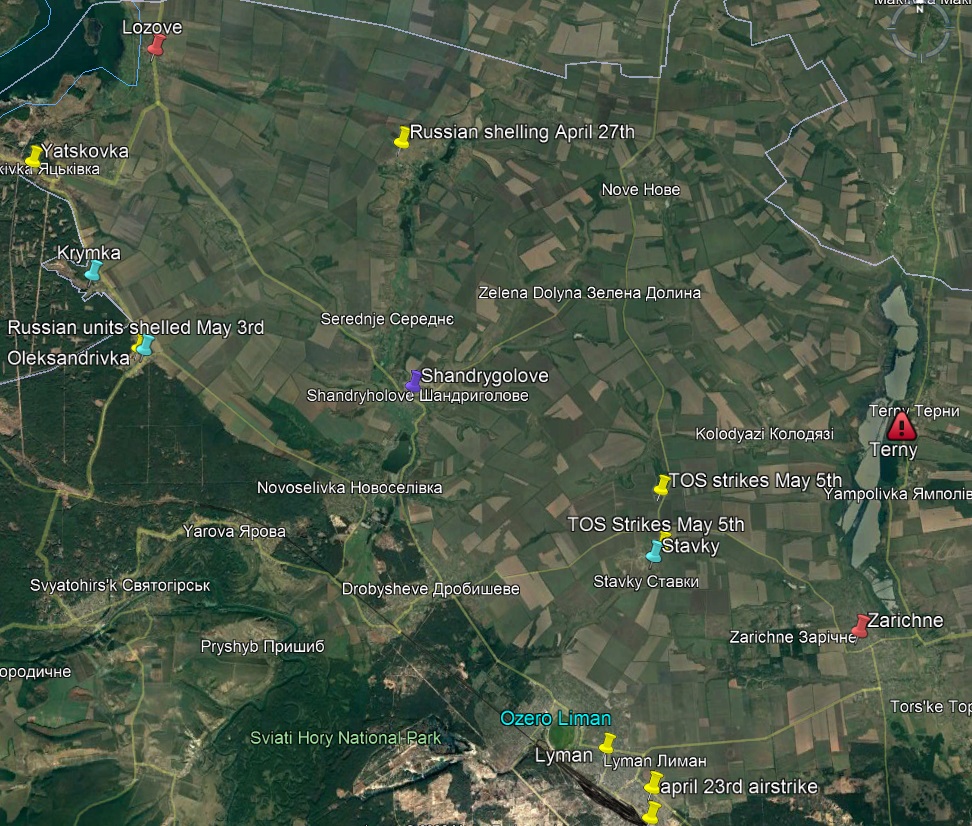
- Yampil (9km east of Lyman) and Ozerne (5km south of Yampil) were reported as under assault by UMoD on April 30th – yes, at the same time. Finnmap and Twitter RUMINT reports Yampil as having fallen and Russian forces in the vicinity of Zakitne, along the T0513 highway (2km north of Ozerne.) This seems probable based on the following:
- This rail bridge over the Donets, south of Lyman, was destroyed on April 29th – with a train on it. Sappers who mine bridges will often wait for enemy vehicles to cross it so they can get a twofer – it’s not mandatory (ensuring the bridge is blown takes precedence) but it’s doctrinal to attempt it if possible. It’s possible it was done by a Russian strike or even sappers, but given how much they need these crossings I doubt it. Interestingly this bridge is on a rail line running parallel to the T0514 which runs south from the eastern outskirts of Lyman – in other words it suggests this was another Blyatskrieg thunder run attempt (around the city of Lyman and the urban fighting no doubt awaiting Russia there.) See also this April 27th image of a destroyed road bridge just east of Lyman, reportedly by Ukrainian forces. Lyman is 10km west of Yampil – if the Russians are focusing on advancing south down the T0514, advancing south from Yampil would provide this Line of Communication flank protection.
- Multiple recent (seen May 1st-5th) geolocated videos show Russian forces in southern Yampil eating shit courtesy of Ukrainian artillery: this BTR-80 being destroyed by a Ukrainian 152mm artillery barrage, this one of Ukrainian shelling flushing Russian infantry out of a building, this further shelling of troops and BTR-82s, and this building with a BTR snuggled up against it being hit by Ukrainian artillery. Taken together this is strong proof that Yampil is currently enemy-held – though it doesn’t seem the enemy is enjoying being there. See also this strike geolocated a few KM northeast of Yampil showing a Russian MLRS strike on a wooded area (a rare example of Russian forces utilizing MLRS for its intended purpose; area targets.)
- These things together – occupied Yampil plus Ukraine blowing bridges along the highway west of there – suggest the Russians have had some minor success in their advances (both the main and the flank support one) prompting prudent destruction of infrastructure to slow them. Note however that Ozerne (which Russia has not reached in force yet, apparently,) is still north of the Donets river in this area, so the Russians will have yet more river crossings to attempt. The terrain also gets much more wooded and varied around there, giving Ukrainian defenders an easier time.
- My general impression of the fighting, between official reports and what geolocated video of combat we’re seeing, is one of pitched battles, attack and counter-attack. That makes sense for the terrain; open ground is excellent for fire and maneuver with vehicles, but on the defensive it’s awful for them. At this point I’ve lost count of how many videos in just the past two weeks I’ve seen of Russian armored vehicles dug into treelines eating shit from drone-spotted Ukrainian artillery strikes. Sure, it’s the only available cover, but such treelines are also screamingly obvious – and tanks simply don’t dig in very well. Anything too big to provide with top cover (i.e. anything that’s not an infantryman or at best an anti-tank gun) is simply a sitting duck given the amount of hard-to-interdict drones and indirect fires in this AOO. Avoiding indirect fire is a matter of having more strategic depth to move in (i.e. being further from the line of contact) as it places one closer to one’s own rear-area defensive assets (high-power, high-value EW and air-defense systems) as well as distances oneself from the threat (both putting units out of range of lighter artillery and drones, and forcing more expensive, longer-ranged drone assets to overfly more friendly eyeballs and MANPADs to find you.) Infantry with ATGMs should be used as the first line of defense if at all possible as they are best able to utilize the scant natural cover and concealment, with armored assets held further back and moving forward to counter-attack enemy thrusts in meeting engagements. By constantly digging in their tanks in the few treelines available, all Russian forces are doing is inviting destruction of both vehicles and crewmen inside them.
- In Rubizhne, we have geolocated video of another Russian mine-clearing line charge launcher being used to destroy buildings, and this Russian tanker explaining to Russian media how his now-husk of a tank came to grief. Note, however, that the tanker interview was first released May 4th, but the line-charge launcher was first posted April 23rd and only recently geolocated. Both events took place about 350 meters apart. Compare and contrast with the dates of other geolocated sightings from the city:
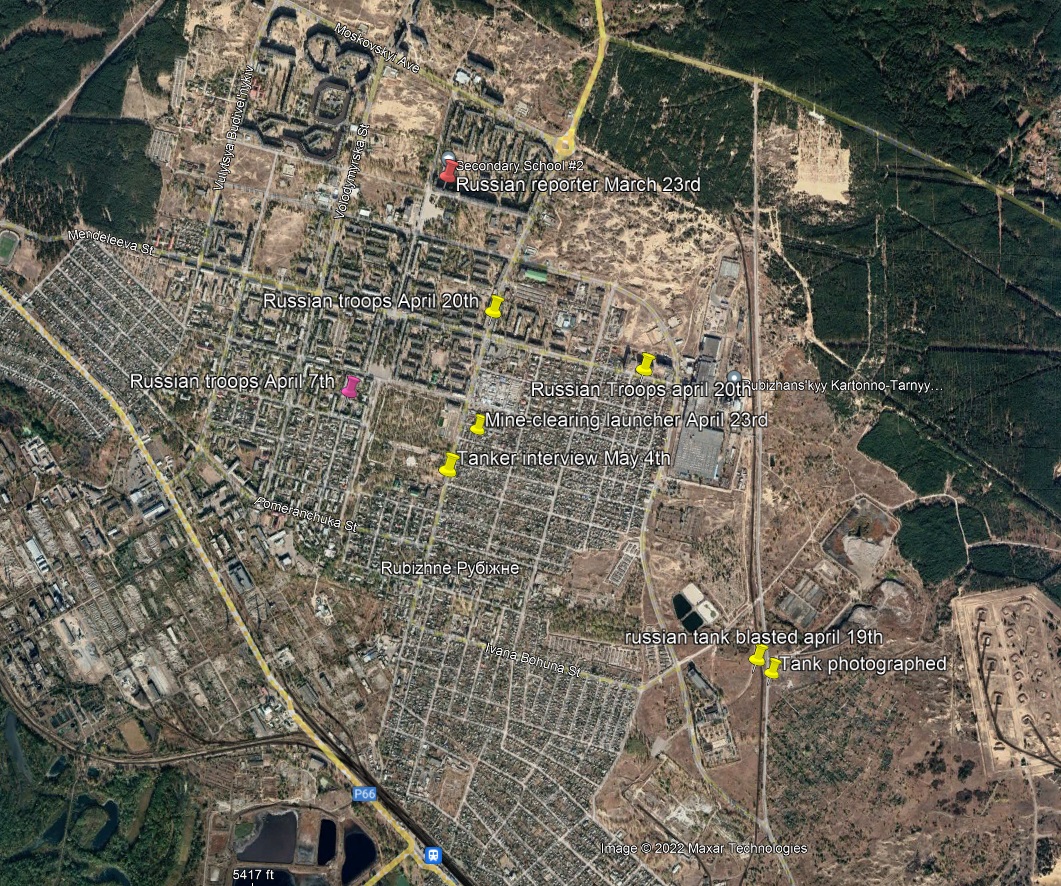
This hopefully illustrates the colossal stupidity Russia is demonstrating by continuing to directly assault an urban area they are also desperately trying to encircle. The desire to keep Ukrainian forces “pinned” is understandable, but the only way this helps is if the advances meant to cut them off from behind happen fast. As the pincers close in s l o w l y the defenders will have ample time to conclude that the city is lost by dint of the encirclement threat, and thus continuing to defend it is no longer necessary, allowing them to retreat – in which case the only way to prevent their escape is by hot pursuit and investment of their line of retreat by long-range fires, both of which can be done without brutal and very costly city-fighting. Russian forces have no goddamned clue what they’re doing.
Donetsk AOO:
- In this area the biggest development is Russian gains in the city of Popansa. UMoD has had little to say about this except to reiterate it’s a primary goal of Russian attacks, and to observe that fighting has been in the city proper for over two weeks now. These two geolocated videos show Russian troops advancing in the southwest areas of the city cira April 27th and these pictures show Wagner group mercenaries outside Popansa’s town hall, which is directly in the center of the city. The presence of Wagner Group – Russia’s plausible-deniable “mercenaries” for Syria and other foreign adventurism – are not only very combat experienced but are also well-equipped (unlike a lot of Russian regular forces, apparently,) so this is the best reason to presume that Russia will actually keep the gains they’ve in Popansa or at least not relinquish them easily.
- Note also that the Chechen President Kadyrov is also jerking off in the environs of Popansa and the Chechens, both in general and Kadyrov in particular, have been fabled for the amount of faked propaganda horseshit they’ve engaged in. The only reason Chechen forces are present in Popansa is so Wagner mercs can adjust easier; they’re used to urban fighting where their only allies are bearded morons shouting Aloha Snackbar while hip-firing uselessly and avoiding the actual fighting.
- This is an excellent chance to show just how useful the newly fixed @GeoConfirmed account’s interactive map is. Now that the map can be filtered by date and type of event it is far more useful. Prior to this I had to work through dozens of Chrome tabs and put these pieces in geographic context myself; often with my own recording of it in Google Earth. The Geoconfirmed map does this for you and saves me a lot of time. It is a tremendous tool you should all be paying attention to.

Southern Defensive Line AOO:
- Almost all recent developments around here are known courtesy of the UMoD. Velyka Novosilka, a major crossroads on this line was reported as still being the overall objective of Russian advances on May 4th and Vremivka, the town’s southwest suburb, was reported as having repelled direct assault around May 1st. Zelene Pole, 14km west of these towns, also repelled assaults on May 1st. The next major crossroads and town along this line is Huliaipole, 50km west-southwest of Velkya Novosilka, and UMoD reported it as the target of Russian assaults on May 4th as well... as well as the city and crossroads of Orikhiv, 40km west of Huliaipole. When I said the Russians were flinging themselves at the entire line of contact instead of focusing their forces, I was not joking.
Kherson AOO:
- First detailed reports of the southern part of this oblast from UMoD in a long time.
- It seems the reports referencing “Oleksandrivka” which I took to mean “Velyka Oleksandrivka” actually meant the town of Oleksandrivka on the Black Sea coast some 35km west of Kherson. I believe I mentioned my confusion on these points in an earlier update – however, given the only fucking thing UMoD has said about this city for a good three weeks has been “Russians are shelling it,” which is about as useful as telling us that the sun is rising, the only significant difference is that Velyka Oleksandrivka is likely Russian, not Ukrainian held, but with Ukrainian units within easy artillery range, given the April 26th report of an ammo depot in that city being destroyed. That reduces the assessed flank threat to the Russian forces north of Nova Kakhovka, west of the Dnieper, but doesn’t eliminate it.
- Speaking of, this video of Ukrainian artillery released May 1st has been geolocated to the crossroads of the T2207 and T0403 only 4km west of Ukrainian-held Osokorivka on the west bank of the Dnieper; supporting the conclusion that the Russian forces here have neither advanced nor retreated. They’ve been stuck here for weeks, but refuse to retreat and consolidate their lines.
- First detailed descriptions of the frontline in southern Kherson oblast in ages:
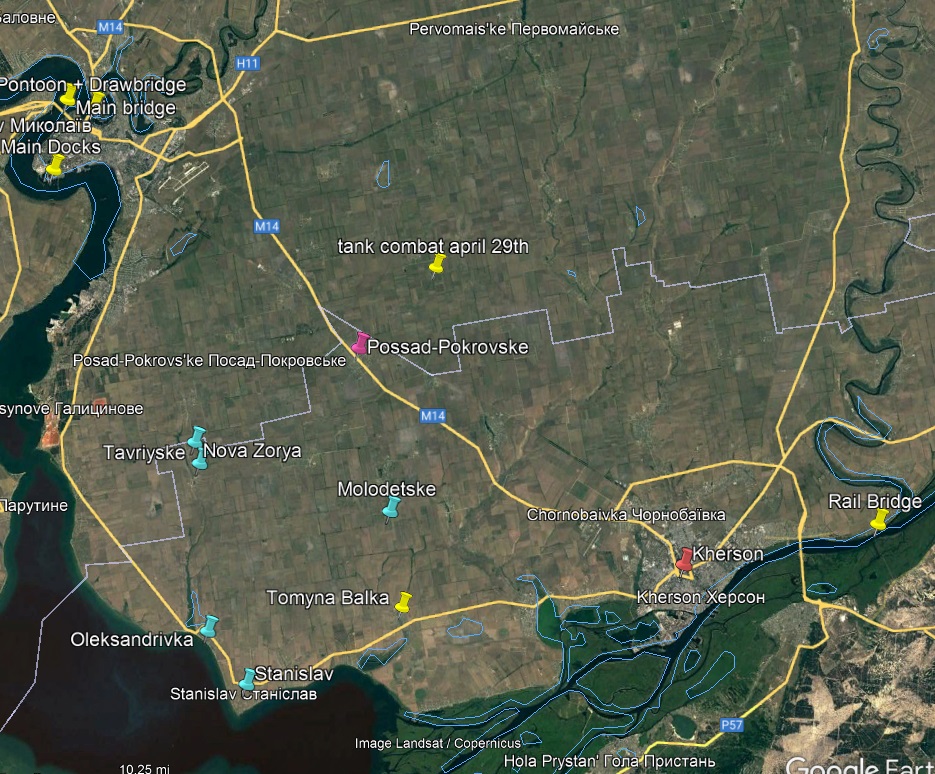
- Nova Zorya declared Ukrainian-held April 27th,
- Oleksandrivka declared Ukrainian-held April 28th,
- Stanislav declared Ukrainian-held April 27th,
- Molodetske declared Ukrainian-held April 27th,
- Mention of “increased hostilities” in Tomyna Balka on May 4th, whatever the hell that means.
- Other than that there is little actual imagery coming out of this area to help locate combat. The most significant thing imagery from this region shows is that Ukrainian forces are hitting targets in Kherson itself regularly with long-range fires.
Sitrep: Operational
- The sheer amount of video showing Ukrainian artillery destroying Russian vehicles I’ve seen in the past week is staggering. What is linked below is only a sampling of it selected because it conveys information additional to the basic fact that Russian forces are clearly eating a wagon-load of shit from Ukrainian indirect fire capability. The general impression I’m receiving is that Russian forces are employing their superior artillery mass mostly to conduct sustained fire on any and every settlement they’re trying to take. As has been noted in this document and by many others, Russian doctrine seems to be to level any objective they wish to take to the ground. This makes some sense for residential suburbs of major cities, provided the right ammo types are used (which they often are not, by the Russians,) given the challenges innate in city fighting. But this seems to extend to even the smallest villages or hamlets, as we’re seeing in the fighting along the Donbas front. This seems to suggest that this goes past a strategy of reducing built-up areas; rather, Russian artillery employment is of the sustained predatory kind; area bombardment of an objective area, not necessarily targeting known enemy maneuver units in the field.
- This probably has much to do with the increasing deluge of downed Russian ORLAN-10 drones I’m seeing – the rate of their attrition has clearly picked up. This is probably the work of western-supplied EW systems for the most part – MANPADs can and have been used against ORLAN-10 drones, but most of the downed drones show no obvious blast/frag damage on them. This is curious because the only confirmed EW devices in use by Ukraine are of the commercial, hand-held jammer type. These should deny the enemy the use of their ORLAN-10s, but not actually destroy them – even some consumer hobbyist drones are programmed to fly home instead of simply landing if their uplink/downlink and/or GPS tracker are jammed, and the ORLAN-10 could at least turn around and fly home using basic inertial navigation, with sensors you can find integrated into most modern smartphones. At the very least they should be able to fly out of the range of the jammer and re-establish contact with their ground station. While a full argument in favor of this must wait for my much-delayed special report on the drone war, my current hunch is that Ukraine is utilizing a microwave-based countermeasure system that is actually knocking out the electronics on Russian ORLAN-10 drones. Currently publicly-acknowledged and fielded counter-UAS microwave systems are rather large, bulky things occupying most of a conex container; i.e. more shit the US made to protect bases in Iraq because We Will Never Fight Another Symmetric war. A brief perusal of commercial offerings, however, show that significantly more portable and lightweight systems are on offer; some of them being developed with the help of USGOV contracts. There’s also the fact that the US Government has produced weapons like CHAMPS; a cruise missile carrying a directed-energy weapon (specifically, a directed high-power microwave) that can fire multiple shots to take out air defense radars. People capable of building weapons like this almost certainly have highly capable and very classified microwave-based C-UAS capabilities, and its highly probable that Ukraine is currently in possession of a few.
- Typically the best way to operate towed guns is in batteries. This is primarily to achieve sufficient mass-of-fire. An important thing to understand about artillery is the value of surprise. Artillery kills by “blast-frag,” that is, high explosive blasting an area with high-velocity shrapnel. Any individual’s likelihood of getting hit by shrapnel decreases greatly if they simply go prone, even more so if they have cover on one side, and almost entirely if they dive into even a shallow ditch or fighting scrape – a foxhole renders one immune to almost everything but a direct hit. That’s why guns typically fire in batteries; you want to put as many shells on target as fast as possible, to catch enemies before they can dive for cover or reach a foxhole.
- However, the above dynamics also mean a single gun is very effective at disrupting enemy operations – even if it’s just one howitzer dropping shells on you, it still obligates everyone to dive for cover or stay in a foxhole till the attack is gone. Sometimes, single-gun fire missions can be effective at generating casualties just by being launched so frequently that they manage to catch enemies up and about, or too far from cover. But primarily they’re useful for disrupting and slowing enemy operations, especially in rear areas.
- Another benefit of this method of employment is that it exposes only one gun and truck at a time to counter-battery fire; which is an important consideration given the proliferation of drone recon on both sides of the fight. This allows Ukrainian forces to limit how many of their assets they expose to enemy counter-battery at any time.
- The above surprise/lethality considerations are precisely why many Western self-propelled guns, including ones now en-route to Ukraine, have a “Multiple Round Simultaneous Impact” capability, which allows one gun to put five rounds on target simultaneously. Also being self-mobile, they will be ideal for this kind of attack, and significantly more lethal Additionally, the M777 howitzer is ideal for this as well – its all-titanium construction (to make it helicopter-transportable via sling-load,) also means a lighter prime mover (i.e. truck) can tow it, allowing Ukrainian forces to free up bigger military trucks for supply duties (and avoid risking them to fire). Additionally the computerized fire control of the gun itself makes unlimbering and firing much faster; the gun can self-locate itself (with GPS,) then calculate where it has to point in order to hit the entered coordinates. Usually, unlimbering requires not only physically detaching the gun and spreading the trails so it is ready to fire, but also finding your exact position with GPS, punching that into your artillery computer, then fiddling with the dials on the gun to set it to the proper windage and elevation to hit your target. The digital system on the M777 streamlines all of that – almost as soon as you’ve physically unhooked it from the towing vehicle, it’s ready to roll. The gun is also more accurate; it’s not just newer than the old worn-out Soviet stuff and built to tighter specifications, but also has a built-in muzzle chronograph to tell what velocity shells are actually leaving the muzzle with, allowing crews to compensate for any small differences between batches of ammunition and performance changes as the barrel temperature changes during sustained firing. Additionally, the gun has a powered rammer. If you look closely at the 2A19 howitzer in the video above you can see the Ukrainian loader having to ram the big shell all the way into the barrel. On an M777 has a cradle into which the shell is dropped, attached to a powered arm that helps the loaders ram the projectile into the barrel. Once these M777s are in action, they will greatly increase the speed, rate of fire, lethality and overall effectiveness of Ukrainian single-gun harassment missions like this.
- Pictures taken from drone video show an entire Russian gun battery knocked out by counterbattery fire.
- This Russian tube artillery simply... missed.
- A look at how bad ground conditions are in the Izyum area – very muddy.
- This flechette-filled shell fired at Ukrainian positions is absolutely baffling. Flechettes are only found in canister rounds – basically gigantic shotgun shells used by howitzers to repel massed infantry attack at close ranges (they saw a lot of use by the US in Vietnam, for obvious reasons.) However, the second picture shows what is left of what appears to be a normal artillery shell (or normal “cargo” shell) complete with nose fuze that simply failed to go off. For an artillery shell the casing itself provides the shrapnel; there’s no need to add flechettes to the interior. What exactly went on here I do not know, except that whatever those Russians loaded into their gun wasn’t the simple HE-FRAG shell that should’ve been in the box.
- This April 30th MLRS attack by Ukrainian forces is claimed to have targeted a command post and killed yet another general, but I link it here because it’s a remarkably good look at just how wide an area a single MLRS salvo will hit due to dispersion. In this case, that’s probably what was desired, because the buildings the drone first focuses on are likely in use by the enemy as a command post, but the wooded area all around them are also probable places to conceal and/or dig in command vehicles, etc. Unitary-warhead blast-frag MLRS (which constitutes the majority of what both sides seem to be firing) excels at destroying softer targets that might be spread over wide areas.
- This video of drone-spotted Ukrainian artillery strikes is unremarkable on its own (aside from demonstrating that the Russian TOS-1 is rapidly approaching status of “extinct in the wild”) but at the end of the video you see video of the operator’s laptop screen taken with a phone, which shows the same scene the drone was focused on, but with a HUD. This is confirmation that the quadcopter drones being used in a lot of these videos are NOT always cheap commercial and/or “backpack” sized drones, but larger, more sophisticated military multi-rotor drones complete with a HUD and most likely laser designators. Now that we have confirmation that the video footage they record can be separated from the HUD overlay data, we know there’s no need for a second drone or ground observer to be laser-designating targets for Ukrainian laser-guided 152mm shells.
- This recent cruise missile interception near Odessa is useful reminder that Ukraine’s air defenses, while dated, can engage Russian cruise missiles. The problem is that they’re not good enough at it, and they have too few systems, to truly provide comprehensive protection against Russian strikes across much of the country, and some strikes will get through, even in critical and heavily-defended areas.
- Note also the Ukrainians were operating this launcher and its loading vehicle alone, not in a battery. They were likely conducting shoot-and-scoot operations, which might explain the use of the Iskander – if the spotting unit is an Iskander unit, they may not have felt they had time to pass the request to a tube or MLRS battery in the field before the target shifted.
- In theory, the other weapon (asides artillery) that tends to make infantry crossings of open ground difficult are machine guns, which are well-known to come in heavier (i.e. .50 caliber) varieties. This has always made Soviet APC/IFV design doctrine... questionable.
- In any case, Ukrainian pilots have certainly demonstrated their willingness to press home close attacks, as this older video shows – you can hear small arms fire hitting the fuselage. These rocket loft attacks are... acceptable if they’re being used as harassing fire to prevent enemies from advancing in the open. If they’re being fired at stationary targets, the job is much better done by MLRS. Even Ukraine, which has less of everything (including MLRS) to work with is better served by keeping their choppers on the ground than sending them to fire a handful of poorly aimed rockets at stationary positions with dug-in hostile troops.
- This geolocated video of a Russian Smerch 300mm MLRS strike on what appears to be a single Ukrainian S-300 TEL and what appears to be, possibly, a single “Flap Lid” engagement radar is interesting as it was located at 48.763059, 37.937565, only 20km from the front lines in the Izyum/Donetsk area. The way anti-aircraft missiles (both surface and air launched) work is that they continue to coast towards their target after their rocket motor burns out; therefore at longer ranges they have less kinetic energy to work with and thus less maneuvering ability. Thus, the closer the launching battery is to the target, the better its chances of hitting. This is the first engagement against a Ukrainian S-300 battery I’ve seen since the ones in the warehouses in Kyiv proper two months ago, and once again I’m impressed with how aggressively Ukraine is deploying their assets. Note also this was not a full battery – only a single TEL and the engagement radar. The rest of the missiles and the search radar are not present – and indeed, neither of them need to be. A tracked contact can be relayed to this position via voice over encrypted radio if need be; once the engagement radar knows where to look it’s not too hard to find the target. The reason for this light deployment is to limit the consequences of being engaged by the enemy – all you need is a single engagement radar and a single search radar to utilize any number of TELs. When (or rather, if) Ukraine loses enough engagement radars that they can’t risk this kind of forward deployment, they’ll still have most of their missiles intact to allow doubling up on targets to make up for loss of pK% with longer-ranged shots. They’re trying their best to ensure their anti-aircraft missiles are expended, not destroyed.
- Ukraine is repeatedly hitting more rear-area assets. See this fuel convoy that was hit at 49.396282, 37.206157 (20km north of Izyum) and this rail bridge that was destroyed by Ukrainian SOF north of Crimea near Melitopol, almost 90km away from the nearest Ukrainian front-line forces.
- Ukrainian forces still seem to be avoiding mass use of their armor assets. Given they have only two active-duty and three reserve tank regiments in their whole force, this makes sense; most of the tanks now engaged are part of mechanized infantry forces and meant to provide integrated support to them, rather than to charge around like Rommel as tank regiments are wont to do.
- Consider this T-64BVK command tank knocked out recently near Kramatorsk. What does it lack that most knocked-out Russian tanks have? Friends. Russian tanks tend to get wiped out in batches, whereas Ukrainian tanks die singly or in pairs.
- This video is sadly too cut-up to tell us much – for instance, why the Ukrainian tank started it engaging targets down along the treeline, then is later seen driving back towards its prior position with the gun aimed down a road it presumably came from. How exactly this vehicle maneuvered (and why) is a mystery, but the standout point is that it’s alone.
- See also this recent video of a lone Ukrainian T-64 fighting and being knocked out. The most interesting thing about this video is the positioning; the tank’s turret is traversed 90 degrees to face the treeline, and it’s positioned near a clear-cut path that cuts through the treeline (for a power-line run, it appears.) This vehicle is effectively in ambush position. The extra soldier sitting outside the tank in his own personal foxhole is also interesting; my guess is his job was to run forward through the treeline to spot potential hostiles without the tank having to expose itself (possibly another man was forward in the treeline and they took turns creeping up there.) This follow-up video of the same tank shows a third incoming round hitting in the same spot. (Impact location is why this tank didn’t catastrophically explode; there’s little in the left rear that will react that way even to HEAT. This was probably also a mobility kill, which is why the tank didn’t displace immediately; note the tank commander disembarking to check the damage, and likely paying for it with his leg. Note also the mislabeling of this as a Russian loss.)
- Incidentally, this video was taken by a Russian ORLAN-10; it’s clearly a fixed-wing drone based on how the camera wiggles, and the fact the aircraft is clearly orbiting, given the angular change throughout the video (hence why the follow-up is taken from the front of the tank.) If this had been a Ukrainian video, that drone would most likely be cuing and/or designating for indirect guided munitions. Instead, this one simply observes direct-fire from another unit.
- This could just be a blind-men-and-the-elephant misunderstanding due to the OSINT window myopia, but I suspect Ukraine is focusing on efficient and combined-arms usage of their armor assets to preserve them for future combat. We know Ukraine’s tank regiments are committed to battle; even their reserves (as we’ve seen T-72AMTs around) but they certainly are not charging around in company strength as Russian tanks almost always do. That kind of movement is best suited to rapid breakthrough attempts, and neither the situation nor the terrain is right for that right now.
- Russian infantry literally does not know how to fight. This is conscript-tier mistakes. This isn’t even fresh-out-of-boot mistakes, as most boots have NCOs to hand that know better and will make sure they don’t fuck up like this. Whoever is in charge is clueless, not just the rifle custodians.
Strategic and Materiel updates to follow, followed by a supplemental Maneuver sitrep for May 5th-7th.
May 6th to May 12th (D+70-D+76) Updates – Materiel and Strategic
This is a massive Strategic update covering significant territory dating back to the end of April to present. I’m posting this now because if I delay to add the significant Maneuver developments I fear I will be overtaken by events, as there’s a fleet underway in the Black Sea that’s likely to do something staggeringly stupid. Standby for Maneuver update later today.
Sitrep: Materiel
- Brimstone is a UK missile best understood as roughly equivalent to the American Hellfire – it comes with in both millimeter-wave radar and laser-guided variants, is roughly the same size, weight, warhead and range (for Brimstone I, at least.) Notably the radar-guided, not the laser-guided, variant was the original and primary version of the weapon, and the later variant added laser-guidance capability to the missile instead of replacing the radar, making for a dual-mode weapon. (This was done specifically to provide a “man-in-the-loop” capability; and while it doesn’t have the direct camera feed of the Spike-NLOS, it still allows a forward operator [using either the ubiquitous drones Ukrainian forces have been using to designate for their laser-guided artillery shells, or an infantryman with a handheld designator] to call in missiles from a rear area much as he would with artillery.)
- The M777 is officially in Ukraine in numbers and already doing work. This impressive secondary detonation of a counterbattery-struck Russian SPG was allegedly the work of this M777 gun. The video also showed us proof that the US has supplied base-bleed (?) and Rocket-Assisted Projectiles for the guns; with the longest-ranged munition shown (M549A1) capable of a solid 30km distance. Russia has RAP projectiles as well, but given that we’ve seen evidence of them leaning heavily on old Soviet ammunition stockpiles months ago its highly likely these stocks are degraded or even exhausted. Even if they are not, Ukrainian artillerymen are now firmly on equal footing with their enemies, if not better. As of May 9th almost all US-donated howitzers are in-country.
- The US has claimed to have made the first donation of electronic warfare equipment to Ukraine since the beginning of the invasion.
- US-made Milkor 40mm rotary grenade launchers have been seen in action in Ukraine. These were not previously mentioned as being donated in aid packages.
- Ukrainians are mounting Mistral MANPADS (on normally stationary pedestal mounts) on pickup trucks; a commonly seen Middle Eastern innovation and almost as good in many ways to some western SHORAD solutions like the Avenger (essentially a turret with Stinger missiles mounted on the back of a HMMV.)
- Portugal is sending 15 M113 APCs as well as five M114 howitzers (the latter being a US Vietnam-era 155mm howitzer. Dated, but in no doubt much better condition than much of Ukraine’s Soviet-era stock, and it’s compatible with NATO ammunition stocks now pouring into the country.)
- This news article from Norway states that multiple Ukrainian cargo airlifters were seen touching down in the country at an airport, a few hours after military flatbed transports were seen moving M109 self-propelled 155mm guns in the vicinity. The M109 was phased out of active service with the Norwegian armed forces some years ago. This almost certainly means Ukraine is receiving some number of M109 SPGs; and every SPG they get is a great boon in terms of enabling their counter-battery and maneuver warfare capabilities.
- This Russian video of a captured Ukrainian BTR-80 notes that the vehicle received a cost-effective modernization with a thermal imager, satellite navigation system and a modern Turkish communications system; which gives us some idea of what kind of upgrades Ukraine’s older Soviet-era vehicle fleet has received. They are certainly not all running original Soviet-era stock equipment.
- More examples of civilian/commercial equipment such as Baofeng radios, thermal optics, Kestrel weather computers (for long range shooting), shovels, hatchets, chainsaws, and rifle suppressors/silencers being sent to Russian troops... via crowd-funding. It’s not the Russian government purchasing this equipment even, it’s civilian crowd-funding. The Russian government cannot even buy off-the-shelf TOOLS to properly supply their soldiers’ needs in the field.
- The US confirmed that Ukrainian troops are receiving training on American unmanned coastal vessels. The possibilities these drones open up should not be under-estimated; in 2017 a Saudi frigate received significant damage from a Houthi speedboat packed with explosives that had been modified for remote control and rammed into the fantail of the warship; in effect turning it into an improvised guided munition. For decades Iranian forces have relied heavily on the asymmetric threat of what are generically called “Boghammars,” i.e. small cheap speedboats armed with simple weapons like ATGMs, MANPADS or a few tubes for firing MLRS artillery rockets, to threaten the strait of Hormuz. The danger they present is one of saturation; in that sophisticated warships with heavy anti-aircraft missile defenses (such as the USN’s) often lack robust tertiary weapon systems (machine guns/autocannon) for engaging significant numbers of light craft. In fact, combating this threat was a significant part of the Littoral Combat Ship’s intended mission, and was the reason their “surface warfare package” provisioned two 30mm guns, (in addition to the rapid-fire 57mm gun already installed) and the costly conversion of the Longbow Hellfire into a VLS-launchable variant to equip these ships with an anti-swarm capability. Russian warships’ reliance on CIWS gives them some aid in this regard, and their Project 22160 corvettes can serve a role similar to the LCS, but they have nothing as dedicated or sophisticated as this – and Ukraine also now has access to the Brimstone missile, which the British developed a specific maritime/navalized version for years ago for service in their own navy. While the warhead is small, a single hit to the radar array of a Russian AAW frigate will easily spell a mission-kill and the range is far greater than simple dumbfire MLRS. The littoral denial potentials here should not be under-estimated.
- A brief and sadly necessary update to the entire clusterfuck surrounding those MI-17 helicopters the US reneged on donating to Ukraine: reference the original story wherein US officials withdrew the original promise due to “fears of expanding the war.” Apparently the tune changed about a week later, because “the war has changed,” because “the Russians have prioritized the Donbas area.” (Translation; the withdrawal from the entire Kyiv front substantially changed Washington’s assessment of Ukraine’s chances; given this is roughly the same time when the heavy artillery was promised. Sending Ukraine what they needed most after their hour of greatest need had already passed is...) Interestingly, the Washington Post also reported at this time (April 20th) that five American-owned MI-17s (from the batch in question that were originally slated for the Afghan air force) were in Ukraine for servicing/depot work already at the time of the invasion, and had already been donated. And yet, over two weeks later on May 4th, our favorite source Anonymous Senior US Defense Official pegged the number of MI-17s delivered to Ukraine as... five. In other words, the United States still hasn’t delivered a single bird from CONUS despite walking back their earlier refusal.
Sitrep: Strategic
Some of the incidents I will summarize in this report I have previously reported; they are mentioned here for the sake of a cohesive at-a-glance grasp of the situation and how it has evolved.
- At least seven Russian oligarchs have died under extremely suspicious circumstances since the beginning of the year. At least three of these oligarchs have been murdered along with their wives and children in what are alleged to be “murder-suicides.” The latest was said (by Russian media) to have been found in a basement room used for “Jamaican voodoo rituals.” Notably, one entire-family murder took place in Spain, and another oligarch (without his family) was found dead in the U.K. Simply put, these are obvious assassinations, and two of them were conducted on NATO soil. This has sobering implications for any real potential of a power upset or regime change in Moscow – the fact that Putin feels he can get away with this likely means he has the strong upper hand when it comes to control of the Russian government, even if he is conducting murders to eliminate any remaining possible resistance.
- There seems to be an ongoing sabotage campaign against military and/or dual-use infrastructure in Russia. (Much thanks to the Youtube channel Military History Visualized for making me aware of some of these earlier incidents which didn’t show up in my usual OSINT feeds.) A (hopefully comprehensive) list of these incidents to-date follows. Twitter accounts often retweet these incidents a day or two (or more) afterwards, I have relied on this Newsweek summation of recent events to positively confirm dates of coinsurance.
- Detonation of a Russian ammunition depot in Kransy Oktyabr, Russia, (near Belgorod) on March 30th.
- April 1st strike on oil tanks in Belgorod which was clearly the work of Ukrainian MI-24 Hinds, as caught on video.
- April 12th sabotage of rail bridge in Shebekino, Russia, only 7km from the Ukrainian border and almost directly north of Kharkiv.
- A structure fire at Russia’s Air-Space Defense Research Institute in Tver, 180km north-west of Moscow, on April 21st. (According to Russian media the death toll from this fire was at least 20.) In this video of the blaze you can see people hastily evacuating the building via second-story windows and the incredible density of the smoke – it’s not hard to see how this one resulted in fatalities.
- The same day, the Dmitrievsky chemical plant in Kineshma went up in flames. [2] According to Wikipedia this facility is Russia’s largest chemical plant, and thus likely plays an important role in making precursor chemicals for various products of military importance such as plastic explosives and solid/liquid rocket fuel. See this video of the blaze.
- April 22nd, a major fire was reported in Korolyov, 22km from Moscow, reportedly at an industrial zone. This is the alleged video of the blaze.
- April 23rd, a house in Barvikha, Russia, belonging to the family of the Moscow regional governor, Andrei Vorobyov, was reported as on fire by Russian media.
- April 25th, oil storage tanks in Bryansk, Russia caught fire. This commercial satellite imagery cira April 30th shows the damage was significant. This event has been well studied by OSINT researchers and the timeframe coincides well with what looks like a legitimate shoot-down of a Ukrainian TB-2 drone on Russian soil.
- On April 27th an ammunition depot in Staraya Nelidovka, in the Belgorod region, went up in flames. (Video also available in this Newsweek article.)
- On April 28th a brief video of what appears to be a car bombing in Moscow, on Kustanayskaya street, was posted to Twitter.
- A serious fire occurred in the GRES-2 nuclear power plant in Russia’s far east, in Sakhalin, on April 30th. The fire was blamed on the “shutdown of a turbine generator.”
- On or shortly before May 1st, an ammunition depot in Tomarovka, Belgorod region of Russia, reportedly caught fire. Video with audible explosions and geolocation in this Twitter thread.
- On the night of May 1st some sort of air engagement took place over the city of Belgorod. Surface-to-air missile systems were clearly engaging something, [2], and sonic booms, jet engines and a possible flare deployment was observed. (This angle makes it look very obviously like an aircraft deploying decoy flares.) (See also this additional audio of a likely sonic boom, and this one.) Additionally there was a possible sighting of a parachute, though the imagery is unclear. Overall it seems very plausible this was an active air-defense engagement against some sort of intruder conducted by Russian fighter aircraft.
- On May 1st a railway bridge in Kursk Oblast was destroyed, which was blamed on deliberate sabotage by the governor of the oblast. The bridge clearly did not suffer normal structural failure. (This has been positively geolocated to Sudzha, Kursk Oblast, 51.170343, 35.385473.)
- Reported May 1st, a fuel depot in Mytishchi, Russia, was filmed burning.
- On the 2nd of May two powerful explosions were heard in Belgorod, and a fire broke out at a “Russian Defense Ministry facility” 30km from the Ukrainian border.
- On the 2nd of May a fire broke out at a major ammunition manufacturing plant in Russia, the Perm Powder plant. This plant reportedly manufactures components for Russian MLRS rockets. Video of the fire here. More video here.
- On May 3rd a large fire was detected by NASA FIRMS satellites at a warehouse in the Bogorodskoye district of Moscow. Video from the ground seems to confirm this was not a false positive. (Allegedly the Prosveshchenie publishing house warehouse?) (An allegedly pro-Kremlin publishing house, according to Newsweek.)
- On May 4th, a Molotov cocktail attack was recorded by the perpetrator(s) as it was conducted against a military recruitment office in the Russian city of Nizhnevartovsk. (Geolocation 60.935214, 76.608121.)
- On May 4th, allegedly fires in an industrial zone of Nizhny Novgorod. (Alleged video of a burning solvent tanker from the incident in question.) (Alleged video of a large structure fire from the incident in question.) (Yahoo News report with more video, which appears to be official PR releases from local Russian authorities concerning the blaze. This report identifies the blaze as starting with big rail tanker cars filled with industrial solvents. Note the chemical factory mentioned earlier also manufactured “chemical solvents.”)
- May 5th, another large fire broke out in Kursk, Russia. The facility in question isn’t clear but it does appear to be an an industrial area.
- On May 6th the Vicalina market in Vladikavkaz, Russia, went up in a major blaze.
- On May 7th air defenses in Belgorod were filmed by locals conducting an engagement.
- On May 8th a second Molotov cocktail attack was filmed by the perpetrator(s) against what appears to be a military barracks in Cherepovets.
The frequency of these events is truly staggering. While the two Molotov cocktail attacks on record do demonstrate that there is some local civilian resistance to the Russian government by its own people, the nature of these attacks – including the filming of the actual act and the targets being obviously military in nature (recruiting offices, likely barracks, etc.) contrast sharply with the nature of the attacks on critical military and dual-use industries such as chemical supply chains, ammunition plants and storage dumps and oil depots. These latter targets are characterized by extreme vulnerability to even a single well-placed incendiary device; just as Russian GRU agents demonstrated with their drone-borne magnesium flare attacks that destroyed ammo dumps not only in Ukraine, but in NATO member nations such as Bulgaria years before Russia’s all-out invasion. It is extremely unlikely that organic civilian resistance would target these facilities, as it’d require knowledge not commonly known to the layman and workers at those facilities would be unlikely to deprive themselves of a paycheck, deliberately kill their co-workers, or conduct sabotage that could be easily traced back to them. The other common characteristic of large industrial sites like the ones that have been going up in flames is that they are huge, sprawling facilities that are not hard to infiltrate on foot should even a simple, cheap commercial drone not be available. Ukraine obviously has a large population of fluent Russian-speakers, many of whom have family in Russia proper and even Russian passports. There are no shortage of potential Ukrainian infiltrators and special-forces agents who could easily and smoothly integrate into Russian society and carry out targeted sabotage attacks. Ukraine is inflicting serious damage on crucial Russian war-making industries without any long-range munitions required whatsoever; making better use of Russia’s own 5th generation warfare tactics than Russia has. Moreover, Ukraine has extensive foreign backing to make good its own industry damages and acquire alternate sources of supply, while Russia has few friends to call upon. Iran is willing but has limited inventories and China will likely ask a high price for its help in the future, and/or will not want to expose itself too much to overly adversarial western reactions. The public impact of Ukrainian saboteurs clearly running rampant in Russian territory is also significant; the Kremlin announced Putin would hold a meeting on May 10th specifically to address it, highlighting that the PR impact is severe enough that even the Kremlin doesn’t think they can brush it under the rug.
- This Stars and Stripes article chronicles an impressive number of Ukrainian cyber-war victories against Russia in general. (A cyberattack is the most likely cause of the fire at the nuclear power plant in Russia’s far east – recall how it was said to be started by the shut-down of a turbine, something easily commanded if one has access to the control interfaces.) Cyberattacks have dumped a tremendous amount of once-secret Russian state data onto the open web. One of the most interesting aspects is that cybercrime gangs in Russia – one of the biggest state havens of such – have been acting mostly in their own interest (i.e. opportunistically) during this, but one tried to take the government’s side. Unfortunately for them, they (like many Russian cybercrime syndicates) had Ukrainian collaborators, who promptly leaked the hacking group’s hacking and ransomware tools online. This was promptly modified by others and used against Russian state-affiliated companies. This aspect of the war has gone very under-reported; this is the first good treatment I’ve seen.
- The rate of attacks on critical infrastructure in Russian-occupied Ukrainian territory has recently picked up tempo. I have previously documented some Ukrainian Tochka-U attacks on diesel fuel or oil storage sites in occupied Donbas, conducted to deny Russian forces use of in-situ fuel supplies, but two have just been conducted back-to-back in as many days. See this burning oil depot in Kirovsky, Donetsk oblast on April 29th, this burning fuel/oil facility in Luhansk oblast on April 30th and this burning oil depot in Makiivka cira May 4th, by what appears to be a unitary-warhead Tochka-U strike. On April 28th the Ukrainian Special Forces took credit for the destruction of this rail bridge near Melitopol in Russian-occupied territory, a solid 80km behind Russian lines, (geolocation) and also seriously damaged the T0514 motorway bridge connecting Lyman and Slovyansk on the eastern front on May 2nd. In addition to the well-known repeat strikes on the airfield in Kherson, Ukrainian forces have successfully been hitting serious targets hidden elsewhere in the city – see this absolutely titanic explosion on April 27th that was caught on video. This apparently targeted a TV broadcast station (which was almost certainly in use by Russian forces to broadcast propaganda, note proximity of broadcast mast in this still shot,) but the massive size of the explosion does not correspond to the unitary payloads of any weapon system in Ukrainian hands – it seems quite probable it was a secondary detonation of fuel or ammunition stores. (Geolocation.)
- Russian long-range precision strikes seem to be focusing more on interdicting supply lines of communication deep in the Ukrainian rear:
Fortunately for Ukraine, Russia is continuing to spread its limited remaining supply of long-range precision weapons too thin. Instead of focusing on one target set to maximize their effects, they are hitting too few targets to achieve serious and lasting results. The above video of damage to the Amursky Bridge is telling – no spans were dropped. Destroying major bridges with standoff munitions is a very difficult undertaking, as the pilings are huge reinforced concrete structures that are resilient to damage. Damaging the roadway surface definitely impedes traffic, but this effect is temporary, and the Amursky bridge is far from the only road/rail connection over the Dneiper river – even in the general area. The slow, steady dribble of Russian missile attacks, and the increasingly frequent use of shore-launched anti-ship missiles to hit ground targets and obsolete Tochka-U missiles pulled from storage indicate Russian stockpiles are either nearing their reserve limit quickly, or they’ve decided to expend that reserve and now must dole them out carefully. Also consider that Ukraine is actively repairing crucial infrastructure damage badly needed by millions of civilians; see this rail bridge over the Irpin river, and the UXO clearing efforts conducted by divers that had to precede this repair work. (The Ukrainian ministry of infrastructure more than thirty road and/or rail bridges have been repaired already.) claims Short of (possibly multiple) heavy air raids by strike aircraft that demolish support pilings with repeated laser-guided bomb hits, putting a large bridge out of action for a long period of time is very difficult to do. Russia simply cannot compensate for their inability and/or refusal to conduct deep airstrikes into Ukrainian territory with long-range precision-guided munitions, as the latter are simply prohibitively expensive to stockpile in required amounts. Not even the United States can afford that many cruise missiles; which is why Tomahawks (in full-scale wars) are used on priority targets and to “kick in the door” for airpower. While Ukraine’s limited ability to attrit missile salvos with air defense has let Russia extract more value from these weapons than they otherwise would have, once those weapons are expended, they are gone and will not be replaced on timescales relevant to this war – while oil stockpiles, food stockpiles and road/rail/bridge infrastructure can and will be repaired in that timeframe, especially given the scale of Western assistance and financing in evidence. By splitting their remaining stockpile between target sets, Russian planners are further diluting the utility of what long-range striking power remains to them – this is even before one counts their questionable utilization of these increasingly scarce against tactical assets such as a single MLRS or a pontoon bridge, easily serviced by 300mm Smerch systems and well within range of them as well.
- Since May 1st there’s been a lot of chatter and Russian activity regarding the Russian puppet state of Transnistria, which Russia uses to justify its occupation of sovereign Moldovan soil. Starting in late April a familiar pattern of Russian preparatory info-op work was seen in action, starting with this RPG attack on the Ministry of State Security building in Tiraspol (occupied Moldova) which did little more than damage the building’s facade. This was followed by claims of ~mysterious drones~” seen near Russian arms depots in occupied Moldova, and persistent Russian propaganda vis a vis a “Ukrainian attack on Transnistria” propagated in local Russian propaganda media. This thread covers the info-ops up to May 2nd or so. While some, including the United States’s government via its Director of National Intelligence, have stated that this seems like obvious intent on Russia’s part to extend their “land bridge” to Transnistria, others have been rather confused, as Russia has a snowball’s chance in hell of actually pulling this off with the forces available. After being driven away from Mykolaiv, Russian forces are now fighting just to hang onto the territory they have around Kherson and forestall a very likely Ukrainian counter-offensive in the not-so-distant future. Ukrainian General Staff statements have more or less (publicly) dismissed this as desperate bullshit aimed at luring Ukrainian forces away from the front lines.
- There is a second possibility, one I haven’t seen mentioned by any commentators (i.e. this is entirely my own interpretation.) The bridge that was hit at Zakota crosses a (man-made) channel in a sandbar that separates the Black Sea from the Budzhak estuary, which is 8~km wide on average and a good 40km long, turning into a marshy delta through which the Dnister river flows. Incidentally, the Dinister’s meandering track also defines the border between Ukraine and Moldova – and the occupied territory that defines the Transnistrian puppet state extends all the way to this corner of Moldova’s borders. In other words, Russia could conduct an amphibious landing south of the Budzhak estuary, using it as a natural barrier to protect their flank from Ukrainian counter-attacks, after which they would only have to capture a 50km long corridor to give their occupied Moldovan territory sea access. This would also cut off a large chunk of (admittedly sparsely populated) Ukrainian territory from the rest of Ukraine, making it de-facto Russian:

- The benefit of this is to pose a long-term threat to the Ukrainian port of Odessa, which lies only 40km north of the Budzhak estuary. The 1,500 man occupation force Russia has in “ Transnistria” isn’t much of a concern (local Territorial Defense Forces could easily attrit them into uselessness before they could accomplish anything of note,) but if Russia had coastal access to build a (small) seaport, they’d have a much-improved ability to move in heavy equipment and supply/ammunition stockpiles. Odessa is one of Russia’s goals for two reasons; one, a desire to land-lock Ukraine, effectively crippling its economy by denying it the massive benefits of ocean access (maritime shipping is by far the most cost-effective bulk transport option on Earth, and thus essential for Ukraine, famously one of the most fertile breadbaskets on the entire planet,) and two, to have the port itself. Along with Mykolaiv and Kherson, Odessa is a crucially important and very well developed port city that feeds resources into and out of all of eastern Europe; it’s a source of wealth and would allow Russia much coercive power over eastern Europe’s economy. Major ports such as Odessa are not simply built on-demand; this is precisely why Russia annexed Crimea instead of building new naval bases etc.
- Thus there is the possibility that Russia’s adjustment to the defeat of their initial war aims includes efforts to position themselves for better post-war preparation for a resumption of war in some year’s time; returning to the slow-burn strategy employed post-2014 until conditions are right for another outright attack, this one better prepared, much better reinforced and with much more realistic objectives. This would also explain why they are so hell-bent on controlling Snake Island; its proximity could aid any amphibious landing here. Likewise, the strike on the Zakota bridge may not be simply to interdict another rail/road route to NATO territory, but to interdict one of the few major crossings Ukrainian forces could use to cross the Budzhak estuary to counter-attack.
- Note that this is speculation, and that the feeble bait explanation is the most likely. However, we have seen a persistent refusal by Russia to accept how limited their current capabilities are and a serious reluctance to limit their initial war aims. It would also fit Russia’s overall stratagems in the past; the 2014 invasion saw open combat between the Russian and Ukrainian army, followed by a continuation of the war with the “rebel” state Russia openly intervened to save from total defeat. Russia’s ongoing puppet-state setup in Kherson and Mariupol may not be merely for propaganda purposes, to precede outright annexation, but to prepare for another round of lower-intensity “hybrid” war, ultimately aimed at taking the entire coastline and crippling Ukraine as a rump state. Note that Dr. Phillip Karber, in his West Point lecture that I’ve linked multiple times before, made the incredible claim that captured Russian battle plans from their 2014 invasion indicated they intended to drive clear to the Dnieper river; taking, at least, a land bridge to Crimea, which would have probably included Kherson. Depending on how much of the Ukrainian military survived and was capable of resistance, there’s little reason to think Russia would have stopped there – they may well have driven north along the eastern bank till the furthest-most northern extent matched that of the occupied Donbas territory; occupying the vast majority of Ukraine’s heavy industrial areas and it’s breadbasket. The only reason this didn’t happen is because Ukrainian forces actually flat -out outmaneuvered and outfought Russia, forcing them to accept more limited gains. A start-again, stop-again approach is perfectly in-line with longstanding previous Russian strategy.
- This Twitter thread makes many excellent observations about the state of the Ukrainian military and just how much impact American training did, (or rather did not) have on the fighting ability of the Ukrainian army today. The underlying point is that the Ukrainian army was beginning big reforms, but didn’t have time to finish them. So while American training helped, the Ukrainian army is not one hand-built by NATO. The army currently whipping the hell out of Russia is, essentially, Ukrainian.
- Given how much Russian propaganda jerks off over foreign volunteers returning home – (after six to eight weeks in high-intensity combat, in which a rotation to the rear is the norm,) this article about foreign volunteers training Ukrainian troops in the proper tactical employment of the Javelin missile system is of especial note. I once saw a documentary (that I sadly cannot find to link) of UK volunteers joining the YPG Kurds to fight ISIS – one of them, a British veteran nearing 50, was enlisted to train YPG fighters in operating the Milan missiles they’d been gifted. His knowledge and service as a trainer was of much greater value than his personal contributions as an aged rifle custodian could ever have been. Ukraine has no shortage of young men willing and eager to fight; it is getting them the knowledge and training to be effective soldiers that is the real bottleneck.
- NATO continues to be manifestly unimpressed with constant Russian nuclear saber-rattling. Despite persistent nuclear threats being made on Russian state TV, NATO’s overall attitude in reply can be summed up as “cool story, bro.” This April 28th rendezvous of US, French, and United Kingdom submarines at a UK base, plus the continued presence of the Harry S. Truman in the northern Adriatic Sea, (possibly still with the Italian helicopter carrier and France’s own CATOBAR carrier in a NATO combined strike group,) indicate that NATO is not impressed.
- Note that given the persistent lack of any reports of Russia mobilizing its nuclear forces or moving them to a higher state of alert, (i.e. actual nuclear signaling,) it’s likely these media diatribes are meant for domestic consumption, rather than serious signaling to NATO.
- Interestingly enough, a Russian military expert stated on Russian state TV that mobilization wouldn’t accomplish much, since the weaponry reservists would enter combat with (much like the war reserve materiel in National Guard armories across the US,) is obsolete and would suffer in a competition with the modern weaponry NATO is donating to Ukraine – and replenishing Russia’s stocks of modern weapons would be neither fast nor easy. This is interesting because 1. it is true, and 2. he actually said it on TV. On one hand, this could be deliberate; a way to ally the populace’s fears of what would be a very unpopular move. On the other hand, it’s obviously not flattering commentary on Russia’s progress in the conflict. Also, other military experts have been openly saying things that are also true and sound even worse for the Kremlin, such as Alexander Sladkov, another expert who also serves as a Russian media military analyst. He stated on his Telegram channel that stopping the flow of arms into Ukraine from Poland should be their “top priority,” and drew a direct connection to the Soviet failure in Afghanistan. As discussed previously, Russia is manifestly and obviously unable to do this, which bodes very ill for their war effort overall.
- A word should be spared for the persistence and scope of Russian propaganda efforts to-date, and the role of OSINT in unraveling them. Note this April 28th post by known Russian shill account “Russians With Attitude” showing imagery of “Russian artillery destroying Ukrainian positions from two days ago,” which was promptly geolocated to the Kyiv area by OSINT analysts, proving it was old footage being recycled to make false claims about current combat. See also this downed Ukrainian light recon UAV that Russia has restaged and tried to claim as a fresh loss and (yet another) re-staged TB-2 presented as a fresh loss. See also Russians attempting to pass off one of their own knocked-out tanks as a Ukrainian loss (with the “Z” on the side of the turret not even properly obscured,) and the one on the rear plainly obvious.) The most remarkable incident is from April 26th, in which the usual sad, sad tableau of “Nazi flag with obvious folds in it dropped in random building and claimed to be Ukrainian HQ unit” achieved hitherto unprecedented levels of hilarity. This tableau of “items captured from a Urkainian neo-Nazi assassination squad” includes three SIM cards – (presumably for burner phones for infiltrators) that are, in actually, three copies of the video game “The Sims 3,” in their jewel cases. Weeks ago I would have rejected this as Ukrainian propaganda, but after weeks of seeing Russian soldiers dropping creased Nazi flags wherever and photographing them as “proof,” I’m no longer surprised by anything.
- A brief discussion as to how very, very badly Russia’s much-vaunted “fifth generation” and/or “hybrid warfare” strategies fell flat during the invasion of Ukraine:
- First, some more recent confirmation/elaboration on the kinds of tactics that were in use: see this New York Times article on Russia’s grave miscalculations vis a vis how many Ukrainians would be willing to turn traitor and collaborate even as Russia openly invaded their country. Especially notable: “The Russians, he said, had not even bothered to court him, they only leveled demands. He said Moscow took the same approach to other politicians in Ukraine’s east. “They didn’t even try to convince us,” he said. “They just thought we would be, a priori, on their side.” A complete and stunning failure to employ even the most basic HUMINT techniques. Also: “The Kremlin, he said, had misinterpreted his respect for World War II veterans and support for rights of Russian speakers as potential support for a renewed Russian empire, something he said was a mistake. He called the Russians “classic megalomaniacs.” They mistook common language and values like attitudes to the Second World War and Orthodoxy as a sign that somebody loves them,” he said.” A neater summation of the colossal failures of Russian intelligence is harder to imagine; they truly believed their own “Novorussia” propaganda, down to the bone.
- See also this Washington Post reporting (multiple interviews) regarding more low-level intelligence collection efforts enabled by (suspected) local collaborators, such as who in the neighborhood was wealthy, and which ones owned civilian firearms. None of those details are new, but this is further confirmation of previously mentioned trends. Select quote from the article: “One thing struck him as peculiar, he said: The Russians visited only two homes on his street — the ones with registered firearms. (Ukrainians are required to register all firearms with local authorities.)” To a certain demographic within the United States this development comes as absolutely no surprise whatsoever.
- Compare this testimony of observed events on the ground with this excellent RUSI report that asks a question long-overdue in the mouths of most professional analysts – what if Russia’s bungled opening moves weren’t a result of ignoring their doctrine due to political constraints imposed by misinformed political leaders, but the result of actually flawed doctrine widely believed by their entire military/intellectual establishment? The lead-in example is Russian literature on “next-generation warfare,” aka 5th generation warfare or hybrid warfare; a topic that’s held much attention in the west as counters were sought for it. As RUSI highlights, Russian military theory and literature has been “faith in the ability to integrate sophisticated long-range strike capabilities with non-kinetic means including information warfare, the cultivation of fifth columnists, and the erosion of hostile state capacity in a way that can limit the duration and intensity of kinetic action and ground combat in particular.” Apparently there was little discussion of the methods and mechanisms by which kinetic and non-kinetic effects could be mingled, and they dryly note that kinetic effects (i.e. an invasion) can drastically invert the non-kinetic effects (turning sympathetic locals into openly hostile ones as they rally to their nation’s flag under attack.) This rather basic principle – one we’re seeing play out in practice in the aforementioned interviews – seems to have eluded the finest military minds in Russia. Moreover, (as a former Russian General Staff officer[!] claimed when speaking to RUSI at a conference) Russian military theorists apparently treat non-kinetic, HUMINT operations similarly to kinetic capabilities like artillery – i.e. something that can be employed quickly, with predictable and repeatable effects. Needless to say this is outstandingly stupid; not even Tom Clancy at his worst would have made such assumptions.
- When one contemplates the full and staggering idiocy intrinsic to the above assumptions made by Russian military theorists, one must wonder not only how Russia could have blundered so badly, but also how Western military theory discourse has so consistently glossed over these fundamental and very visible failings in so much of their own literature. Clearly, some were aware of it (RUSI,) but far from all – such fundamental misconceptions should command front-page, above-the-fold treatment in the literature. I have noted nothing of the like in past years.
- The article’s commentary on Russia’s attitudes towards long-range precision strike weapons (cruise and ballistic missiles) has relevant bearing on aforementioned commentary vis a vis the limited effects Russia can expect from their current rate and focus of said strikes.
- A necessary commentary on the Twitter user @CanadianUkrain1, the one who claims to be a Canadian volunteer/ex-Canadian SOF fighting in the Kherson region. While doubt on the veracity of the account had been cast before, on April 30th he posted a truly phenomenal work of LARPing in the form of this thread, allegedly roughly detailing a covert operation into Kherson which began with Ukrainian soldiers changing into civilian clothing to infiltrate the city for recon. (Note this is expressly against the laws of war.) This drew immediate backlash and more intense scrutiny of the account’s posted media, with the few allegedly original pictures quickly deemed fake staging and the rest re-tweets of legitimate media from other accounts and sources. Time/activity analysis also suggests he is indeed living in an eastern North American timezone. Some concluded he was a mere LARPer, but as others pointed out the only donation drives he promoted are actually legitimate Ukrainian government accounts/fundraising activities (unusual, since the most common reason for such fakes is to steal money.) The point made in this tweet stands out to me; I have also seen things I put into this document with extensive “only this dubious account’s say-so” confirmed not twelve hours later by other sources. As they conclude, there is a possibility the account is semi-legitimate; a Ukrainian info-op drawing from the activities of real units. However, the post drawing criticism is no such thing, but (if this is the case) a pure feel-good propaganda post. A later attempt at damage control claiming the prior story was itself an info-op to influence the enemy was well-written, but just reaffirmed the account is peddling some sort of bullshit because telling the enemy your last trick WAS a trick undoes all benefit it might have given and prevents you from ever using it again. The fact the account is still tweeting after such a compromise, in turn, suggests it’s not run by Ukrainian intelligence at all. Perhaps a true LARPer who has friends/contacts actually in the field? Overall a good reminder that liars, be they freelance attention-seekers or professional military intelligence agents, absolutely exist in the discourse of this war and why I am so very loath to quote “dude trust me” claims from various Twitter accounts, no matter how popular they are or in how many other places I’ve seen the rumors they’re speaking repeated.
Snake Island Incident
The Snake Island incident deserves coverage here, if only for posterity. The absolute shellacking the Russians got over this barren little rock is staggering. (Note the exact timing of these events is not clear, but it seems to have taken place over the course of a few days.) They first lost two Raptor-class (and/or BK-16/18 assault boats) to Ukrainian TB-2 air attacks, followed by two more. Then a Project 11770 Serna-class landing craft delivering more troops to the island was hit by a TB-2 strike while still disembarking its passengers. (Longer version with very excited Ukrainians in the background.) This was made possible by TB-2 strikes on SHORAD systems guarding the island, including a Strela (SA-13 “Gopher,”) ZSU-23-2 23mm AA gun emplacements, and a Tor missile system (SA-15 “Gauntlet.”) (It should be noted that the TB-2s MAM-L laser-guided micro-glide bomb outranges all but the SA-15, and the SA-15 can only barely reach. Failure to deliver a Buk system to the island is baffling – even if just the primary TELAR of the SA-11, or an SA-17 “Grizzly” aka Buk M2.) This was followed by TB-2 strikes on critical infrastructure on the island, as well as other targets. (I, for one, am tremendously amused by the likely air-defense vehicle [judging by cooking-off rockets] positioned under a camouflage tarp that was the right color and composition to blend into the terrain, but was rendered useless by the sandbag barriers all around it that both gave it away and did nothing to protect against direct hits by guided munitions.) The next development was a completely unopposed low-level iron-bombing run by two Ukrainian SU-27s on the islands buildings and infrastructure, greatly degrading the long-term utility of the island for any habitation or military purpose. After all this, what was likely an evacuation helicopter (an MI-8AMTsh or MI-17, given the left-handed tail rotor,) landed on the island and was promptly destroyed by yet another TB-2 strike. This transcript of what is alleged recorded (un-encrypted) radio communications between one of the ill-fated patrol boats and Russian support forces (audio in the video) is of interest because the boat is expressly calling for air support – presumably fighter cover to deal with the aptly-named “chandelier” (TB-2 drone) shadowing it trying to get a good shot in. This annotated map summarizes the slaughter.
Around the time the first pair of attack boats were destroyed, there was significant activity suggesting a larger event afoot; including some mobilizations of Russian search-and-rescue assets, though it was noted that no radio frequencies used by/for Russian Navy emergency communications/SOS had seen traffic of any kind. Our old friend FORTE-11 was seen flying rather tight racetracks west/southwest of Snake Island shortly thereafter. It didn’t take long for Ukraine to officially claim the destruction of a second major Russian surface combatant on March 6th, this time the Admiral Grigorovich class AAW frigate Admiral Makarov. On the afternoon of March 11th, commercial satellite imagery spotted what one of the best naval analysts in the business evaluated as two Grigorovich-class frigates sailing together. (Of the three Grigorovich-class ships currently in commission, all three belong to the Black Sea fleet. The third is known to be in the Med, though, as a formal member of the Black Sea fleet, treaty obligations mean Turkey would be obligated to let the ship back into the Black Sea if it wished to transit the Bosphorus.) While the ship is confirmed to be intact, the fact that it was clearly NOT present while Russian forces on/near Snake Island were being slaughtered and begging for air cover on the radio, and that Ukraine claimed a sinking, indicates the ship was likely attacked by Ukrainian anti-ship cruise missiles. It clearly survived the attack without damage, either evading or defeating the missiles with hard and/or soft-kill measures – but the demonstrated threat was great enough to force it to vacate the area. Note the commercial imagery also shows a large aircraft airborne near Crimea as well, likely an A-50 AWACS aircraft, and landing craft/landing ships active.
This almost certainly means Russia is going to attempt to retain ownership of Snake Island. Previous successful Ukrainian operations (such as the April 1st MI-24 Hind raid on the oil tanks in Belgorod city and the resupply flights into Mariupol) indicate that Russia likely has not been able to maintain 24/7 operation of their AWACS capability. Sustained operations of large, older aircraft (the A-50 debuted in 1984) are difficult – the United States’ E-3 Sentry is of similar vintage and the much-discussed possible replacement with the E-7 Wedgetail was not only recently announced, but announced as a priority of exceptional urgency – not because of lacking sensor capability, but because the 40 year old airframes are growing increasingly costly to maintain, and thus, to operate. Notably, their availability rate (aircraft ready to actually fly, rather than in servicing and repair) is a pathetic 40% for the entire fleet. Note that of 40 airframes built, Russia reportedly has 22 A-50M models and 4 A-50U (the first variant/upgrade to actually upgrade the radar) in service, as of 2017. Given the costs and fleet sustainment issues even the United States, an aerospace leader is suffering with aircraft of similar age, the Russian Air Force’s ability to maintain sustained, round-the-clock airborne radar coverage is highly suspect. Thus putting one up around the same time the Black Sea fleet is sortieing from Crimea once more suggests a more serious commitment; Russia likely intends to commit to proper air coverage of the fleet this time, using AWACS to assist both ship’s integral air defenses and most likely Combat Air Patrol coverage of the fleet as well (fighters with modern anti-aircraft missiles are perfectly capable of engaging cruise missiles and can do it at ranges far in excess of a warship’s own defensive systems.) The fact that both Admiral Grigo- Goro- Gigglefuck-class ships are clearly underway together suggest that Russia is actually taking the lesson of their asskicking to heart and deploying sufficient force to not only deploy replacement assets to the island, but to properly cover their landing with air and naval protection. Russia really wants that rock.
Why Russia wants that rock so badly is a bit of a puzzle to me. It’s certainly well-positioned to assist in the de-facto blockade of Odessa and Mykolaiv, and it could serve as a replacement for the Moskva as a radar picket – or even better, as a way to deny airspace over the western Black Sea by parking an S-300 or S-400 battery on it. As a surface-search radar station it’s limited (again, horizon distance of surface capping out at about 10nm,) but it could serve as an excellent reconnaissance drone/helicopter base to conduct maritime patrols of the western Black Sea in support of the blockade as well, as well as enabling general sea control duties (i.e. direct action by Ukrainian forces.) The problems with this theory are twofold – one, if Russia intended for this usage, why didn’t they put an S-300 battery ashore already? Such an operation would require direct roll-on, roll-off operations by one of Russia’s landing ships (as the large vehicles can’t fit into landing craft) making it rather vulnerable. However, the island has supposedly been occupied since D-day, after the famous “Russian ship, go fuck yourself!” incident. And the Moskva was sunk weeks ago. Russia’s had ample time to conduct such a landing/reinforcement operation, complete with sufficient local air cover (either from aircraft or surface ships) to guard the operation. Apparently, they have not. Nor can I detect any evidence from imagery that sea control operations were underway – no fuel bladders for helicopters, no tent hangars for longer-term basing, etc. Just an occupying force for local facilities that amount to a communication tower and a lighthouse. And all of these potential uses have to deal with the island being just inside Grad MLRS rocket range of the Ukrainian shore. Admittedly, that’s over a small enough area that Russia might fancy their chances of being able to deny that shore with their own MLRS systems, but that’d require nigh-constant aerial reconnaissance, possibly difficult to provide given the high rate of attrition their drones (ORLAN-10 especially) have been suffering. (They can no longer deploy one of their light patrol corvettes just offshore given the now-demonstrated threat of Ukrainian shore-to-surface capability.) And should Ukraine deign to redeploy one of their 300mm Smerch MLRS systems for a day, Russia has no hope of pre-emptive counterbattery denial – that postage stamp of an island will be saturated with death in an awful hurry. Russia’s intense desire to hold this island, then, I can only attribute to two causes – one, the same territory-grabbing desire that informs their puppet-state theater in Kherson et al; preparing the ground for a more advantageous “peace” (via territorial water claims enabled by possession) or because of the previously-mentioned possibilities vis a vis seizing a land corridor to Transnistria.
Moskva Incident – Update
For posterity’s sake (and to not upset the alignment of text and all the damn images in this Google Document) I will submit this here and add a link to the end of the original report. Not an hour after I posted my original eight-page report detailing thoroughly the dated nature of the Moskva’s missile-defense capabilities, an actual image of the stricken warship was leaked online, showing not only her primary fire control radar in the aft and stowed position, (identified as such by the identical position in many many photos of the ship at anchor or at berth) but her close-in point-defense missile systems were also undeployed. In other words, the explanation already seemed to be truly as simple as “they were just that damned stupid.” I confess after three hours of research and writing I was just too dejected to add the addendum to the original report. More recently, however, professional analysts have raised the question of if Moskva’s systems were operable at all, especially given the known issues in the Russian Navy (including funding and crew quality,) and the challenges such dated systems often present their operators in any Navy. On May 6th this analysis was vindicated by a seemingly authentic document leak; a report on the readiness status of the Moskva as of Feburary 10th, 2022. The thread just linked contains a full translation of the document and the findings are galling: the main engagement radar for the S-300 system was faulty and required vendor service promptly, the Osa-based point-defense launchers had radar problems as well, the fire control for the AK-630 CIWS batteries had issues with both radar and electro-optical backup systems and the search radars caused harmful interference that disabled the satellite communications system! As of February 10th, 2022, the Moskva was effectively defenseless. She was useless as a warship. It is highly unlikely any of these issues were resolved to any satisfaction by vendor support before initiation of open hostilities on Feb. 24th. What exactly the Russians were thinking by letting this pile of trash leave port is unknown. Her only value at that point was as a radar picket.
Incidentally, we also have actual confirmation (via “leaks”) that United States intelligence provided the targeting telemetry for the Neptun cruise missile attack that destroyed the Moskva. Aside from my own mild surprise that the US was willing to provide such data even thought they were still balking at providing multipurpose helicopters (almost certainly due to their cross-border strike potential) the most notable aspect of this revelation is how many defense commentators on Twitter wrung their hands in alarm at the US “risking escalation” by revealing this, as if the Russians had never, at any point, drawn a connection between the ever-present cloud of NATO SIGINT/ELINT/MPA/AWACS aircraft around Ukraine and their own persistent misfortunes. The strength of many academics and analysts (including OSINT analysts) belief in the magical power of words rivals that of the journalists whom they inexplicably trust.
May 6th to May 12th (D+70-D+76) Maneuver Update
Sitrep: Maneuver
UMoD General Staff reports used in this analysis:
May 6th [Early] [Late]
May 7th [Early] [Late]
May 8th [Early] [Late]
May 9th [Early] [Late]
May 10th [Early] [Late]
May 11th [Early] [Late]
May 12th [Early] [Late]
Follow along on the Geoconfirmed map or the Finnish Scribblemap. I’ll provide my ugly maps for context when there’s significant developments so you can get an at-a-glance idea of territory changes.
Kharkiv AOO:
The Russian front north of Kharkiv has definitely been forced back. If Russian forces were retreating, they were conducting a fighting retreat.

- On May 6th UMoD reported liberation of towns/villages further north than the previously known Ukrainian advance of Staryi Saltiv and settlements roughly along the T2104 highway (that runs east/west through Shestakovo): Oleksandrivka, Fedorivka, Ukrainka, Shestakovo and Peremoha. Notably, Cherkaski Tyshk was reported as partially liberated. It was only reported as fully liberated on May 10th – the same day as Ruksy Tyshky was, 3km northwards along the same road.
Taken together, this implies overland movement by Ukrainian forces to the east of the heavily wooded area and road running north-south to conduct flank attacks, while Russian forces fought to keep the road (“Soborna St.”) open. The exact nature of this fighting (retreat or rout?) cannot be verified yet, but assuming a Russian retreat in good order they’d want to dig in hard at the first decently built-up area available; which would be the towns of Slobozhanske and Lyptsi about 8km up the road. Fighting for Cherkaski Tyshky and Rusky Tyshky may have just been to avoid a Ukrainian encirclement by cutting the road that was their main line of supply. If Ukraine advanced up the road I’d expect Russian forces to fight for every town in succession, as every kilometer closer to the border Ukraine pushes, the better their chances of inverting the dynamic in this AAO; i.e. one side hugging the other’s crucial transport and supply hub with heavy artillery. Russia cannot well fall back to a defensive line that has some breathing room and distance from Kharkiv because Kharkiv and Belgorod are so close to each other (70 kilometers.) In terms of modern artillery and maneuver warfare this is a howitzer fight over a ping-pong table and Ukraine just got the upper hand.
Incidentally, see this geolocated video of Ukrainian artillery strikes just south of the village of Vesele Becere, itself lying along an east-west road that runs to Lyptsi in the West and the now-Ukrainian controlled Peremoha/Ukrania 10km east. Interestingly, this position is a modest hill and is heavily entrenched with 360 degree earthworks, in imagery taken 10/8/2018: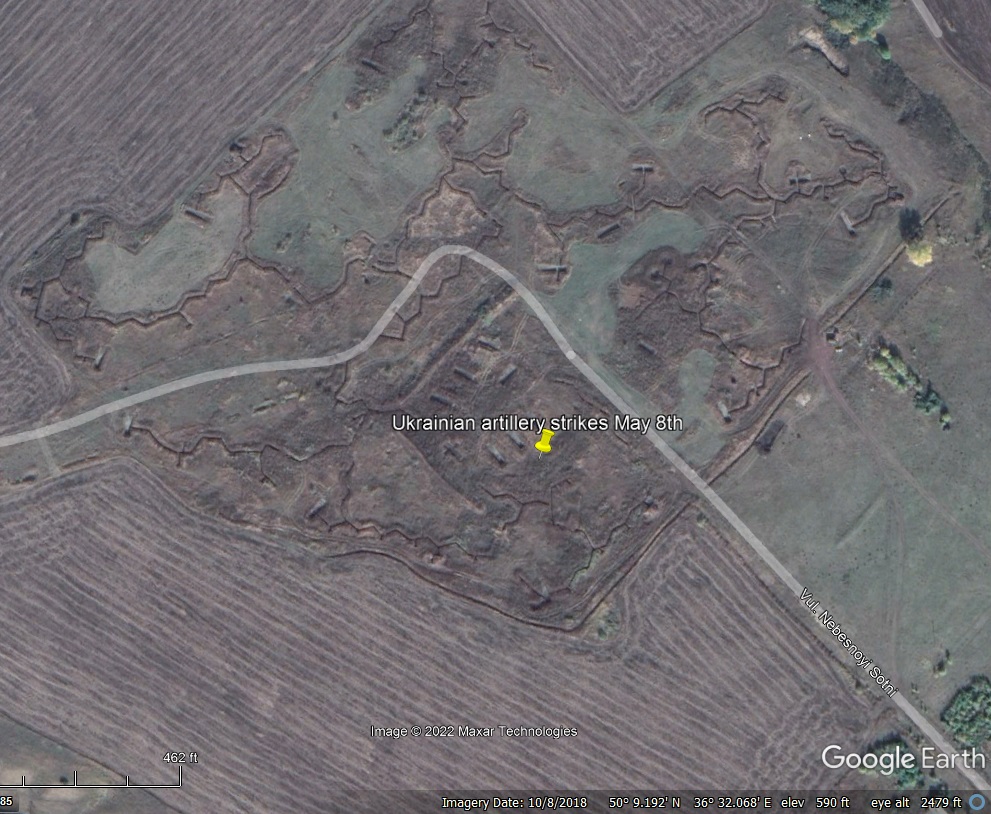
This can only be a Ukrainian army pre-war forward position for border defense (it’s an obvious axis of advance towards Kharkiv, after all.) This suggests the terrain/LOC’s here make it a natural choice for defensive line, and the fact that Russian troops were apparently occupying it indicates they intend to use it.
Given this position is only 10km from the Russian border, if Russian forces are pushed back any further than Slobozhanske/Lyptsi/Vesele Becere, I’d consider that a rout, not a retreat. They have to hold as far forward as they can and diplomatic lines on the map lose all their power once a major shooting war starts. The terrain’s the same on either side of the border. Retreating behind the Russian border means nothing as the Ukrainians might well opt to follow them.
- Rubizhne was also liberated May 10th. This puts almost 70km worth of the primary road-rail link between Belgorod and Kupiansk inside Ukrainian BM-21 Grad MLRS range, and about 55km of it inside M777 howitzer + Rocket Assisted Projectile range.
- West of the big wooded area (a national park as far as I can tell) UMoD reports the village of Pytomnyk was liberated on May 11th. This is 4km north of Ruska Lozova, liberated April 30th. On May 11th drone video was released showing a Russian howitzer being hit and destroyed by accurate Ukrainian counterbattery fire, geolocated to a large villa north of the village. A follow up ground-level video of the site showed a second destroyed howitzer – this was released the same day, indicating the speed of the advance.
- UMoD reported Russian shelling on Slatine (aka Slatyne) and Prudyanka on May 8th to delay Ukrainian pursuit (presumably up the T2117 highway they straddle.) UMoD also reported that Kozacha Lopan, 10km up the road from Prudyanka and only 5km from the Russian border, was Russian-occupied on May 8th, specifically mentioning Russian efforts to entrench for a defense here.
- The village of Oleksandrivka 60km northwest of Kharkiv, and almost on the Russian border, was also reported liberated May 6th. I think that’s the village in question, as it’s the only good candidate in the area. However there’s so many damned villages in Ukraine with that name even the Finnmap authors are befuddled with it.
Izyum AOO:
- This most remarkable piece of intelligence shows a heatmap of cell phones in Ukraine “connected to the Russian mobile network in Ukraine” (“roaming” through Ukrainian towers using protocols only typically used in Russia, or something like that, I assume.) As the map clearly shows the largest Russian force concentrations are clearly in the Izyum to Rubhinze-Severodonetsk AAO.
- If you recall the Ukrainian pontoon bridge seen thrown across the Siverskyi Donets river near Protopopivka (27km west of Izyum, where the river turns north,) on May 3rd? By May 7th Russian forces had struck it... with an Iskander missile. The precision and explosion size can only be an Iskander or a laser guided bomb, and given how infrequently Russians have been seen employing PGMs from their fighters (to say nothing of aggressive forward deployment of S-300 batteries by Ukraine,) it seems unlikely. This is a hilariously poor use of such an expensive and increasingly scarce munition, as the old Tochka-U’s Russia has dragged out of storage is more than good enough to service the target. Pontoon bridge sections are just floats made out of thin mild steel; bomblet submunitions are perfectly suited to destroying targets like this.
- Note also you can see a second bridge, of the correct length to cross the river, a bit south of the first one – but this one is tucked up against the bank. This is positioned for quick deployment – the Donets is a relatively fast-flowing river, so you can deploy the bridge by giving the upstream end a sufficient nudge and letting the current swing it across (with guy ropes ready to keep it from going too far, of course.) In this position the bridge can also be quickly tied to motorboats on either side to be moved like a barge – in this case, up or down the river to reposition it (to avoid attack.)
- The fact that no Ukrainian units are anywhere in evidence, and the date the video was released, strongly implies that Ukrainian forces were able to complete their crossing before this attack happened – to say nothing of the plainly evident second bridge ready to either deliver more reinforcements, or allow the already-crossed units to retreat. The fact Russian forces had to call on an Iskander to engage this target casts serious doubt on their ability to promptly utilize artillery fires on time-sensitive and/or mobile targets. Russia’s been bleeding pontoon bridge sections for two months now. Ukraine’s just getting started. If Russia can’t hit the actual units…
- The upshot of this is that Ukrainian units are conducting a counterattack on Russian units west of Izyum and north of the river, and Russia’s already failed to stop them at the river. I’ve seen no more information on the progress of this counterattack, sadly.
- The Russian advance south of Izyum towards Barvinkove is still stalled. UMoD reported Nova Dmytrivka repelled direct assault on May 6th, followed by reports of Russian preparation/convalescence for continued assault on May 9th. As of the 12th these preparations are apparently still underway. A dearth of recent imagery from this area suggests that action has indeed dropped off a bit.
- Ukraine’s positions north of the Siverskyi Donets river between Izyum and Lyman are still intact, according to both imagery and UMoD reports:
- Oleksandrivka (the one just east of Krymka, to be clear) reportedly repelled assault on May 4th and again on May 9/10th. Russian assaults were said to be directed towards Novoselivka on May 12th, which jells with UMoD reporting repeated assaults on Shandrygolove 3.7km north of there on May 6th, 9th, and 10th.
- Recent geolocated imagery:
- Ukrainian artillery strikes on Russian positions at Krymky. UMoD last mentioned this as a goal of Russian attacks on May 1st. This could indicate the town is now Russian-held, or it could be fire in close support of frontline troops. Units engaged are BTRs but the massive secondary cookoff suggests it was delivering to (or pulling from) an ammo dump so either could be true.
- Ukrainian artillery strikes in Oleksandrivka: first seen May 3rd, so not as current, but it looks very much like active fighting given the spread of the destroyed vehicles (aka smoke plumes.) It looks like an entire advance into the town proper was ended by Ukrainain laser-guided artillery strikes.
- Ukrainian artillery strikes in Shandryholove.
- Holding this area between Izyum and Lyman – which is fairly heavily wooded, unlike much of the surrounding terrain, and thus offers good cover and concealment on both the ground and from airpower – threatens to create a stronghold in the middle of Russian advances south of it, from which those salients can be cut off and/or supply-interdicted.
- Between Lyman and Rubinzhe:
- UMoD reported Lyman is the goal of assaults on May 11th, suggesting the city proper isn’t actually under direct assault yet – Ukrainian defensive positions are holding outside of the city proper, one presumes.
- Fighting in Ozerne is still underway; see this geolocated Russian propaganda reel showing shellfire hitting a Ukrainian-occupied building, followed by 30mm autocannon fire from a Russian IFV. 5Km north of Ozerne in Yampil Russian forces are still under artillery fire, but it seems to be Russian occupied - see this video released May 10th of an ATGM strike here and an artillery strike on an ATGM carrier on May 7th. Ergo, the advance south down the road (necessary to support the flank of any southbound advance past Lyman) still hasn’t reached the Donets river.
- Likely because of the aforementioned resistance along this axis, Russian forces attempted to cross the Donets river on May 8th about 8 kilometers east of Yampil. With their usual brilliant tactical acumen, they chose a spot at 48.938332, 38.059901, where an island splits the river into two narrow channels a mere 20 and 30 meters wide; cutting down the number of bridge sections needed. Even better, a power transmission line took advantage of the island, so the heavy forest both north and south of the river already has a convenient clear-cut through it. This could be summarized as “screamingly obvious crossing spot,” and naturally Ukrainian forces destroyed/captured the Russian bridging equipment and drove them off in short order.
- Very tactical. Much surprise. So maskirovka.
- On May 9th or so, 12km east of the above-mentioned bridging attempt and 10km south-west of Rubhinze, Russian forces attempted a large, fast river crossing that was utterly obliterated by Ukrainian artillery fire. Aerial imagery of this clusterfuck is absolutely incredible to behold – scroll the whole thread. These wonderfully-labeled images show the whole tableau of slaughter in a way that both makes the colossal toll clear, and also how/when it happened. An entire battalion – not a Battalion Tactical Group, which is frequently under-strength (due to its parent regiment being under-strength overall) and is provisioned with lots of extra artillery to try and compensate. No, enough assets to form an actual, full-strength battalion – as in five companies worth of tanks or IFVs. See also this breakdown. Actually, more, as there’s seventy destroyed vehicles counted and not more than ten engineering/bridging/supply vehicles that I can see. They were very clearly caught in the middle of their crossing and utterly annihilated – both the forces waiting on either bank and the ones actively crossing the bridge.
- Remarkably, this Twitter account purports to have been involved in it; a Ukrainian combat engineer who alleges he advised local forces on where to expect Russian crossing attempts. Two noteworthy aspects of his story definitely scan. First, his claim of predicting where Russian troops would cross. Military doctrine that I’ve read holds crossings should be conducted where the river winds into your side of the river, so you can line up your forces on both sides of that natural salient and put enveloping fire on any troops trying to push against or halt your bridgehead. Just as importantly (esp. for the Donets) the river’s current is slowed when it goes around a curve, simplifying bridging operations. The second aspect is Russian forces’ use of smoke concealment – they allegedly lit the forests around the area on fire and deployed “smoke grenades” (more likely smoke pots and/or white phosphorus devices meant to produce larger volumes of smoke.) This definitely tracks with Russian doctrine. Smoke concealment isn’t bad, but expecting it to adequately cover movement of this scale, in the Year Of Our Lord 2022, is exquisitely retarded. And yet Russia’s been fairly consistent at applying decades-out-of-date Soviet doctrine, if only because they lack the capabilities to do it any other way.
- Note that I predicted debacles such as this approximately two months ago and would like to inform you all that I did, in fact, “call it.” See also my comments about five weeks ago regarding Ukraine’s motive in allowing the self-evident farce of Russia’s pontoon bridge near Izyum to continue existing, especially the “desire to not interrupt an enemy while they are making a mistake” part, and “Normally I would think that even Russians aren’t stupid enough to ram a big convoy through a bridge link they’ve been using constantly – and even broadcast propaganda of – but I didn’t think they were stupid enough to repopulate Kherson airfield with helicopters for Ukraine to dump MLRS on more than once, either.”
- Additionally, the village of Voevodivka, which lies crammed in between the two cities, was reported as under assault on May 9th and the subject of heavy fighting on May 10th by UMoD.
- East of Severodonestk, the UMoD is reporting heavy fighting in a triangular area between the villages of Nyzhne, Toshkivka, and Orikhove. Toshkivka has not been mentioned by the UMoD before the May 10/11th mention of being under assault. It likes 3.5km west of the previously-attacked Nyzhne, where “rebel” forces filmed themselves putting up a victory flag over the town council buildings on May 9th. Ergo Nyzhne has probably fallen.
- Popansa has definitely fallen, with the UMoD confirming that Russian forces were consolidating their control of the town cira May 6th. However, as our friendly cartographic Finns point out, Popansa (having been only a kilometer or two away from the front lines of the Donbas war, and an obvious major objective for “rebel” forces) has had field works and trench-lines built all over its vicinity that are visible on satellite imagery (defense-in-depth.) Given that Russian forces have been trying to take Popansa for over two months now it’s guaranteed that Ukrainian troops will have dug extensive fallback positions. Indeed, UMoD states that Russian interest seems to lie mainly in securing the highway south-west to Bakhmut, rather than pushing due west overland.
- The overall takeaway here is that recent analysis by ISW and others vis a vis Russian forces abandoning their attempt at a grand encirclement and settling just for encircling Severodonetsk seems accurate. To accomplish the more limited encirclement they’d need to break through in the area of Orikhove/Toshkivka (16km southeast of Severodonetsk along the P66 highway) and somewhere a similar distance south-west of Rubizhne – which is exactly where that reinforced battalion-sized force was wiped out of existence.
Donetsk AAO:
- Not much progress in evidence in this AAO, which is no surprise. UMoD indicates that Marinka (the much-battled over southwestern suburb of Donetsk city) is still in Ukrainian hands, with Russians attacking from (yet another) Oleksandrivka, the one that lies just east of Marinka in the contiguous “tail” of suburbs that lie along the north side of the N15 highway. 10km directly south of Marinka likes Novomykhailivka, which is reported to be holding off assaults (cira May 12th) coming from the direction of Slavne, 6.5km eastwards, (spelled “Stepne” by UMoD) and Stepnoe, 8km south-east.
- Some truly remarkable geolocated imagery from the northwest fringe of Donetsk city really highlights why Russian forces have been stymied here for over two months:
Russians in trench positions May 7th. Ukrainians in trench positions May 11th. (These two positions are only 500 meters apart.) More northerly Ukrainians in trench positions May 11th. Building hit by rebel ATGM May 11th. Please note the ATGM gunner is aiming for an already-damaged piece of wall – this is quite possibly the result of one or more previous missile engagements against that same spot done to break a hole in the wall and allow for putting a round into the room. This kind of strategy is time-tested enough that an American WWI engineer’s field manual I own has a table listing the number of rounds required from a 1903 Springfield rifle to break a hole through various barriers. Hopefully this illustrates the nature of the combat in this area neatly. To break through such heavily entrenched areas Russia either needs an end-run (through an area defined by a river they are very bad at crossing) or they need a much better and more competent concentration of firepower and maneuver forces (which they’ve outright refused to do.) Expect little to nothing to happen in this AOO forthwith, barring some unforseen development.
Mariupol AOO:
- Recently seen and geolocated imagery from the northern edge of the Azovstal steel plant show Ukrainian resistance is still extremely stout, and that Russian forces are still struggling just to get past the perimeter. See this video of Azov fighters engaging in close urban combat and blasting away with RPGs at the northern edge of the complex around May 12th. This video seen the same day shows “rebel” forces taking Azov mortar fire not 162 meters west of the previous video’s location. Note the empty “gondola” style train cars on the track; this is a small loading/unloading/marshalling yard on the north edge of the complex, likely for pig iron and/or coal, which is the kind of bulk commodity gondola cars are usually used to move. In other words, this isn’t even the beginning of the truly built-up areas of the plant, which lie further south.
Southern Defensive Line AOO:
- Neither UMoD nor geolocated imagery has much to report here. UMoD claims continued artillery duels along this line of contact and imagery bears that out. UMoD does report Russian thrusts or probes continue, but these are likely only done to obligate Ukrainian defenders to hold a contiguous line and not move reinforcements northeast.
Kherson AOO:
- UMoD reported on May 11th that Russian forces were industriously improving their defenses with entrenchments/earthworks at Velyka Oleksandrivka, and also at Bruskinske. The latter is previously unmentioned by UMoD. It lies 18km due south of Velyka Oleksandrivka, along the T2207 road south towards Kherson, and only 7.6km from the Inhulets river, which defines and protects the west flank of Russia’s northern presence west of the Dnieper. It seems Russian forces here have finally given up on trying to take any more ground and are digging in to hold it.
- From the area west of Kherson proper, some recently geolocated imagery suggests Russian forces hold ground a little further west than previously believed. Believed by whom, I don’t know, as I am not putting much faith into lines on the map unless I can see the trenches there myself. Also of interest is this recent drone video (seen May 11th) of yet another Treeline Of Death claiming Russian lives, located at 46.677497, 32.196508. This is a solid eight kilometers west of Molodetske, which UMoD claimed was Ukrainian held on April 28th.
- Taken together with the first point; this could either mean 1. UMoD is showing off older imagery or 2. it’s simply that the front line is oscillating back and forth a lot in this area due to the extremely flat ground making attacks and counter-attacks easy, but holding static positions difficult – as the above Treeline Of Death shows. That particular treeline is far better than most we’ve seen as it also lies along a road with a substantial ditch; making for an excellent berm and defensive position; but with the ubiquitous presence of drones to spot for artillery even that can only go so far. The only real safety for tanks, especially Russian tanks, is distance – and given Russia’s manpower shortage, the optimal strategy of a forward defense with ATGMs and infantry, with tanks counter-attacking from behind as needed, is likely unfeasible.
Major operational update to follow.
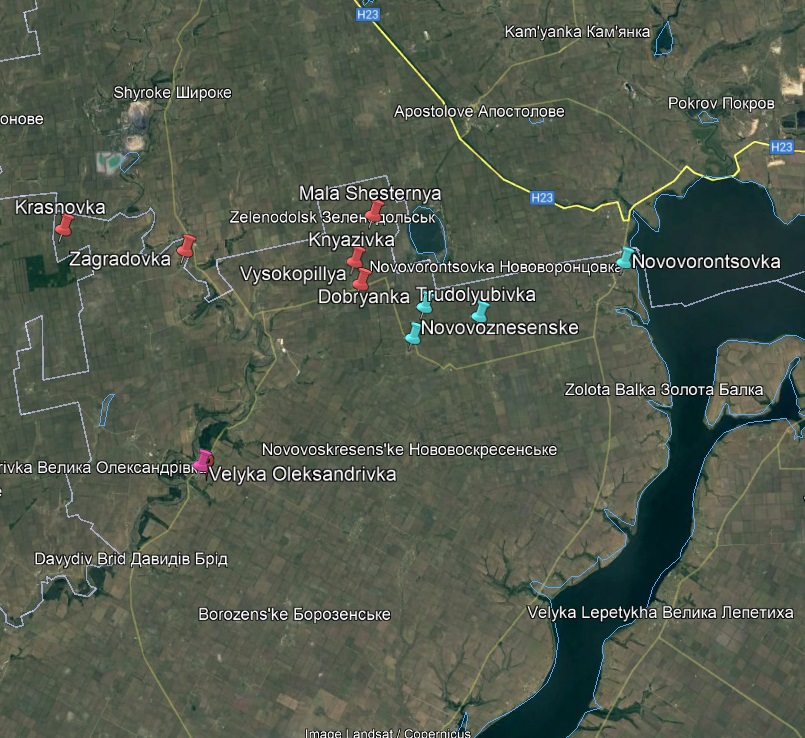


%23/media/File:2014.11.21_%25ED%2595%25B4%25EB%25B3%2591%25EB%258C%2580_%25EC%258A%25A4%25ED%258C%258C%25EC%259D%25B4%25ED%2581%25AC_%25EC%2582%25AC%25EA%25B2%25A9_(15863350681).jpg&sa=D&source=editors&ust=1652544342161459&usg=AOvVaw2KHyF9x1s9Oiua-YU4W8-T)
%23/media/File:2014.11.21_%25ED%2595%25B4%25EB%25B3%2591%25EB%258C%2580_%25EC%258A%25A4%25ED%258C%258C%25EC%259D%25B4%25ED%2581%25AC_%25EC%2582%25AC%25EA%25B2%25A9_(15863350681).jpg&sa=D&source=editors&ust=1652544342161753&usg=AOvVaw1lKCs2EN_1_CJclVRUJUXY)